I don’t know normally dedicate a post to one subject as there is too much gardening to do. But I decided to dedicate this post to discussing cutting Palm trees properly because I am fed up seeing palm trees butchered by men with chainsaws.
Now any idiot can buy a chainsaw and claim that they are a professional. And no doubt it will definitely be cheaper than the real professional. But the end result is ugly butchered trees that have been hacked to pieces and are now ripe for a visit from the Palm Weevil.
Now whether you take my advice or carry on butchering your trees it is up to you but here we go.
16th March 2026. Things I have been doing lately.
Well to be honest, it’s not things I have been doing, it’s things I have been getting done. Cutting Palms is the only thing that I do not do myself in my garden. There are four reasons for this:
The aforementioned I cannot stand seeing butchered palms
I have twelve palm trees some of which are 40ft high
I am old and wish to preserve my bones
The idiot son has made me promise not to climb ladders as I often fall off
Why cut your palms? There are lots of good aesthetic reasons for cutting your palms. Probably one of the least important is that they look messy, unsightly and blight your garden. The photo below shows a typical example.
Not only unsightly but also dangerous
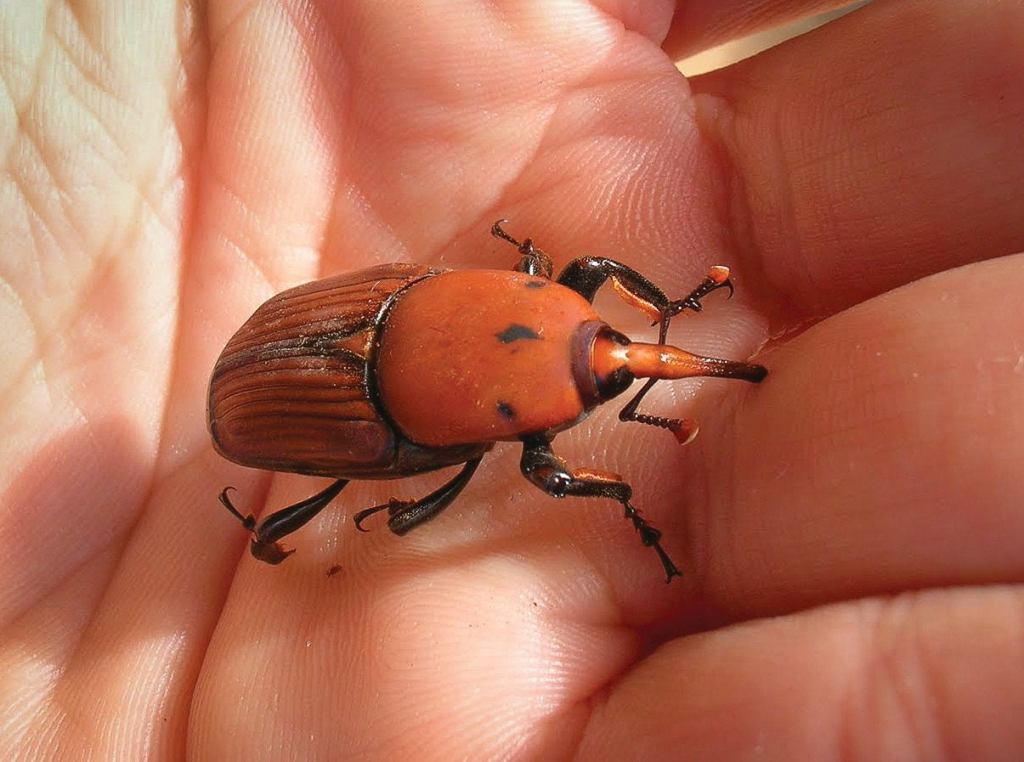
The thing is not only does this look unsightly it also dangerous as the added wind resistance can make the tree susceptible to wind rock and eventually falling. In addition all that dead vegetation hanging down is an ideal home for virus and of course the dreaded Palm Weevil shown in the photo below.
Here is one I caught last Summer
Whilst the Red Palm Weevil mainly attacks Phoenix Palms, there have been instances of it attacking Washingtonia and other species.
I have dealt with treating against Palm Weevil in other posts so if you have a problem just use the search button and you will find the relevant post.
When to cut your Palms. The best time to cut your Palms is between January and March. This is the period when most of your trees growth is over for the season and is also the time when the Palm Weevil will not normally be flying.
If you cut your Palms at any other time, especially during the hight of summer, then you are inviting the Palm Weevil to come and lay its eggs in your tree. When Palm trees are cut in the summer they will ooze sap. This sap can be smelled by the Palm Weevil which I am told has an amazing smell and a highly developed olfactory glans. Research has shown that the weevil can smell a damaged or cut tree from over 1 kilometre away.
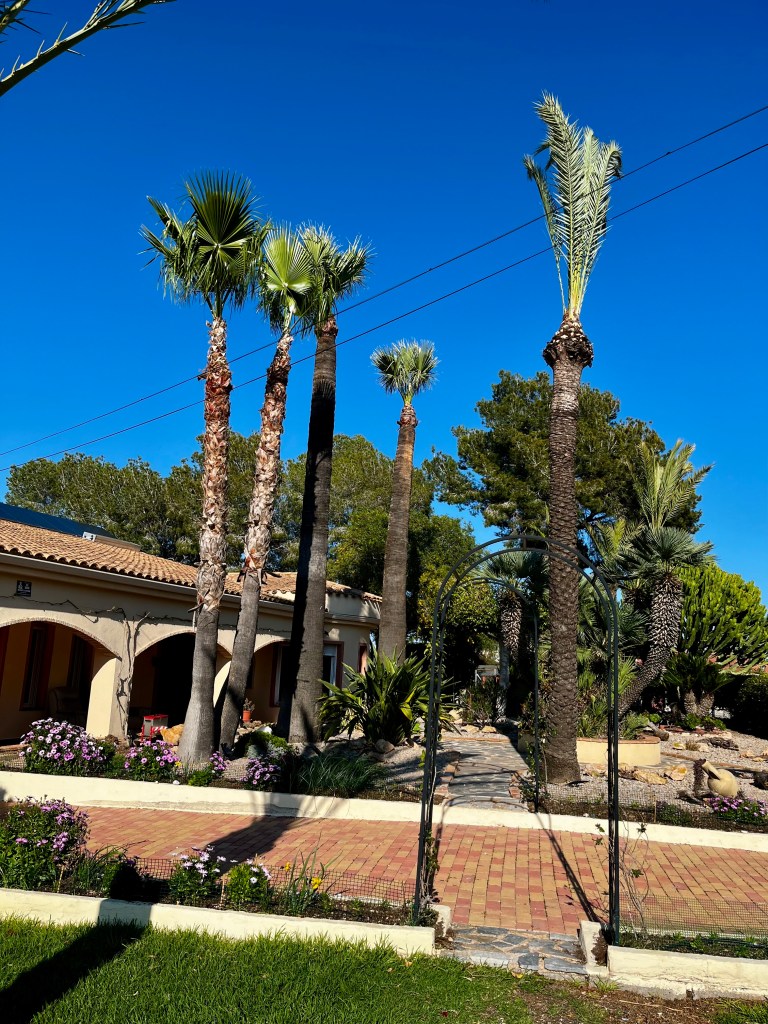
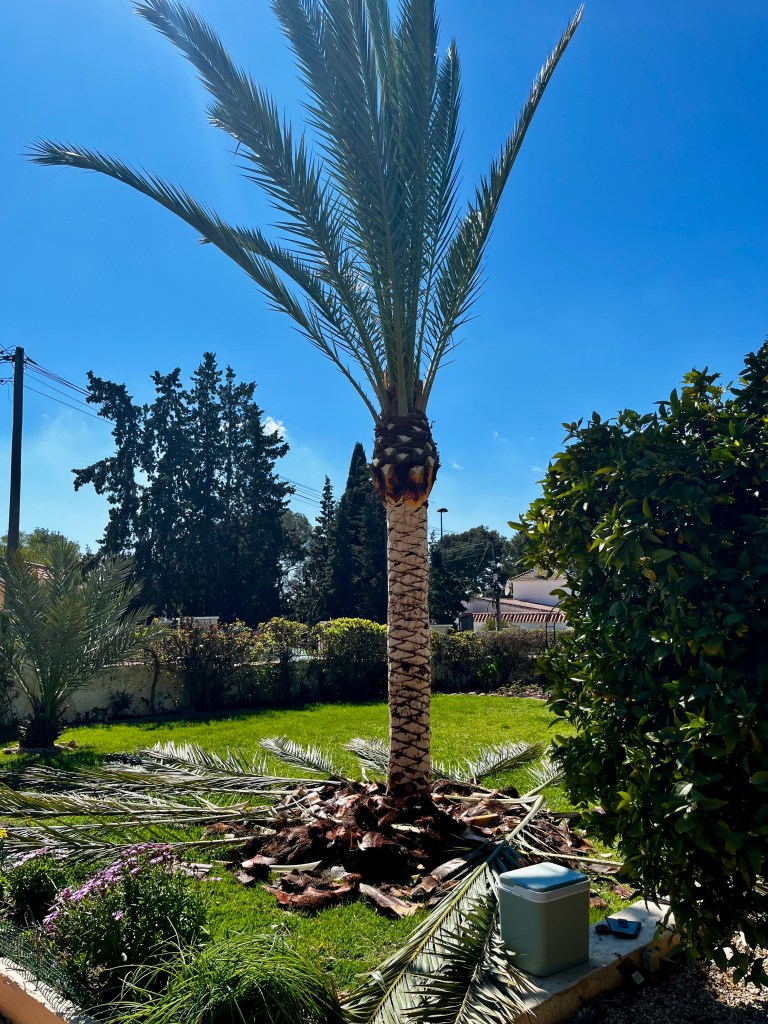
How to cut your palm trees. At its simplest you should aim to have your tree cutback so that the remaining fronds are more or less upright. The photo below shows some of my newly cutback palms.
Don’t they look lovely, unfortunately they don’t stay that way
Why use a professional Palmerero. The title Palmerero is commonly used to refer to a professional palm tree cutter in Spain. These are highly trained and skilled individuals who know everything about palm trees and how to prune them. As I said at the start of this post you will find lots of men with ladders and chainsaws who will cut your trees back a lot cheaper, but may well end up damaging your trees and leaving them unsightly.
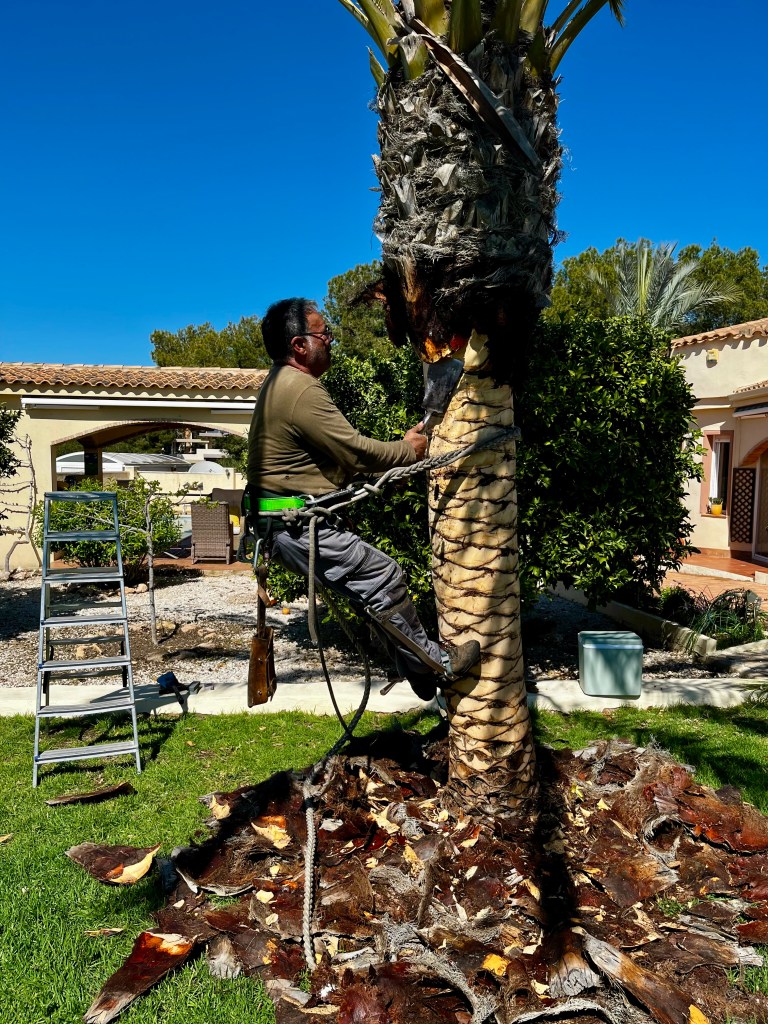
Palmereros do not use any machinery. Instead they use a specialised knife called a corbellote or in different parts of Spain a corvellot to prune and trim the trees. Because they do not use ladders Palmereros will use a climbing technique that involves specialist boots and a harness to scale even the highest trees. This means they are not hacking at your palms from the top of a short ladder and instead can get right up to the crown to inspect for damage.
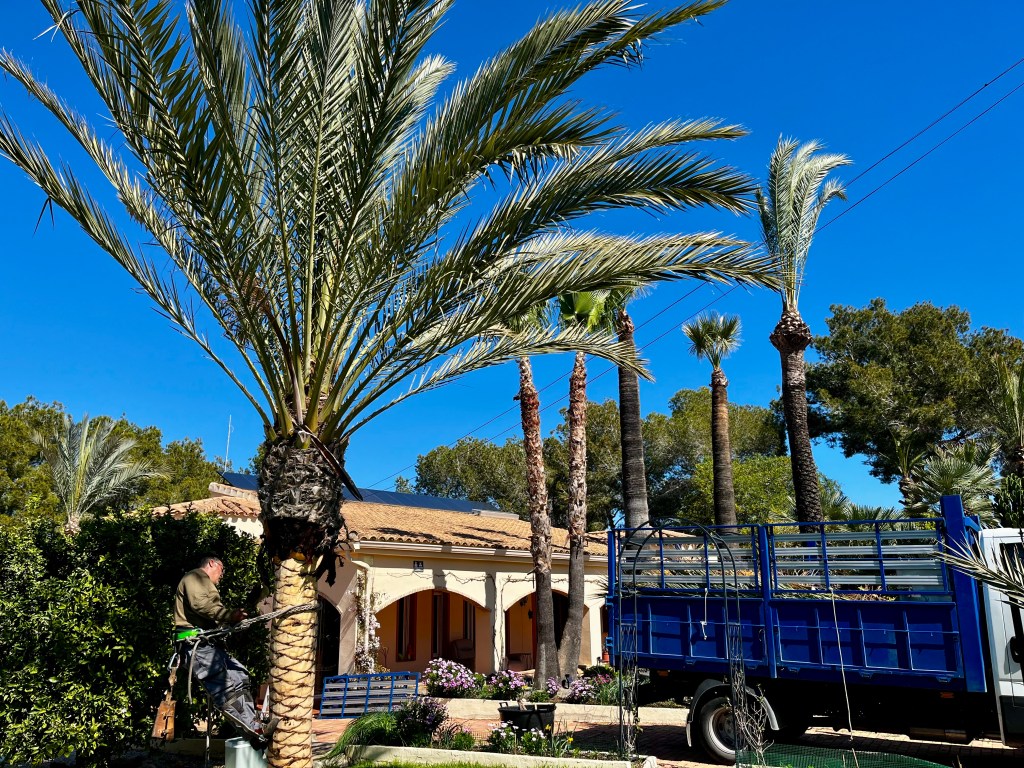
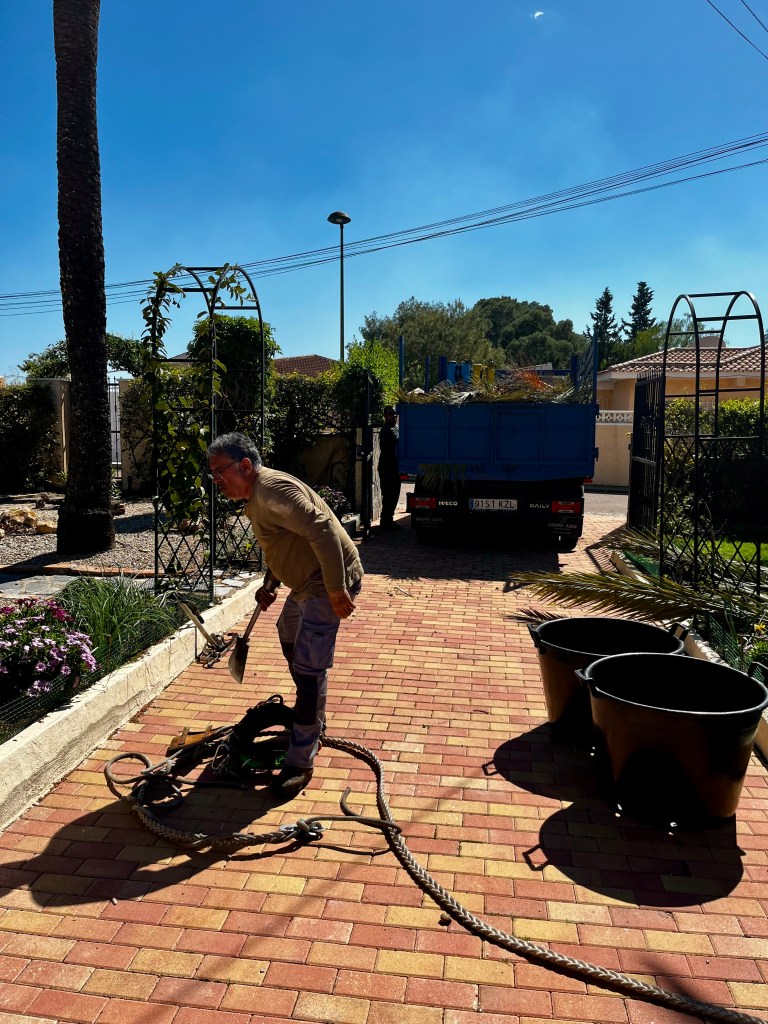
I have used the same Palmerero, Antonio for over 15 years and have always been satisfied with his work. He and his son arrive and graft away all day and then clean everything up and take it away. I have included some photos of Antonio at work.
Here is Antonio at work shaving one of my small palms. I am showing you a photo with a small palm as you can see the specialist boots, harness and cutting tool
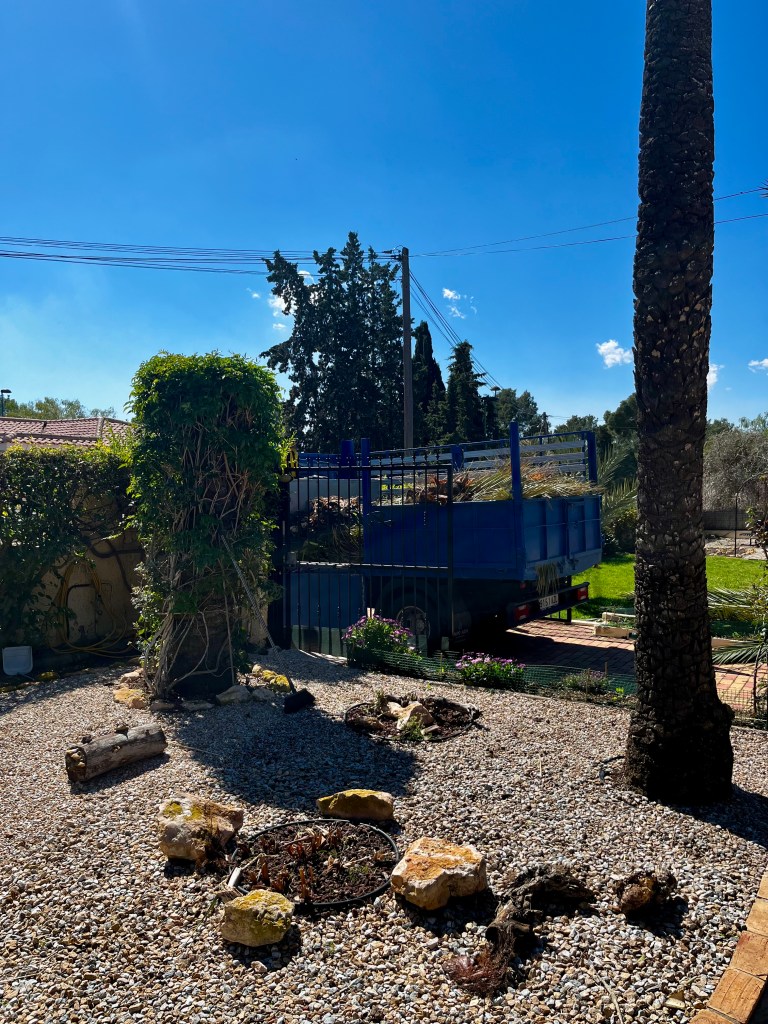
That’s it for another year, everything packed up and off they go. Unfortunately there will always be a little bit of collateral damage from 15ft palm fronds falling 40ft.
I am sure there are many other Palmereros available but I am happy to recommend Antonio. He covers most of the Costa Blanca as far as Benidorm so het tells me. This is totally unsolicited but here is Antonio’s number 630389536.
The big winter cutback is now complete. Normally at the completion of the big cutback I stand back and survey the garden with quiet satisfaction, but this year has been marred by controversy.
Pruning my big Ficus tree is normally the last item on the cutback, mainly because it is a mammoth struggle between man and tree, resulting in the loss of much blood, severe bruising, sprains and spectacular falls from a great height. However, this year I did it differently resulting in hurtful insults from the tree accusing me of cowardice. To be honest I am a bit ashamed of my actions and don’t really want to talk about it, but more later, for now let’s get on with the gardening.
15th February 2026. Things I have been doing lately:
Cutting back ornamental grasses
Planting new trees
Dealing with the big Ficus and accusations of cowardice
Cutting back ornamental grasses. If you have ornamental grasses then you know how lovely they look in the autumn and winter. Their long floating blades and fronds blowing in the autumn winds add movement and texture to the garden at a time when it can look a bit bereft and boring.
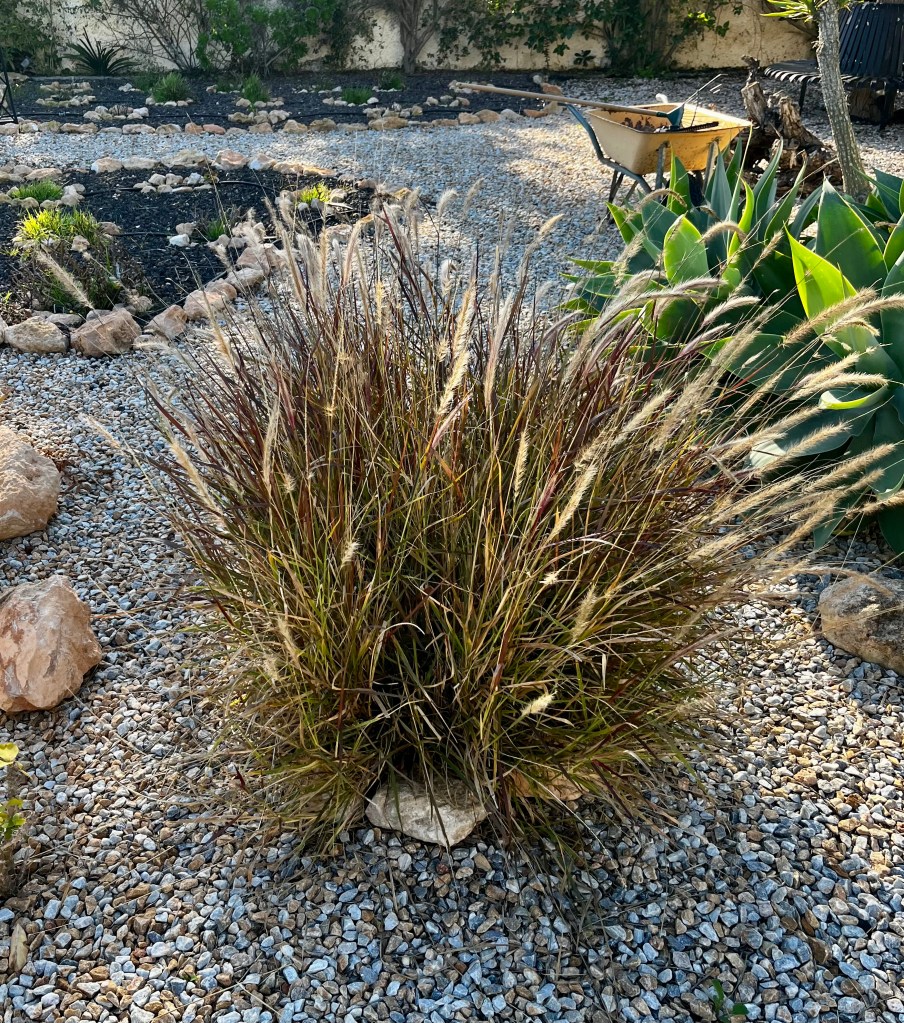
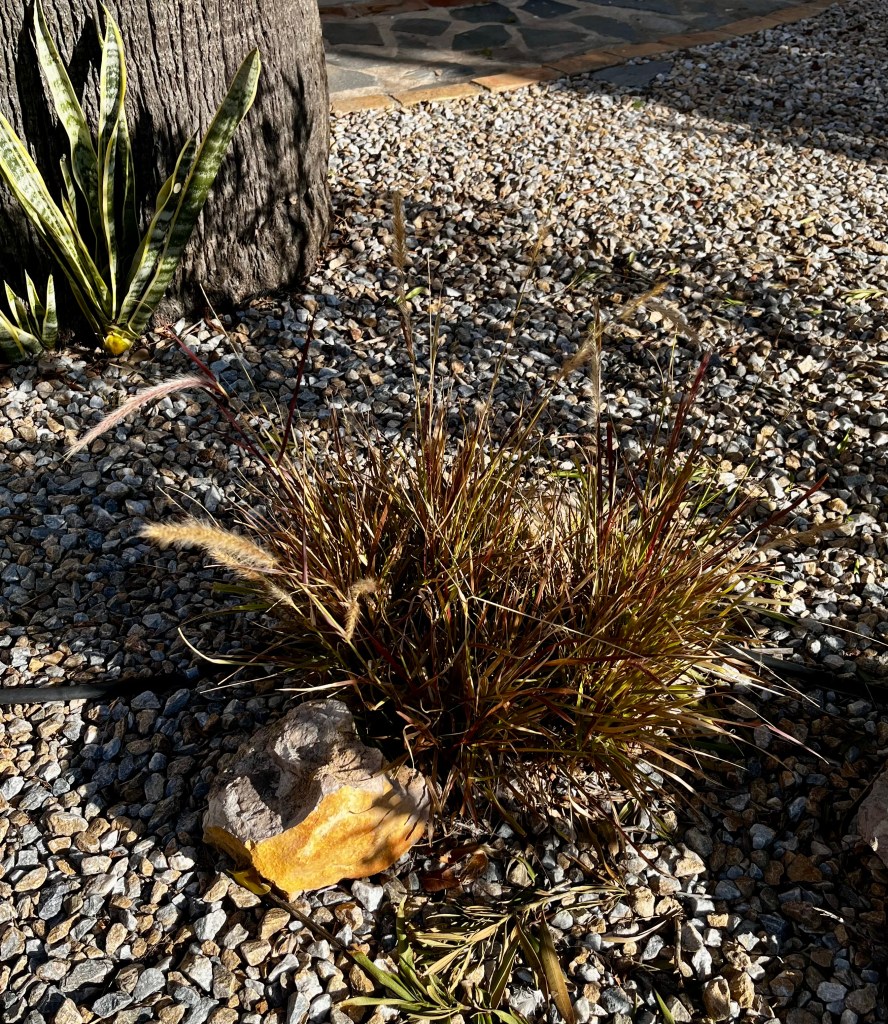
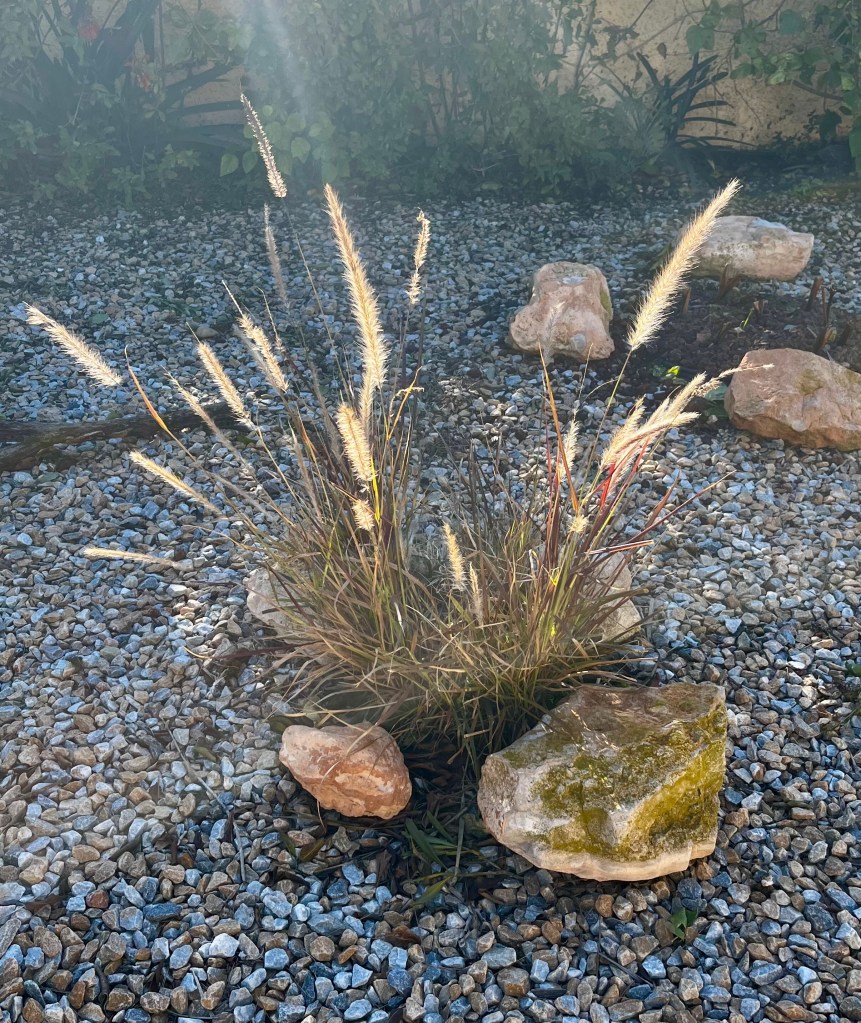
I mainly favour large Fountain grasses for their stately bronzed fronds, although I do have one smaller blue grass which has yet to reach its full potential. The photos below show my grasses before their trim.
Most of my grasses are transplants from bigger plants that I have separated over the years and in the last few weeks they have looked lovely. However, if you don’t cut your grasses back now then they will become congested with old growth and you will hinder this years growth.
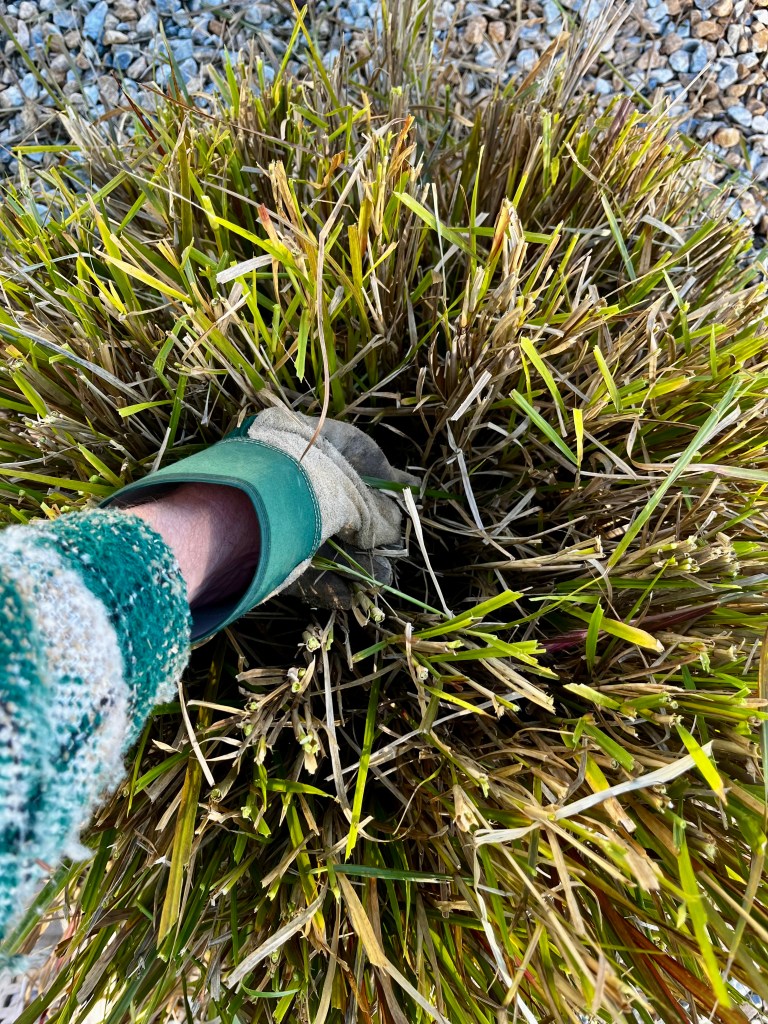
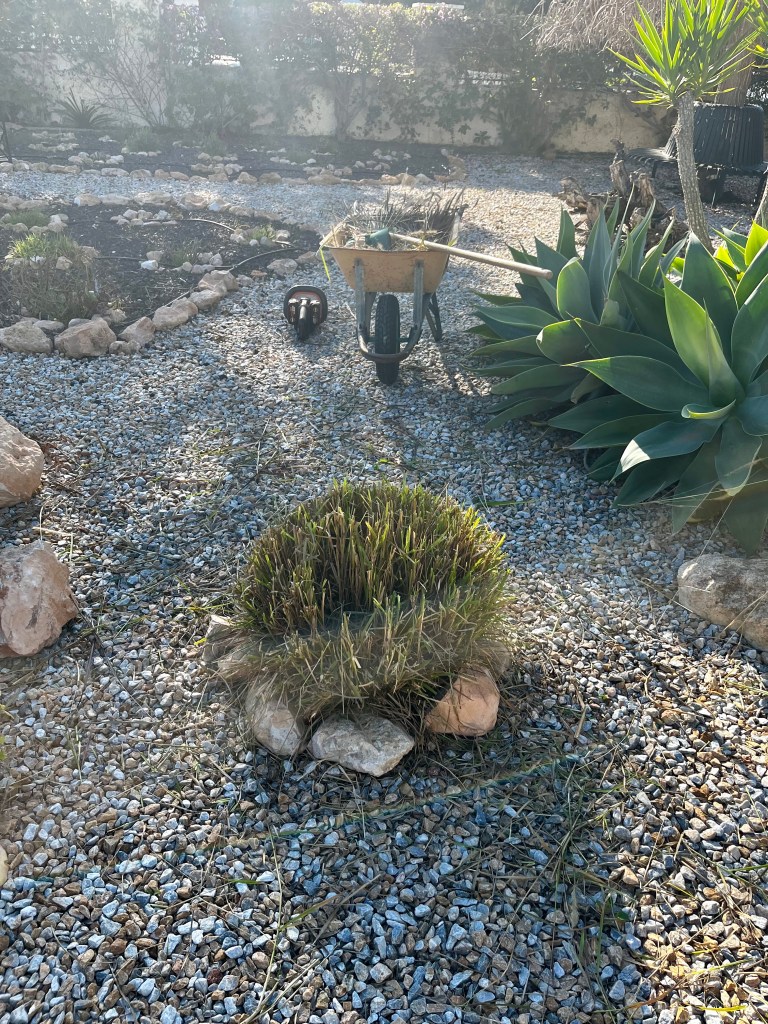
All you have to do is get your hedge trimmers or shears and cut the whole thing back to a small mound. Once you have the grass cut back then get your garden gloves on and pull out any dead grass from the centre of your plant. Gloves are important as grasses can be sharp. The photos below show my efforts at clearing the congestion at the centre of one of my grasses, and the finished and trimmed plant ready for new growth to bust through in about a month.
You need to get right into the centreAll ready for Spring growth
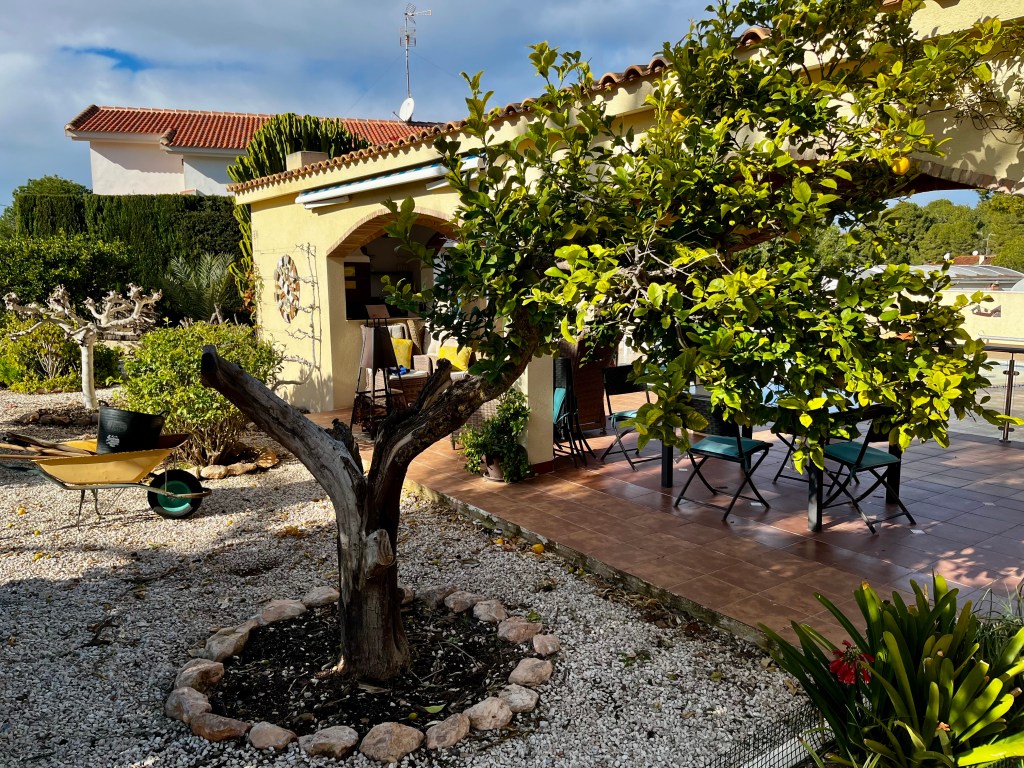
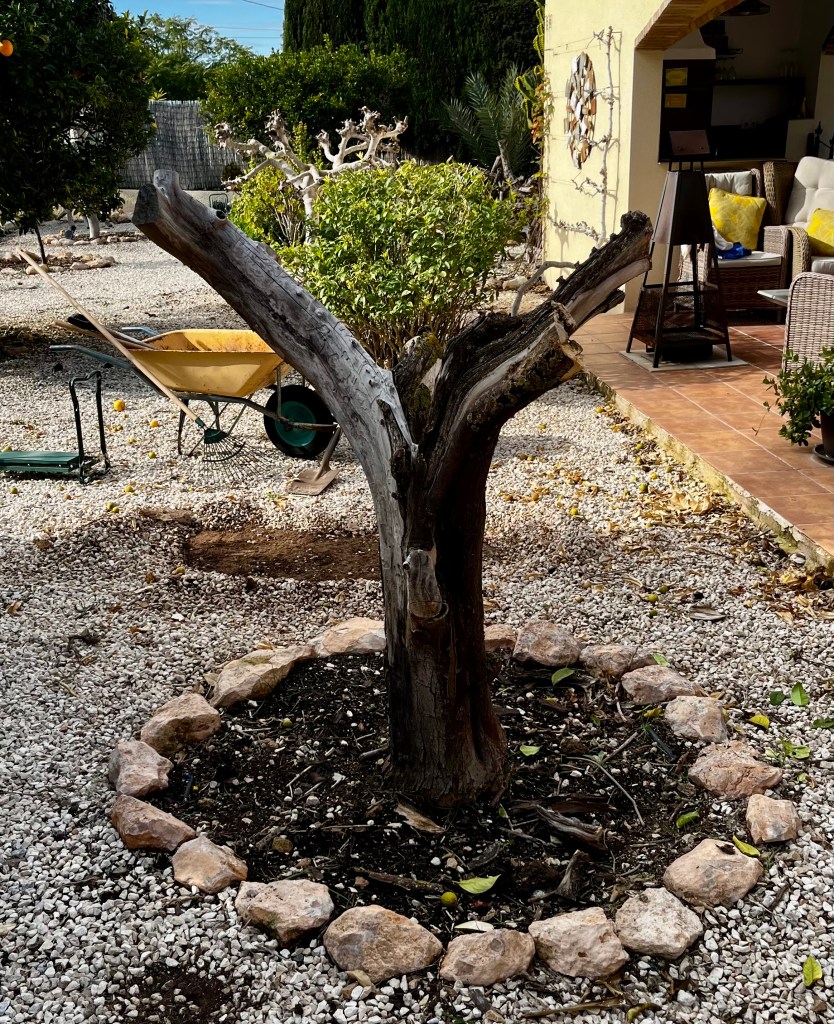
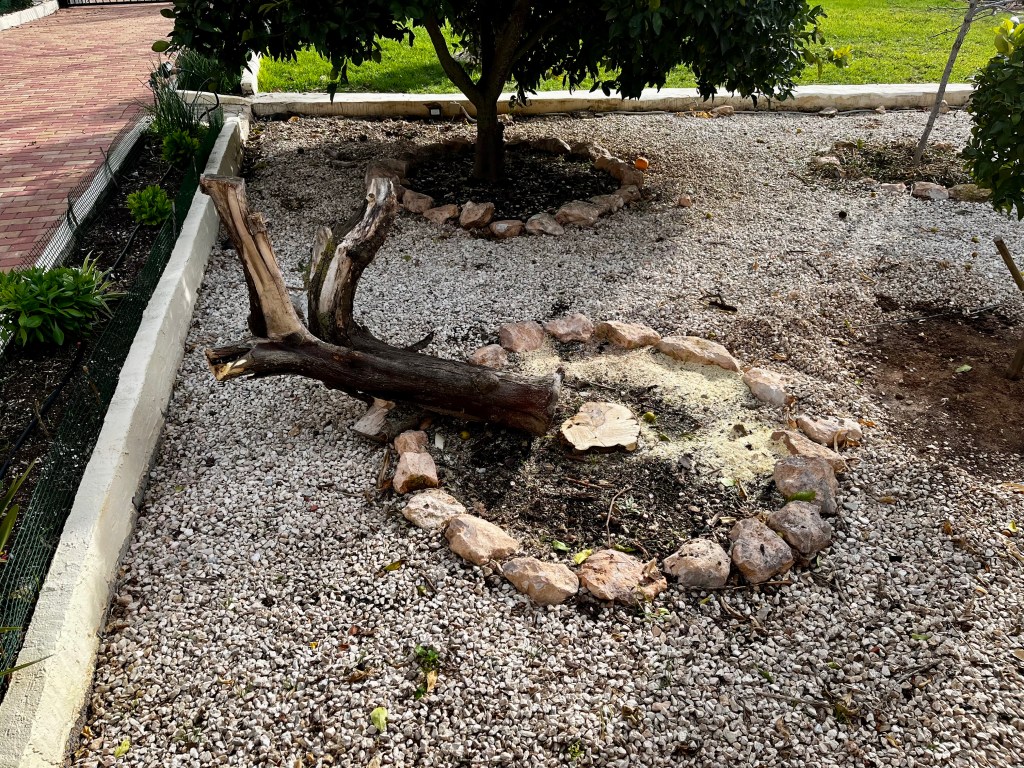
Planting new trees. My only lemon tree has been gracefully dying for about 2 years which has been a cause of great concern to Cruella (my wife) who relies on it for lemons for her gin. It is an old tree, and I have been carefully managing its decline. However, it has reached the end and it had to go, especially if I was to get a new tree in this year. The photos below show my old tree leaving this earth gracefully.
This is not assisted dying, this is loving family care of an old and dear friendA last fond farewell25 fruitful years come to an end
If you are going to plant new trees in the Costa Blanca area, then you only have a planting window between November and March to get your new tree into the ground. Any later than this then your new tree will have difficulty getting going in the heat. By getting it in whilst the soil is beginning to warm and there is some rain around but the sun is not too hot, then your new tree has a chance to set some root before the heat of the summer.
The first thing you have to decide is the position of your new tree. My fruit trees are in two parallel lines in a typical orchard style. In effect this means that my new tree will be in line, but essentially it needs to be at least 3 metres from the trunk of my old tree. The reason for this is simple. The soil around the old tree will be depleted and the roots of the old tree are still in the soil and won’t rot for a few years.
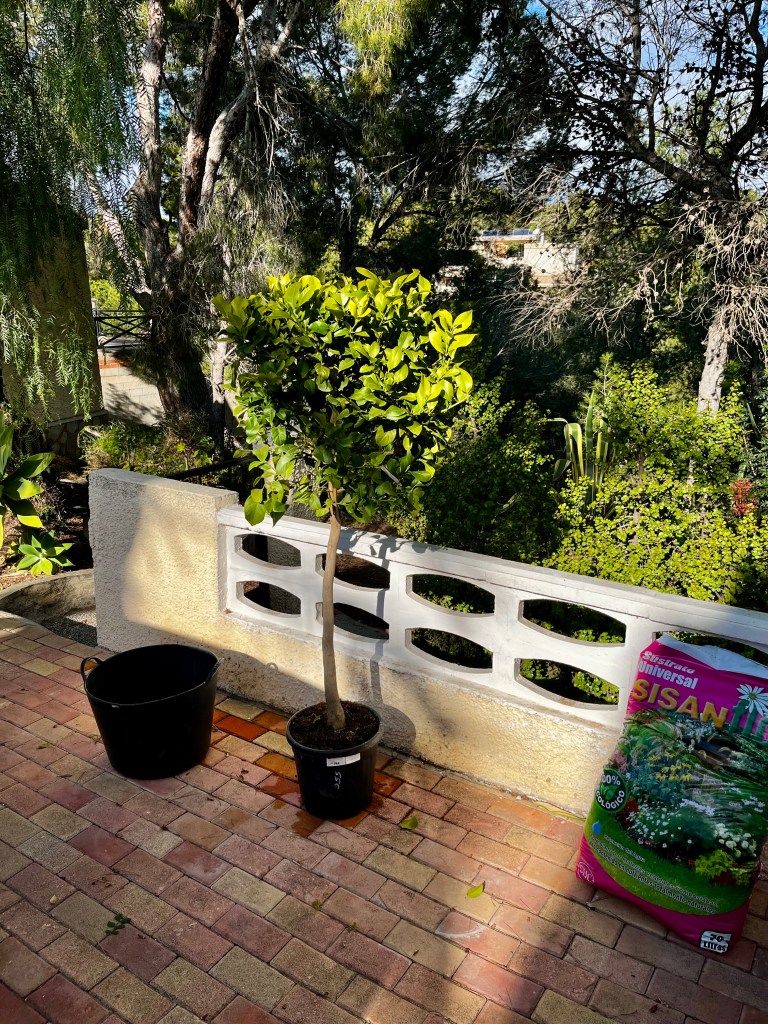
Your next decision is what type of new tree to buy. You can buy spindly things grown from seed, mid size trees grown on grafts, or cut down larger trees. I prefer mid size trees grown on grafts as they are relatively mature, won’t have the frailties of seed grown trees or the potential disease of cut down trees. Anyway, which ever you choose soak it in a bucket for at least three hours before planting. The photo below shows my chosen tree draining after its soak.
New life, new hope
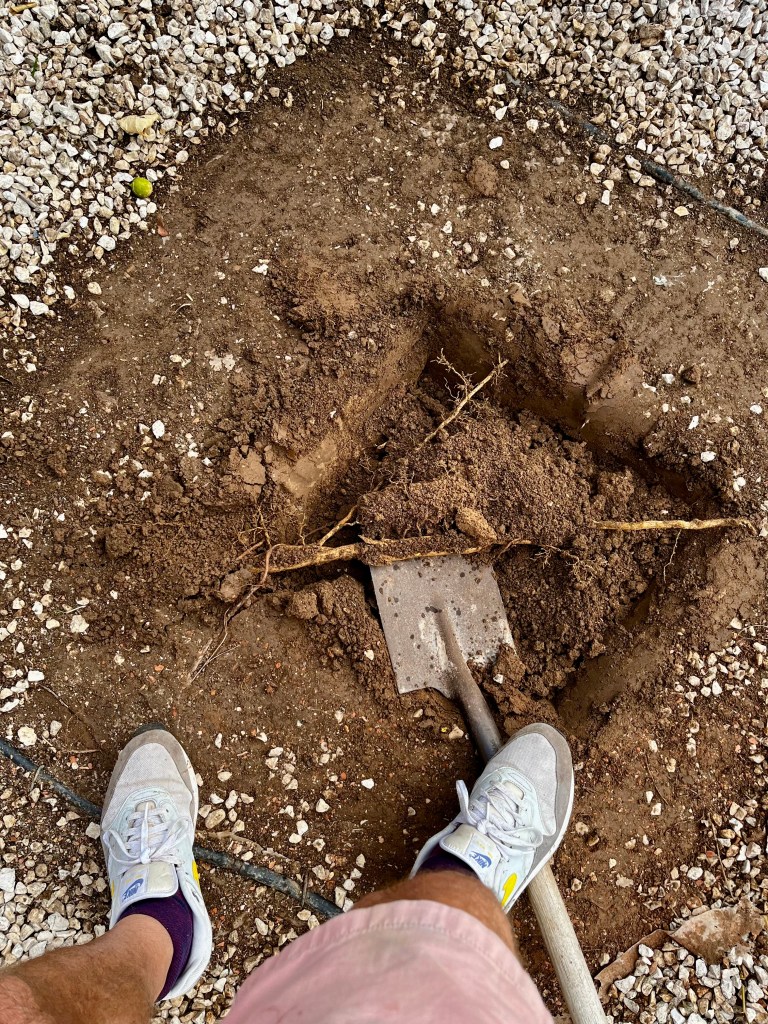
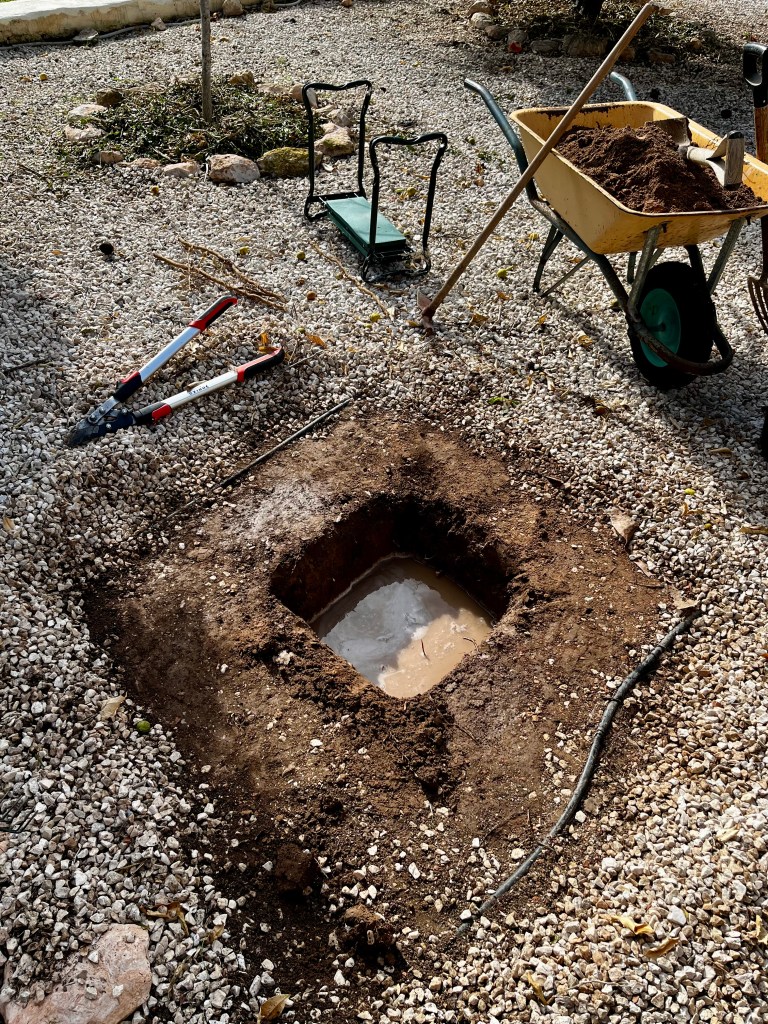
Once you have your tree it is time to get it into the ground. Dig a hole as big as you can, ideally twice the size of the root ball (but to be honest these days I am lucky if I can dig a hole). Chop out any roots you find from the old tree. When you are happy with your hole, fill it with water and let it drain. The photos below show my progress.
Old roots The holeHeres to 25 fruitful years
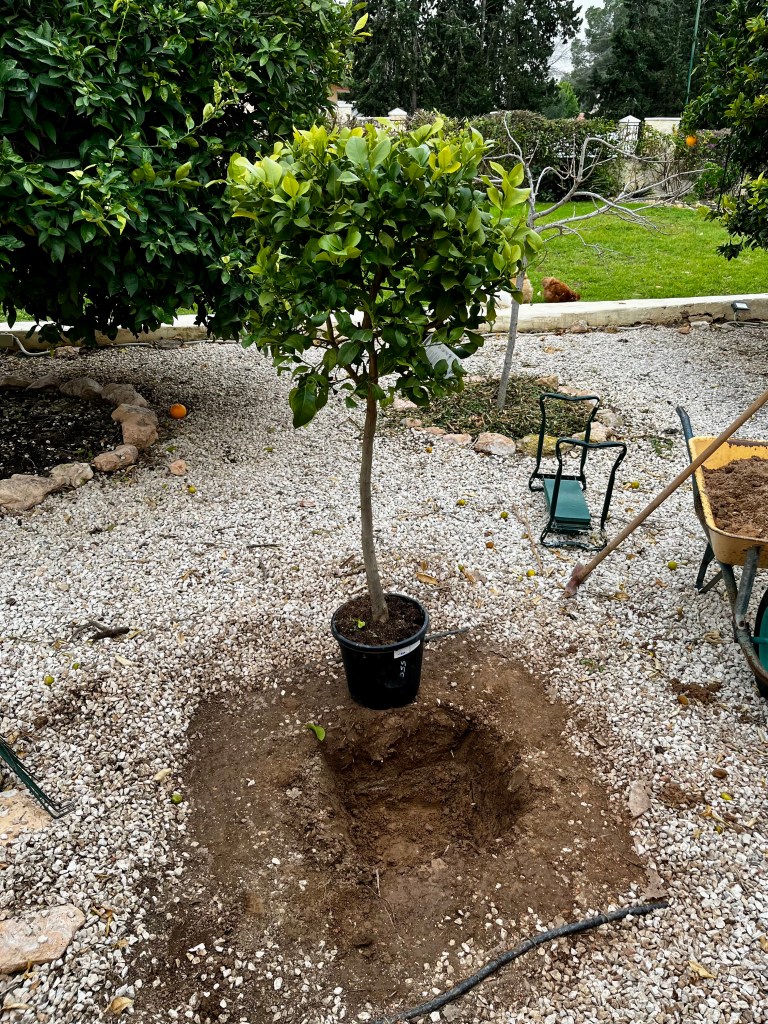
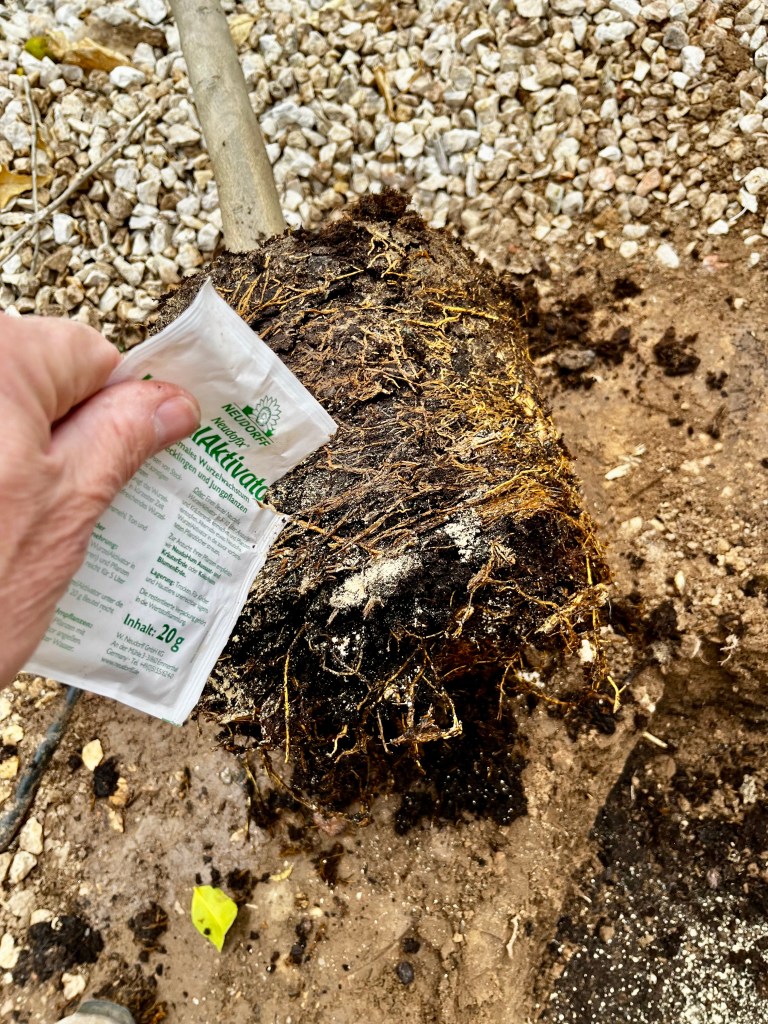
Now to the important part of planting your tree. Your aim is to give your new tree the best chance of survival, and that means careful preparation. First, ease your tree out of its pot and carefully spread the roots out of their pot shape. Next, sprinkle the roots with Mycorrhizal fungi to encourage root growth (you can buy this in most garden centres).
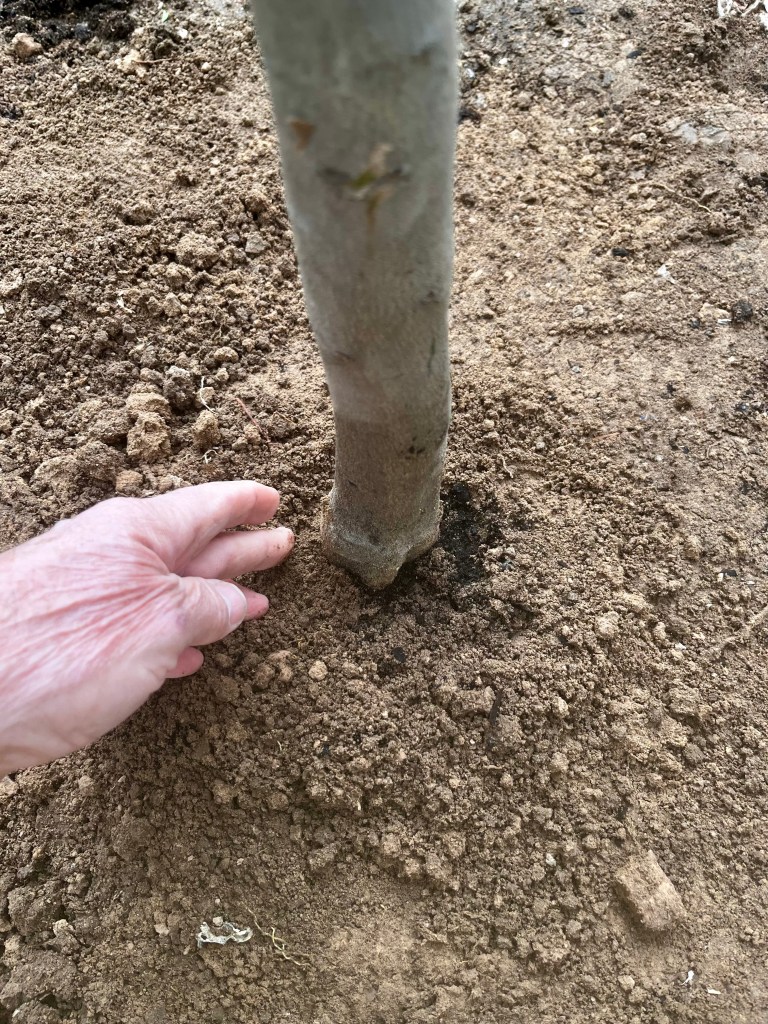
Now plant your tree in a 50/50 mix of really good compost and the existing soil, ensuring that you firm the soil well down by treading it in. It’s really important at this stage that you do not cover the the graft with soil. The graft is the swelling at the bottom of the trunk. If you cover this with soil you may get growth from the graft host. See photos below.
Sprinkling the magic of fungusNever cover the graft and keep an eye on it
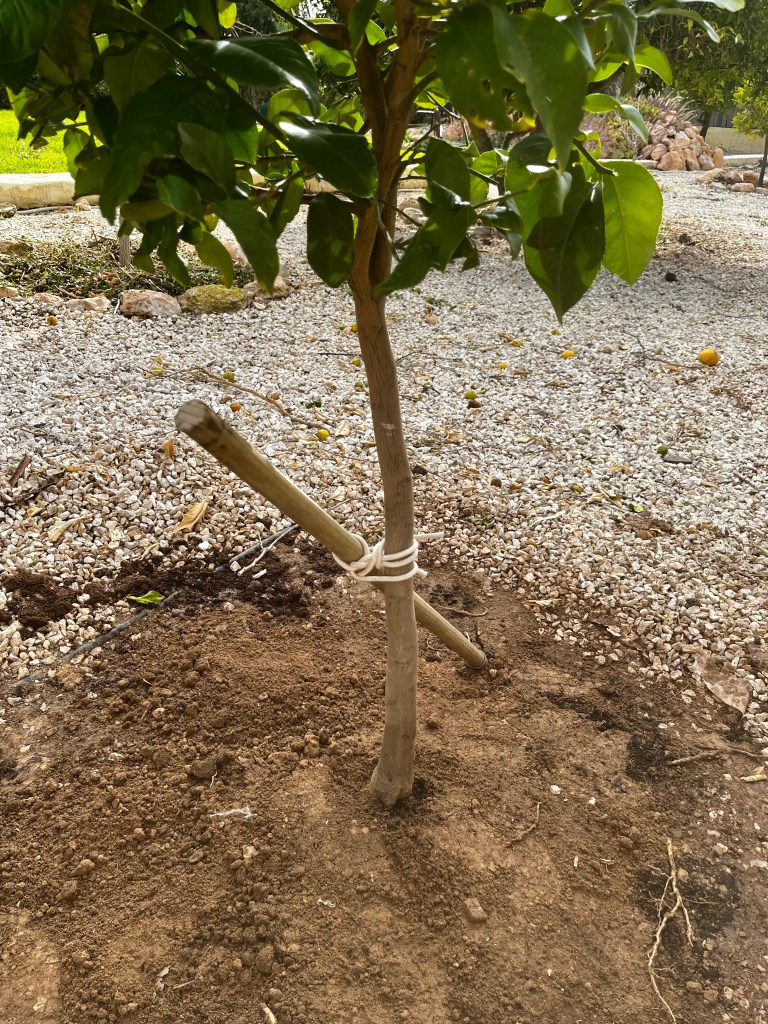
Finally, when you are happy with your little tree, you will need to stake it against “root rock” which can happen in high winds and stop your tree taking. All you have to do then is to water it profusely for the first few weeks and enjoy its first year of growth.
Luckily this was staked before the recent horrendous winds
Dealing with the big Ficus and accusations of cowardice. Regular readers of this blog will know that I finish the big winter cutback by pruning my big ficus tree. Years ago I shaped this tree into a pruned donut shape by cutting out its central trunk. This meant that in the spring each year I had to prune and reshape the tree to retain its donut effect.
Some of you might envisage that this would seem to be a rather easy task. But no, the ficus is big and tall and has a vicious temper. It has never forgiven me for the original removal of its central trunk, and it takes every opportunity to smash, bash, cut and bruise me in our annual encounters. The photo below shows me mid battle in years gone past.
Happy carefree days; I usually fell out of the tree
Normally I can feel it malevolently watching me as I go about all the tasks in the big winter cutback. Sometimes if the wind is blowing in the right direction I can hear its leaves rustling and whispering vicious threats of what it is going to inflict upon my body. Every year so far I have psyched myself up through a mixture of prayer, character building readings and a little yoga. But this year something just snapped. I couldn’t face it.
I blame the fact I had been softened up by the rest of the garden before this big encounter. The roses had made me bleed so badly I became anemic. Falls from and through the hedges bruised my body so badly that the police were called in and Cruella (my wife) accused of domestic violence. My back and bones hurt so much from digging that I am now a chiropractor case study. And all of this physical and mental damage whilst being constantly insulted and laughed at by chickens.
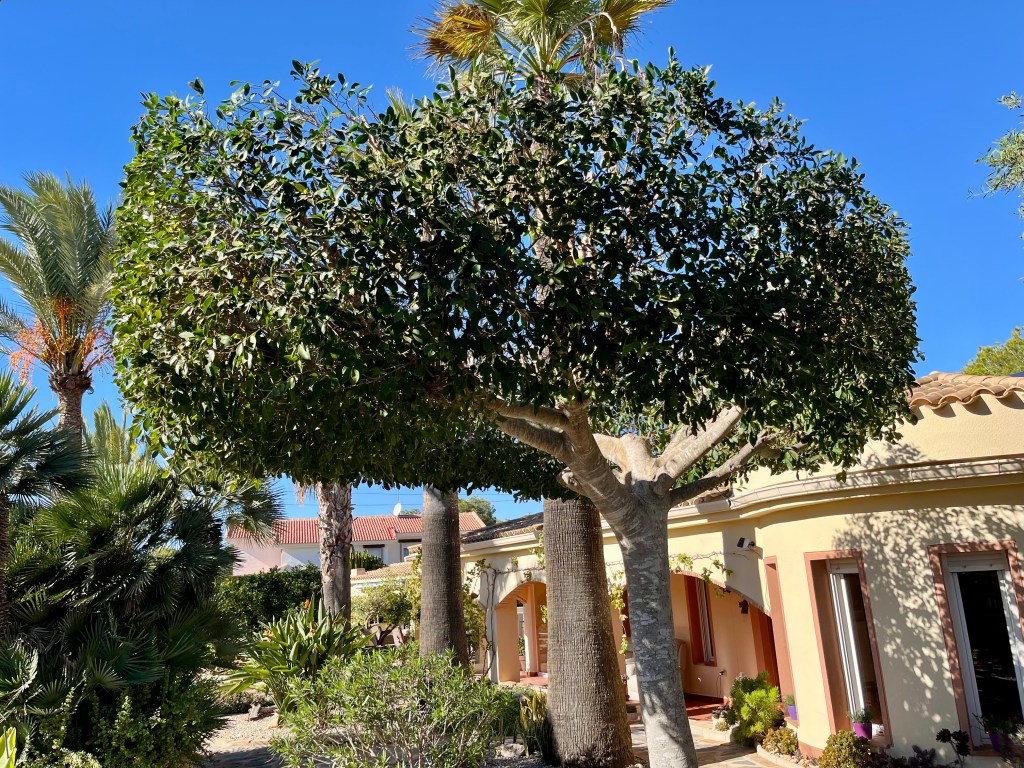
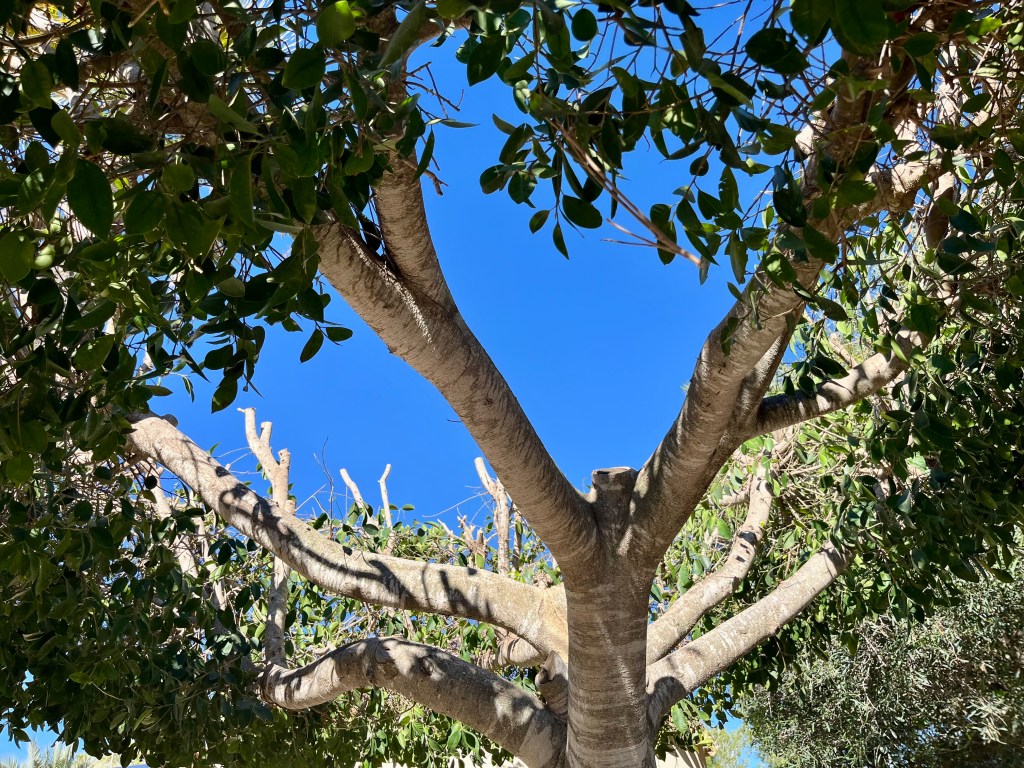
So the obvious happened, I called in tree surgeons to prune and cutback the big ficus. To be honest, they did a lovely job and pruned right back into shape. But that is not the point, since then the ficus has loudly proclaimed that I am a coward to all the plants in the garden. I lost respect amongst the plants and my authority was being questioned even amongst seedlings. I could barely look at the ficus with its knowing sneers and open contempt. The photos below show the big ficus after its professional prune.
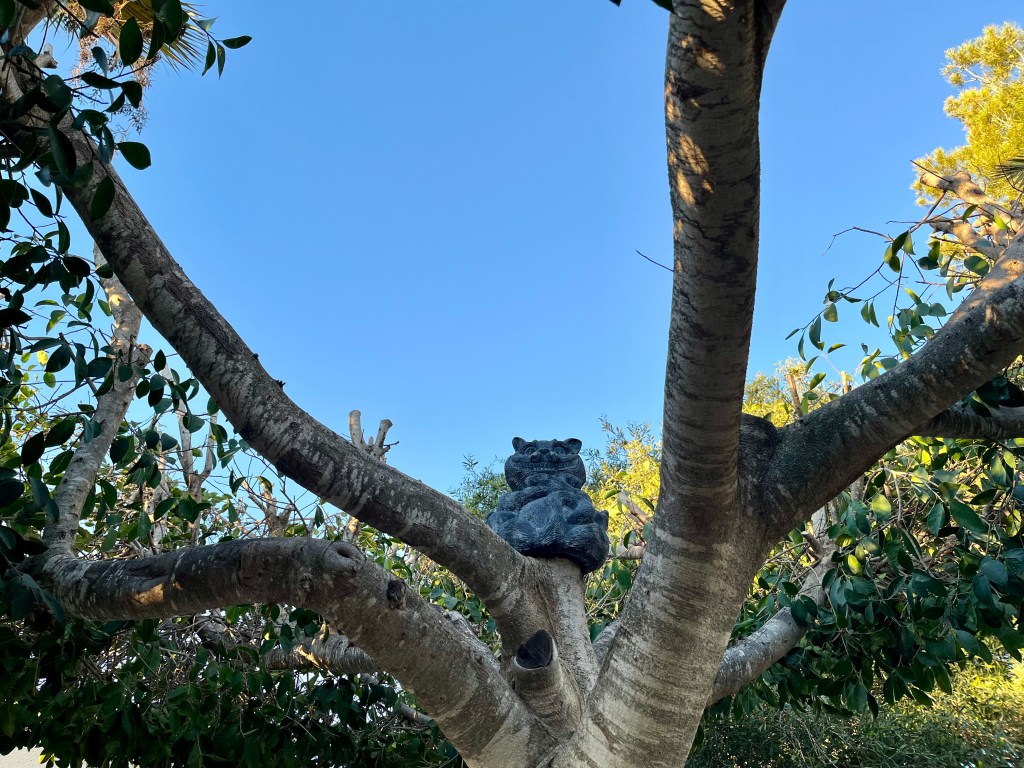
Look carefully what do you seeA nice open canopyThe Cheshire Cat back in place
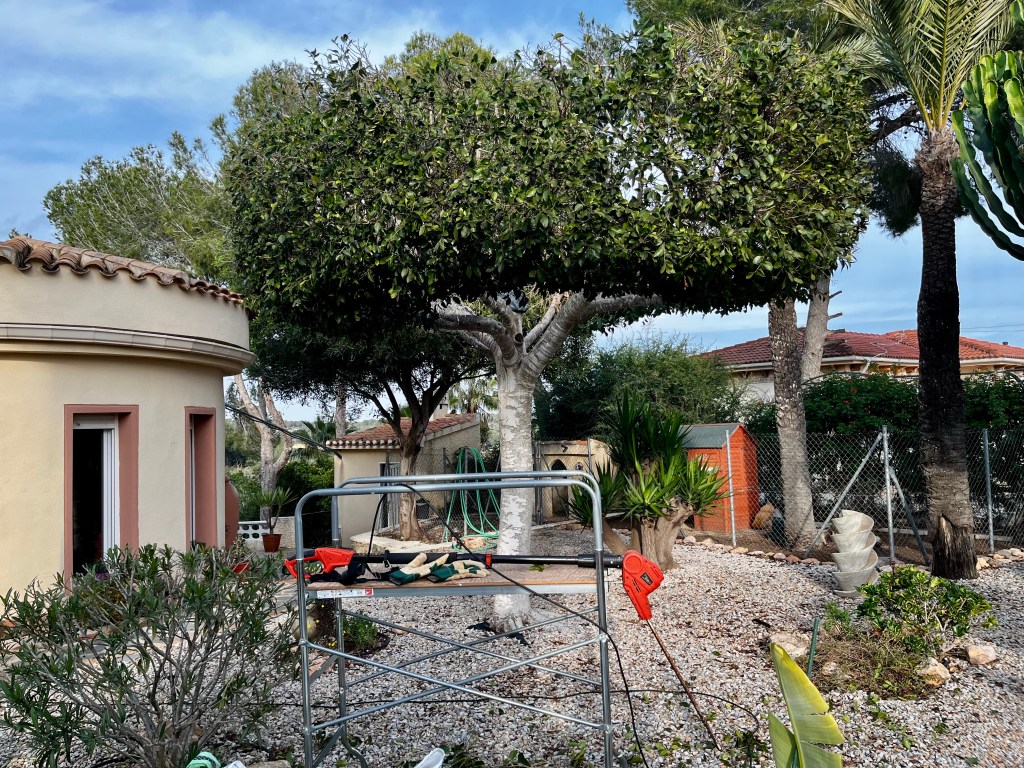
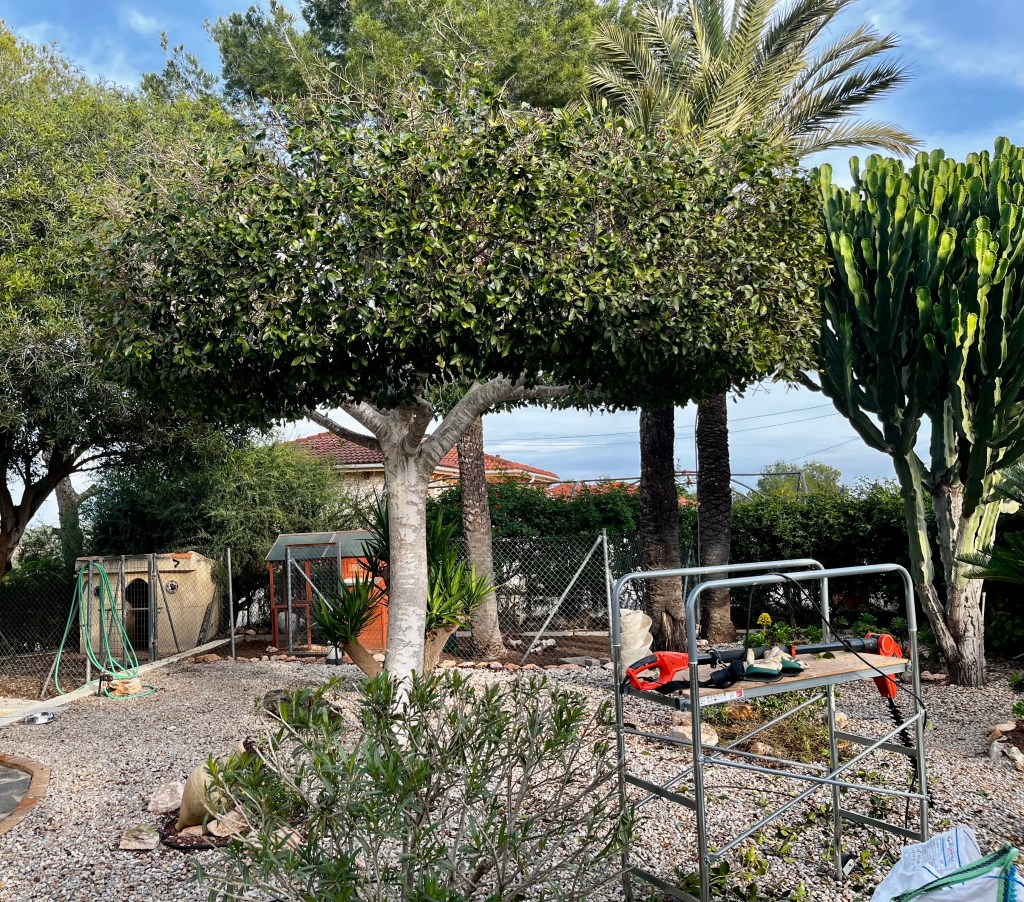
After days of torment and sleepless nights I knew I had to gain the respect of the garden or it would be all over. Suddenly it came to me. If you look at the first photo of the ficus above you will note that the left hand edge of the tree canopy is slightly higher than the right – the tree was lop sided and looked unbalanced. This was it, my opportunity to regain face and respect in the garden.
I boldly got out my ladders, platform and tools and with a great deal of ceremony and fuss began to re-trim the tree to give it a semblance of balance. As I worked the tree stayed silent, but I knew it was looking at me; at first with pitying hostility but as I proceeded it eventually melted into looks of understanding, trust and comradeship. The photos below show me at work.
You can’t see me I’m in the tree
Well I am pleased to tell you that it all ended well. After I had finished I sat in its boughs and we discussed past battles and skirmishes. We laughed and cried about our antics when we were both younger telling each other our favourite parts of our various battles. Eventually it was getting dark so I climbed down. But I am pleased to tell you that it doesn’t end there. We have agreed to collaborate on a book, we have a tentative title; “The Old Man and the Tree” what do you think, it has a sort of ring to it, Hemingway would love it.
On we go with the big winter cutback, part 3. You should be more than half way through the systematic cutback of your garden, your back is aching, your compost bins are filling up, the cold and wet days haven’t stopped you and the end is in sight.
All was going well until Cruella (my wife) demanded that I stop messing around gardening and create a new soft play area for her girls. I explained how essential the winter cutback was but she refused to be moved insisting it was a human right as covered under the UN Charter and the ECHR. I explained that her chickens were not human and therefore not covered under this legislation. She has now hired human rights lawyers and is seeking a judicial review. Anyway enough of this nonsense on with the gardening.
24th January 2026. Things I have been doing lately:
Pruning fig trees
Dealing with broad leafed weeds in grass
Cleaning up and composting leaves
Cutting back hedges
Refurbishing the chicken soft play area
Pruning fig trees. Most fig trees in Spain are left to grow into huge towering hulks that lower over gardens in threatening sprawls. All too often their fruit is too high to pick and when it falls it makes a sticky mess all around the trunk mixed in with bird poo that creates a dead zone under the tree.
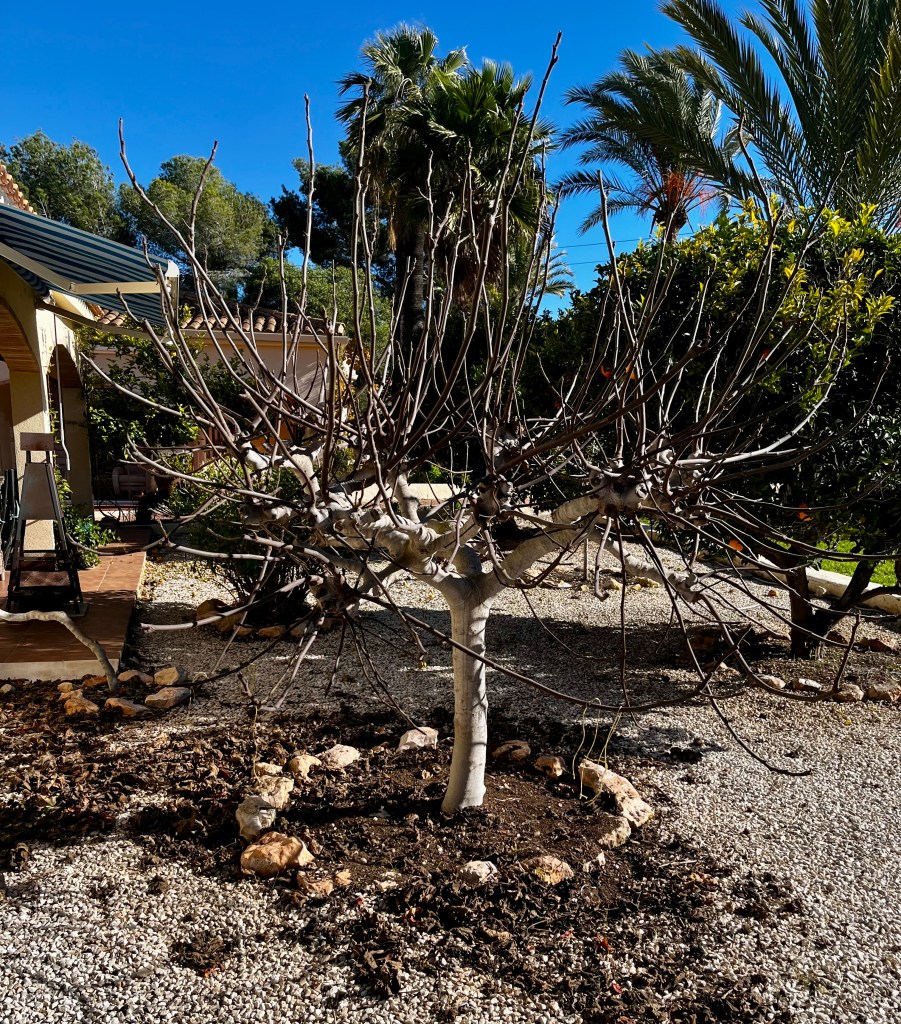
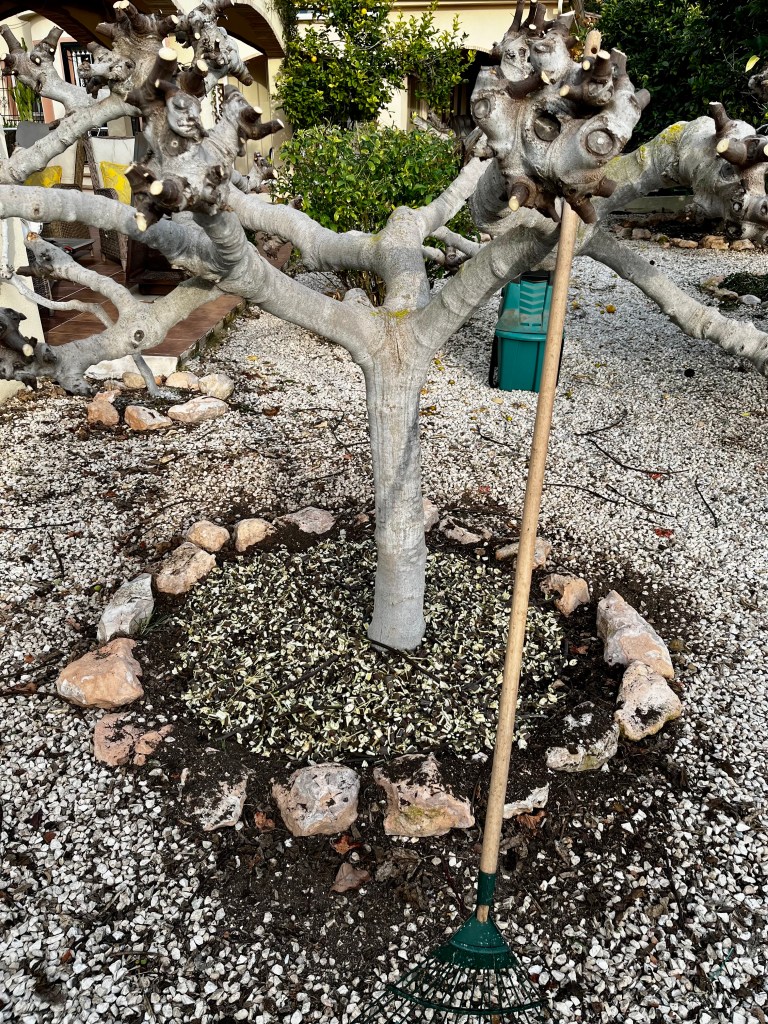
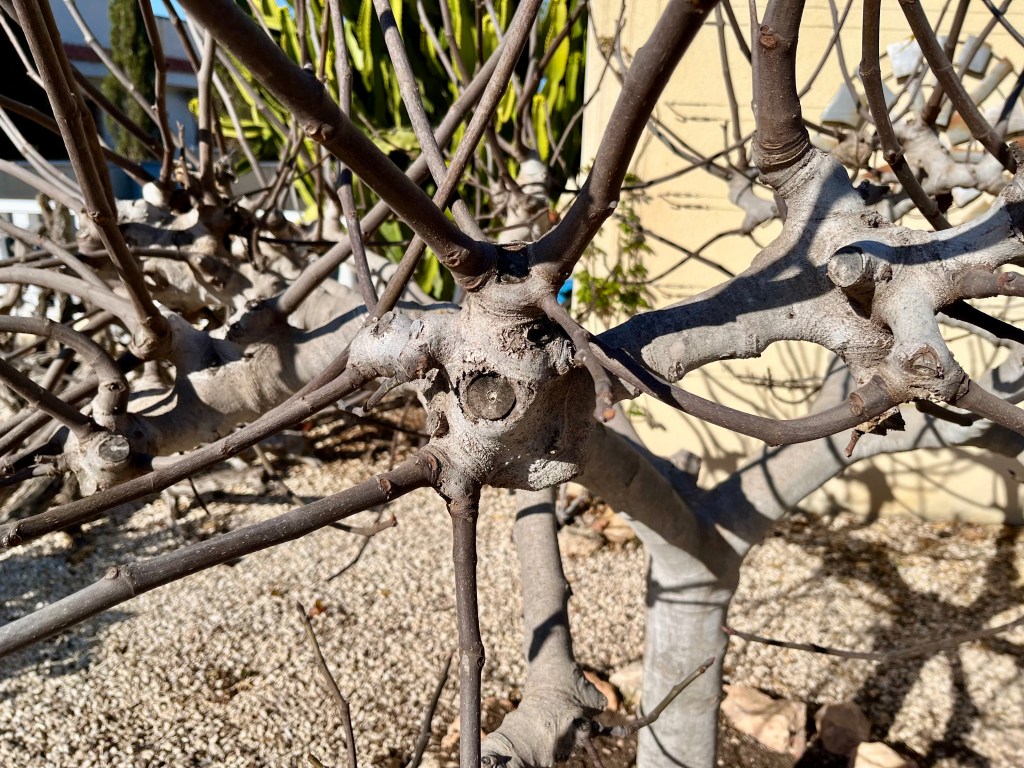
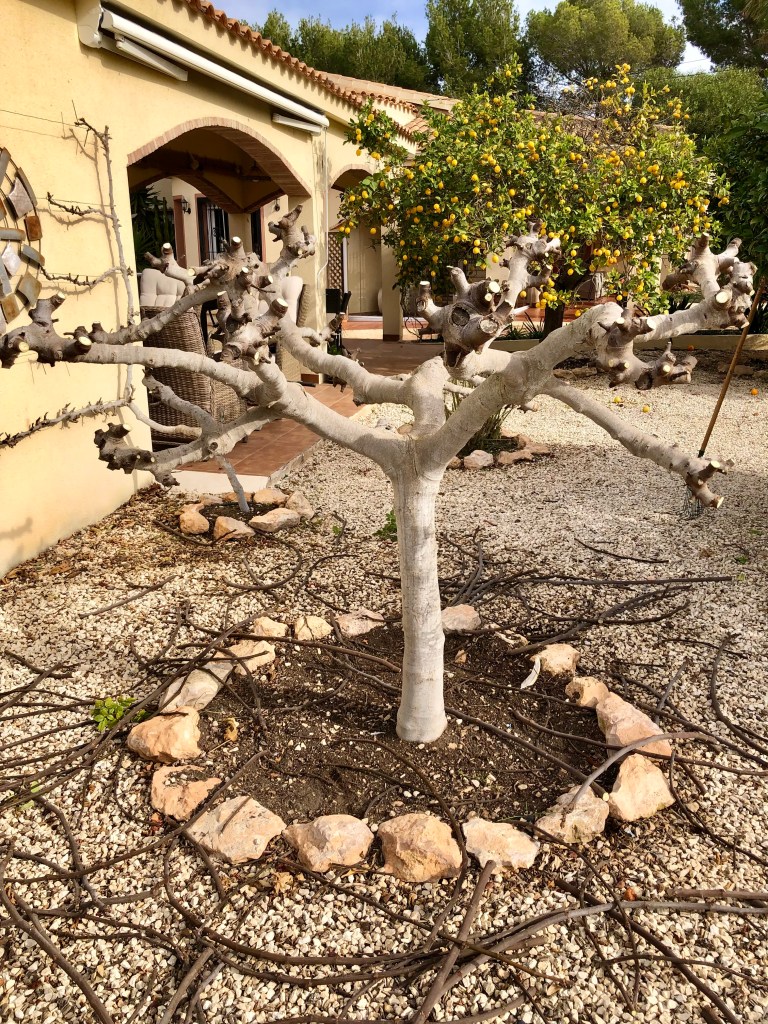
It needn’t be this way you can carefully train your fig to be a fruitful adornment to your garden. The starting point is radical pruning. Now this can be scary as you have to prune back to a few strategic branches spaced around the trunk of the tree. Once you have pruned your tree back to these strategic branches, then all you have to do is cut back to these branches at the end of each growing season. The photo below shows one of my trees ready for its annual cutback.
From this photo you can see that the tree has been pollarded back to selected branches and the long “whippy” growth is the only part that will be pruned. Before you begin pruning ensure that all the leaves are off the tree as this will mean that the caustic sap has drained back to the roots and you are in no danger of being burnt.
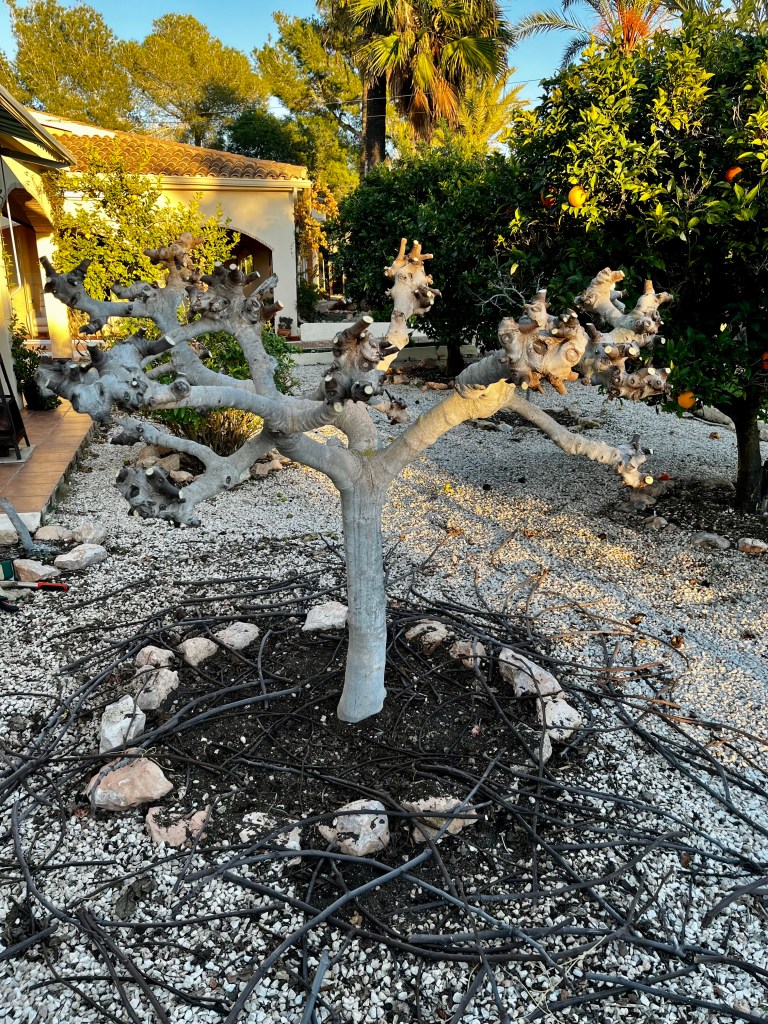
All you need to do then is snip all the new growth off using your long handled lopers. Just take them back to the knuckle at the end of the branch and the new growth will grow from this point. The photo below shows the tree ready for the new growth.
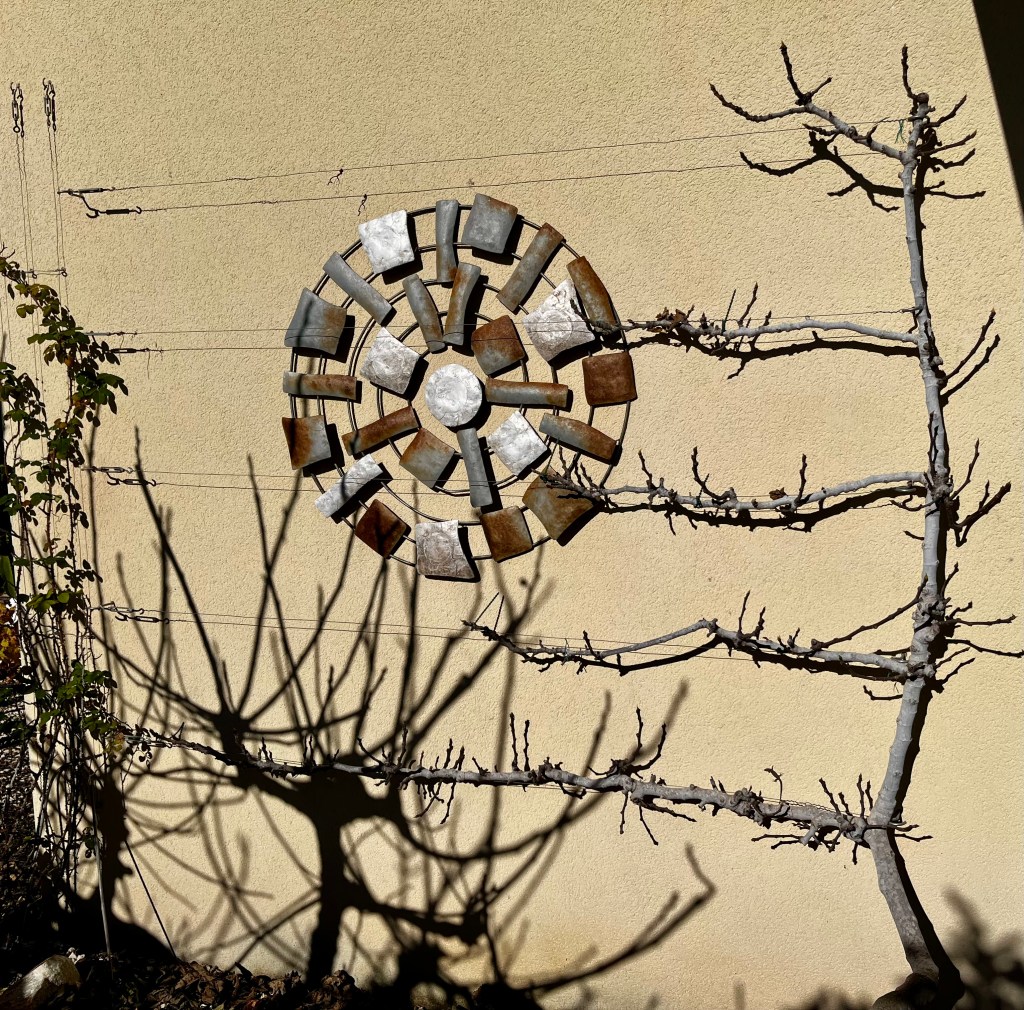
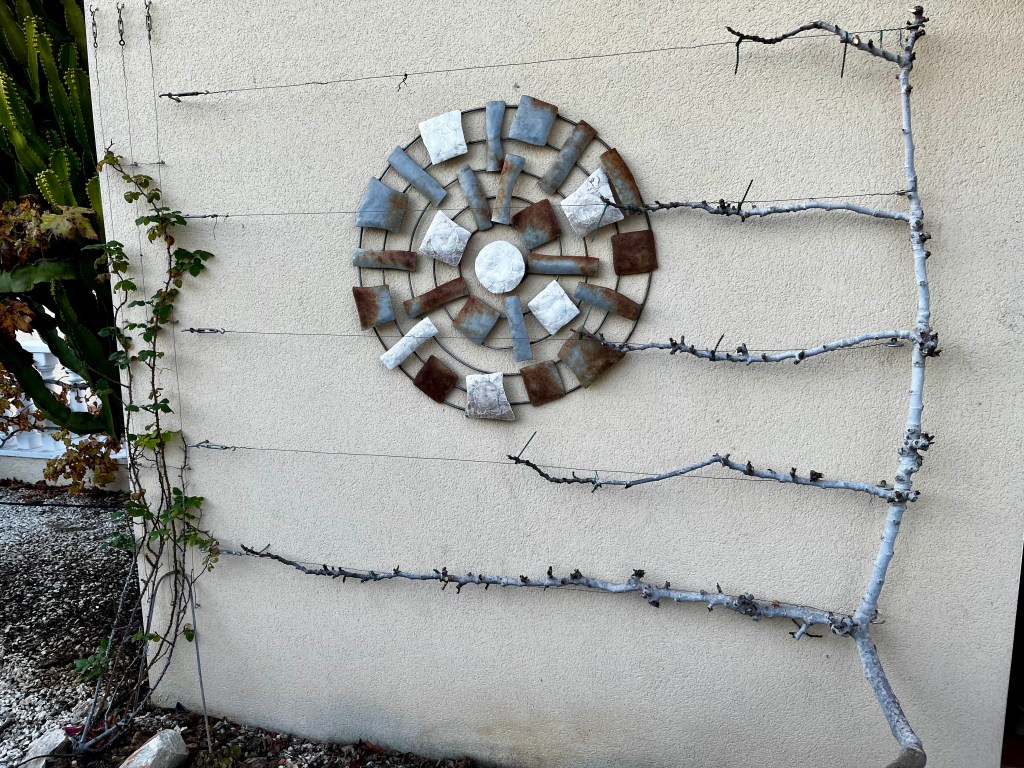
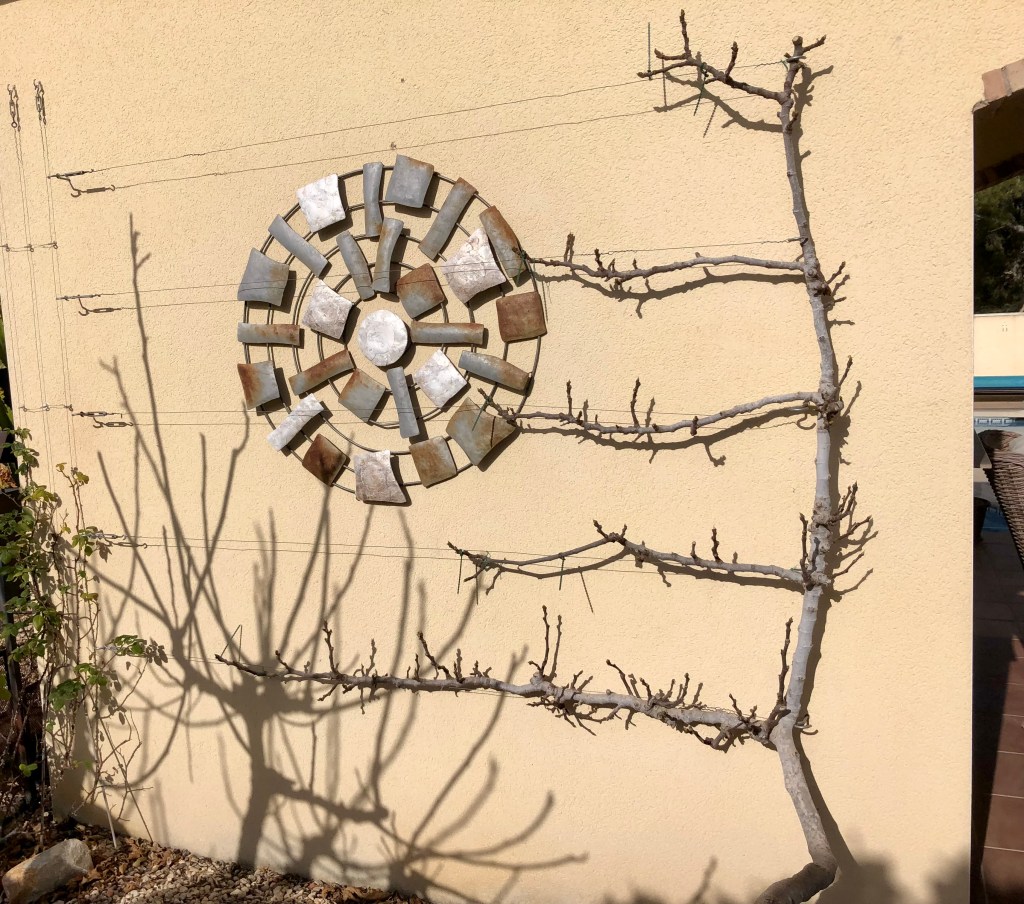
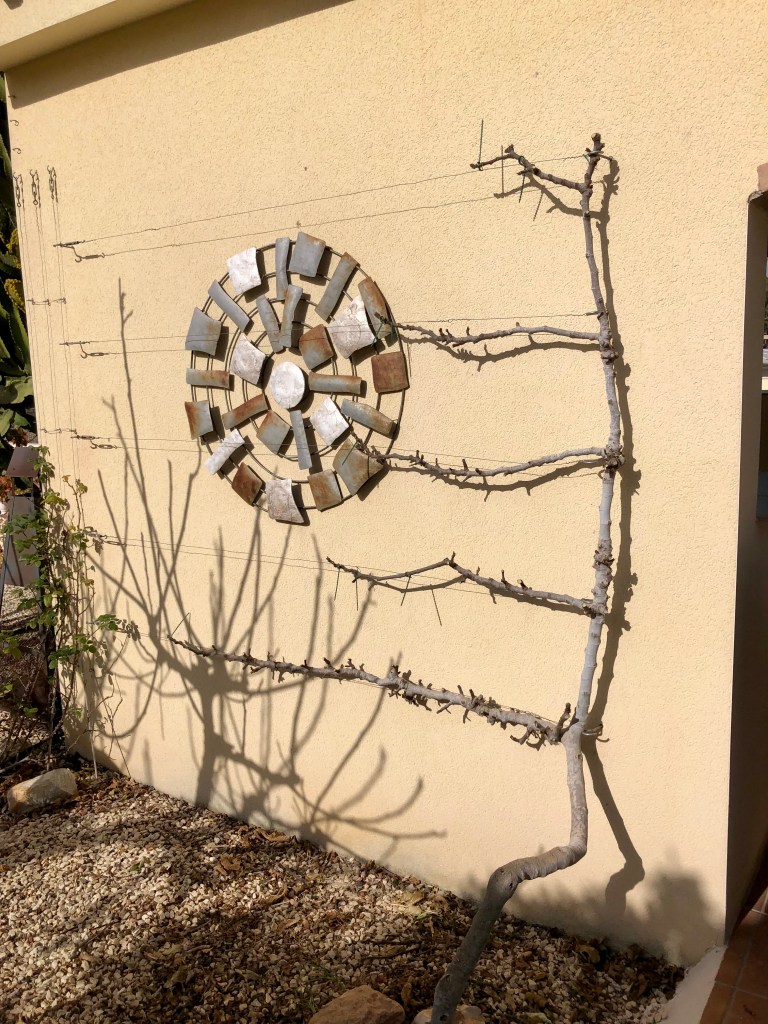
In addition to my standard fig I also have an espalied fig that I have trained along a wall over a number of years. The process is the same; just take off the side shoots and leave the main branch. The photos below show the espalied fig before and after.
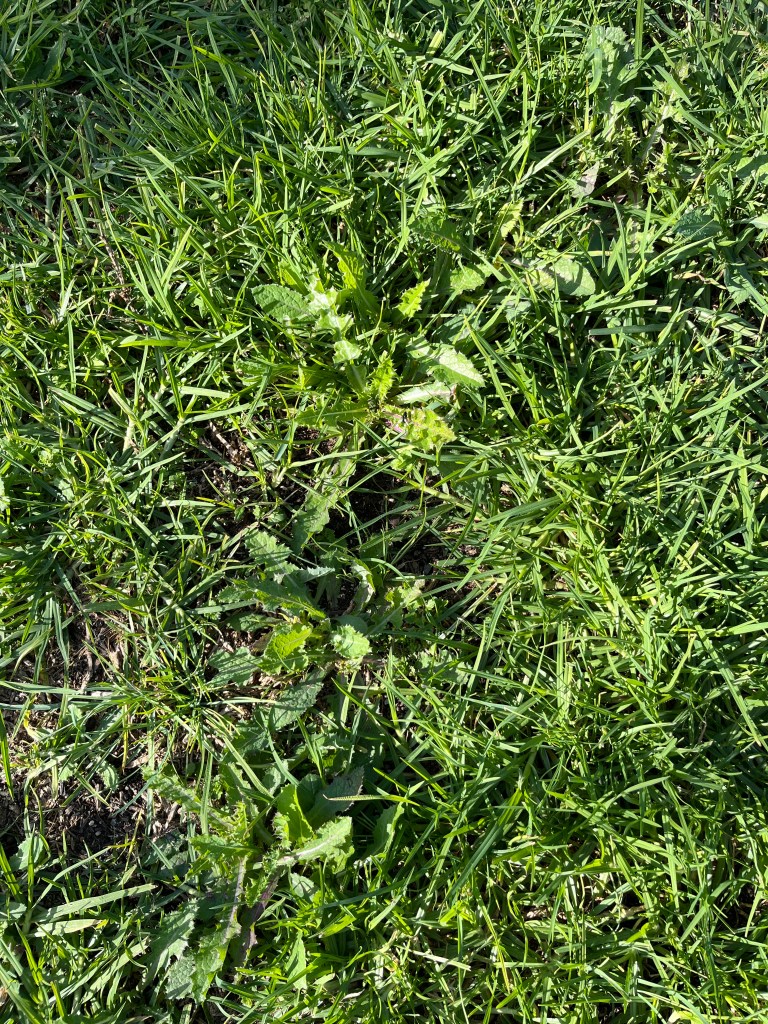
Dealing with broad leaf weeds in grass. Now I know not many of you have lawns in Spain, and that is perfectly understandable. However, for those of you that have, now is the time to treat for broad leaved weeds.
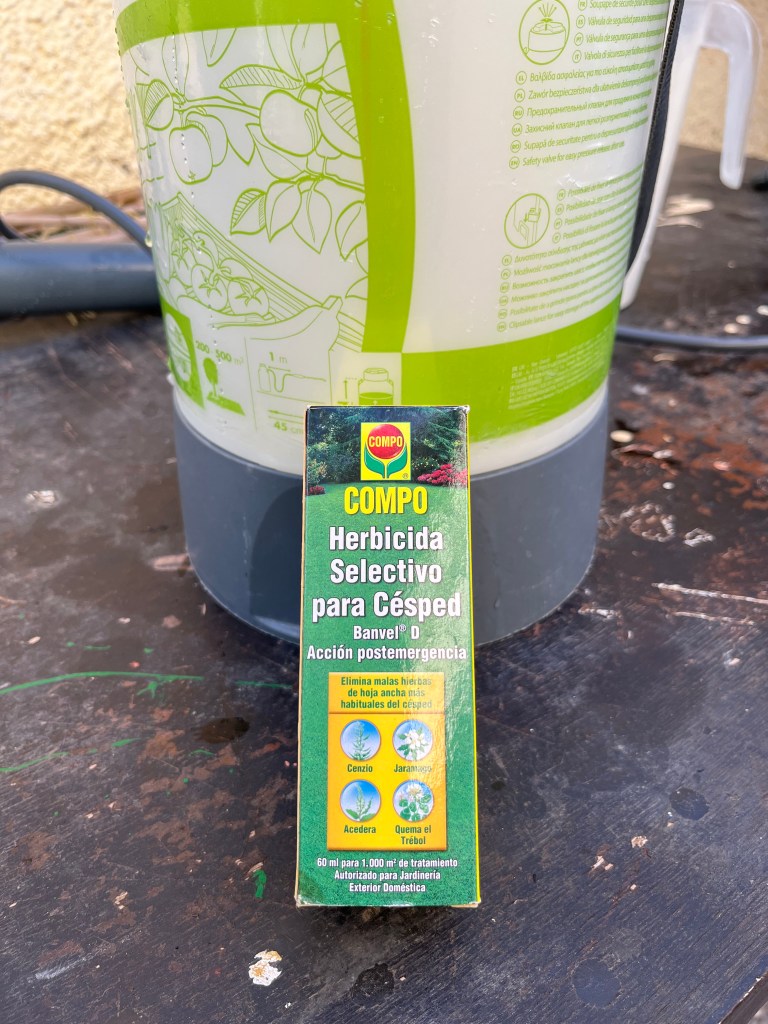
Broad leaf weeds such as Dandelion etc are growing ferociously at this time of the year. They, spread their leaves out, kill the grass underneath and then set seed to give you another generation. You can if you wish, go round and remove all of these weeds by hand, but it is a time consuming and difficult process. Instead use a selective weed killer. This can be sprayed on to the offending weeds without harming the grass. The photos below show the problem and the solution.
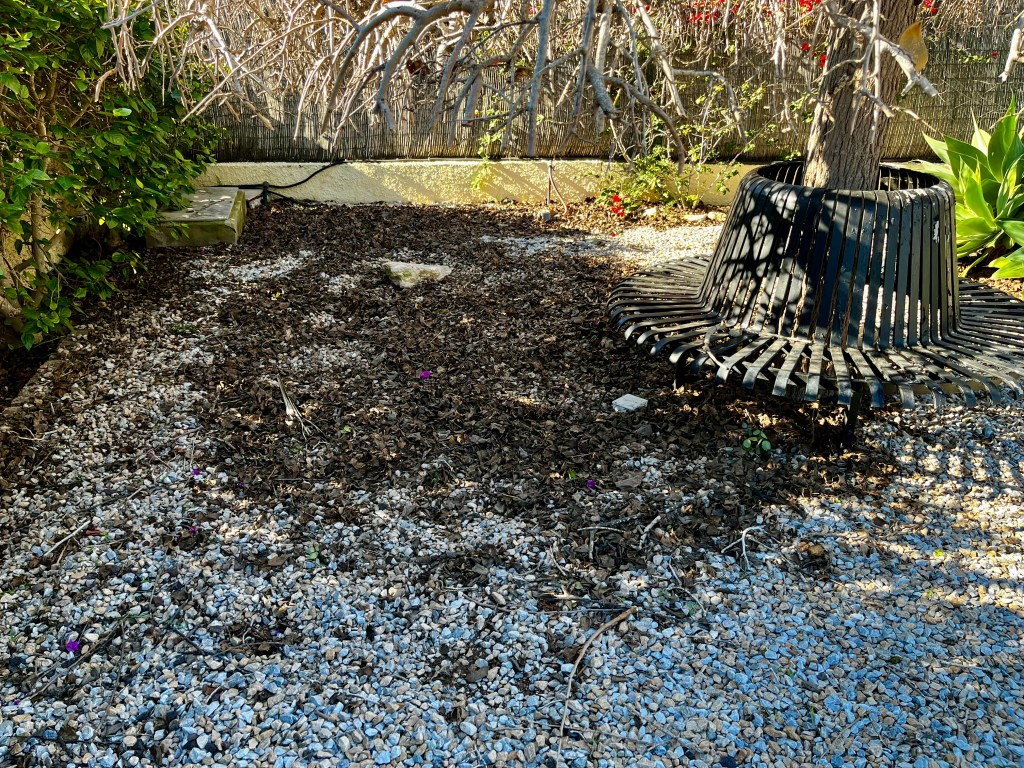
Cleaning up and composting leaves. An integral part of the big cut back process is that you will create lot of fallen leaves, which taken together with the normal winter leaf fall will have left you with various piles blown all over your garden. The temptation is to just leave them and let them blow around. But the danger with this approach is that the leaves will gradually breakdown into a fine tilth on your gravelled areas and on paths creating a lovely medium for weeds. In addition they provide a perfect environment for slugs and snails to foray forth and eat your new plants. The photo below shows a perfect slug and weed environment.
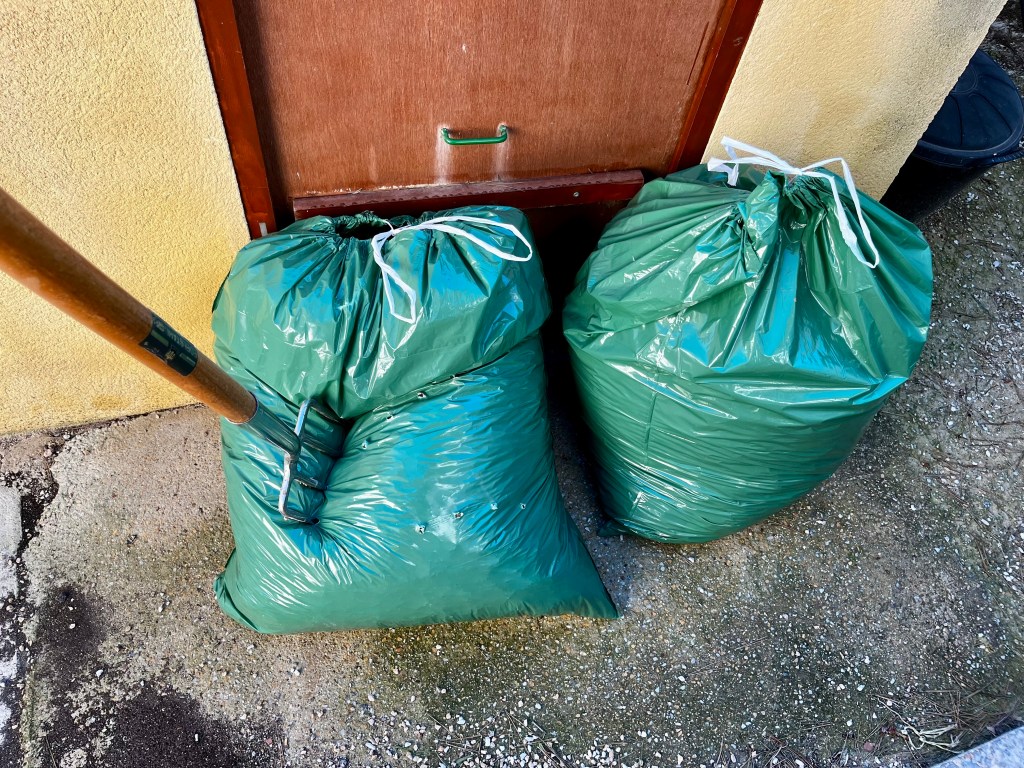
You have to clean them up, but don’t do it grudgingly, and don’t just throw them away. Instead compost your leaves to make a lovely top dressing mulch for next autumn. The first thing to do is to sweep or blow your leaves into heaps. Then load them into plastic sacks, making sure to crunch them down as you go. Once you have filled your sacks, puncture them with a garden fork in a few places to encourage air circulation. Once you are ready store them in a shady corner of your garden and just forget about them for 6 months. After this time they will make a nice mulch for top dressing. The photos below show my world famous sack pricking technique and my leaves shady corner.
Cutting back hedges. I take joy in hedges as they provide a floriferous back drop to the garden and a wonderful home for lots of wildlife. As I wander around I see thousands of houses with 2 metre high walls all around their garden. A good well planted mixed hedge will give you all the security and privacy of a wall but with the added bonus of an ever changing backdrop throughout the seasons.
But as hedges are living things you have to cut them back once a year. Over the years I have developed a technique of planting hedging plants quite close together and making them fight for air, light and space. This technique encourages prolific flowering and is a joy to behold. The photos below shows some of my hedges and the battle of the big cutback. Click on each photo for a larger view.
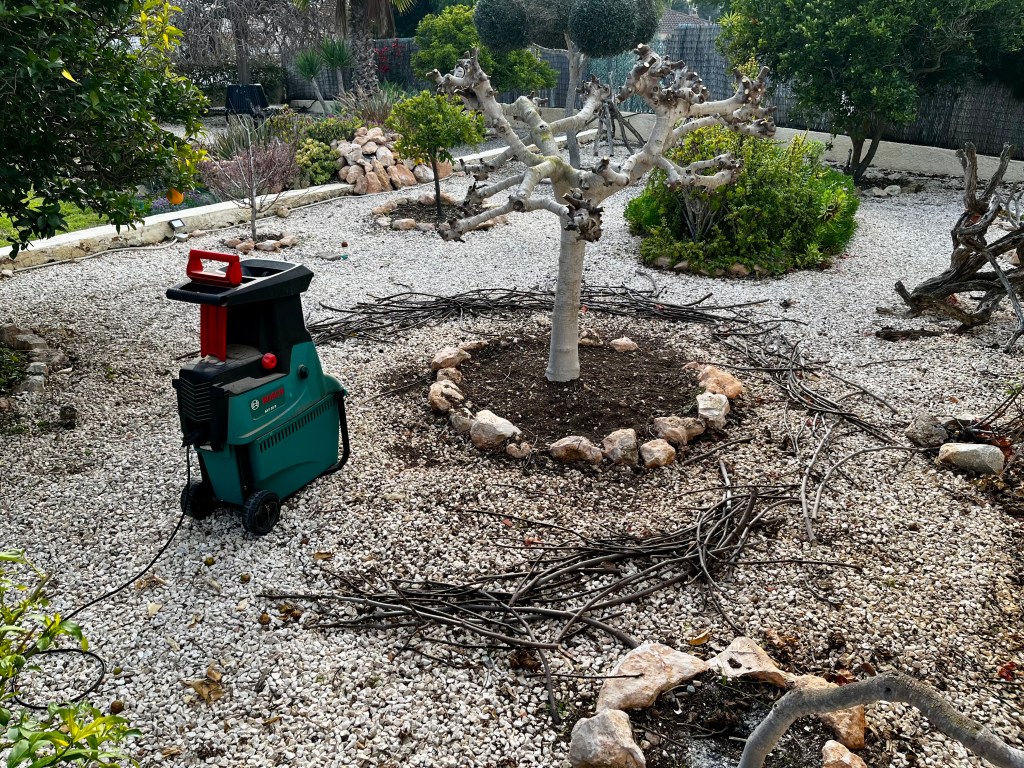
At the end of the cutback process don’t just throw everything away, instead shred what you can and then either compost the material, or where appropriate spread it as a mulch under your trees. See the photos below.
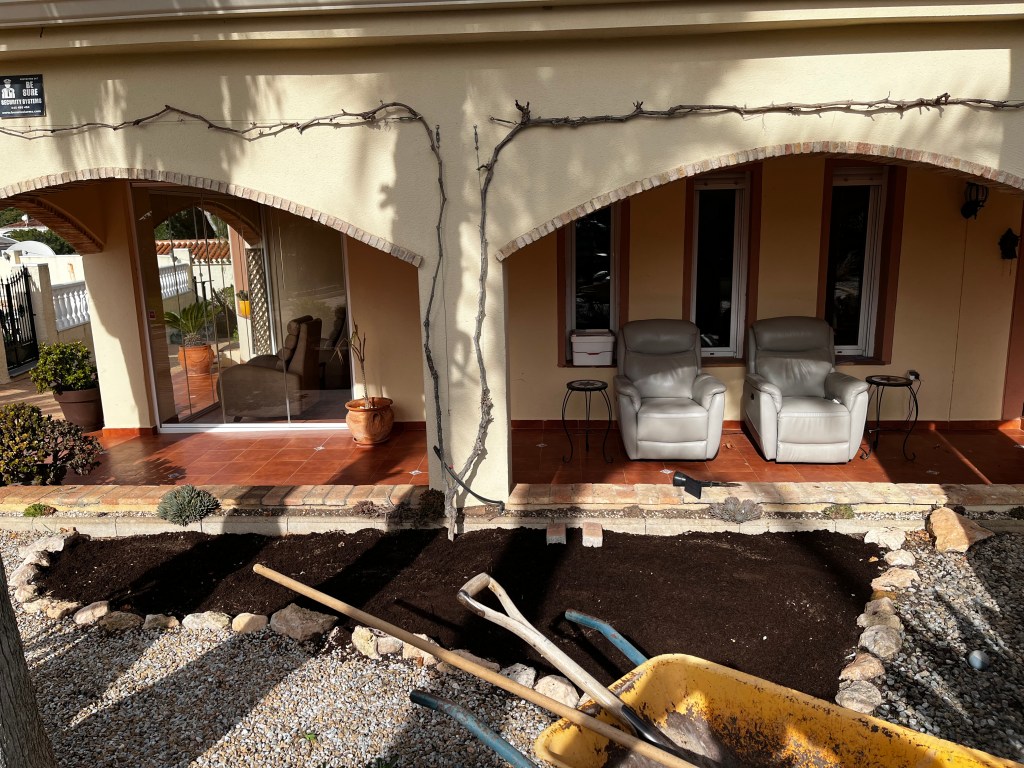
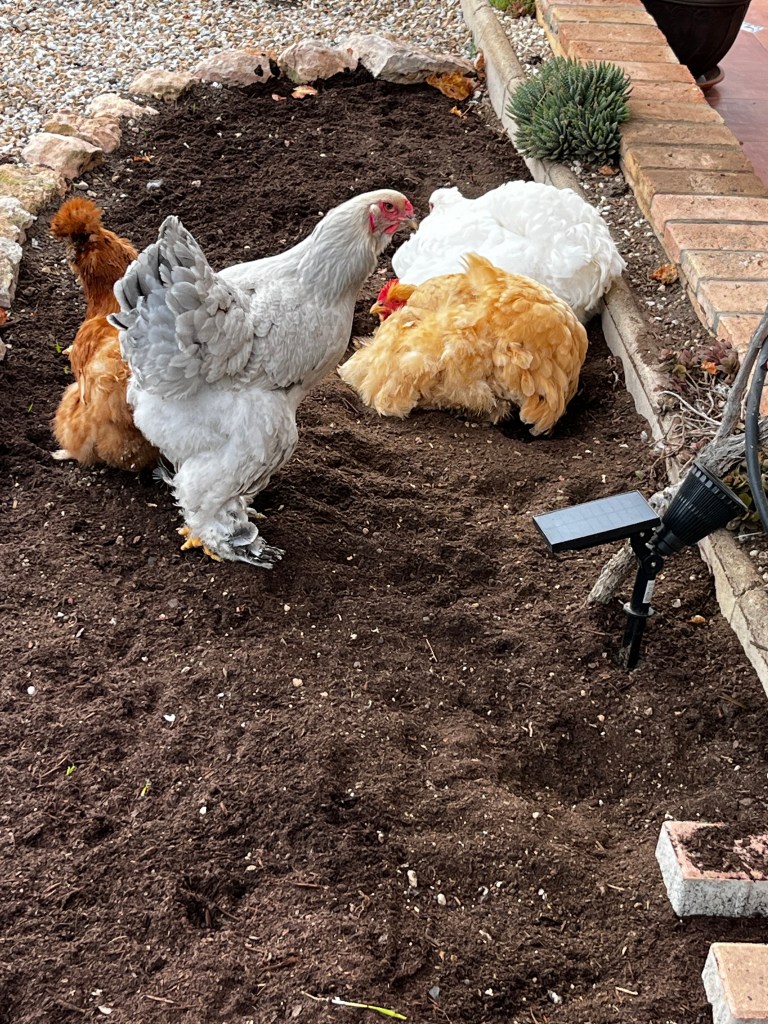
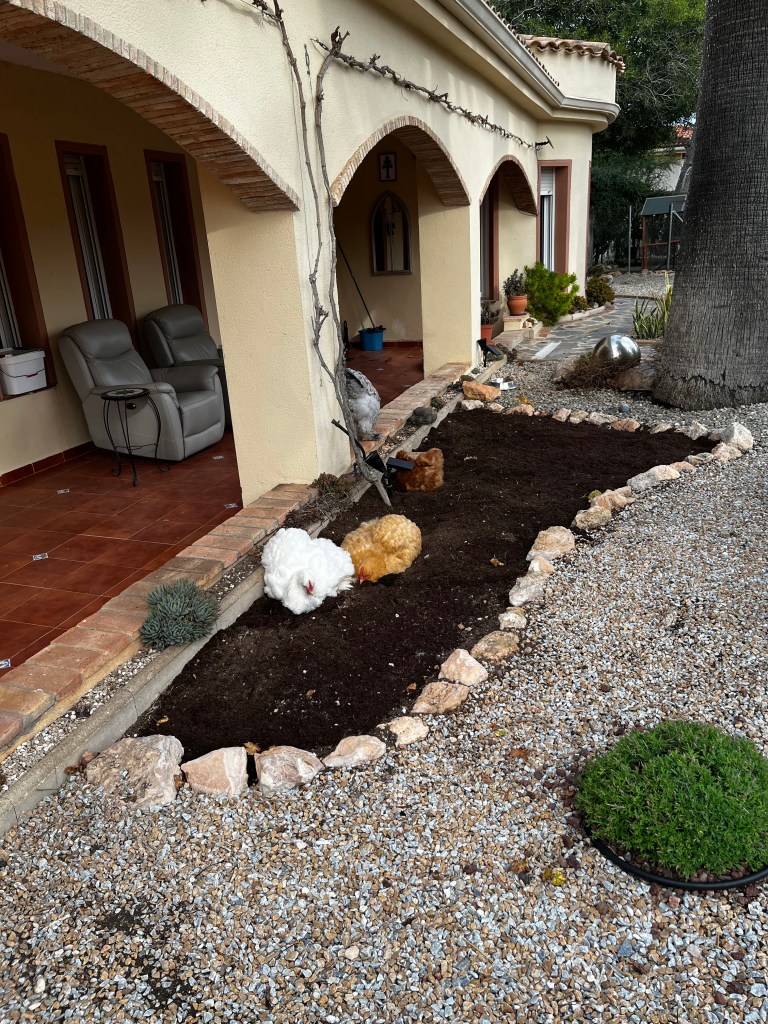
Refurbishing the chicken soft play area. I am ashamed to admit that I have a chicken soft play area in my garden. Basically it’s an area that once was lawn. It is located right in front of our Naya (Verandha) where Cruella and I sit and take our morning tea. I took out the grass and replaced it with cheap compost, this then allows Cruella’s girls to disport themselves first thing in the morning whilst Cruella feeds them sliced grapes and gives them their instructions for the day.
All of this activity takes place in Chickenese so I have no understanding of what’s going on. Over the years I have picked up key words in Chickenese, but not much, mainly I only understand when she points at me; so I now know the chickenese word for “pig”.
Anyway, I had to stop the big winter cutback to refurbish the soft play area with new compost. She also wants me to install a swing and a slide, but I have refused . Hence my being referred to various international bodies for chicken human rights abuses. I know she is talking nonsense, but I am beginning to worry as I have received several threatening legal letters. She tells me a date is set for hearings so I am thinking of Lawyering up.
The photos below show the start of the refurbishment of the soft play area. Then just when I get the surface all nice and neat they dig it up again.
Well after all the fun and festivities of Christmas it is time to get on with the big Winter cutback. If you get out into your garden now you will not only lose a few pounds and feel better, but your garden will thank you this summer with lovely refreshed growth.
If you have a large garden then you need to plan your winter cutback over a number of weeks. If you have no other plan, then the simplest way is to start with your smallest plants and work your way up to the really big ones. If you follow what I am doing over the 4 or so stages of my winter cutback then we will cover most common plants in Spain.
I have to admit that my annual winter cutback has been much disrupted by the visit of my idiot son. Cruella (my wife) has been beside herself for weeks preparing for his visit, especially since he will be taking his advanced certificate in chicken care. Under Cruella’s supervision he has been taking exams from The University of Applied Chicken Care – motto: “Sapientia ab Ovo”.
Anyway enough of this nonsense let’s get on with the big winter cutback.
8th January 2026. Things I have been doing lately:
Reshaping Yucca to improve garden design
Trimming Sago Palms
Pruning Solanum
Reshaping trailing Lantana
Pruning roses
Invigilating chicken exams
Reshaping Yucca to improve garden design. If you follow this blog then you will remember that I posted a short while ago about cutting and reshaping Yucca. However, I left one large stand of Yucca out of my last pruning round as I wanted to give more thought to reshaping it.
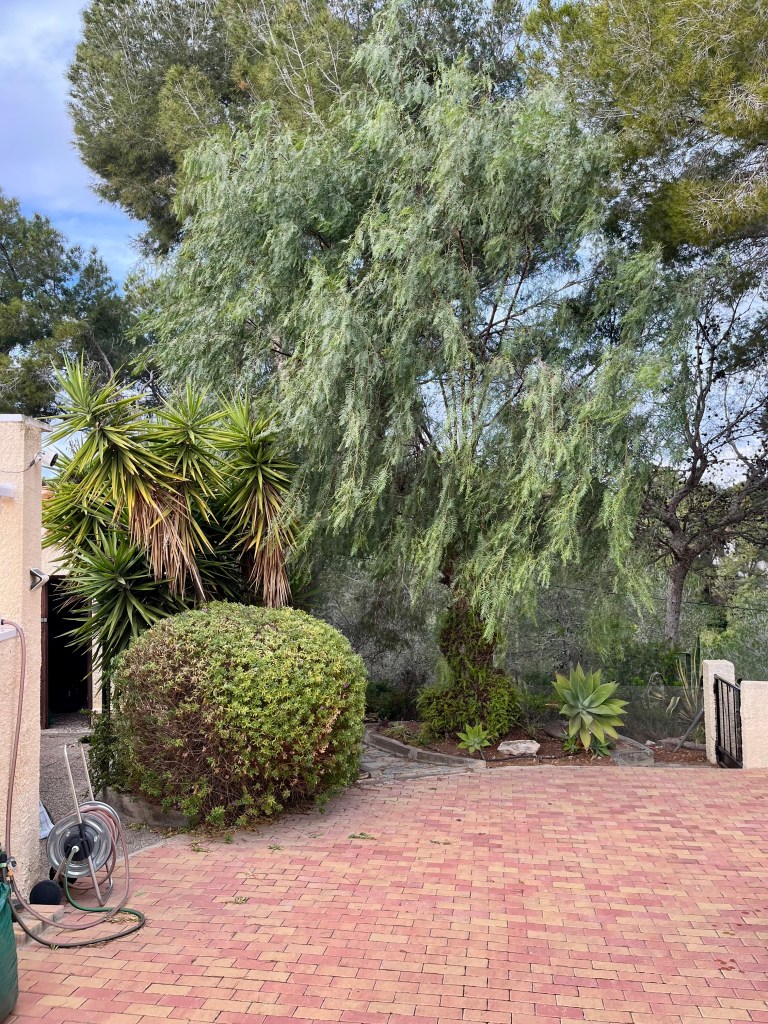
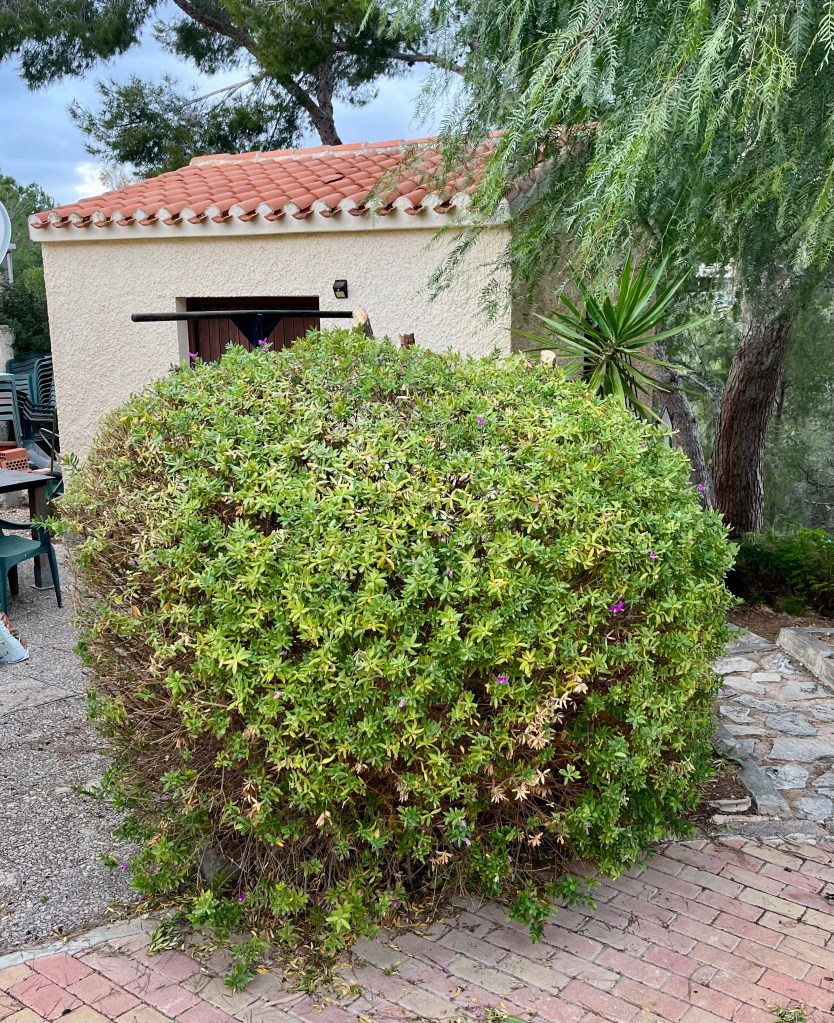
The area I was contemplating stands at the bottom of my drive and over the years I have created a pleasing combination of: Yucca, Californian False Pepper tree and a large bush Myrtle. Together these present a pleasing vista at the end of the drive. However, they had all become rather ill defined and needed to be brought back into harmony. The photo below shows the problem.
Although I had reshaped the Myrtle, the Yucca and the tree were still too entangled
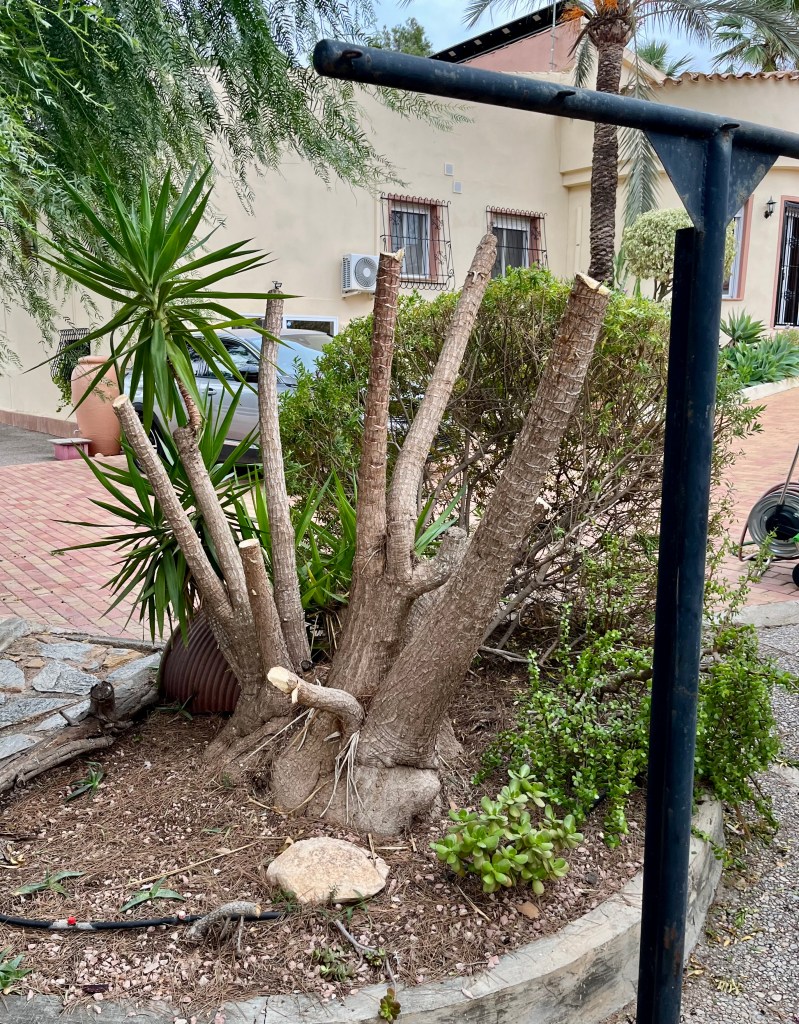
The solution was to reshape the Yucca by cutting it back to different levels. When this regrows – as it will within 6 months it will once more present an attractive integrated perspective. The False Pepper tree will be refreshed by being completely pollarded in about a year. The resultant cutback can be seen in the photos below. Remember, gardening is all about planning for the future – whether you will see it or not. A real gardener plants trees, he will never sit in the shade of.
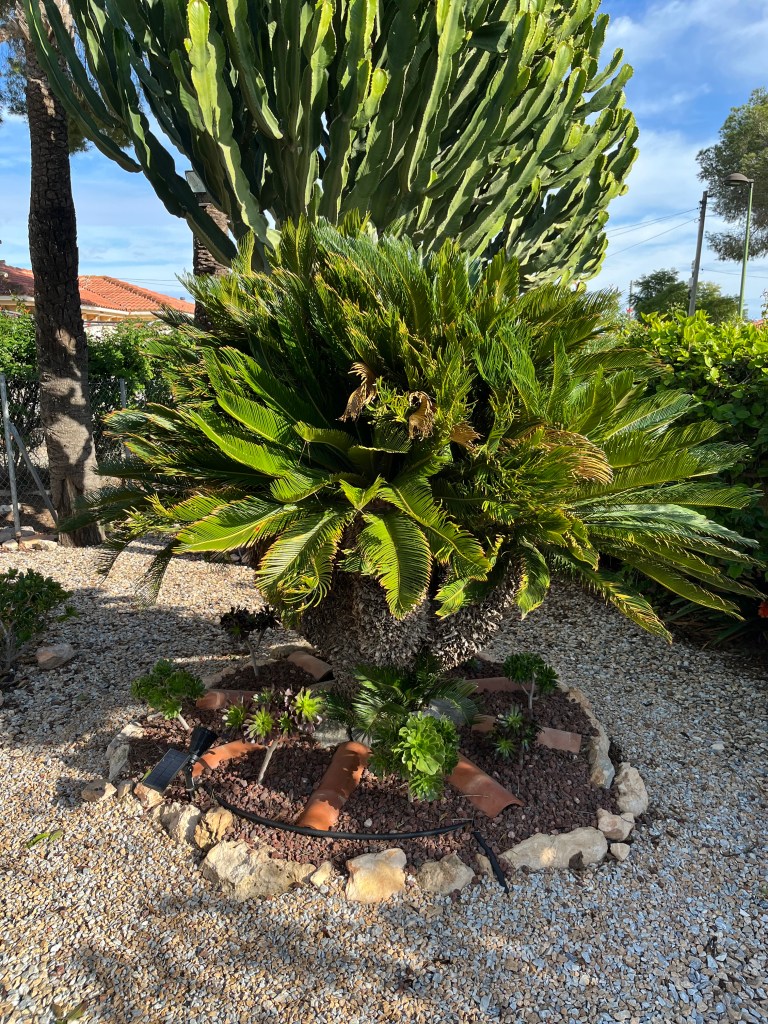
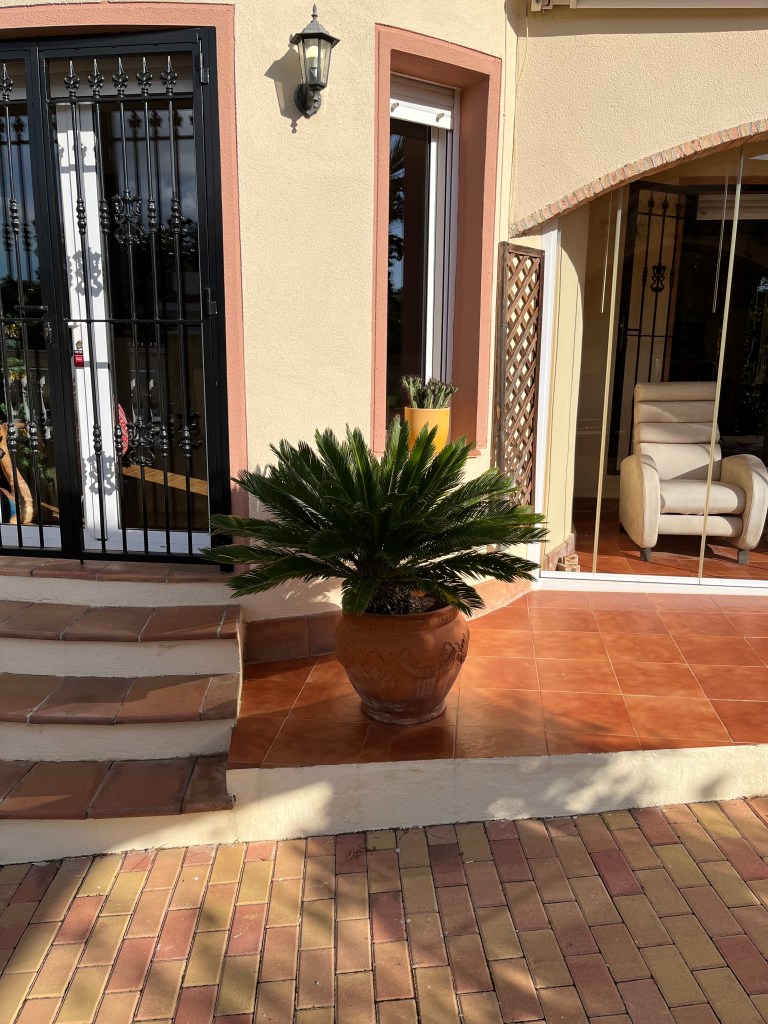
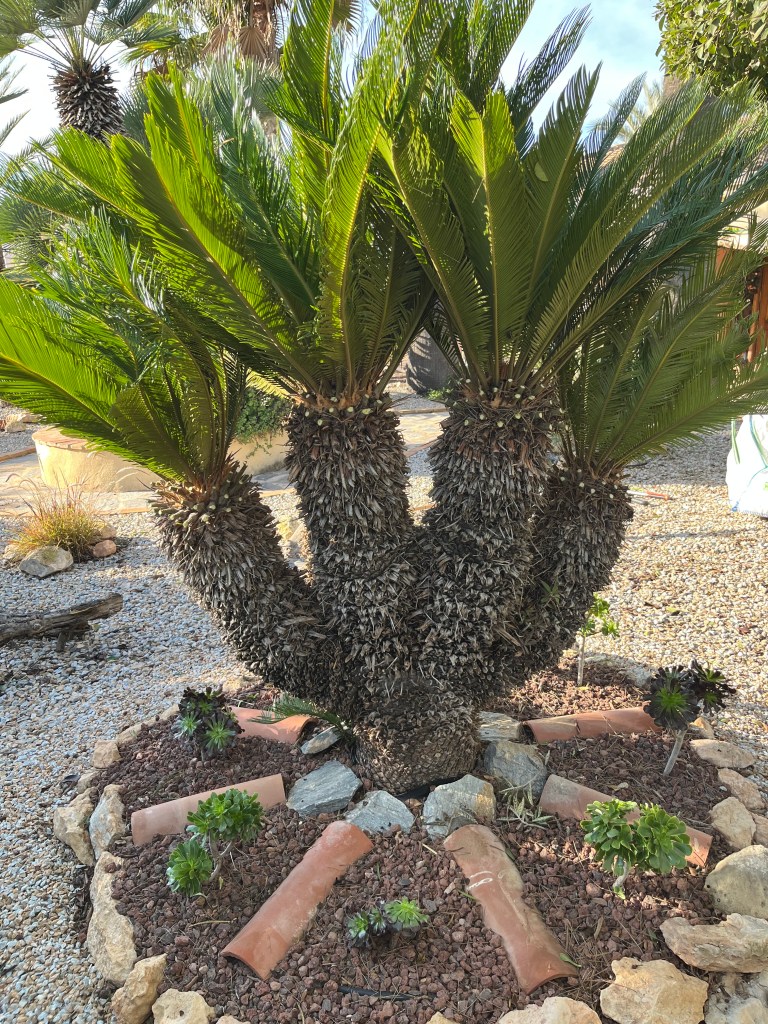
Trimming Sago Palms. Sago Palms are prized plants in many Spanish gardens. They provide structure, but are slow growing and because of this are very expensive. So if you have one you need to take care of it. I have a number of Sago Palms of various sizes, but the two that need attention are a large multi branch plant in my front garden and a smaller version in a pot. Photos below.
I like to keep these plants relatively tidy, which mainly involves taking off all the fronds apart from the top two rows. It is important that you leave at least two rows to continue nourishing the plant. Also two rows should guarantee that if you lose one, you still have a back up.
To trim Sago Palms I use long handled lopers to get right into the base of the fronds. You also need to wear eye protection and gloves as they can be very spikey. The photos below show my newly trimmed plants.
Pruning Solanum. I have Solanum in many variations in my garden. Some free standing, others are either growing through hedges or climbing up walls. In this case I needed to prune my climber to keep it in shape. At its simplest this involves just getting your hedge trimmer or shears out and trimming the plant back to the wall, whilst at the same time being careful not to cut off any long sinewy runners (it is best to tuck all these in before you start to cut). The photos below show the before and after.
what do you mean you can’t see any difference
Reshaping trailing Lantana. I love trailing Lantana as its spreading habit provides the perfect setting for island planting into gravelled areas. In Spain too many people turn their gardens into gravel or tiled plant deserts. I understand this as the effort of watering unsuitable plants under a sometimes fierce sun can be disheartening as your garden turns to desert each summer and all your plants die.
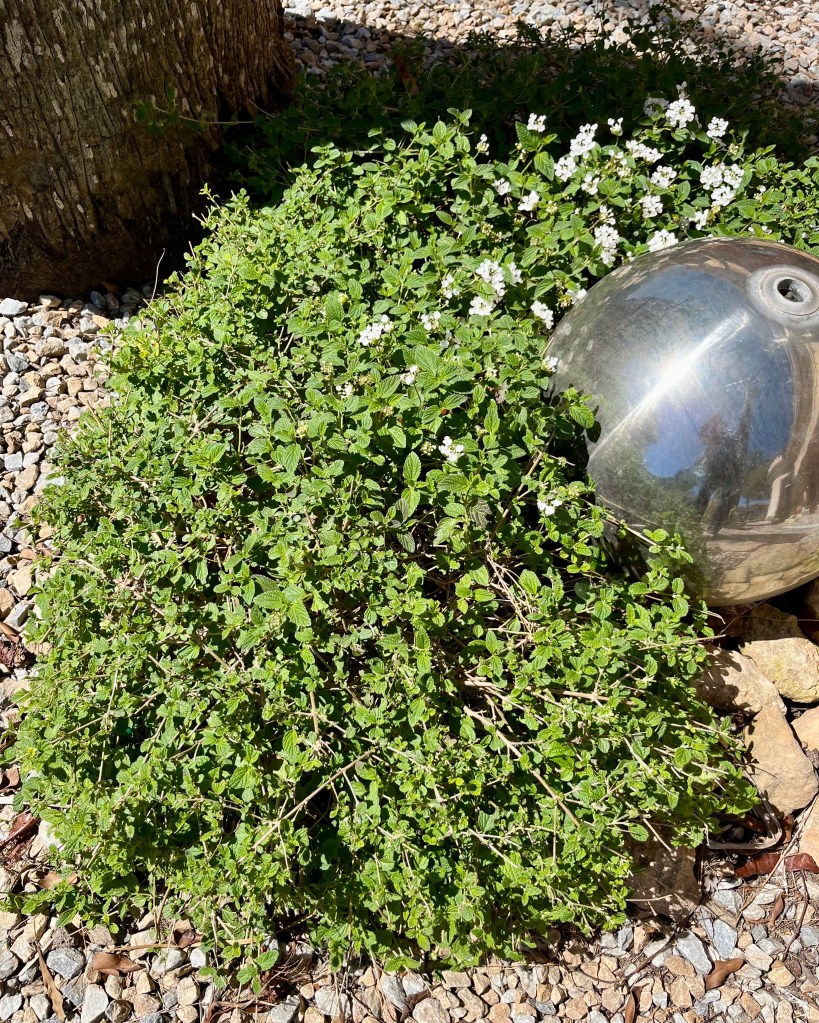
Trailing Lantana provides the perfect antidote as they are fully climatised to Spain, need little watering, yet flower profusely all summer providing a green oasis in gravelled areas. I have lots of Lantana in all its forms throughout my garden so when it comes to the big winter cutback they are a relatively easy candidate. The photos below show some of the Lantana that are due a haircut.
You do not need to be fussy when cutting back Lantana. Get your hedge trimmers out and give them a good short back and sides. Once they have been trimmed back, you will start to see re growth within a month and off they go again. The photos below show my newly reshaped Lantana. Note that once I expose the area underneath the plants the chickens quickly move in to mop up any slugs, snails etc. Cruella accused me of exploiting her girls.
Pruning roses. At my house in England I prune roses in the usual way using secateurs and carefully cutting back to an outward facing bud etc. But in Spain I have lots of roses, and over the years have discovered that I do not need to be so delicate. Out come the hedge trimmers again, everything is cut back drastically.
I then leave everything for a week or so before I clear up the dried cuttings and only then do I go around with my secateurs checking for too much dead wood above buds and trimming back. The photos below show some of my roses before and after. And yes, I know that grass is growing under my roses and I am ashamed, but I have lost so much blood over the years trying to remove it that I have now reached a compromise.
Invigilating chicken exams. As I mentioned at the start of this post the idiot son will be taking his advanced certificate in chicken care. Under Cruella’s supervision he has been taking exams from The University of Applied Chicken Care. Cruella has decided that I should be the invigilator for his exams. The photos below show some of his efforts.
Basic chicken handling (small)Basic chicken handling (large)Rewarding and basic briberyHow high can a chicken jumpElsa discusses with Cruella how he is progressingSmiles all round as Helga confirms a pass
Cruella was euphoric at his pass and insisted that he was now ready for basic broom flying lessons. I warned her that this was just too much and should be postponed. But she insisted and the subsequent failure can be seen in the photos below.
He didn’t have the right equipment and he never really got off the ground. He landed on top of my compost bins and broke the lids; I am thinking of suing for damages.
Cruella shows him how it should be doneHe didn’t stand a chance with that equipment
As the gardening year draws to a close, I thank God for the peace, pleasure and knowledge that this year has brought forth from my garden. I extend to you and your family the joy of the season and wishes that your gardening activity in the coming year is both bountiful and floriferous.
Merry Christmas and a happy new year.
from
James, Cruella (my wife), her chickens, the little white Dove, the spirit of Tango the lonely blind Labrador and the idiot son.
All of the above is true, and in that order. I know we are stretching it a bit as a gardening blog, but all I really want to do is garden, but other things keep interfering.
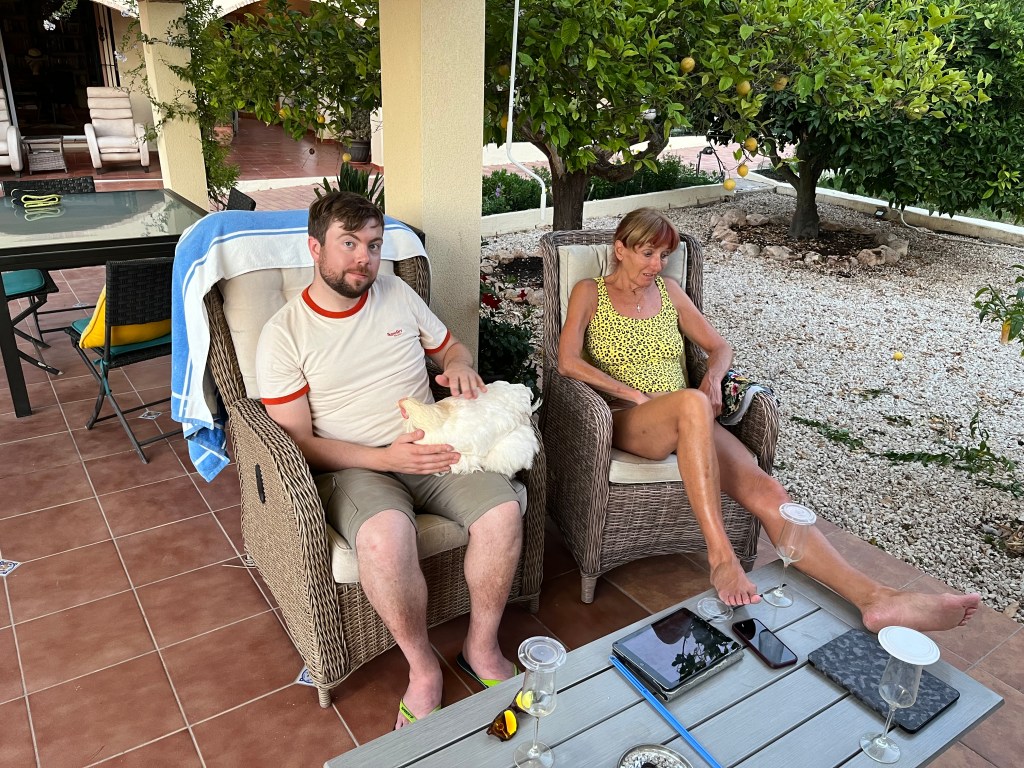
Our idiot son returned for his birthday weekend. Cruella (my wife) and her chickens had spent days preparing. There were banners, a specially commissioned song in Chickenese and a Haiku poem as he likes Japan.
Welcome, dearest one
The house wakes to your presence
Sunlight fills the rooms.
When Cruella told me that her girls were going to perform a special Haiku, I thought she meant Haka that the New Zealand rugby players do; I was looking forward to seeing chickens dancing and sticking out their tongues, you can imagine my disappointment. Anyway, on with the gardening.
19th July 2025. Things I have been doing lately:
Netting figs
Styling Yuccas
Singing to orphans as I clear the potting bench
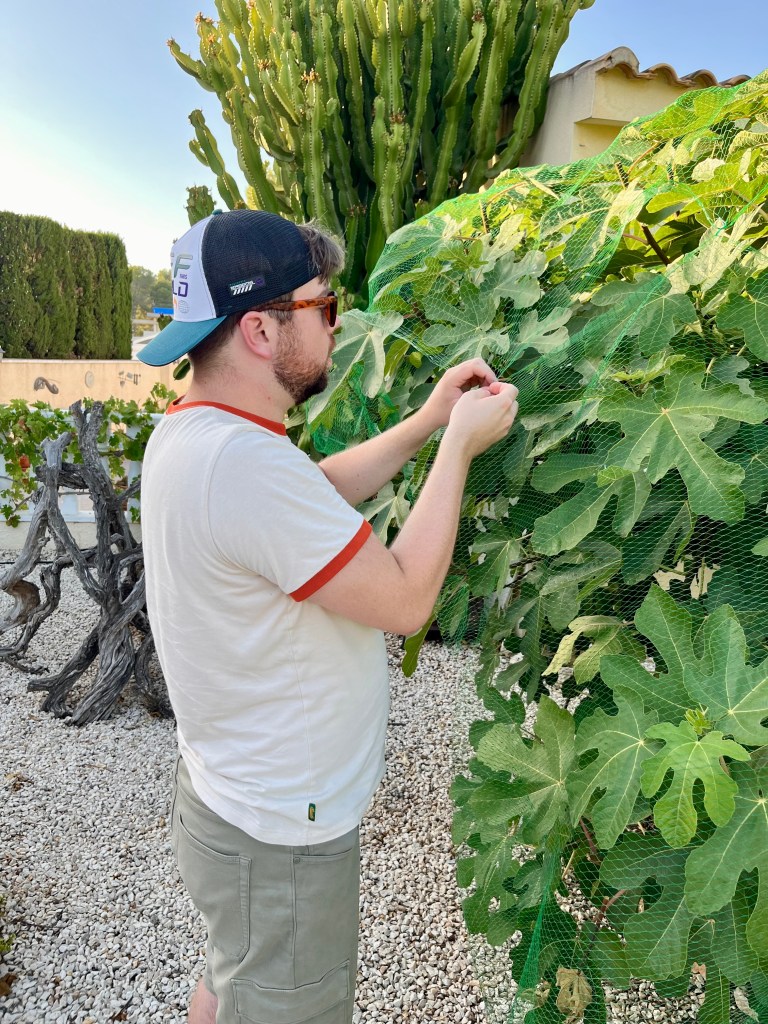
Netting Figs If you have fig trees then now is the time to net them. Even though your figs are probably not quite ripe, don’t postpone this necessary task as the birds can easily strip a fig tree of ripe fruit overnight.
If you are going to net your figs or other fruits, then it is important that you use the correct small gauge mesh netting. If you use a larger open mesh then this will become invisible to the birds, they will fly into it and get caught. When you come out in the morning to inspect your figs you will find a flock of fat birds hanging upside down and flapping. The photo below shows the netting I use.
I have two fig trees, one of which I have espaliered along a wall. My normal approach is to invite different friends around to assist with this task. But Cruella insisted that it would be a good bonding activity for her girls and their brother (the idiot son). Despite my protests that chickens could not net, she insisted her girls had been raised to do anything a man could do.
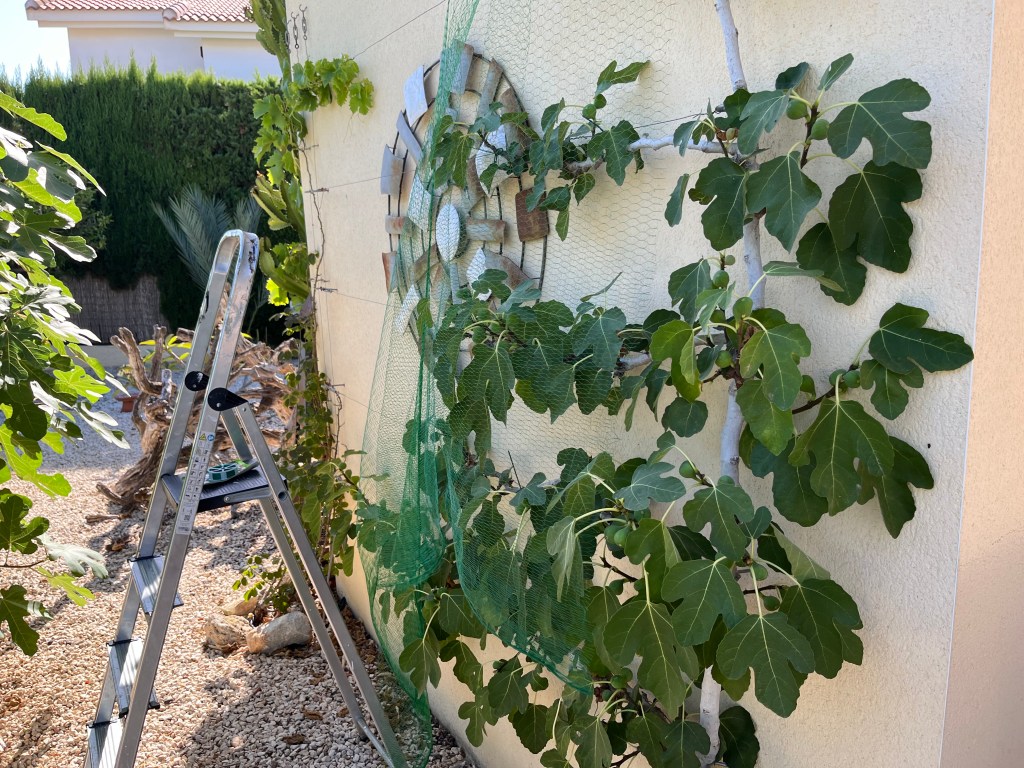
I netted the espalier fig myself and would have gone on to try and net the big fig myself, but Cruella saw me and insisted I was denying her girls a “learning experience”. Anyway the photos below show the espalier being netted.
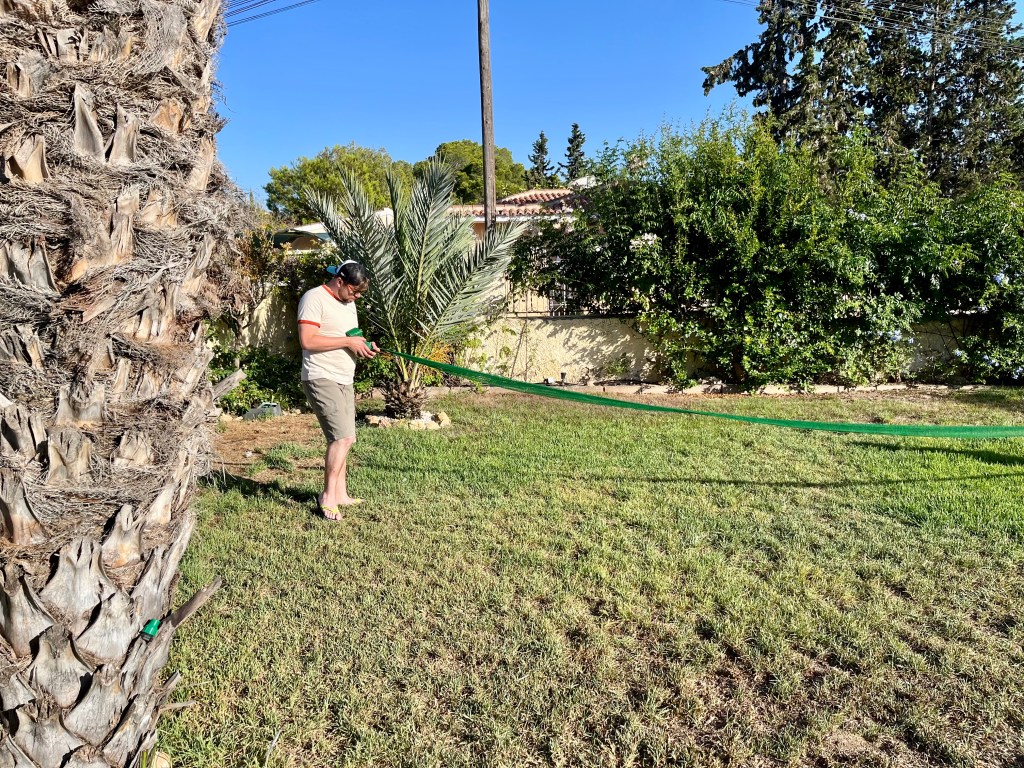
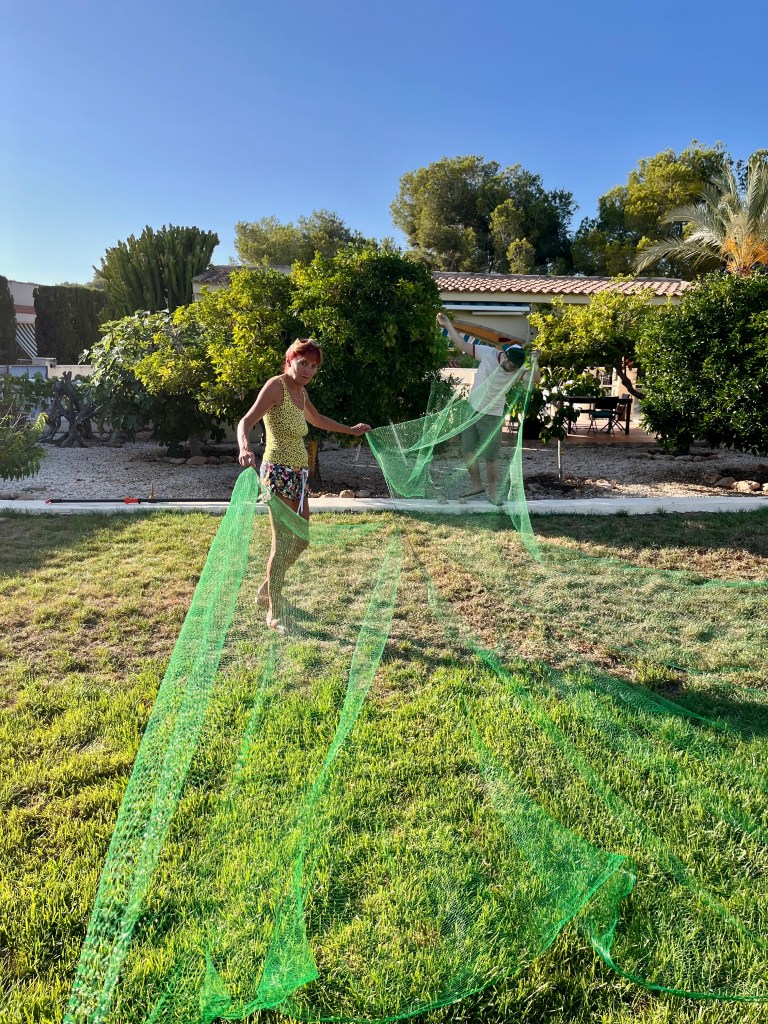
The first part of netting the big fig is to measure out and cut the amount of net needed. Once this is done you need to join together the two halves of the net as most nets are never wide enough to completely cover the tree. The photos below show Cruella and the idiot boy in action. I was in charge of strategy and Cruella decided it was too hot for the chickens and they should remain in the shade.
Cruella had already smothered them in sun screen
The photos below show the measuring out stage followed by the joining together stage.
The idiot boy trying to find the end of the netCruella waits patiently He eventually found itFor some strange reason he started to dance
The next stage is hauling your net over the top of the tree without it becoming ensnared into the branches at the top. I have developed a technique over the years that requires two people to manoeuvre the net down the side of the tree whilst I hoist the middle of the net up using an extendable pole. The photos below show this process in action.
Cruella holds it all togetherThe big lift
The final stage is tieing your net down around the tree to lower branches. The photos below shows the idiot son in action tying in, followed by a triumphant photo of me.
5 years in the scouts and still can’t tie a knotPost netting cuddle for ElsaNone of this would have been possible without my technical,expertise
When we had finally netted and tied down the tree, Cruella insisted that we should have a party to celebrate her girls first time netting; I pointed out that they hadn’t done anything but she accused me of nitpicking or possibly a “hate crime”. Anyway the party photos are below.
This was the cabaret the idiot boy doing his ventriloquism actCruella insisted her girls are carried to bed after a strenuous day
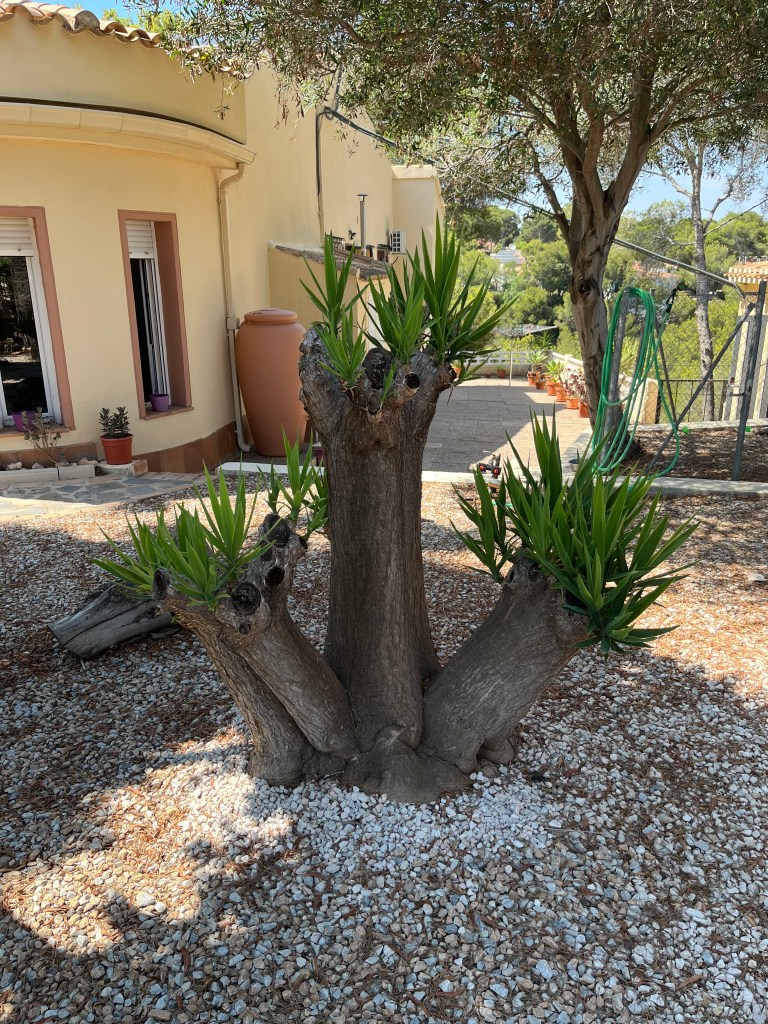
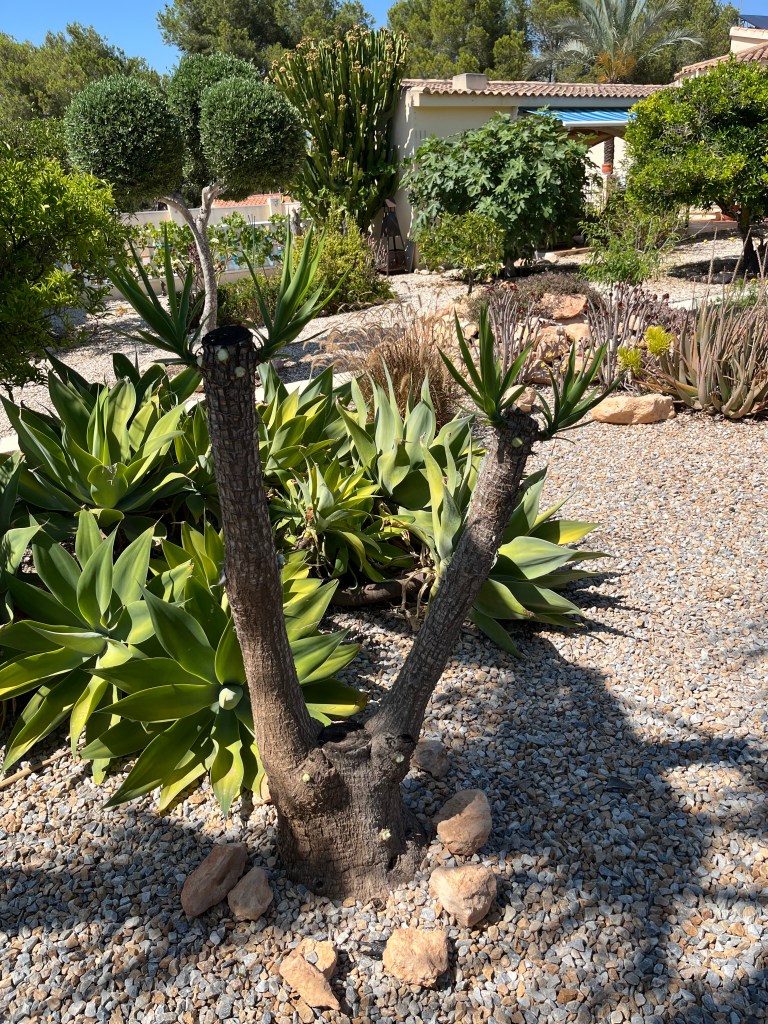
Styling Yuccas Those of you with Yuccas – and this means everyone in Spain – know that these can be useful, hardy, statuesque plants that can add height and interest to your garden. However once Yuccas get too tall or messy then they detract from your garden and end up looking like extras from those bad 1960’s westerns. It needn’t be this way. As Yuccas are canes they can be cut back and shaped to your desire and they will normally regrow from around your cut area.
Every 5 years or so I chop all my yuccas back to a manageable and interesting height. I then leave the cut plants for about 3 months or so till I start seeing regrowth. Usually there will be far more sprouting shoots than you require and some will be in the wrong place. All you need to do, is take your gardening knife, wander round the plant and choose the shoots that you wish to retain, those you don’t want just cut back cleanly where they join the trunk.
The photos below show where to prune and my various yuccas before and after their restyling. Click on each photo for a larger view.
Singing to orphans as I clear the potting bench
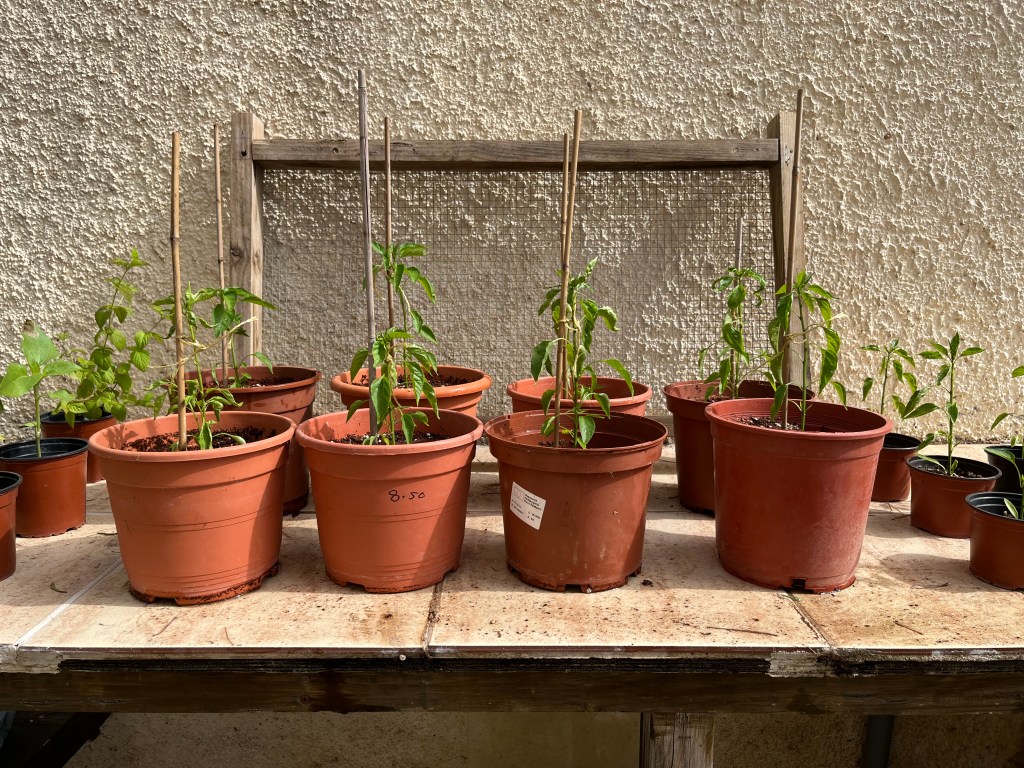
One of my saddest jobs as a gardeners is telling the plants that remain on the potting bench that unfortunately they won’t be going out in the garden. These are the orphans who have failed to be chosen, either because they are just not pretty enough or are just too immature. Now with the hot weather they won’t be able to be planted out.
I always start the talk the same way; I tell them they are “special”, and just because they haven’t been chosen doesn’t mean they can’t be happy. I talk about all their friends who are now growing in the garden and how they are getting on. Sometimes we cry, but that’s only to be expected, though I try not to break down in front of them.
I always end my talk the same way by telling them I have been proud to grow them, they haven’t let me down and God loves them for what they are. After my talk, and when everyone has dried their eyes, it’s on to the annual sing song.
This is my favourite part. I sit on the compost bin lid with my legs dangling over the edge and beat out the music to all their favourite songs. Mainly they like songs from the shows: Evita is one of their favourites as they like the drama. My absolute favourite is “Nelly the Elephant”, I bash this out really loudly and we all belt out the chorus. Cruella came round the corner and asked me why I was singing “Nelly the Elephant”. I explained it was our annual singing. She said “I didn’t hear any singing only you” I didn’t tell her you need a Soul to hear it.
Our finale is always the same song “The Sun will come out tomorrow” from the show Annie. It is always good to end on optimism. I kiss them all goodnight and slowly walk away. I postpone the compost bin till tomorrow!
I know this is a gardening blog, and most of you will have little sympathy for my current animal problems. But bear with me I haven’t been able to blog for weeks because I have been overwhelmed by non gardening issues. All of this has been caused by Cruella (my wife) heading off to our English house to oversee the purchase of a new house for the idiot son.
She took off about three weeks ago. It was bad enough that she scorched the lawn on take off (new broom problem), she also left me in charge of all the animals. Amongst other things I currently face the following problems.
Tango the lonely blind Labrador can no longer walk properly or get up from lying down. This means I have to lift up his back end whilst he scrabbles to get lift off from the floor. We then comically stumble outside me half carrying him whilst he trys to maintain his dignity.
The bees are making wonky comb in one of my hives and I can’t find the Queen. All the frames are stuck together and the bees have made a large wax football in their hive.
The chickens have become truculent and won’t go to bed at night. They are demanding to be carried to the coop individually and kissed good night.
Now do you see my problems.; but don’t worry I am still gardening furiously every day.
22nd June 2025. Things I have been doing lately.
Cutting back dead Iris
Feeding and scarifying the lawn
Gently trimming fruit trees
Potting up Chillis
Mistreating chickens
Cutting back dead Iris. It is all over this year for Iris and if you have followed my advice you will have deadheaded the flower head and left the stems to go fully brown. If you have, well done, as you are guaranteed lovely flowers next year from your replenished bulbs.
All you have to do now is give a good compost mulch over the area previously occupied by the Iris. This will replenish the soil and prepare it for your succession planting. I will be putting Petunia And some sun flowers in these areas.
It is important that you thank them for all their lovely flowers, wish them goodnight and a safe sleep and promise them that God willing you will see them next year. The photos below show the process of saying goodbye to the Iris for another year.
ReadySteadyGoA wonderful resting place . The bulbs reinvigorated and the stems get ready to replenish the garden next year.
Feeding and scarifying the lawn. I know not many of you have lawns in Spain but if you aspire to one, this is what you need to be doing now.
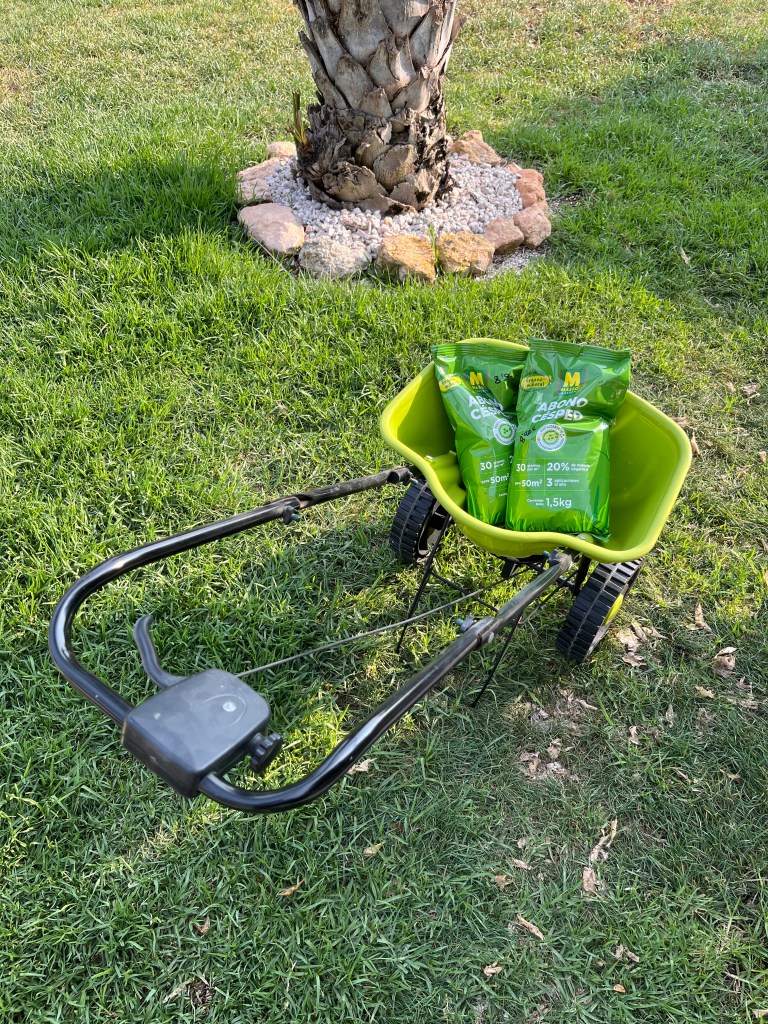
Firstly, set your mower on the very highest setting and don’t be tempted to bring it down till October. If you cut your lawn too short it will undoubtedly get scorched in the summer heat. Next you may need to give your lawn a very light scarifying with a rake. This is not the big winter scarifying and you should not use a machine. The aim is to stop any thatch developing and inhibiting new growth. Finally give the lawn a feed. The photos below show the process.
Gently trimming fruit trees. Trimming fruit trees is a controversial topic at this time of the year. Some gardeners would balk at the fact that you may lose some setting fruit. But hey ho we rogue gardeners don’t mind pushing the gardening envelope.
The basic idea is that all the old fruit is more or less off your citrus trees, you now have two main jobs. Taking off any suckers and opening the centre of the tree up to let in light and air. If you look at the two trees below you can see the problem. Their centres are congested and they have branches that are too high to properly pick fruit. Click on each photo for a larger view.
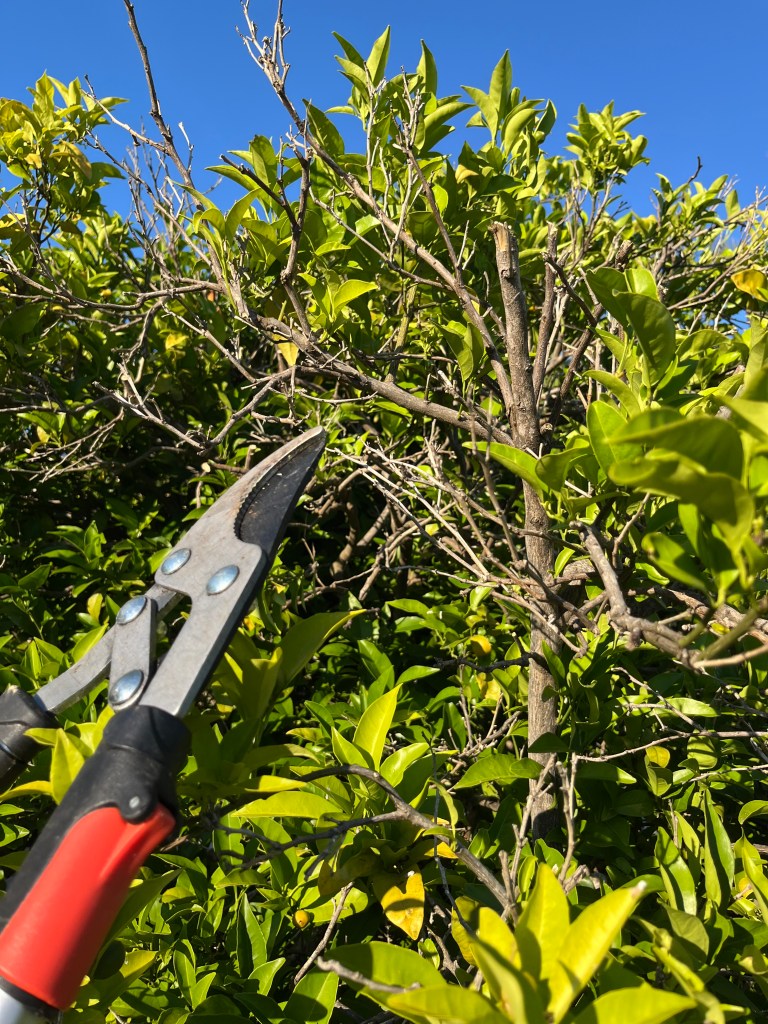
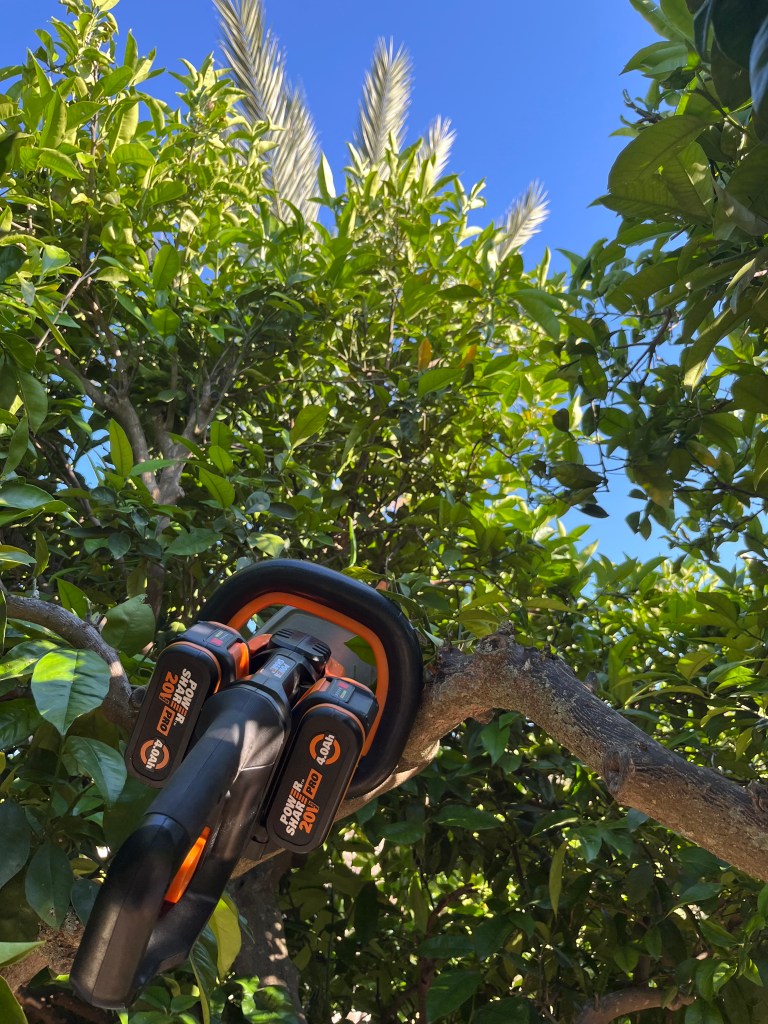
The first thing to do is open up the centre using a hedge trimmer or shears/lopers. The process is shown in the photos below and the outcome.
The sky 1The sky 2
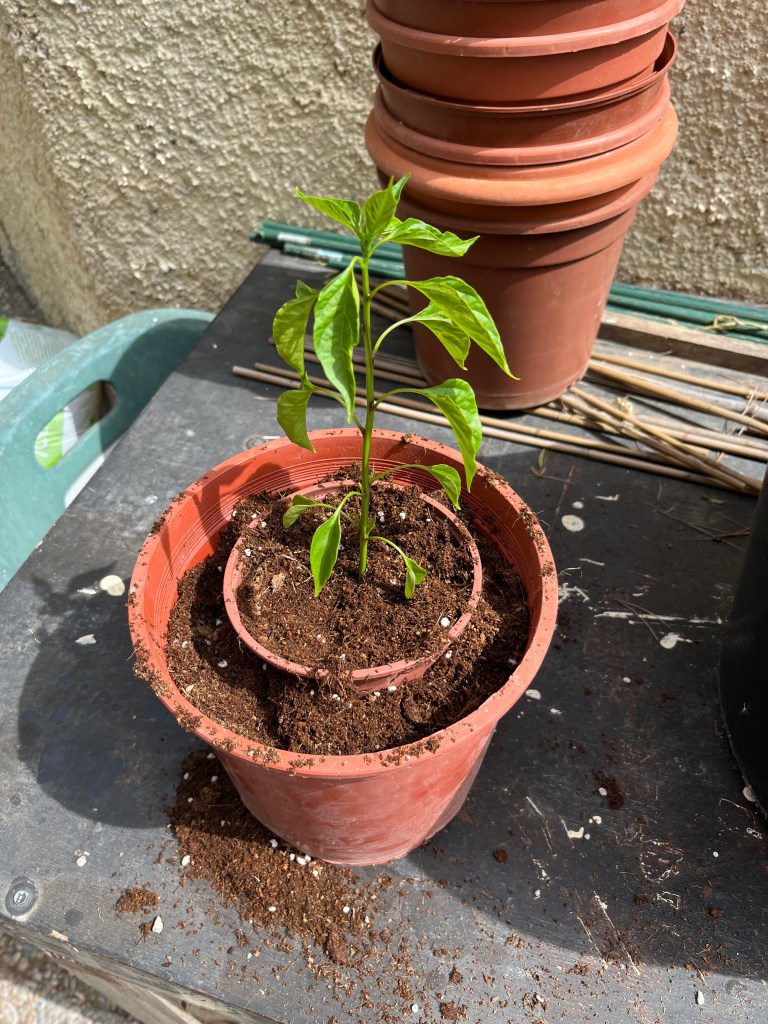
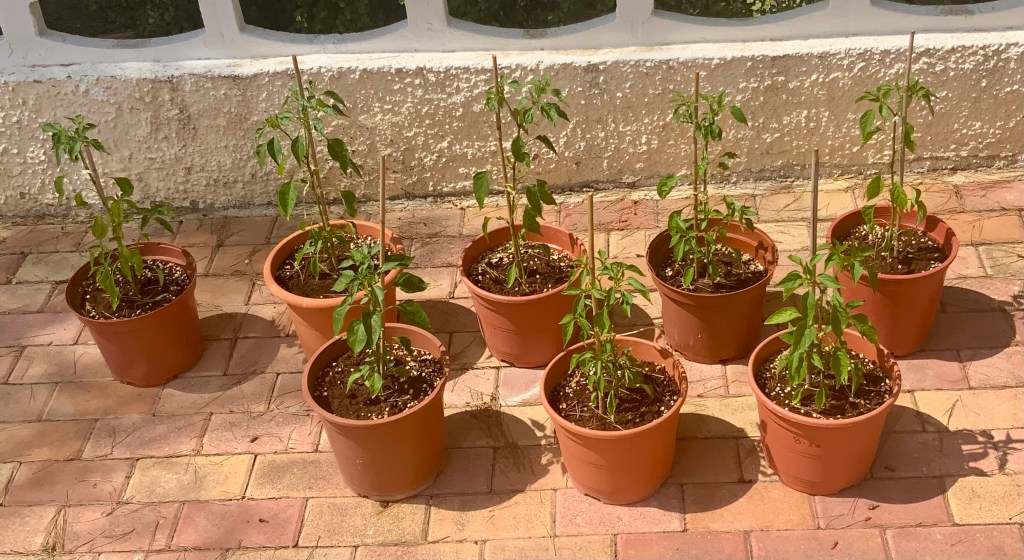
Potting up Chillis. The process of potting up seedlings is the same whether it is Chillis or otherwise. So if you haven’t grown some Chillis this year (although they are easy to grow from seed), don’t worry just apply the technique to all potting up. See description and photos below.
Place your plant inside its existing pot into the larger pot then back fill with compost. In this way you will prevent root disruption.
Once you have backfilled the new pot, ease the plant out of its old pot and gently firm it into the plant shape hole in the new pot.
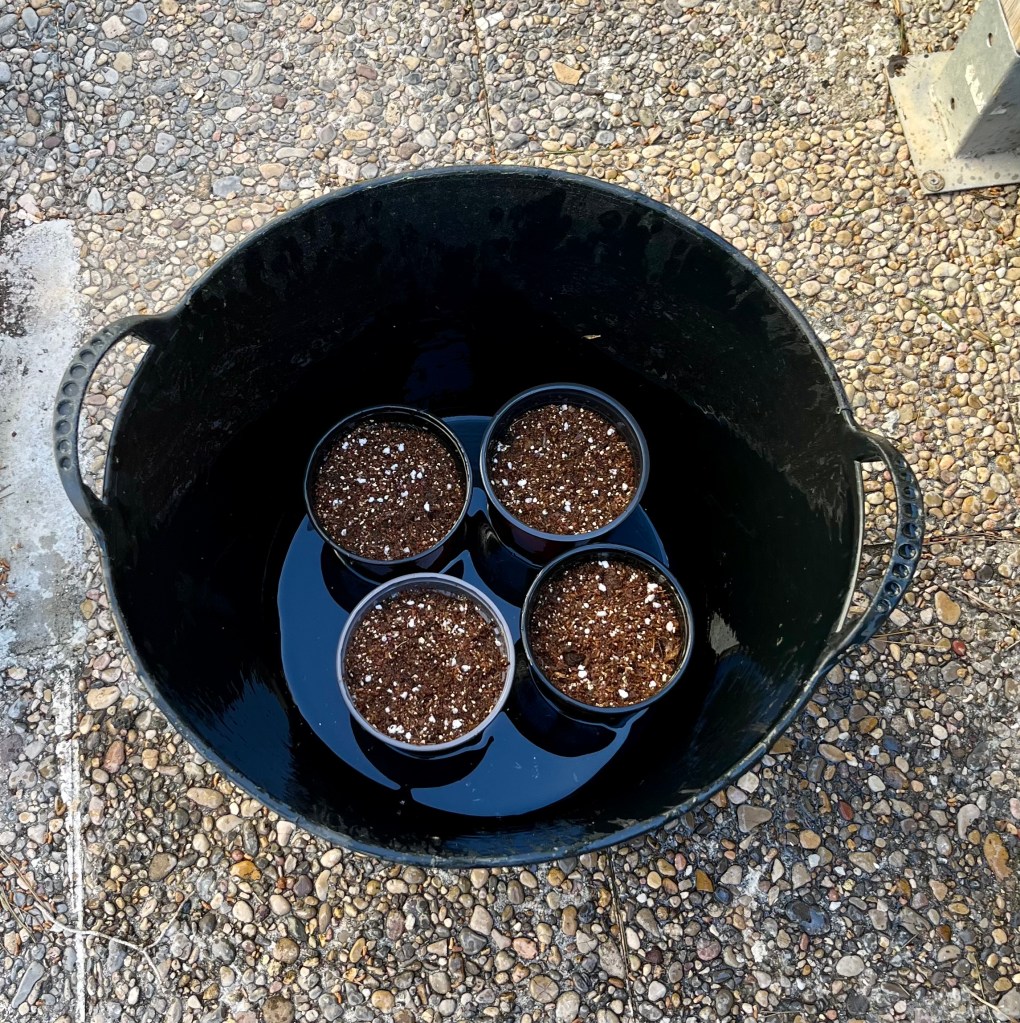
Water the pot by standing it in a trug so that it can absorb water up through its roots.
If necessary tie the new plant up to a cane. Always tie in a figure of 8. First around the cane then loop around the plant this stopes the stem rubbing on the cane.
Stand the pot in the semi shade for a day or two, then get it out in the sun.
Note the figure of 8At least a year of Chillis
Mistreating chickens. At the start of this post I mentioned my chicken problem, it all comes down to the fact that they won’t go to bed in their coop at night, instead they insist on sleeping in a big huddle just outside the front door on the Naya.
When I told Cruella (my wife) about the problem she told me I was mistreating them and that they had to be carried to bed individually, sung to and then kissed on the head before being put gently into their place in the coop. I of course demurred and have developed my own technique.
This involves two stages. At dusk, when I find them in a huddle just going off to sleep, I brush them all awake by nudging them with a broom. They all then start to panic and run around I pursue with the broom and guide them all into the coop.
After dark, they have then formed a huddle by the door of their coop and are fast asleep. I then grab them one by one and stuff them through the coop hatch. I start with the largest all the way down to the smallest and as I push them in they fit together like one of those Russian dolls. The photos below show my technique.
The huddleMy response, the broomThe dusk chase down. My approaching shadow installs terror before I stuff them up one by one.
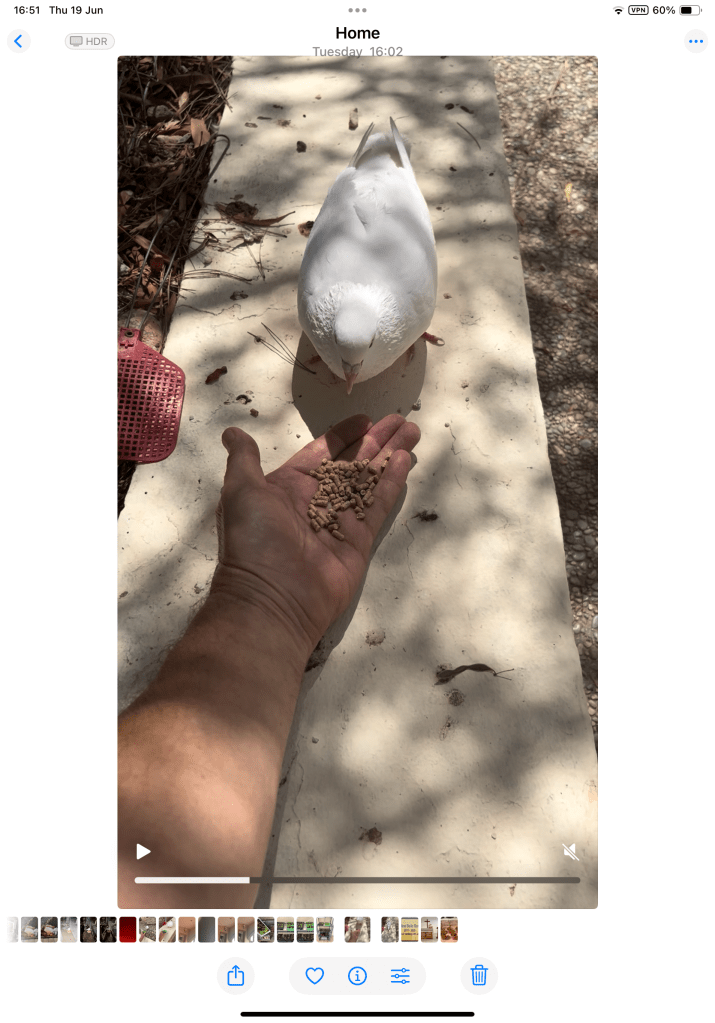
But don’t worry, I am not an insensitive beast; just to prove it I have taught the little white Dove to eat out of my hand.
I know the above title is a bit confusing, but all will become clear later. But in the meantime you need to be continuing to plant seeds and now you can also begin to take cuttings from your strongly growing perennials. Take action now, or you are doomed to continue buying expensive plants from Garden Centres which in many cases die within a few weeks. In the meantime I am getting ready to welcome my bees! and getting on with the gardening.
10th April 2025. Things I have been doing lately:
Treating for Palm Weevil
Finishing patching the lawn
Starting my plant feeding regime
Taking cuttings
Pricking out seedlings
Getting ready for my bees
Treating for Palm Weevils. The dreaded Palm Weevil has started flying now that the weather has got better. This large beetle lays its eggs mainly in Phoenix Palms and the subsequent grubs munch the trees to death. You should not be cutting your palms at this time of year as the beetle can smell a cut palm from a long distance. The photo below shows some of my many palms cut by a professional Palmista before the beetles were flying.
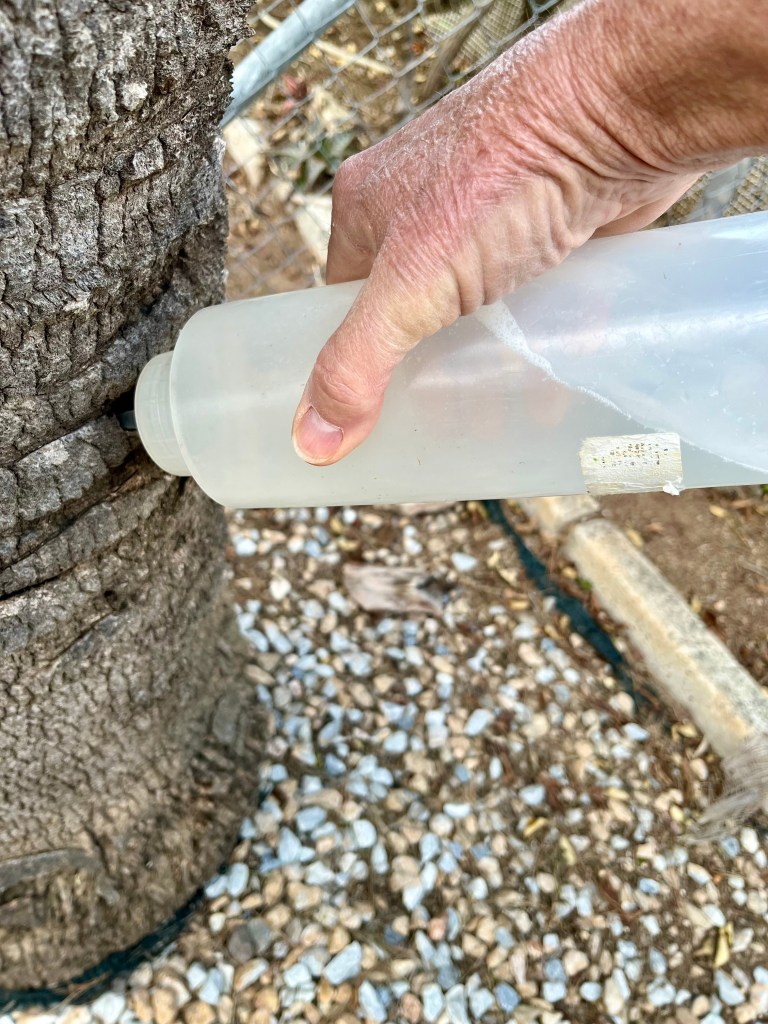
Because my palms are too large to treat at the crown I developed a different method of delivering chemicals to the crown. This involves drilling a hole diagonally half way into your palms trunk. Fill the resultant bore hole with proprietary weevil killing chemicals, and allow the sap to take the chemicals up into the crown and infuse all the fronds with killer chemicals. One nibble of your palm and the beetle is dead.
This is a simple method that once in place will ensure your palms are beetle free. All you need to do is keep topping up the chemicals every month or so, and once a year poke a steel rod in the hole to keep the scar open and stop the tree calcifying it over. The photos below show me in action.
Clear the bore annuallyPour in the chemicalsSeal the hole with stopper
Finish patching the lawn. If you have a lawn then now is the time to do any last minute reseeding on bald patches. I don’t know why I bother really, my lawn is now just a chicken playground. But anyway, if your lawn needs patching up just scratch and scarify the bald part. Add some top dressing. Then sprinkle some grass seed and cover with fleece. Keep the area moist and the warmth of the earth should do the rest. The photos below show my efforts.
Scarify and top dressThe seed I useA patchwork lawn
Start your plant feeding regime. You should have already started your citrus feeding routine, and now is the time to start feeding other fruiting trees and shrubs. Don’t be tempted to think one size fits all, and that you only need a general purpose feed. Yes, a general purpose feed will do no harm, but it will not contain specific nutrients that are targeted at different plant types.
The photo below shows the variety of different types of feed that I use. In addition each watering can gets a “Glug” (old English term) of iron.
Taking cuttings. If you have a favourite plant, or just want to multiply your existing stock of plants for free, then now is the time to take cuttings. The cuttings you take now can be allowed to develop over summer on the potting bench, ready to be planted out in the autumn.
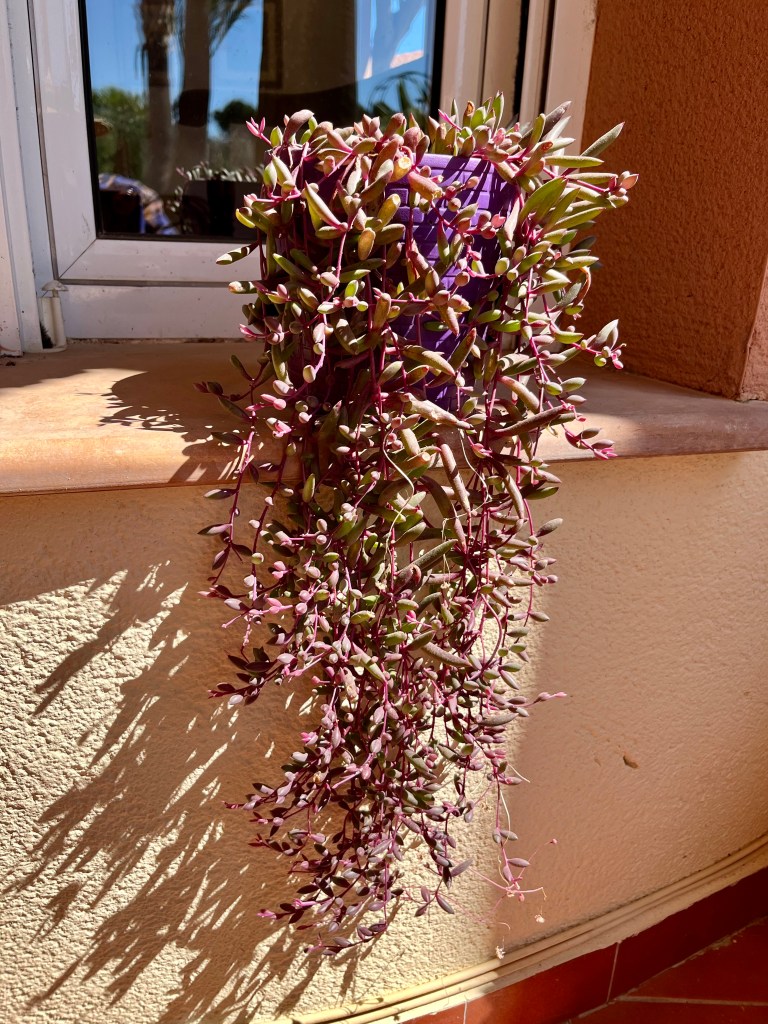
My first cuttings have been taken from Dianthus, Trailing Lantana and Little Pickles. See photos below.
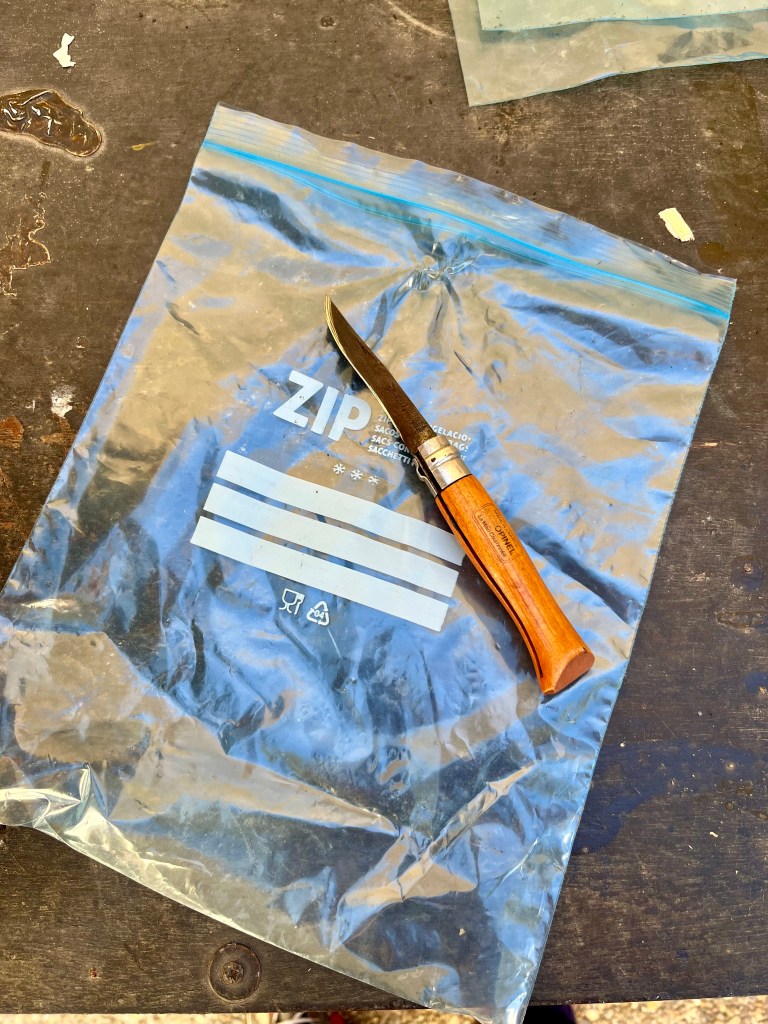
An easy way to take cuttings is to go around with a sealable plastic bag and your pruning knife (never secateurs as they crush stems) and select non flowering stems. Take at least three cuttings from each plant by cutting just below a leaf or growth node. Place your cuttings straight into your bag to stop them drying out as you wander round.
Once you are back at your potting bench, make sure you have the following to hand:
good free draining compost with added vermiculite
a selection of sealable ziploc plastic bags (available in every supermarket)
short pieces of can cut to about six inches
rooting hormone powder or liquid (not essential but helps)
Fill 4 inch pots with your good free draining compost, water them well, and tamp down the compost to remove air pockets. Take your cutting, remove all leaves up till about the top two, holding your cuttings by the leaf, dip them into your rooting compound and then place gently into pre prepared dibber holes around the side of your pot (3 or 4 to each pot).
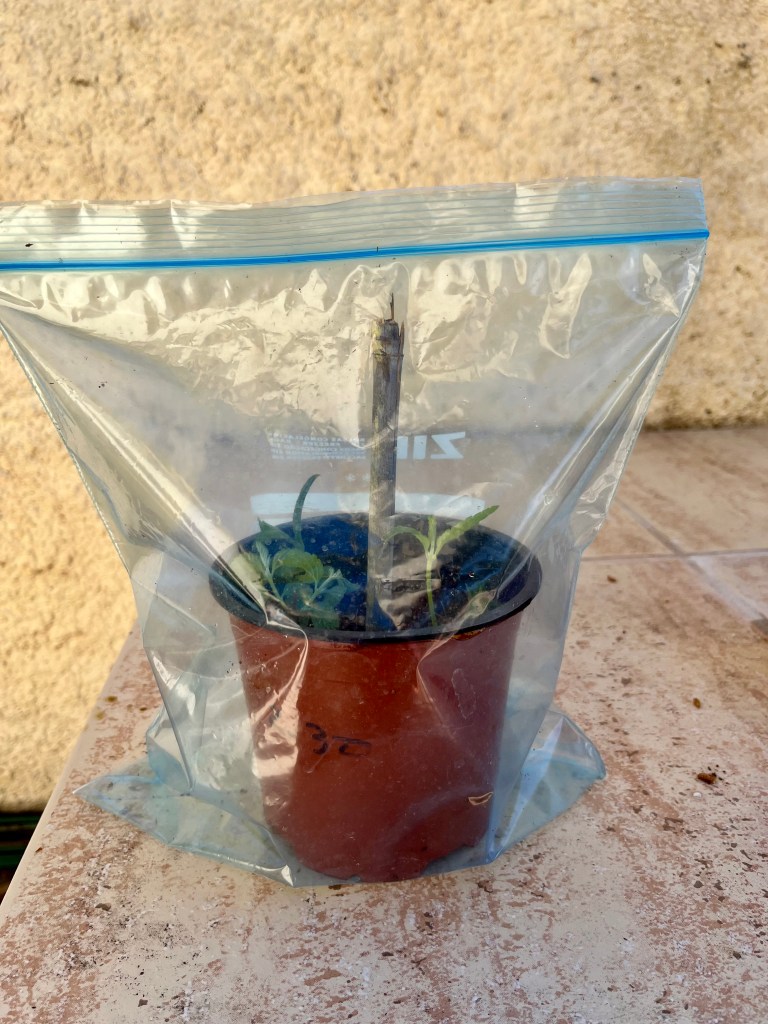
Push your little cane right into the centre of the pot and then seal the whole pot into your plastic ziploc bag. The cane will stop the plastic bag collapsing onto your cuttings and starting rot. Place your pots in the shade and leave them alone. They will have a mini micro climate so will not need watering till they get some roots and new growth. It is a good idea to open the bags every 3 days or so just to refresh the air, but only for a moment don’t leave them open. I like to breathe into them as I think a dose of Co2 might help! The photos below show the process.
Pricking out seedlings. You will remember in my last post that I have been sowing seeds. This should be a regular feature of every gardeners calendar whether you have a huge plot or a small terrace. The joy of growing seeds and seeing them developing is an essential part of being a gardener. Don’t be lured into huge garden centres to buy, at great expense, plants that you could easily grow yourself. Any way enough of. My ranting.
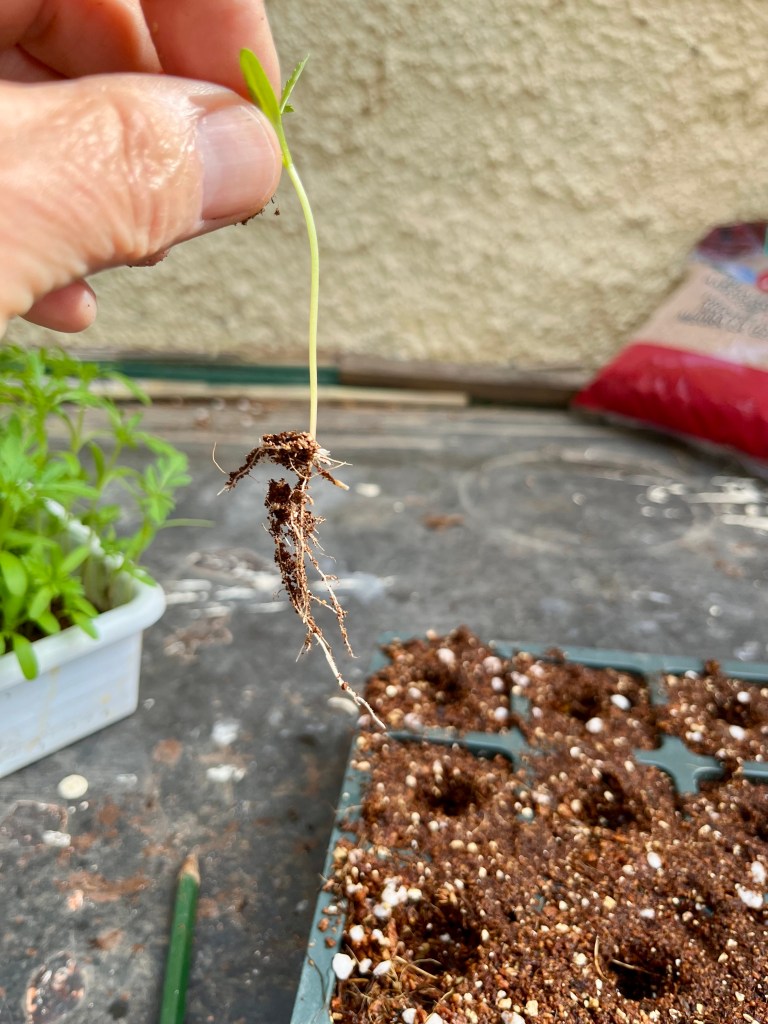
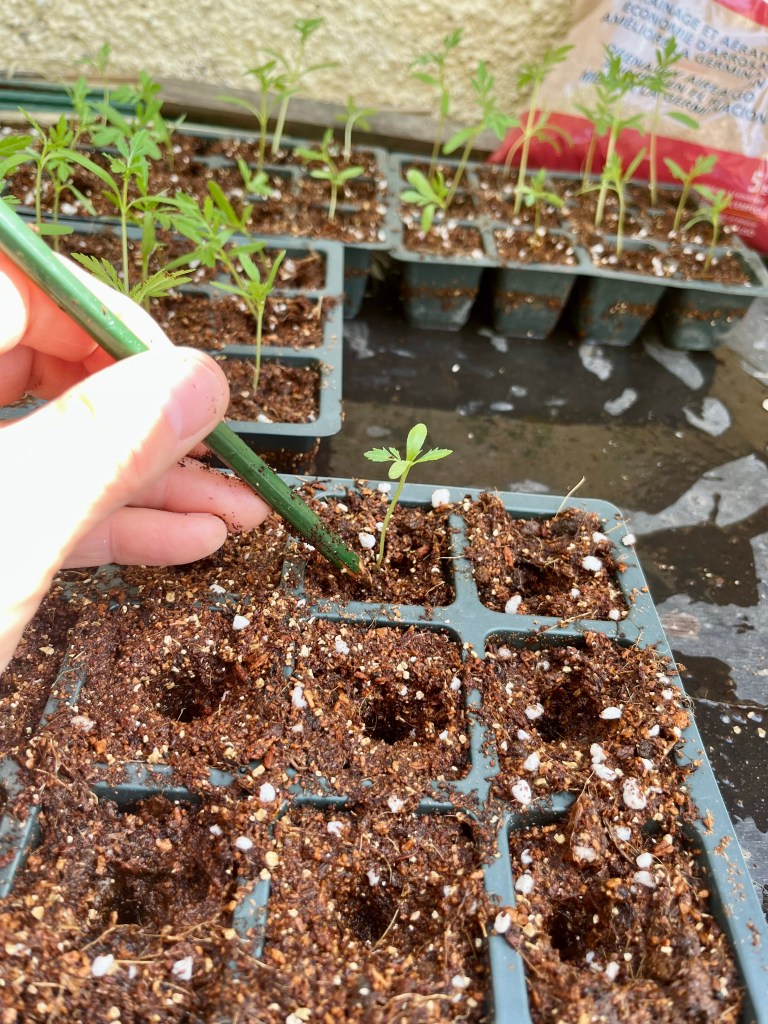
When seeds have sprouted and have at least two “true leaves”- discount the first two leaves and wait till there at least four or more. Then It is time to “prick out”, cue laughter, stop it. When you prick out seedlings you are basically easing them out of their seed tray and replanting them in individual modular plug trays to give them more growing room.
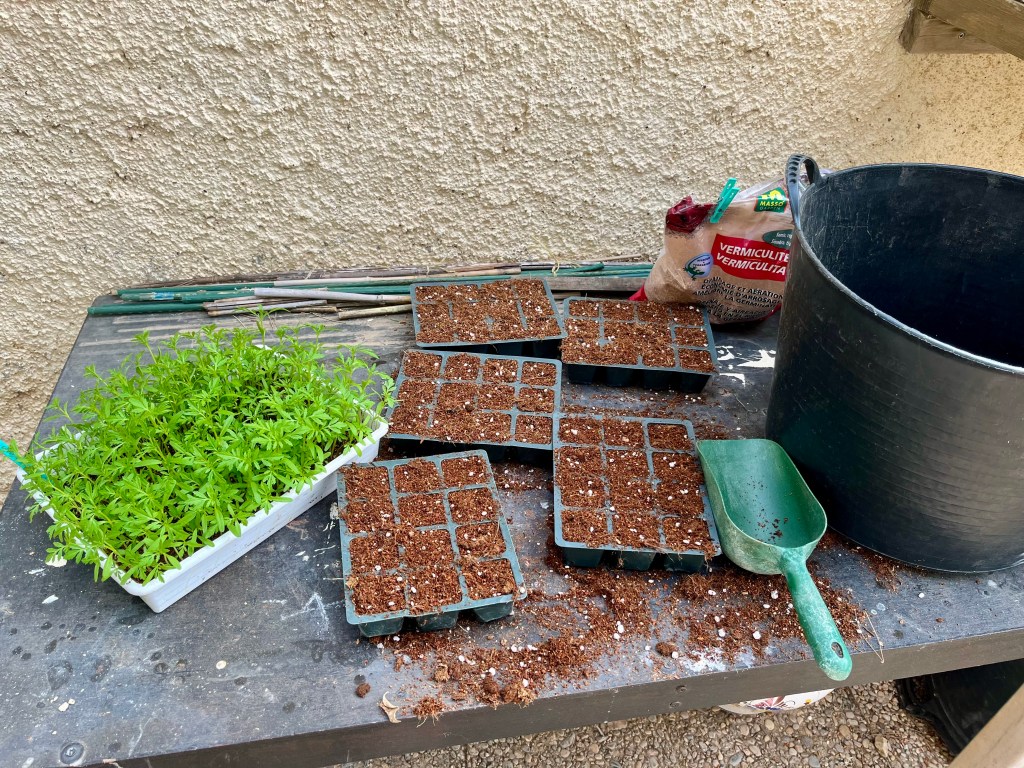
I use a pencil to gently ease out a group of seedlings, then separate them and holding them by a leaf ( if you hold them by the stem then you may damage the seedling), I carefully transplant them into watered and prepared plug trays. This can be quite an intense process so I tend to do it over a couple of days. Once the seedlings are rehomed, then keep them out of direct sun in a sheltered spot until they settle in and then gradually accustom them to direct sun. The photos below show the process.
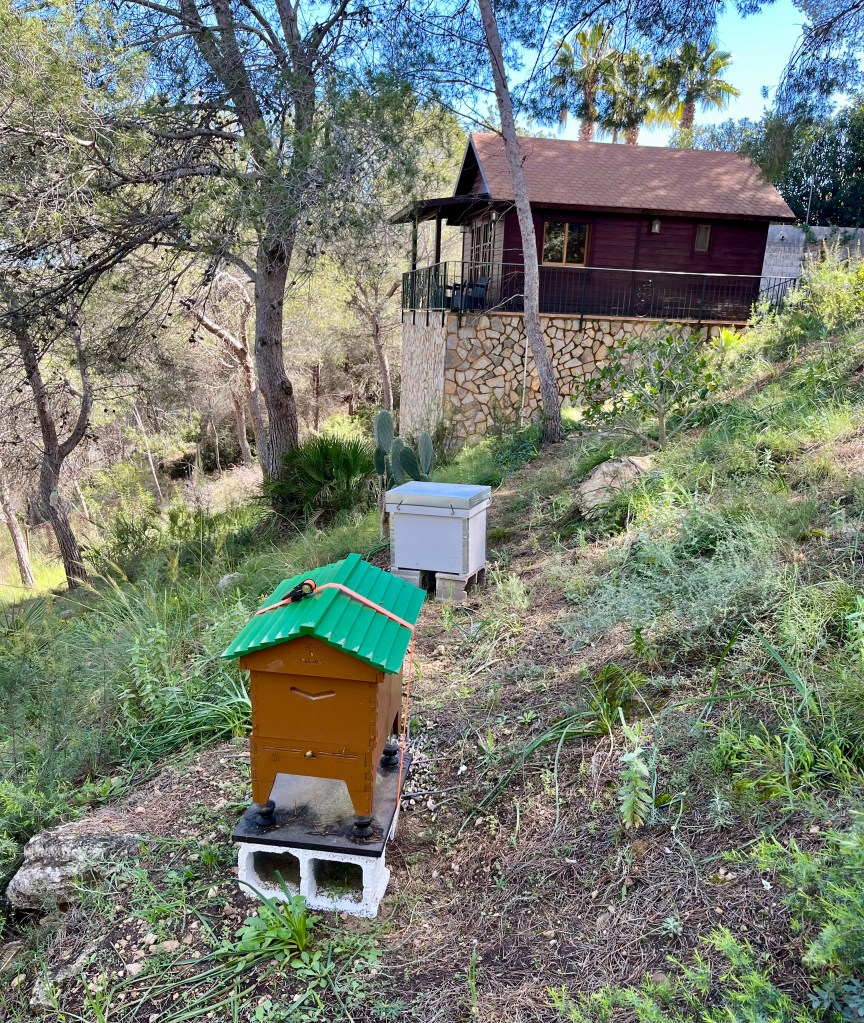
Getting ready for my bees. It has been a year in the planning but my bees arrive later this month. I will be setting up two hives which will be a wonderful addition to my garden. I have been taking an online bee course, I have watched numerous YouTube videos and I am as ready as can bee (sorry about the pun). The photo below shows my hives ready for occupation.
Cruella wants to turn our guest cabin (in the background) into a clubhouse for all her 20,oo4 girls
When I told Cruella (my wife) that bees are mainly female she became quite animated and said that her girls would prepare a welcome party to help the bees settle in. I explained that wouldn’t be necessary but she started rambling about girls leaving home and the need to feel welcomed she eventually ended up calling me an unfeeling chauvinist and shouting girl power slogans at me.
Anyway the outcome is that she and her chickens. have been preparing banners and posters to welcome the bees, they have even started knitting little sweaters as gift as for the bees for them all to wear for the welcome barbecue. I will keep you informed of how it goes when 20,000 bees meet 4 chickens and Cruella.
The big winter cutback continues, and this post covers the main jobs you should be doing in your garden right now. Remember, don’t delay as growth will start in late February and you will have missed the window to prepare your garden for summer.
All is going well with my cutback and I have managed to find a use for the chickens in the garden; Cruella (my wife) is not impressed. Anyway, this is what I have been up to:
19th January. Things I have been doing lately:
Pruning figs safely
Pruning grapevines
Cutting back ornamental grasses
Pruning figs safely
Mulching with chickens
A well maintained fig tree is a joy: it not only looks good, but it provides you with hundreds of juicy figs. Unfortunately the majority of figs trees in gardens in Spain are large bulky behemoths that are far too big with fruit that is impossible to reach. Maintaining your fig tree is simple. If you have a young fig tree (less than 7 years old), then just prune to keep the tree trim and with an open centre. If however you have a large tree, or one that you want to keep manageable then I would recommend pruning to a “pollard”. When pollarding you take the tree right back to a few key branches then let it grow annually from these knuckles. Unfortunately you may lose fruit for the first year, but thereafter it will be much better.
I have two fig trees one that is pollarded and one that is espalied. The photos below show both trees when they are in full leaf. Click on each photo for a larger view.
The important point to remember when you are pruning figs is that they will weep a very caustic sap from their pruning wounds so you must not attempt to prune until January or February when the sap will have returned to the roots. Even then it is best to wear a long sleeve shirt, gloves and eye protectors.
The photos below show both of my figs with their leaves off and safe to prune.
The large free standing tree was pollarded a few years ago so all that I need to do is to take back this year’s growth to the knuckles. Using lopers, and secateurs I cut everything right back to knuckle, but be careful not to take it right back or you will breech the “collar” of the branch where the next growth comes from. Leave a centimetre or two.
The first photo below shows the structure of the knuckle, the second shows a knuckle pruned, and finally the tree cutback for another year and ready to burst into leaf in about a month.
Pruning the espalier tree is different. I want this to grow along the wall on the wires that I have trained it. So the main stem I have stopped growing and want no more upward growth. Neither do I want growth at the back against the wall, or any growth that goes to the right, as I am espaling to the left. In this case I trim all the side shoots back to the lead branches. The end result is shown in the photo below.
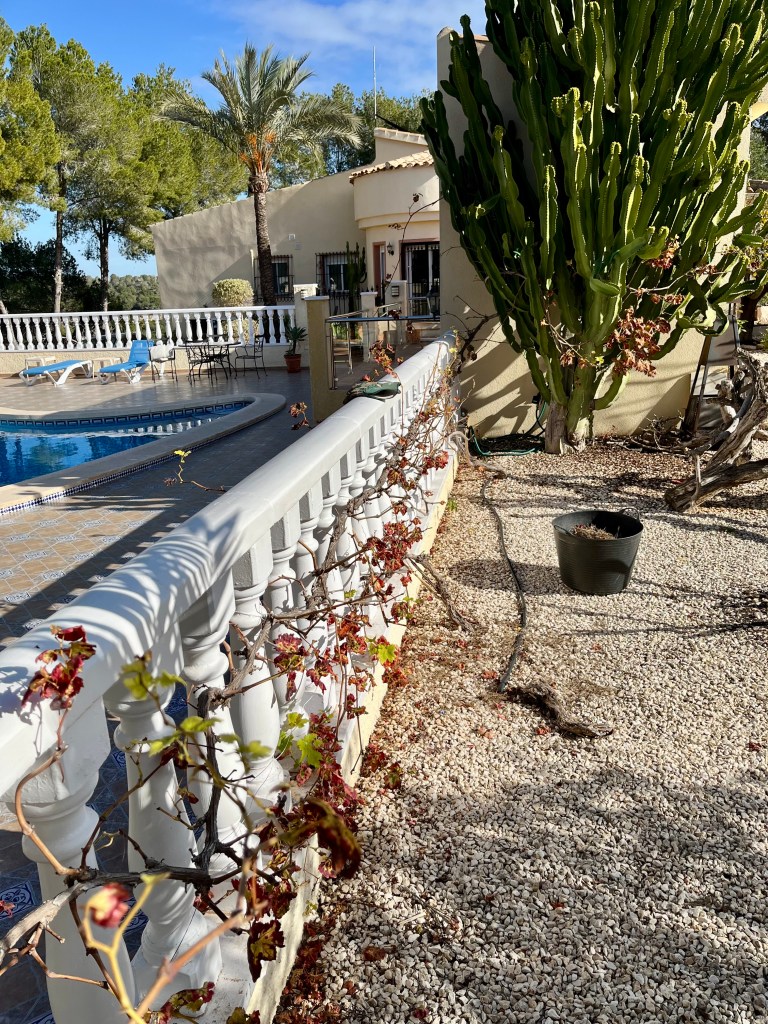
Pruning grapevines. Pruning grapevines is very similar to pruning espalied figs. You need to take all the side shoots away and take everything back to the main vine. I have three grapevines. One grows along the front of the house and is mainly ornamental as it gets mildew each year because of its position against the wall. The others grow along wires attached to balustrades and therefore have lots of air flow and ventilation. See photos below. Click on each photo for a larger view.
In each case I just move along the main stem taking out any side shoots and taking everything back to the one strong vine. The photos below show the vines pruned. You may be interested to note that I am using the large Euphorbia at the end to grow the vine through, hopefully this will be a nice feature in a couple of years.
Cutting back ornamental grasses. You have to be determined when cutting back ornamental grasses. You might think “well they don’t look too bad let’s leave it this year”. But if you are lenient then this years growth will soon fallback into a matted mess, that will not only look untidy, but will hinder this years new growth.
Cutting back grasses is simple, just use your hedge trimmer or shears to cut right back to a small mound shape. The photos below show one of my my grasses before and after its trim. Click on each photo for a larger view.
Shearing Lantana. Lantana are a perennial favourite in Spanish gardens. It is a reliable and hardy shrub that produces a continuous flow of lovely little flowers all summer. I prefer trailing Lantana and these do not need much pruning, but to keep them in shape you should shear around the outside to keep them neat. The first photos below show my main Lantanas ready for a trim, whilst the second shows them brought back into shape. Click on each photo for a larger view.
Mulching with chickens. If you have a compost bin, (and if not, why not?), then now is the time to start mulching your flower borders and under trees with your compost. If you don’t have your own compost then buy some from a garden centre. The benefits of mulching is that you replenish the micro organisms in your soil and generally enrich and enhance your growing medium. The photo below shows my composting area with a full bin and one in the process of being emptied.
This is a gardening gold mine
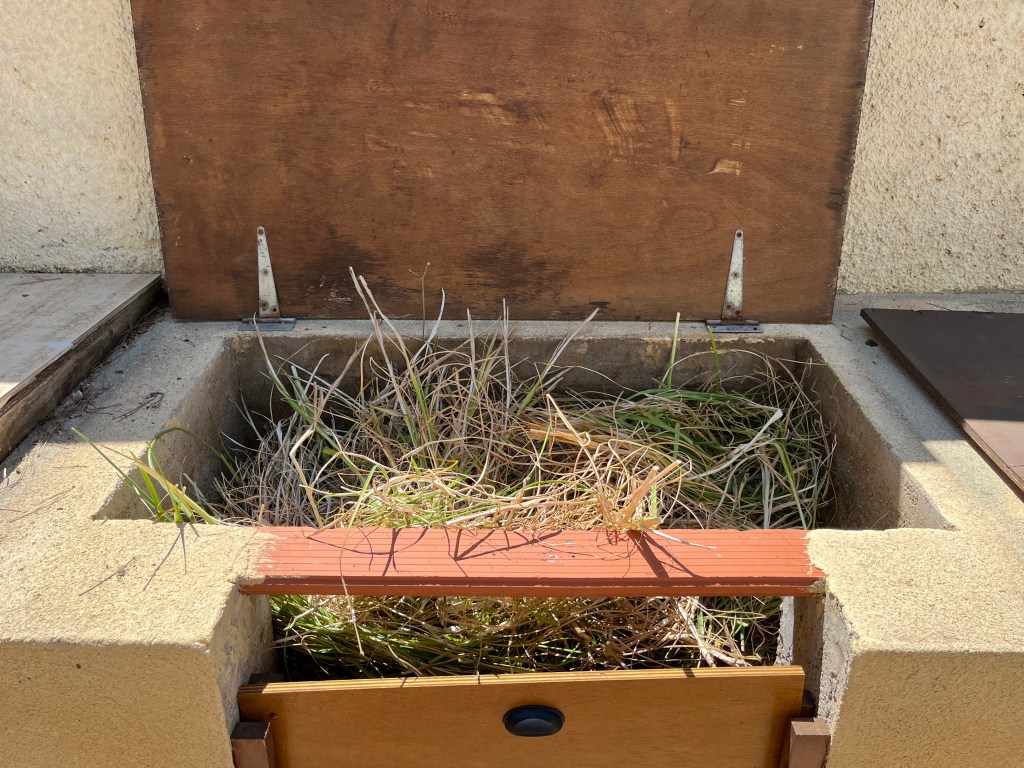
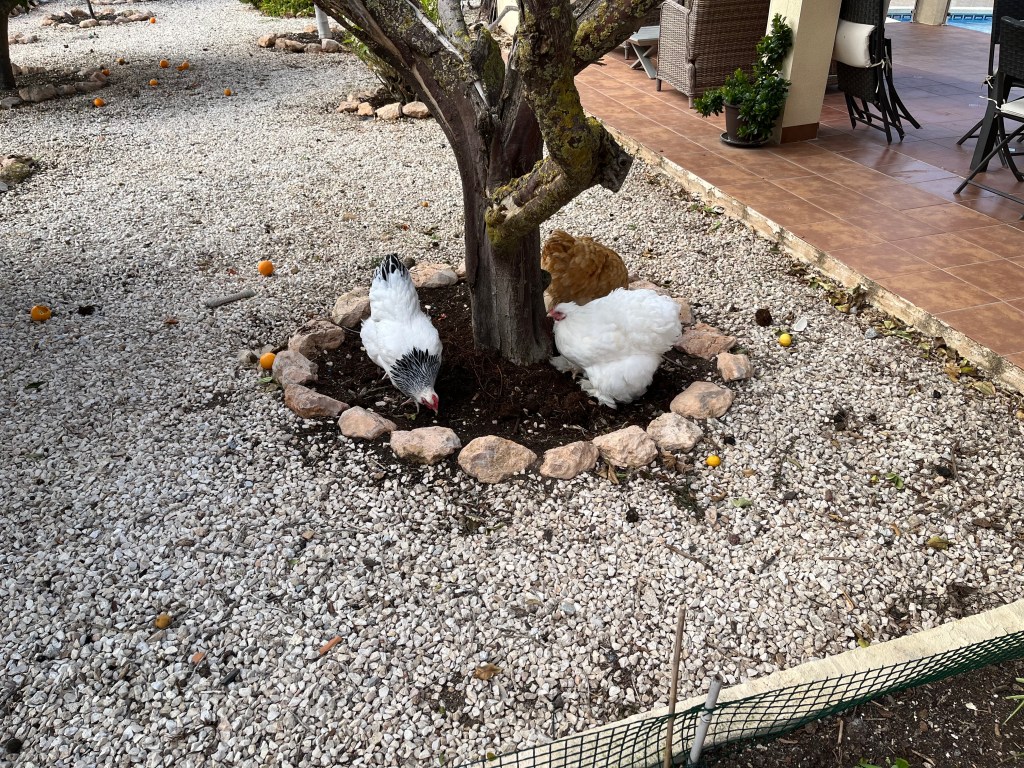
Normally I spread mulch under all my fruit trees, only to see the bloody chickens kick it all over the place. This year I had a great idea, instead of spreading the mulch I left it piled around the tree trunks and just as I hoped the chickens then spread it for me. The photos below show the chickens in action. Click on each photo for a larger view.
When I rushed in to tell Cruella (my wife) about my great idea, she said “you are exploiting my girls” and demanded reparations for slavery. I explained that they were enjoying it. Despite my explanation she stormed off furiously and called all the chickens together. Since then she has given all the chickens what she calls “slave names” and keeps muttering about the underground railway and heading north. As if all this wasn’t bad enough they have started chanting in chickenese what sounds like work songs. So far I can make out “Go Down Moses” and “Nobody Knows the Troubles I’ve Seen”.
Anyway the upshot of all this is that she demands I pay them a living wage. I agreed that they should benefit from their labour and promptly produced a plate of maggots from the compost. Cruella ran away screaming, but the chickens seemed pleased, if a little perplexed.
It’s warming up, there is a hint of buds and we gardeners are waking from our winter torpor, it’s almost Spring, and you know what Spring means – seeds! Yes, it’s time to start thinking about how you will fill your Summer garden with floriferous beauty, and there is no better way than to grow your own garden from seed. I know that lots of you love to rush off to the Garden Centre and stack your trolley high with all sorts of unsuitable plants. But think how much more fulfilling it will be if you can grow your own garden.
Now I am not being a purist, of course you can buy plants, but why not give seeds a chance (start with a couple of easy to grow packets) once you start it is addictive and may I say a lot cheaper. As you can tell from my enthusiasm I have already got things underway. I was so filled with the joys of gardening that I rushed out and got Cruella (my wife) a Valentines Day gift. Sadly it all went wrong as the chickens deliberately sabotage my efforts. Anyway on with the gardening.
24th February 2024. Things I have been doing lately:
Harvesting self sown seedlings
Sowing the first seeds
Harvesting and sowing Chilli seeds
Preparing for the death of Agave Attenuata
Regretting my Valentines Day purchase
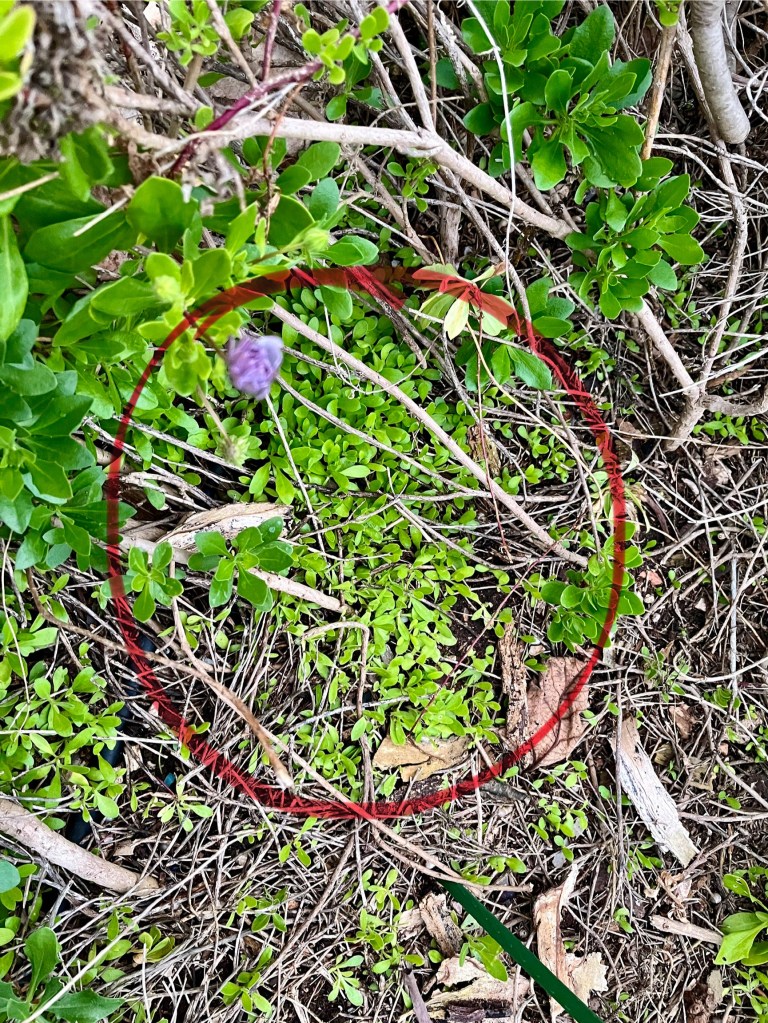
Harvesting self sown seedlings. One of the best way to get your garden going in Spring, is to take a look around your flower beds and check for any self sown seedlings that your summer flowers may have left you as a gift. One of the most prolific self sowers in Spain is the Maragaritte Daisy/Osteospermum. These lovely long flowering Daisies will drop hundreds of seeds which by now will have formed into little seedlings. The photo below shows just one part of my garden with thousands of seedlings.
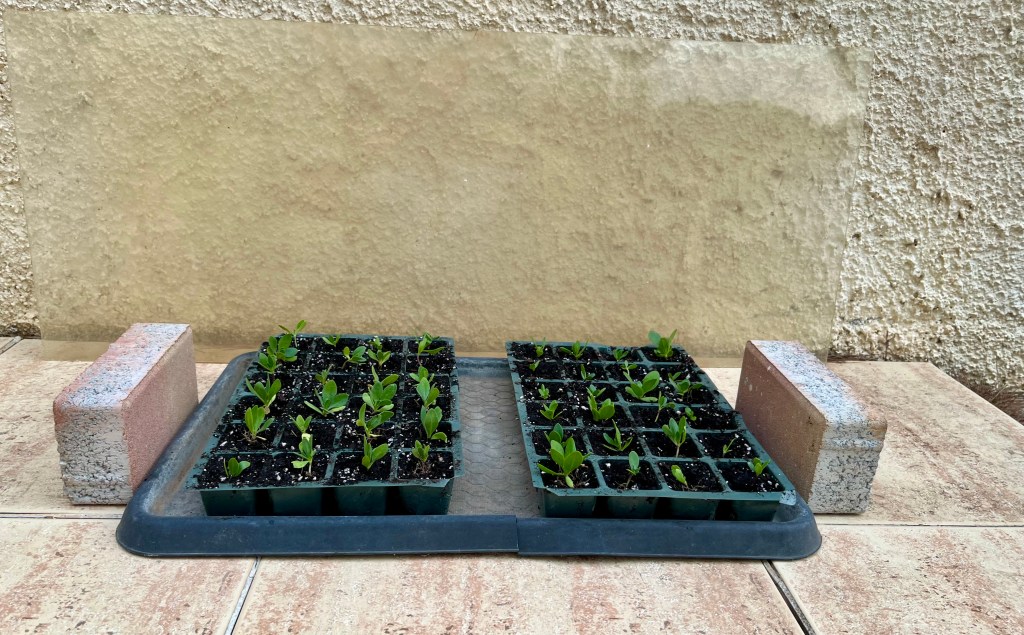
But the trick is not to leave the seedlings where they have self sown, instead you need to harvest them and pot them up to let them grow on a bit before planting them out where you want them. The photos below show me harvesting the seedlings by gently prising them out of the soil with a trowel before placing each seedling into individual seedling trays. Note the close attention from big Bertha. (she has reverted and is no longer known as Bert, it was something to do with the chest binders that Cruella bought from John Lewis). Click on each photo for a larger view.
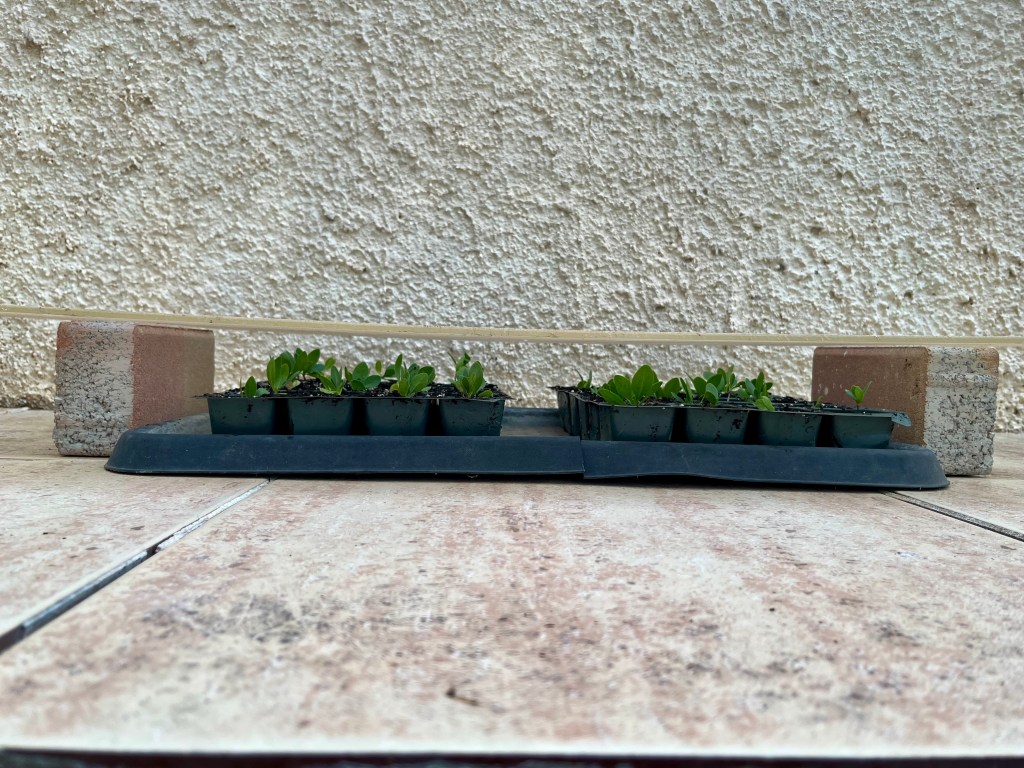
I have to cover the seedlings with glass as the Blackbirds will soon be digging
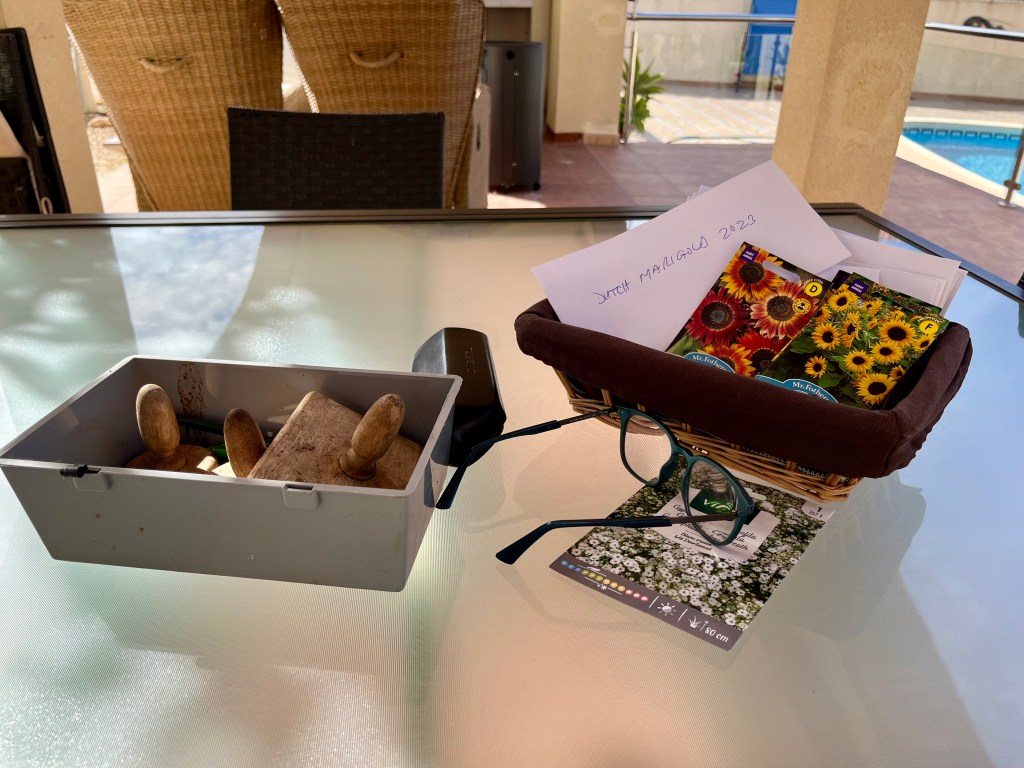
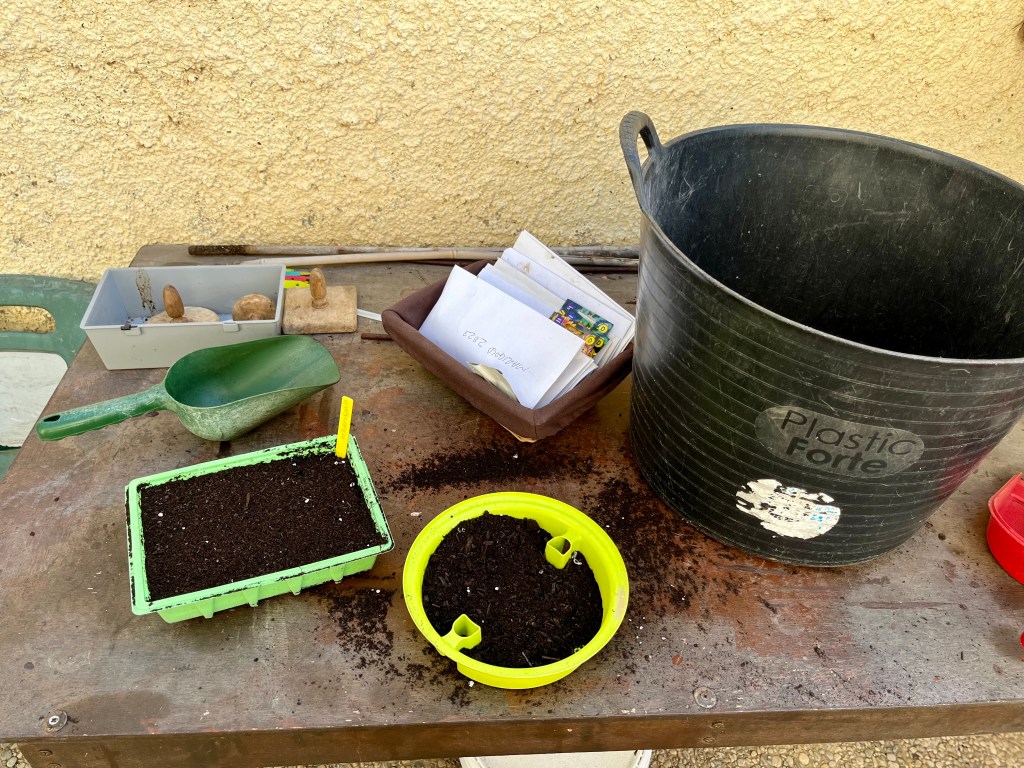
Sowing the first seeds. There is nothing better than contemplating the seeds you harvested from last year and deciding which order you are going to sow them. The photo below shows my preparations and the delight of contemplating things to come. Click on each photo for a larger view.
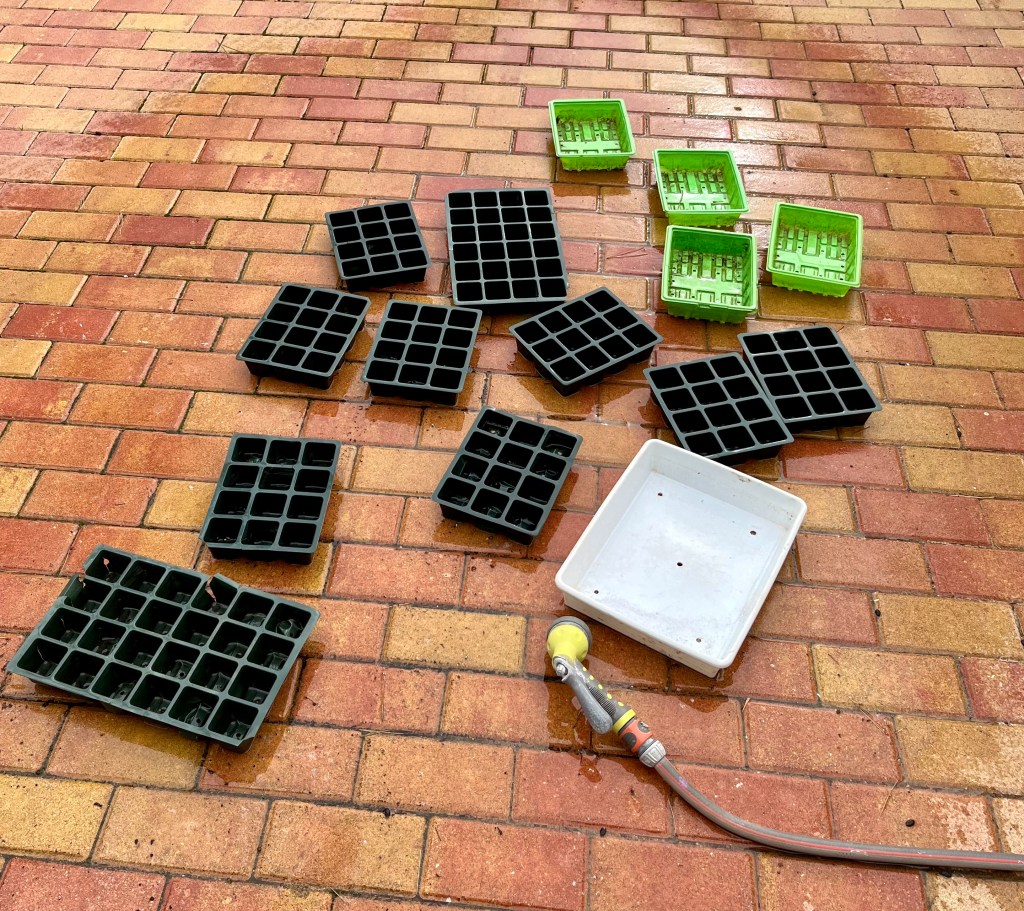
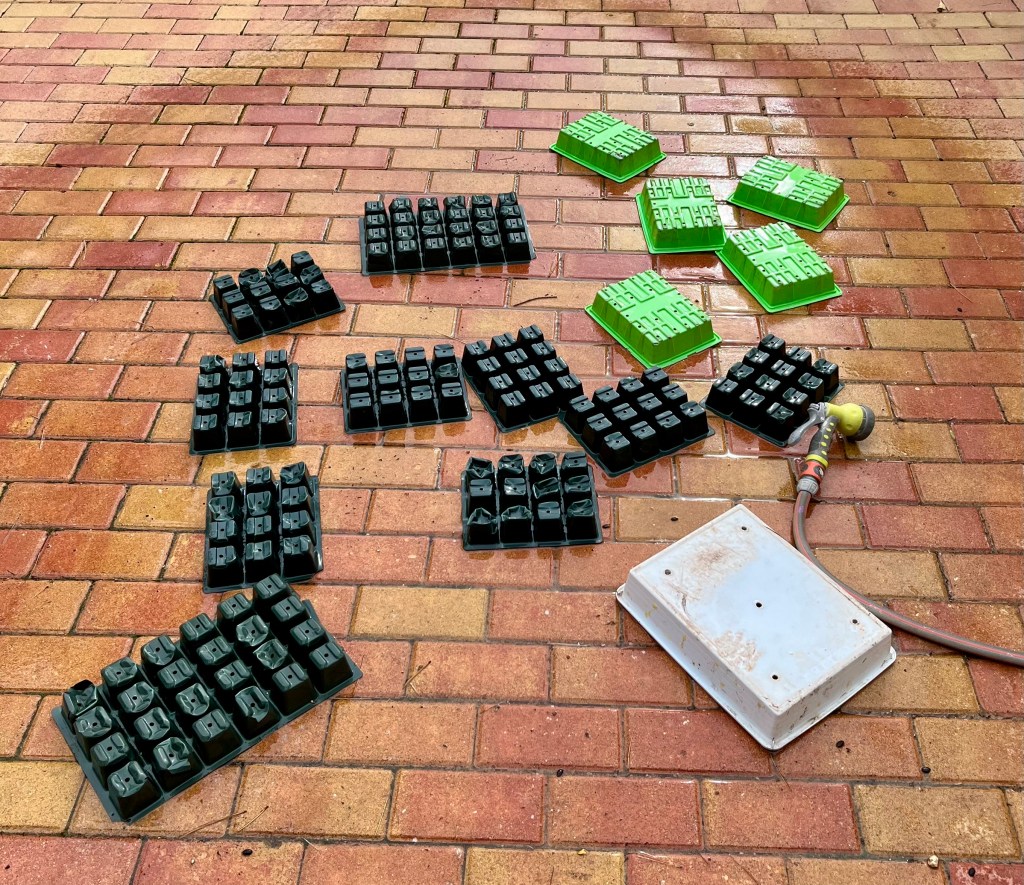
Before you get carried away with sowing seeds there is some basic preparation you need to undertake. If you are sowing into pots or seed trays you have used before, then it is important that you thoroughly wash them inside and outside. The last thing you want to do is carry over viruses and pathogens that are lurking in the residue of last year’s soil. All that is basically required is that you use a powerful hose jet to wash away any soil residue. The photos below show some of my seed trays after their annual ablutions. Click on each photo for a larger view.
insideand out
Once you are ready to sow your seeds then you need to mix a good compost (not from China shop) together with Perlite to form a nice free draining medium that will not leave your little seeds waterlogged. Most seeds mainly require sprinkling on the surface of your compost then covering with a light sprinkling of compost.
Once you have lightly tamped down the surface to ensure seed and soil contact, then you need to place your seeds trays in a light warm area such as a window sill, or greenhouse. Be careful of fierce sun as this will dry the compost out to quickly. I buy a cheap little mini green house and use it for 2 or three years and then discard and start again. You will only need it for a couple of months at the most. The photos below show my seed sowing activity followed by my seed trays resting in their new home. Click on each photo for a larger view.
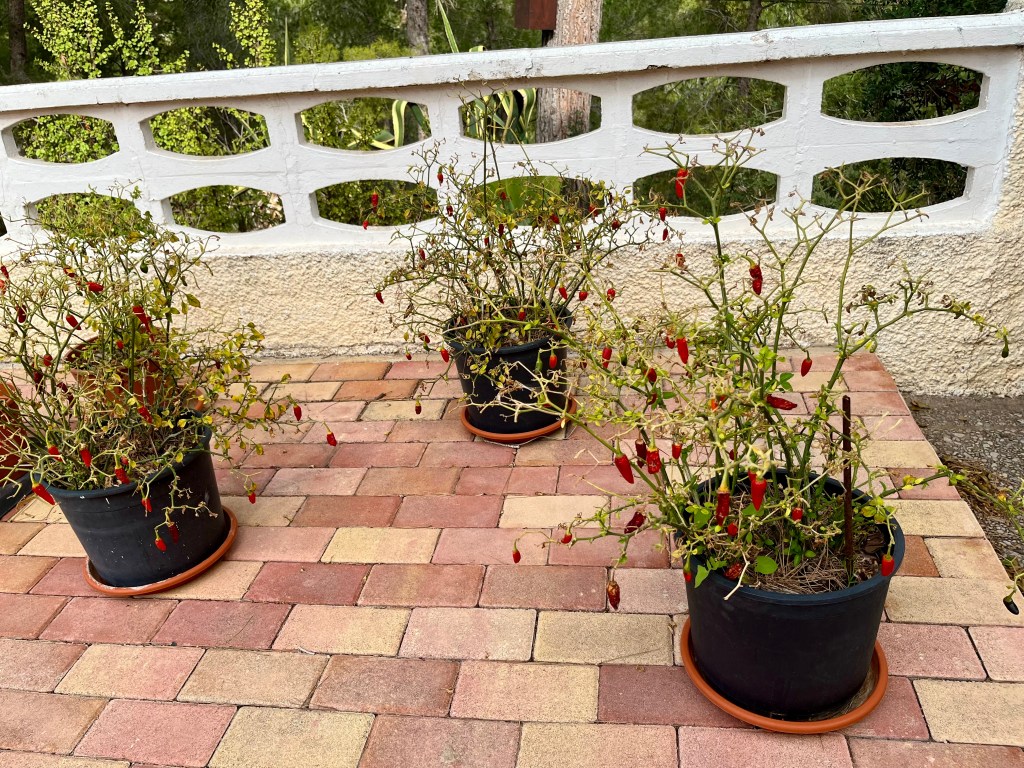
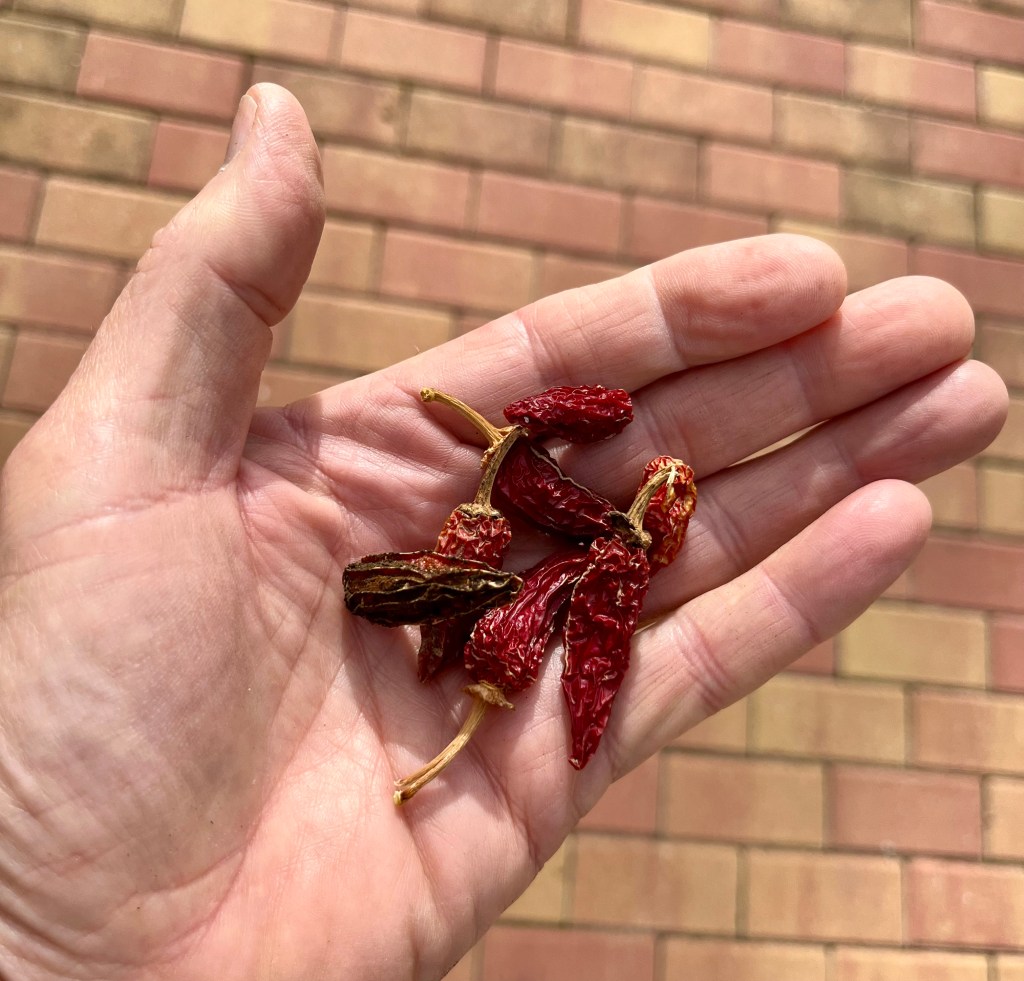
Harvesting and sowing Chilli seeds. Chilli plants are a joy to grow as they are so prolific. I leave my chilli plants to fruit over a two year period with just a chop back at the end of the year. The third year I remove the old plants and sow new seed in lovely fresh compost. By doing this I am getting rid of the old tired compost and creating a whole new generation of plants. The first photo below show my tired old plants heading for the compost heap, followed by the ripe seed pods that I have left on the plants and which will form my next generation. Click on each photo for a larger view.
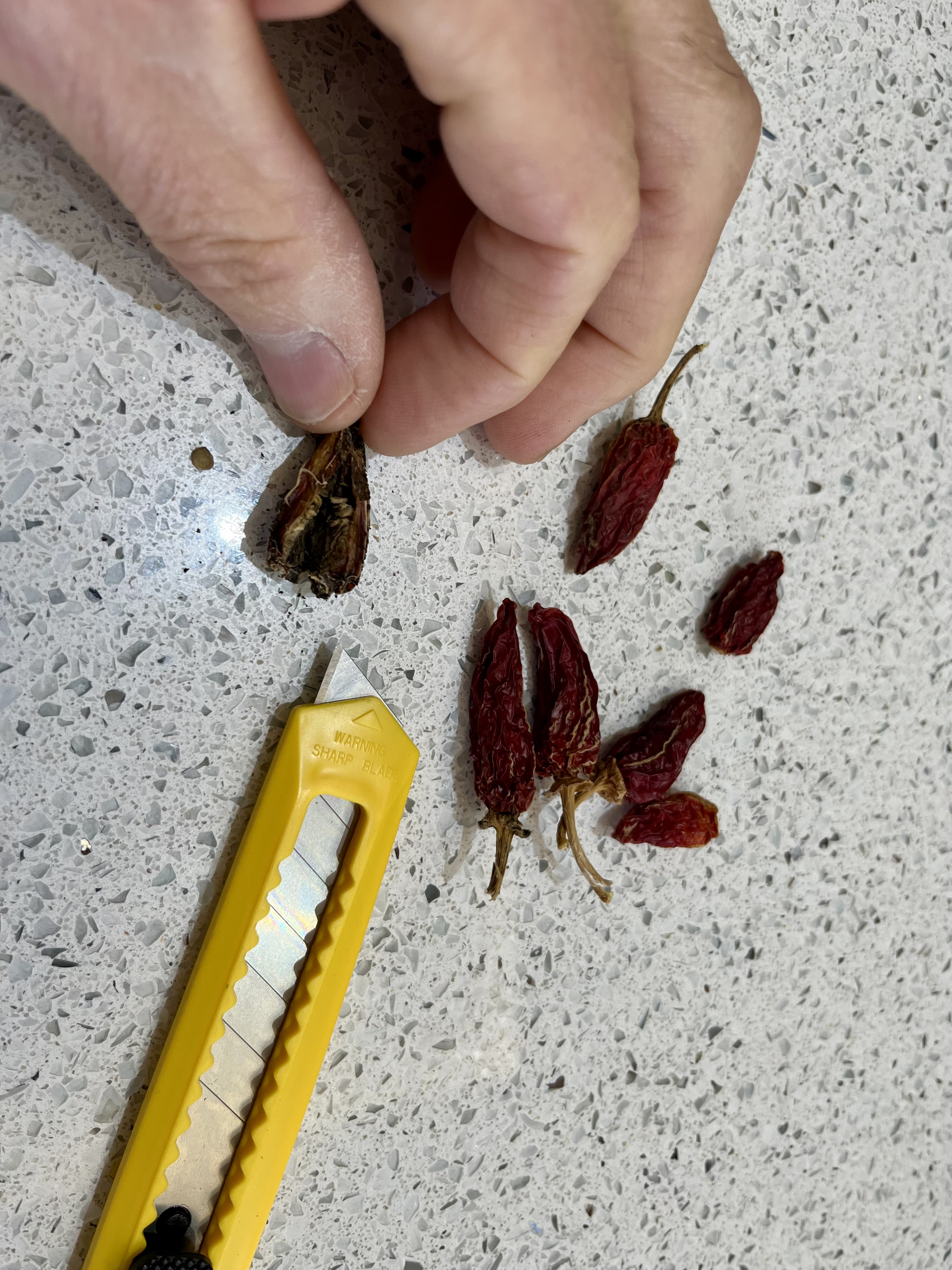
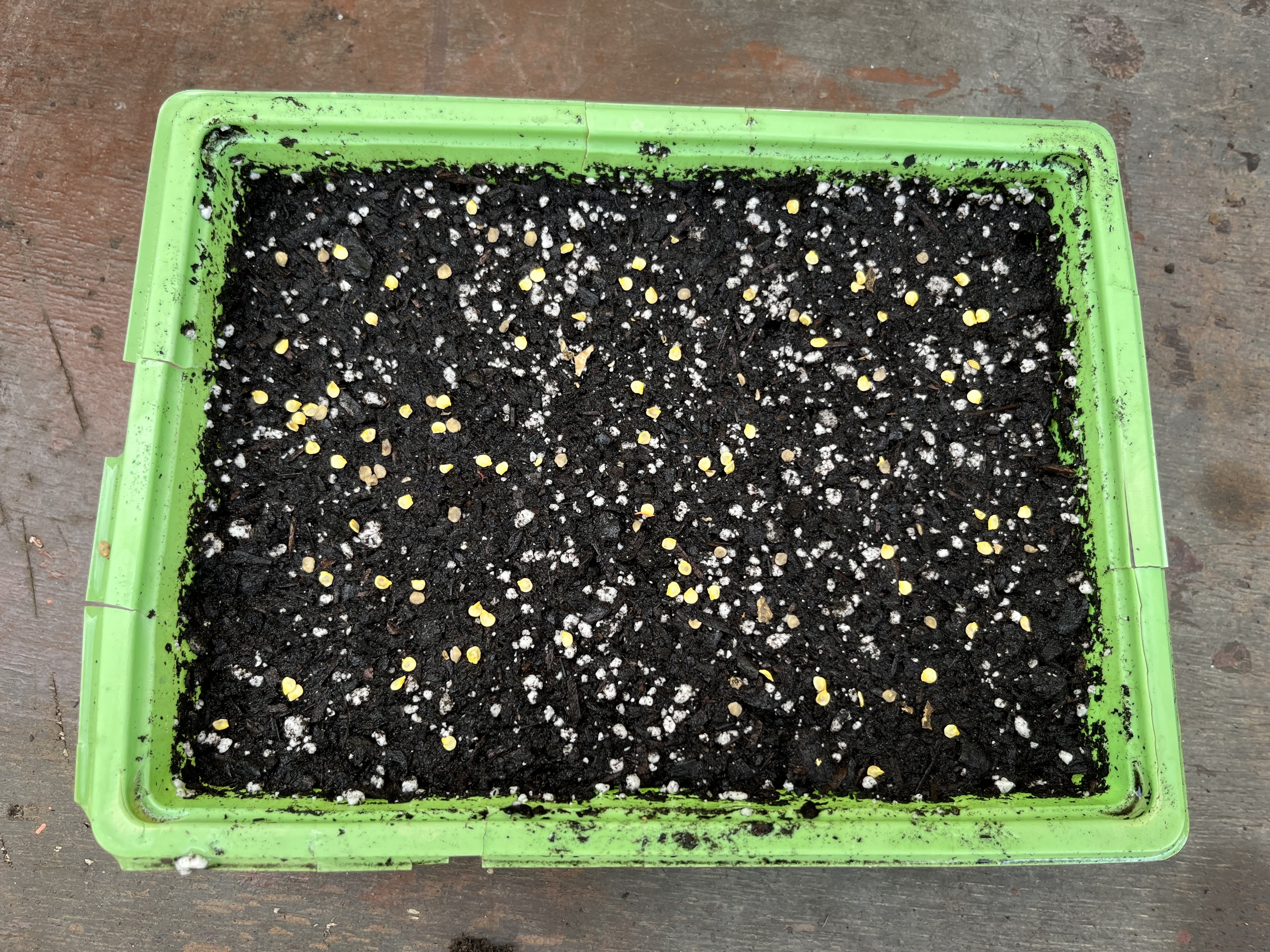
Getting the seeds is very simple. Using a scalpel, or very sharp knife, slice carefully down the side of the dried seed pod and carefully tease out the seeds that will be there waiting for you. The photos below show my scalpel work, together with the gathered seeds. The final photo shows the seeds scattered evenly across a seed tray before being lightly covered with compost. Click on each photo for a larger view.
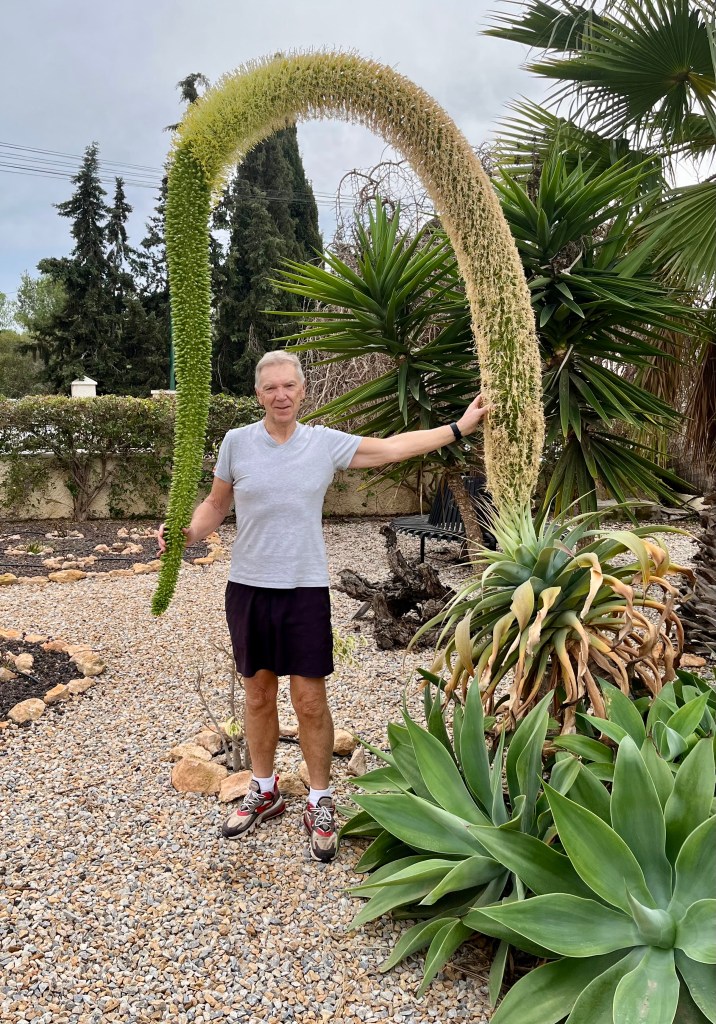
Preparing for the death of Agave Attenuata. Losing any plant is a dreadful experience for us gardeners. We tend them, nurture them, watch them grow day by day and experience joy when they flower. That makes it all the more poignant when you lose an Agave Attenuata.
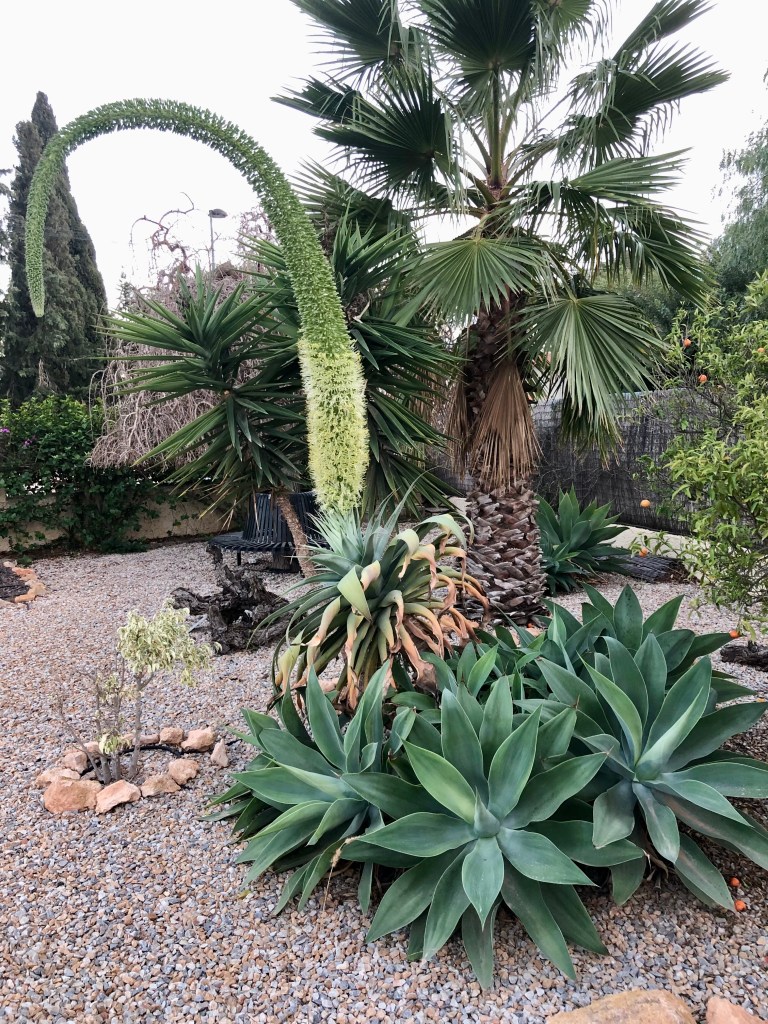
These lovely plants are very popular in Spain as they are one of the few “unarmed Agaves”, by this I mean they neither have teeth or spikes so won’t stab or cut you. They also have a charming habit of creating lots of pups which eventually surround them like a loving family. They take a long time to flower (12-20 years) and like lots of Agaves, when they do, they die leaving only their orphaned pups to cope on their own. The photo below shows a family of orphaned pups who lost their Mum about 5 years ago.
Eventually one of the orphans will go on to adopt the role of mother but it can take a long time. I think the one at the back right is shaping up to be Mum.
Regular readers of this blog will know that I have been lucky enough to see a number of my Attenuata flower. It has always been a painful process made much worse by the mockery of Cruella (my wife) who constantly heckles me in my sorrow by shouting “it’s only a plant, get over it”. On one occasion she proposed what she termed “assistant plant dying” and said that both me and the plant should go off to Dignitas!
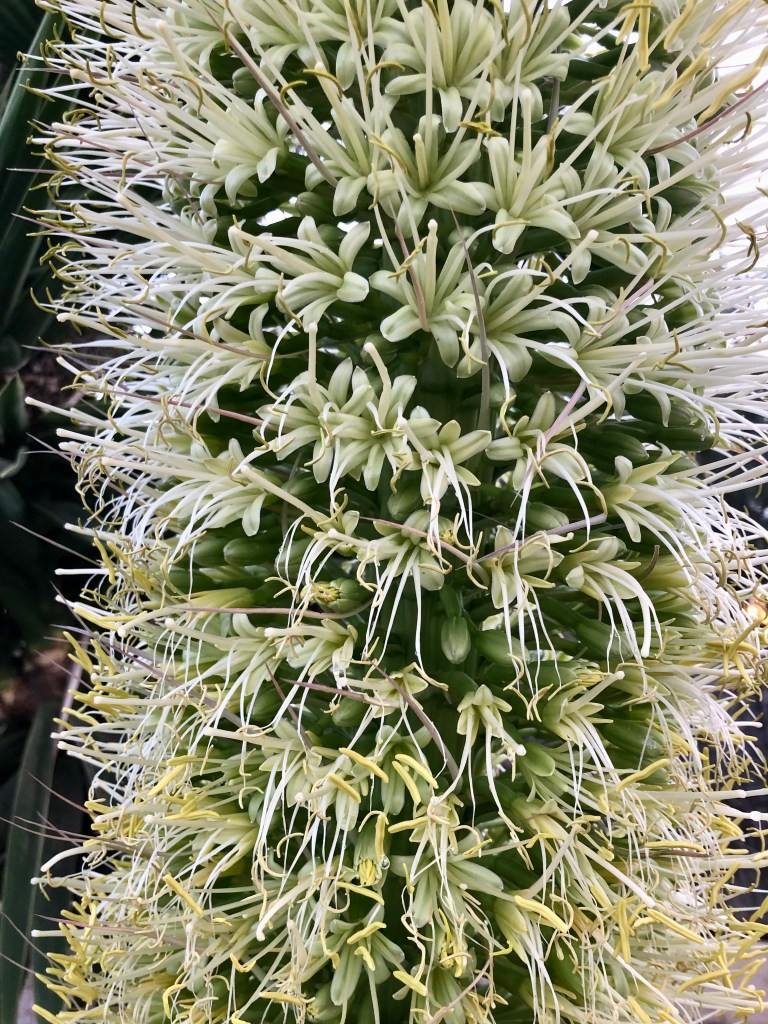
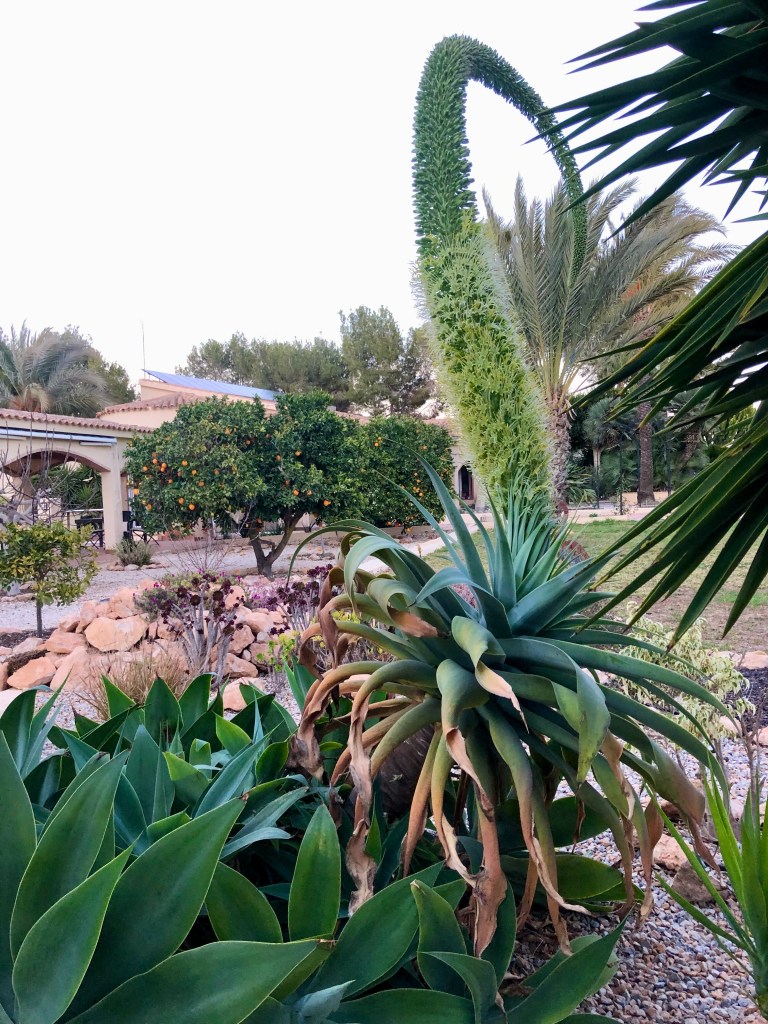
As always on these occasions I conduct myself with dignity and commit my evenings to sitting by the plant as it flowers. We talk over old times, when it was just a little pup and I reassure her that all her pups will be taken care of when she goes. The photos below show my cherished Agave developing her flower spike. The beauty of the flower spike is marred by the tragedy of her oncoming demise. Click on each photo for a larger view.
As her flower spike gets taller so she gets weaker, and this is when I start to sing. All Agaves have a tendency for classical opera, so I tend to sing arias mainly from Puccini and especially La Bohéme.
We start early on when she has accepted she is going. I hold her flower spike and sing “Che gelida manini”. As we progress she takes on the part of Mimi and I Rodolfo as she coquettishly sings “Sì, mi chiamano Mimì”. We both then finish the day with “O Soave faniculla” the pups act as the chorus and as she finishes on the famous high “C” we are all in tears. I am dreading the future. The photos below show us singing the first act, if you look carefully you can see the pups leaning into the chorus whilst visible signs of decay can now be seen on their mum. We shall sing the famous deathbed scene of Act 4 in a couple of weeks, in the meantime I am giving bereavement classes to the pups. Click on each photo for a larger view.
“Che gelida manini”“O Soave faniculla”
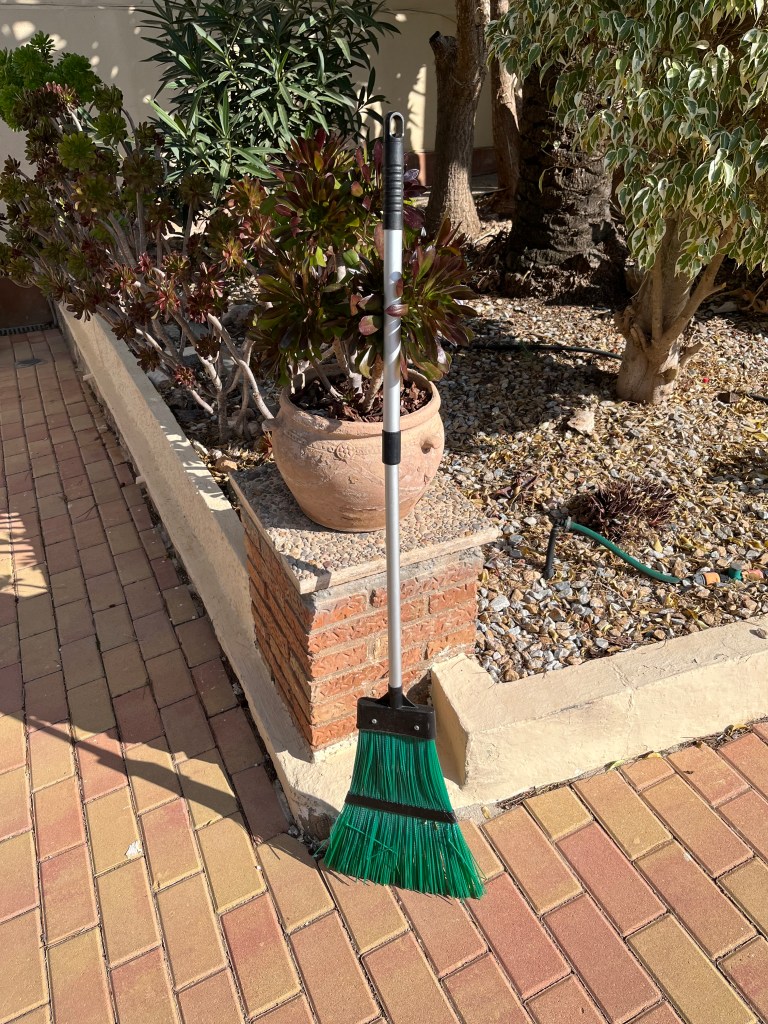
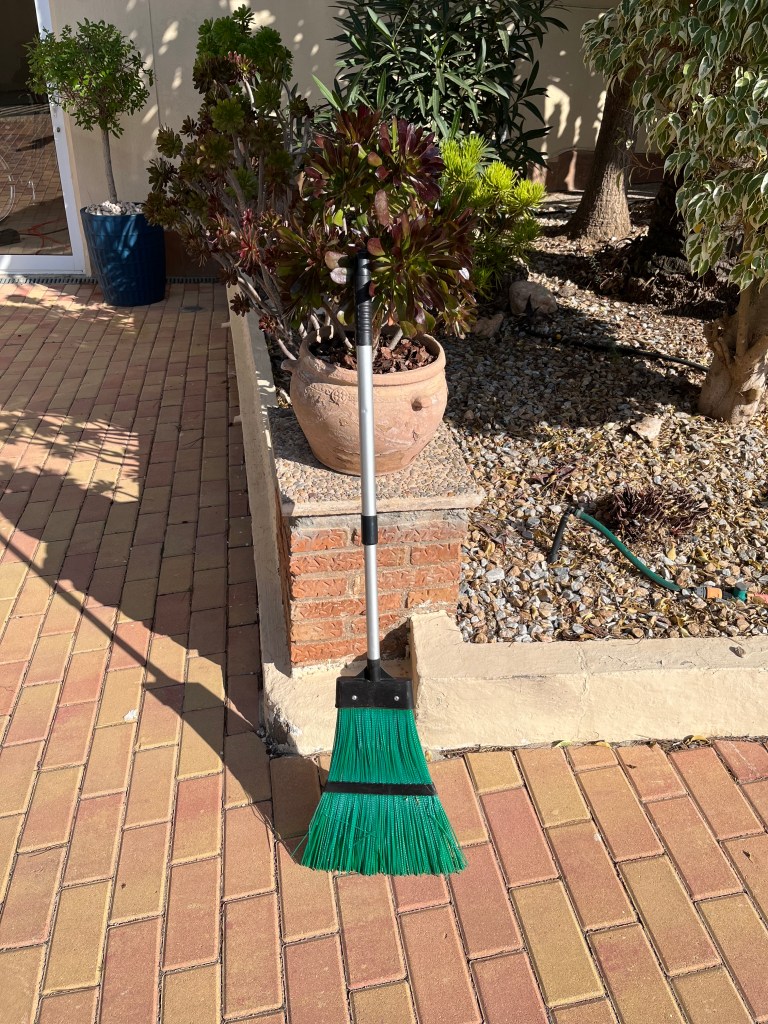
Regretting my Valentines Day purchase. As if things weren’t bad enough with my poor Agave, Cruella (my wife) had demanded that I make an effort for Valentines Day and get her something romantic. I racked my brain for days and eventually came up with the perfect present that was both practical, stylish, and suited to her personality. At great cost I bought her a new titanium based, multi positional short take off and landing broom. The photos below show this wonder of modern technology in both its extended long take off mode and its shortened take off mode.
Given that most of her current brooms are what you would term shoddy, I thought she would be delighted. She took one look at it and proclaimed “I wouldn’t be seen dead on that modern crap”. She stormed off in a huff and spent all of Valentine’s Day with her chickens murmuring darkly in chickenese whilst occasionally giving me black looks. The upside was that I could get on with sowing seeds!
Who knew that gardening could be so Rock and Roll; I always thought Guns and Roses was a stupid name anyway. If you have roses and figs, then now is the time to get them pruned back. Add a little bit of grass for you old hippies and we are really rocking. To think that Cruella (my wife) thinks that gardening is boring. Without further ado, let’s get on with the big cutback .
17th January. Things I have been doing lately:
Pruning Roses. People sometimes make out that there is a lot of mystique about the timing and methods of pruning back roses. But roses are very hardy and can take quite a lot of rough handling. The photos below show some of my roses ready for their annual prune. Click on each photo for a larger view.
It is important to remember that climbing roses are pruned differently to bush roses. With climbing roses I recommend running hedge trimmers lightly up the length of the plant just removing excess side growth without cutting the upward stems. In this way you will maintain height but get rid of bulk. The photos below show my climbing roses before and after their trim. Click on each photo for a larger view.
Now if like me you have lots of roses (I have 30) then pruning can be quite a time consuming process, so I recommend that you do it in two linked stages. First, be brave and get out your hedge trimmer or shears and just prune back all your roses to the required height – I recommend taking off at least two thirds of the height.
Second, get on your knees and prune each individual plant as follows. With bush roses the simplest method is to prune back by about two thirds to the nearest outward facing bud joint. As part of this process take out any crossing or diseased stems to leave a nice open centre to the plant a bit like a wine glass. The photos below show my roses pruned. Click on each photo for a larger view.
The more perceptive amongst you will note that the final photograph shows that you can barely see the pruned rose from the leaf debris and grasses growing through. I am sorry to tell you that this is when it gets difficult and when the real hard work starts. Oh and unfortunately you will lose a lot of blood. Using a pointed trowel you need to get under each rose and remove all the leaf debris and dig out the weeds and grasses. The rose thorns will get you no matter how good your gardening gloves and you will bleed quite a lot.
This is the important part so please pay attention. Sepsis though rare affects a number of gardeners each year. If you cut yourself – and you will – then it is important that at the end of your pruning blood bath you wash your hands and then bathe your cuts with an alcohol solution to ward off infection. The photos below show my lovely rose beds all restored and ready for this year’s growth. The final photo shows the all important alcohol to sterilise your many cuts. Click on each photo for a larger view.
Pruning fig trees. Most fig trees in Spain are allowed to grow into giant behemoths sprawling over gardens like something conjured up by Gandalf. Their fruit is often too high to harvest and they shade out other plants nearby. I have two fig trees: an espalier and a free standing tree. As a lover of figs both of my trees are cosseted. They are fed, netted and pruned at exactly the correct time, and in return they provide me with abundant fruit. My trees are shown below in their unpruned state. Click on each photo for a larger view.
You should only prune figs when you are sure the sap has returned to the roots as figs have a caustic sap which can inflict quite severe burns if you foolishly cut any branches during the growing season. There are many ways to prune figs, but whatever your chosen method there are two key elements.First, ensure that you have trained your tree so that you can easily reach the fruit at the height of the growing season. Second, prune to achieve an open aspect at the centre of the tree to let in maximum light and air.
The pruning method I have chosen for my free standing tree is to pollard it back to six main branches each of which have numerous stems during the growing season. For the espalier fig, I just remove perpendicular side shoots to encourage lateral growth along wires. The photos below show you both trees after their prune. Click on each photo for a larger view.
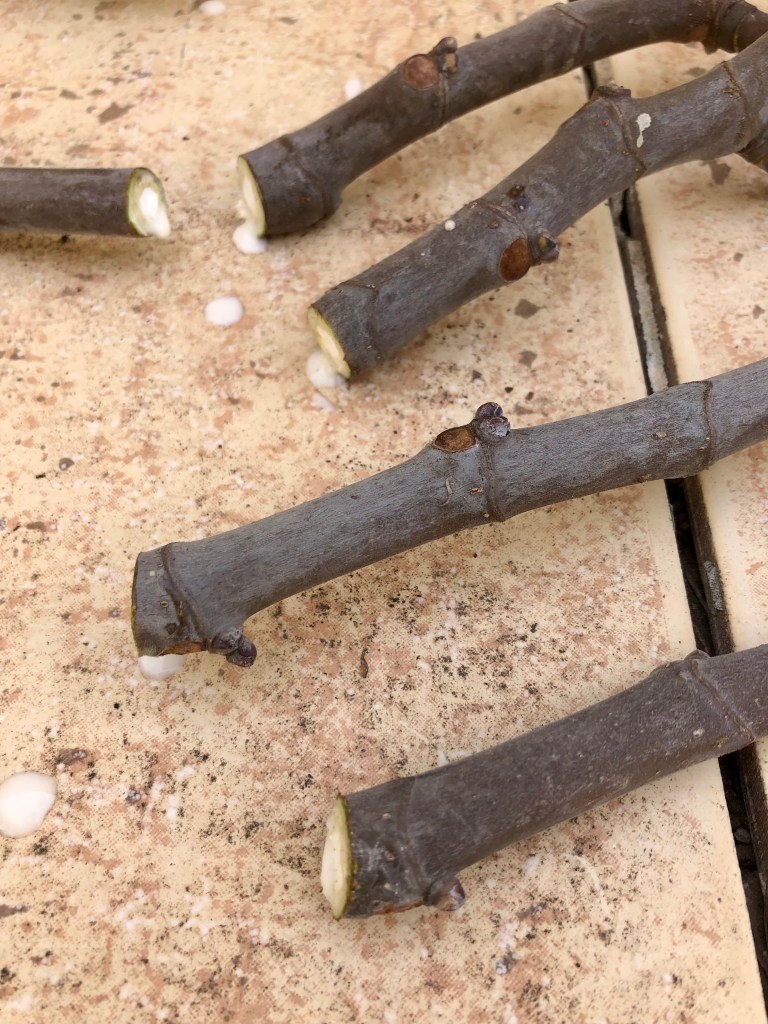
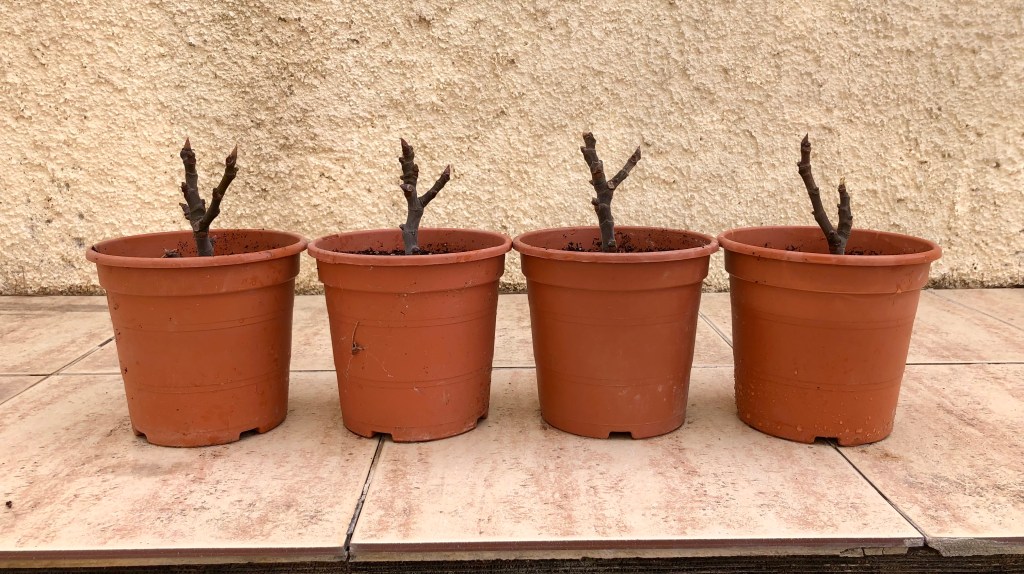
If you want to propagate your trees either to have more, or to give to friends, then this is the ideal time. Many of the branches you have pruned off will have buds just waiting to spring into growth. Choose some of the best of these; I always look for healthy strong branches with multiple buds at the end. Cut them back to about 30cm just below a growth node then dip the ends into growth rooting hormone (don’t worry if you don’t have this it probably will still work). Pot them up in free draining compost and leave them in the winter sun. With a bit of luck you will have some new trees in the late springtime.
The first photo below shows my choice of potential cuttings. This is followed by an indication of where to cut. Then the process of dipping into hormone rooting liquid. My free draining mixture one part compost to four parts soil is shown as an action photo of a trug. Finally my little cuttings ready to get going. Click on each photo for a larger view.
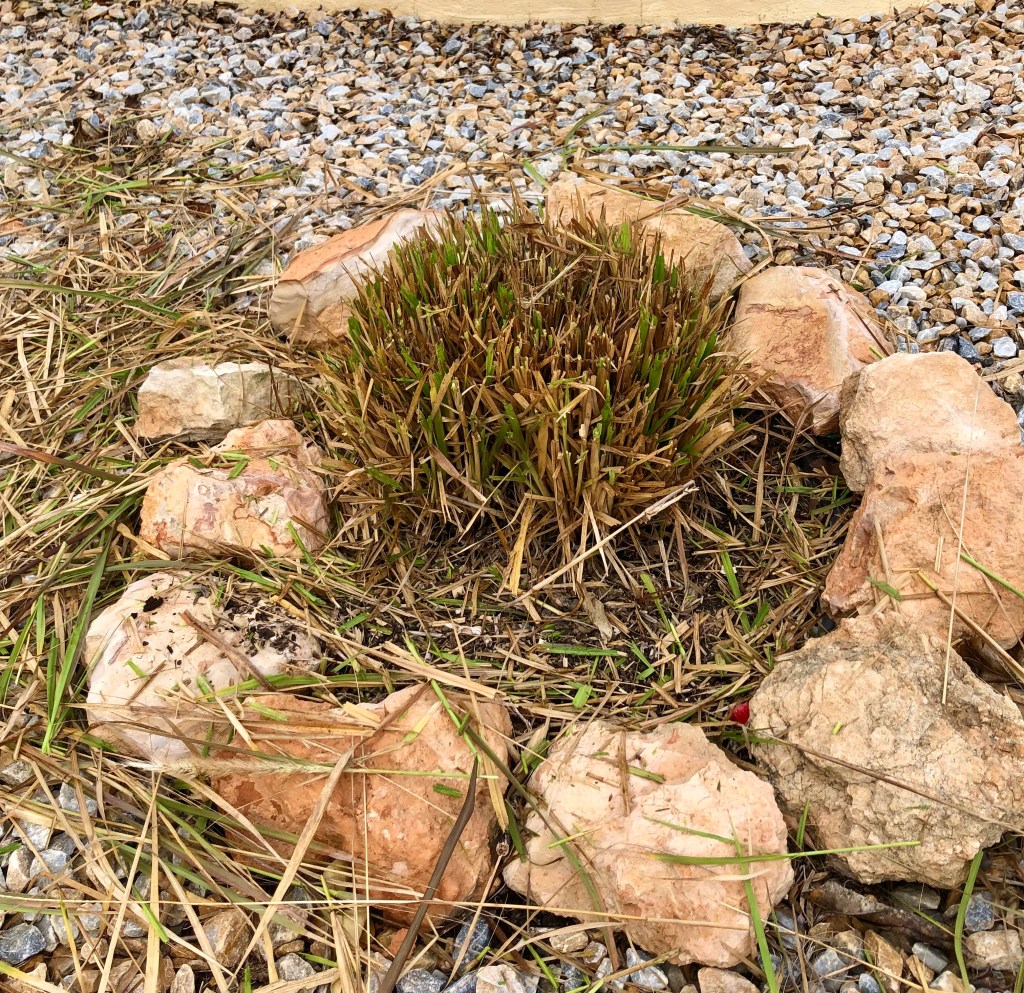
Cutting back Fountain grass. I have one large Fountain grass which unfortunately had died in the middle as most grasses will do over time. I split it just over a year ago and replanted 3 into my own garden and gave some to my friend Camilla who is making a new wonderful garden. Anyway, now is the time to cut back grasses. The simplest way to cut back grasses is just to use your hedge trimmers to gently trim around the plant to make a small mound shape. Do not be tempted to square the grass off (as Ayuntamientos have a habit of doing) this guarantees a short life before the centre dies back. By creating a mound you maximise the light and air to the plant.
The photos below show my little transplants before their cut back and finally how it should look after cutting. Each mound will get bigger each year until eventually the splitting process takes place again. Click on each photo for a larger view.
Yes, it is that time of year when we gardeners have to get out there and cut everything back. Failure to take action now will mean that your garden will not fulfil its potential this Summer. Over the next few weeks I will be pruning, cutting back and generally getting my garden into shape for the coming summer. I will be working with the types of plants you have in your Spanish gardens, so just follow what I do over the next few posts and we can guarantee a lovely garden this summer.
Unlike most of you I have certain hindrances whilst doing my garden, namely: Cruella (my wife), her brood of chickens from hell, and as a special treat the idiot son has come home for a holiday and Cruella has declared him a chicken whisperer. Anyway, let’s get on with the gardening.
10th January 2024. Things I have been doing lately:
Over the next few posts I will keep you up to date with the big winter cutback, but this particular post will cover the following:
Pollarding Peruvian False Pepper trees
Pruning Sago Palms
Cutting back Dame de Noche
Pruning climbers
Dealing with the chicken whisperer
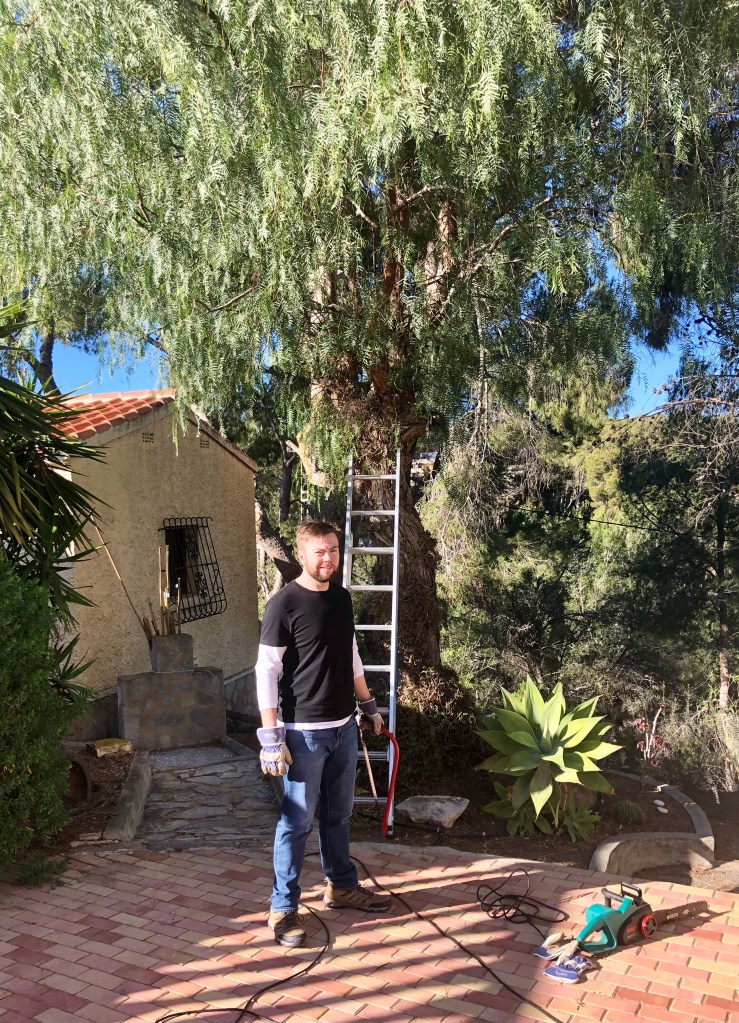
Pollarding Peruvian False Pepper trees: This tree can be found in many Spanish gardens. Its weeping willow type foliage and lovely little red peppercorn fruits provide an attractive tree that can grow up to 15 metres tall. However, too often the false pepper is allowed to grow into a huge behemoth that whips around in the wind and covers you terraces in discarded foliage and blocks your swimming pool skimmers. The photo below shows my tree before pollarding.
Left to grow this tree canopy would double in size over the next few years.
The secret to keeping the false pepper as a useful part of your garden landscape is to ensure that you pollard it every 5 years or so. Pollarding involves radically pruning back the main branches which reshapes the tree and encourages secondary growth that will stay manageable for a few years. When pollarding you need to use a chain saw or bow saw to cut each of the main branches about 6 inches from the base of the branch. By keeping the correct distance from the base of the branch you will not damage the branch “collar” which contains the growth instructions for the branch.
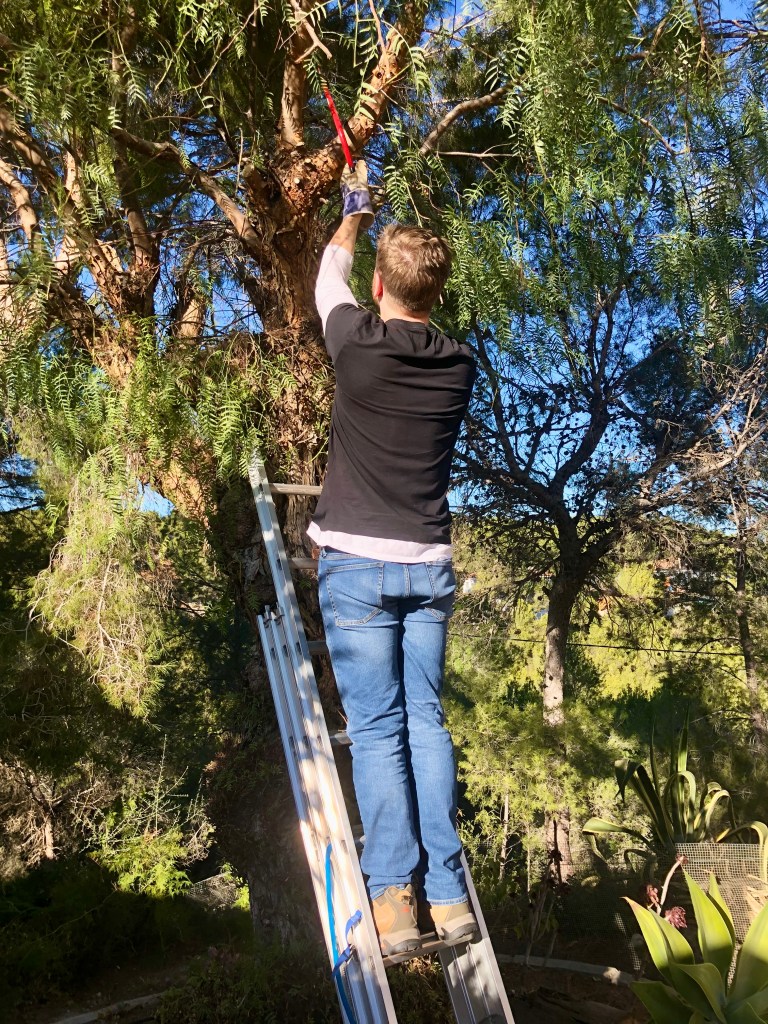
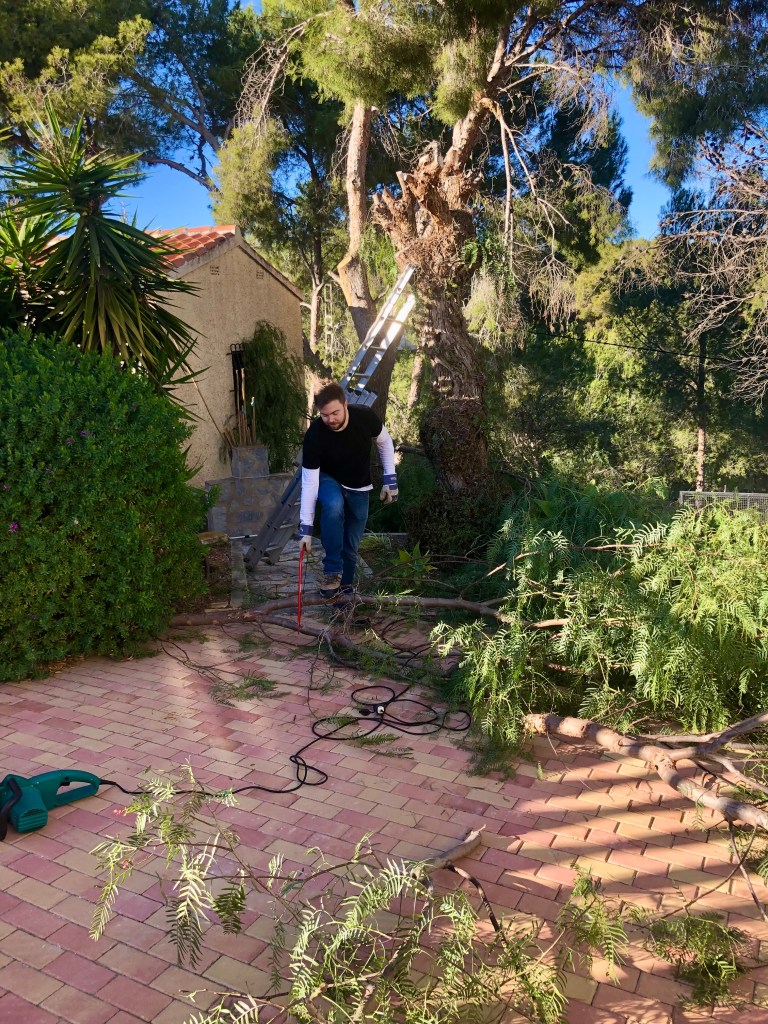
Luckily the idiot son was visiting so I persuaded him to help me pollard the tree. I had to promise him copious quantities of beer and Cruella insisted that I held the bottom of the ladder at all times. The photos below show the idiot in action with the final photo showing the finished pollard. Click on each photo for a larger view.
I wanted him to use the chain saw but Cruella wouldn’t let himThe final pollard will last at least five years
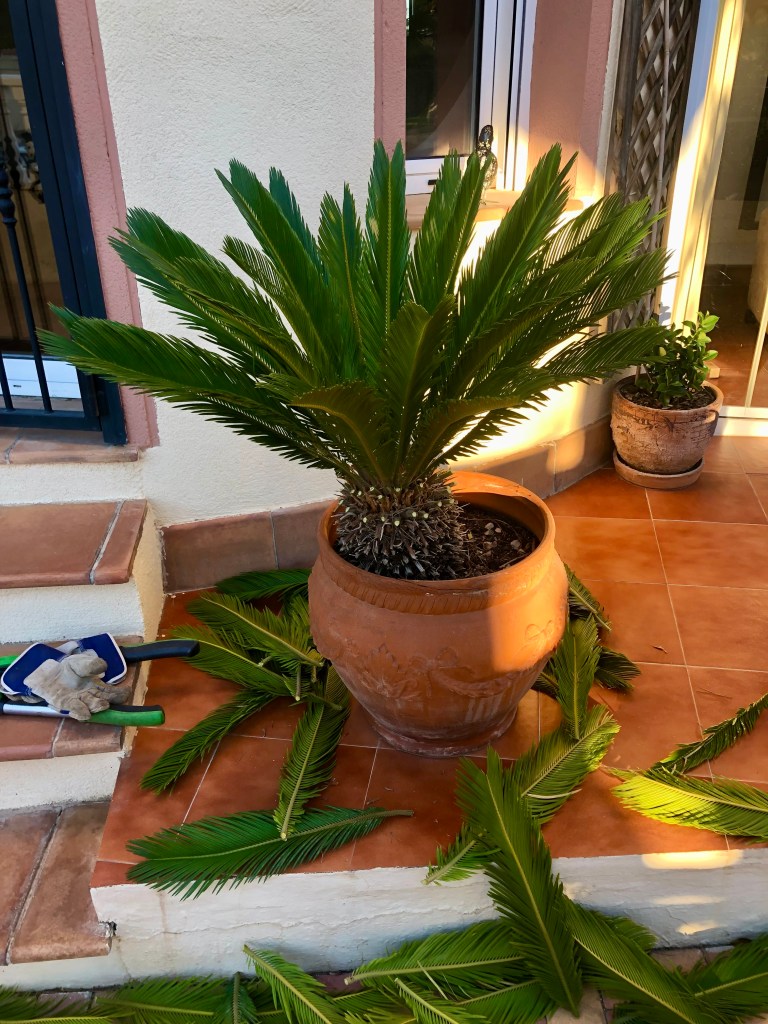
Pruning Sago Palms: The slow growing sago palm is another perrenial favourite in most Spanish gardens. These can be majestic if pruned correctly, but if just left to their own devices, they are just another green lump in your garden. There are two schools of thought on pruning sago palms. The first says that you must leave the fading yellowing fronds on the plant as they provide nutrients. The other says keep it pruned and tidy and if necessary give it a feed. I support the latter process and always prune mine back to two rows of fronds from the top. Two rows is important as if you left just one row and then these became diseased then you could lose the plant. I have two main sago palms; one is in the ground and the other in a pot. Both are shown below. Click on each photo for a larger view.
From the photos above you can see that both are due a trim. Using long handled lopers I gradually move round the trunks taking off rows of fronds until I am left with just two rows on each stem. The photos below show my handiwork.
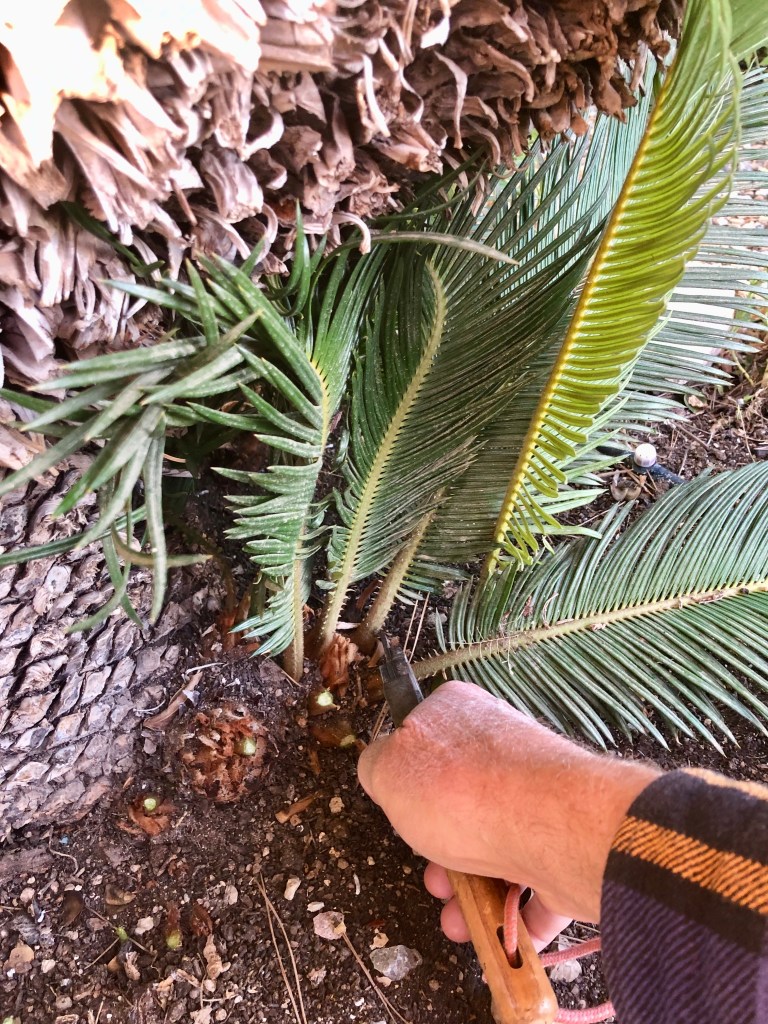
The final stage in pruning the sago palm is to remove any pups it has thrown from the base of its trunk. These look like mini sago palms that are emerging, and you can pot these up, but that is for another days post. Today we just need to take them off to tidy up the plant. The first photo below indicates the pups circled in red. You just need to remove these with your secateurs or lopers and then the plant is left nice and tidy for the summer.
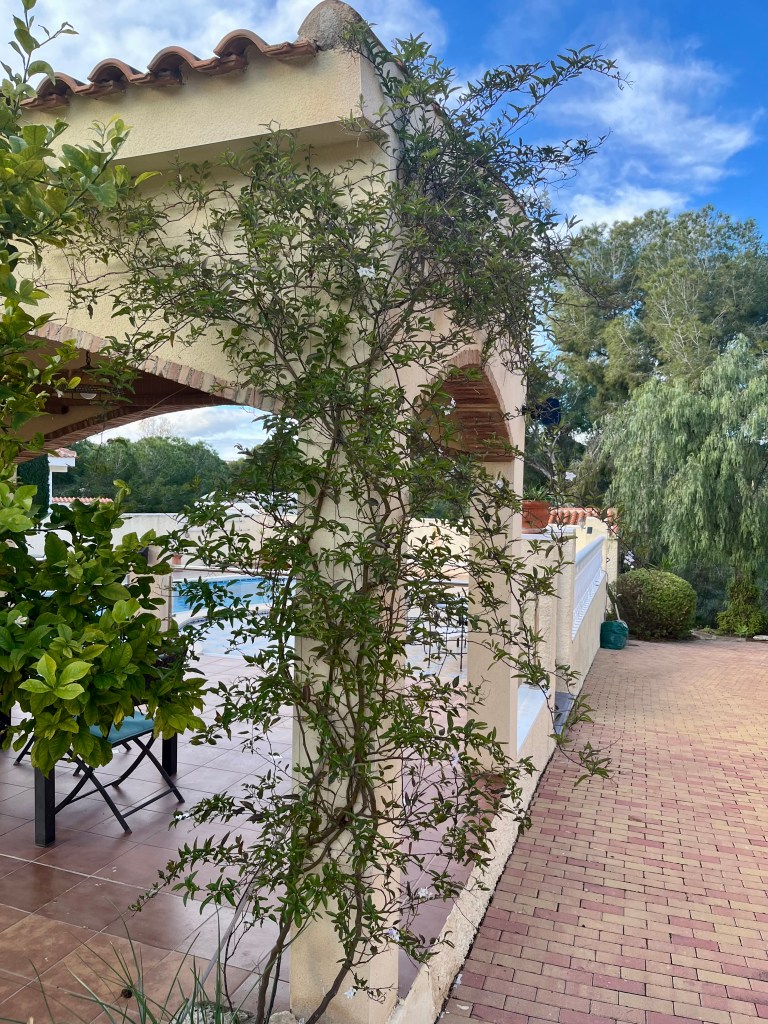
Cutting back Dame de Noche. The lady of the night which is a night scented Jasmine needs to have its final cut back now if you are to enjoy its lovely scent in the summer. You should have already cut the plant back by a third after its first flowering to allow a second flush of flowers. This final cutback can be quite drastic to encourage a healthy shapely growth. Depending on the age of your plant you can take it back to 6 inches.
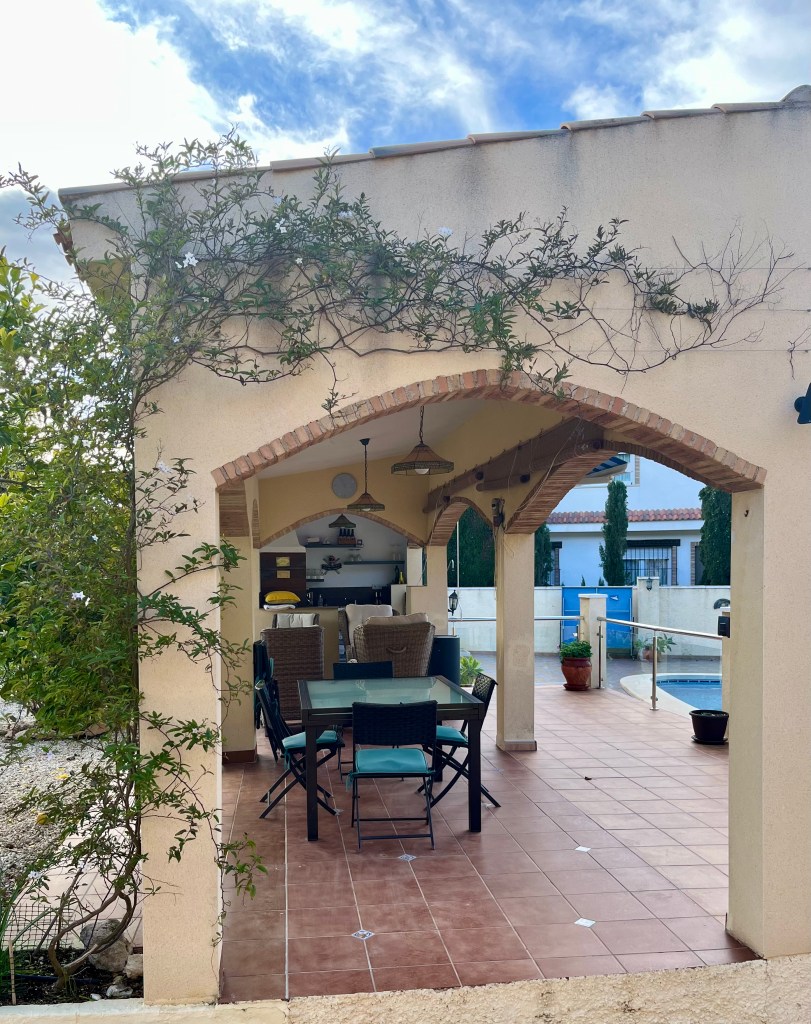
The first two photos below show my dame de Noche looking straggly and ready for its cutback. Notice that I have planted my dame de Noche close to our outside seating and eating area so that we can benefit from the beautiful night scent. Click on each photo for a larger view.
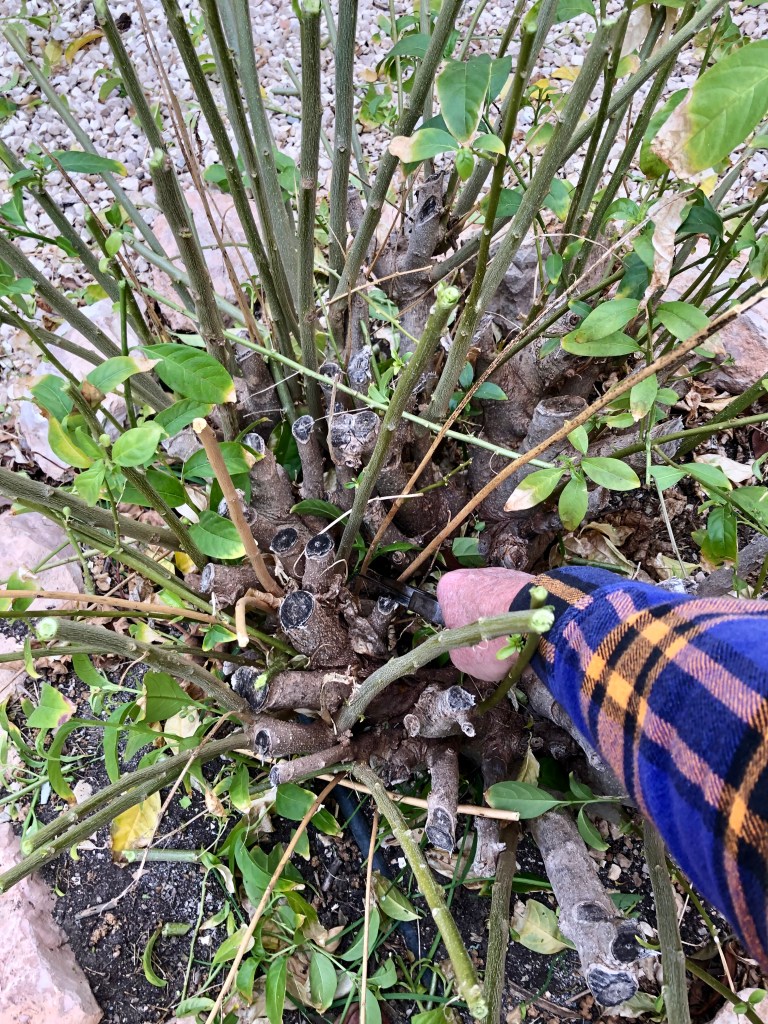
The next photos show the plant cutback and ready for its final pruning. To finish the prune use your secateurs to open up the centre of the plant to take out crossing stems and let light and air in.
The final prune leaves the centre of the plant open
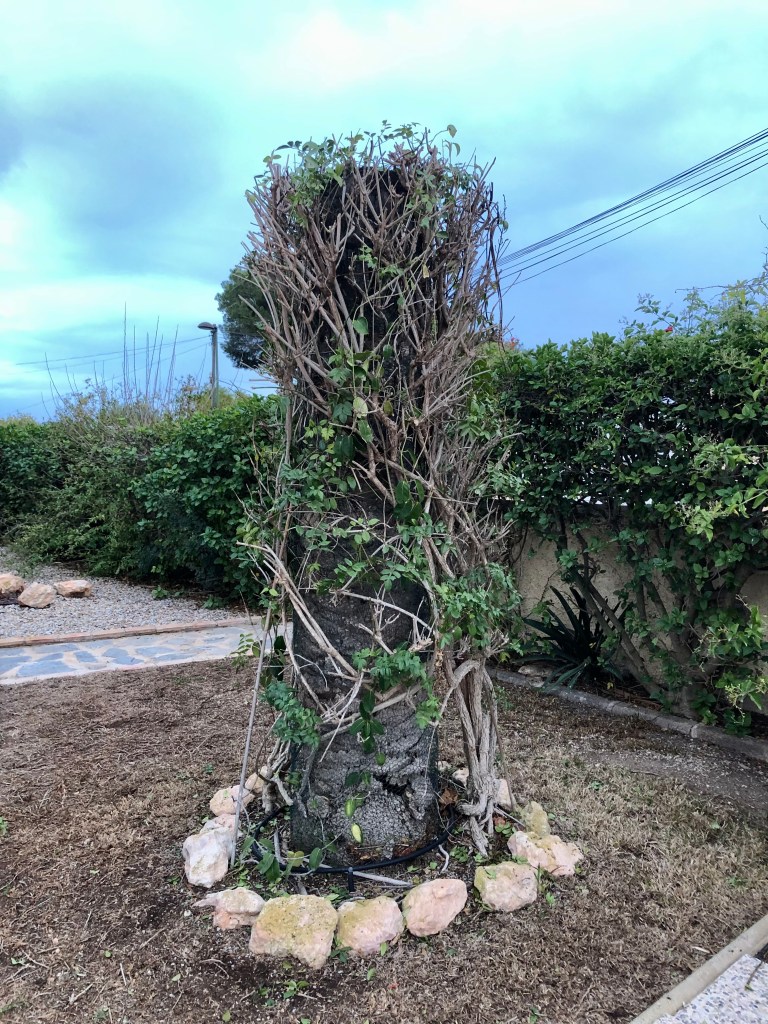
Pruning climbers: The trick with pruning climbers is that you do not want to lose height but you do want to reduce bulk so that you can let light into the plant. So in effect what you need to do is remove side shoots. The simplest way to do this is to run your electric hedge trimmers up the front of the plant aiming to stay away from the upward growth. Lacking hedge trimmers just use garden shears to achieve the same effect.
So far I have cut back the Solanum that grows up the side of my outside kitchen and dining area and also my column of plants that I trained up a palm trunk. The photos below show that all that is needed is to just take away bulk and bring back shape. Click on each photo for a larger view.
BeforeAfter
Finally, don’t be tempted to feed or overwater the plants you have pruned. Wait a couple of months till you see new leaf growth and then give a light feed.
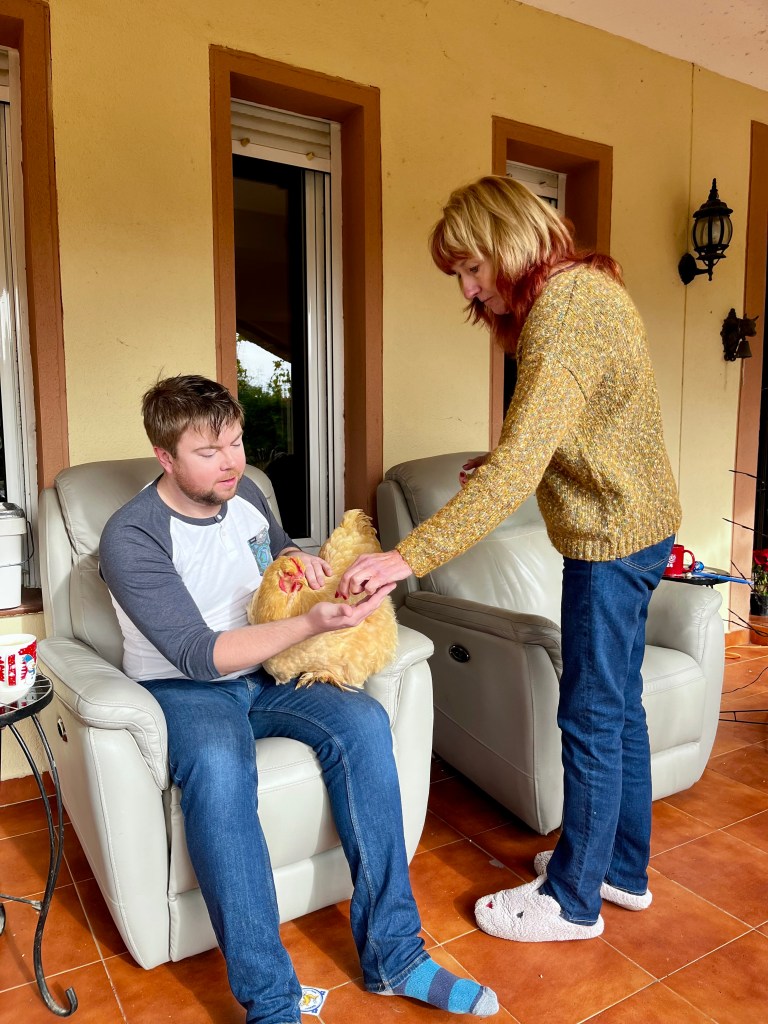
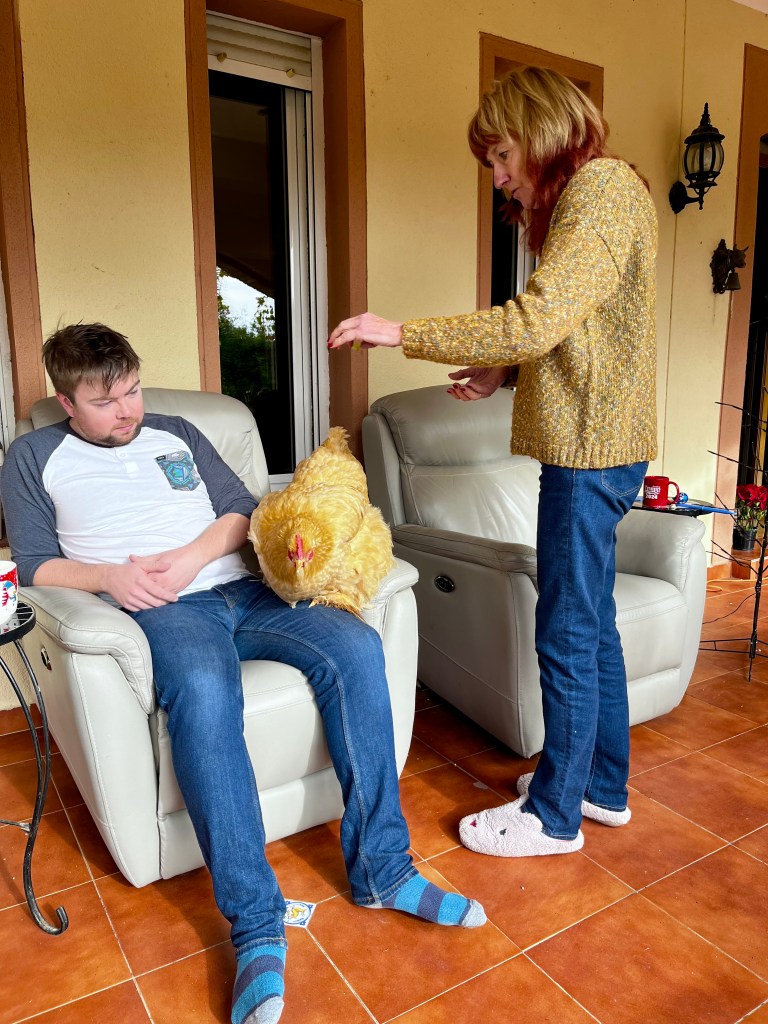
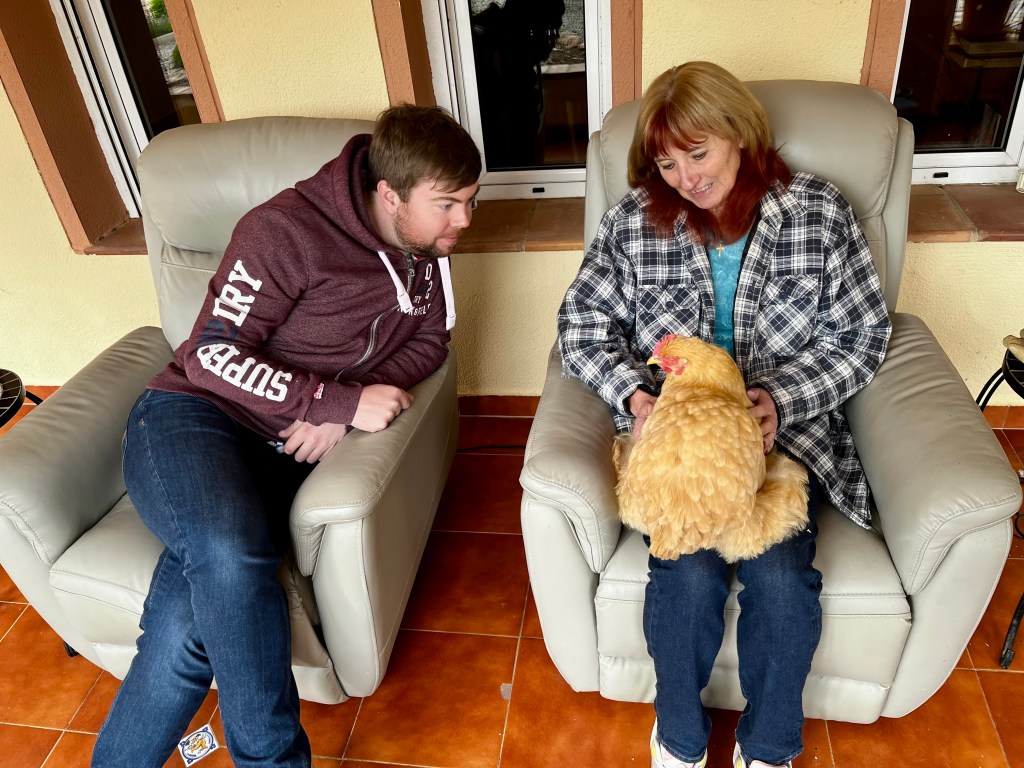
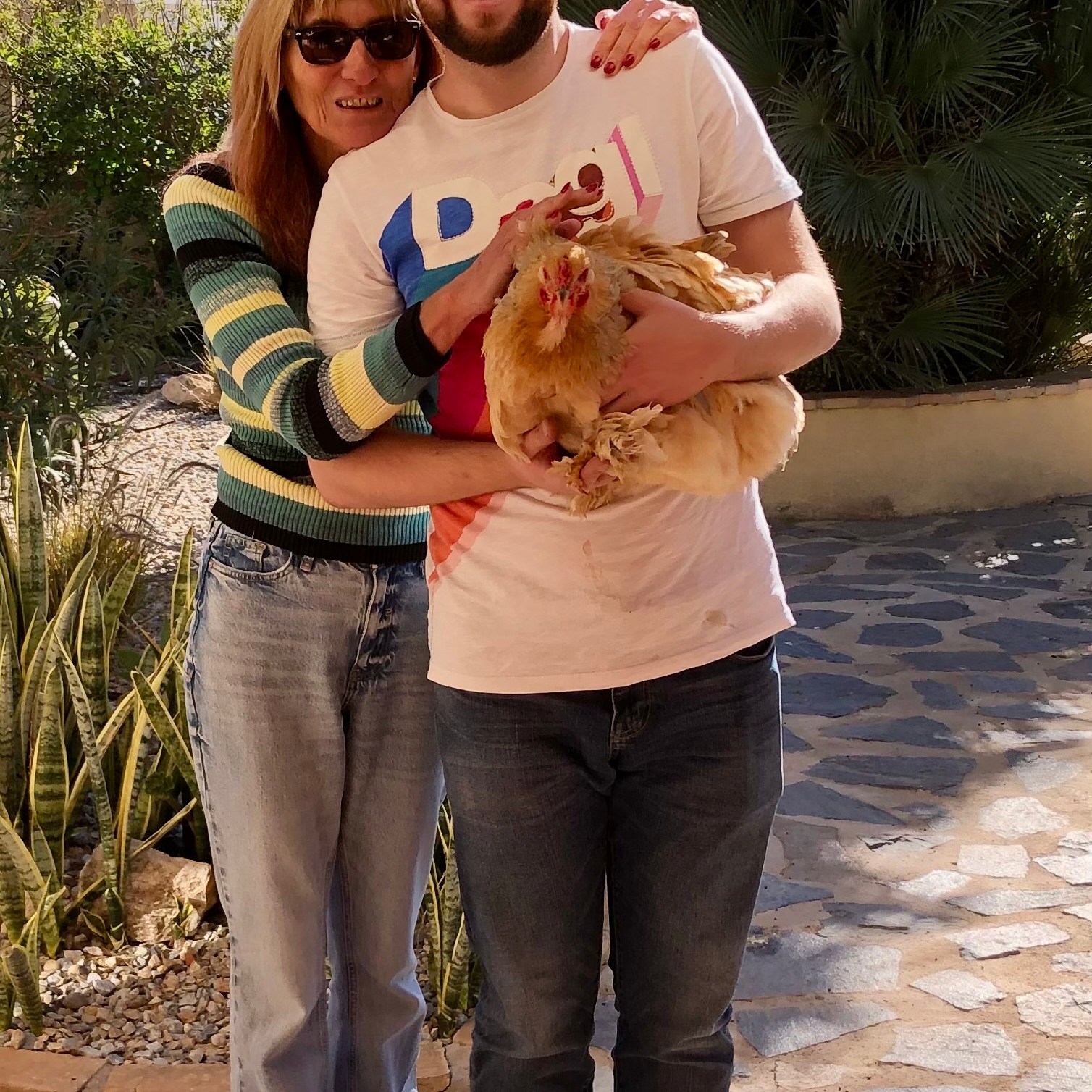
Dealing with the chicken whisperer. Whilst I have been dealing with the start of the big Winter cutback, Cruella (my wife) has been training the idiot son in the art of chicken whispering. She is trying to convince him to leave the world of Finance and become her rightful heir, or as she calls him “Prince of Chickens”. So far he is holding out, but she is making him follow a strict curriculum of chicken studies. This includes lessons in Chickenese every morning followed by hands on work with the chickens in the afternoon. Early evening is spent in the so called art of chicken whispering. The later evening is spent in the rites and mysteries of putting the chickens to bed, but I can’t tell you anything about this as I am not allowed to see what goes on.
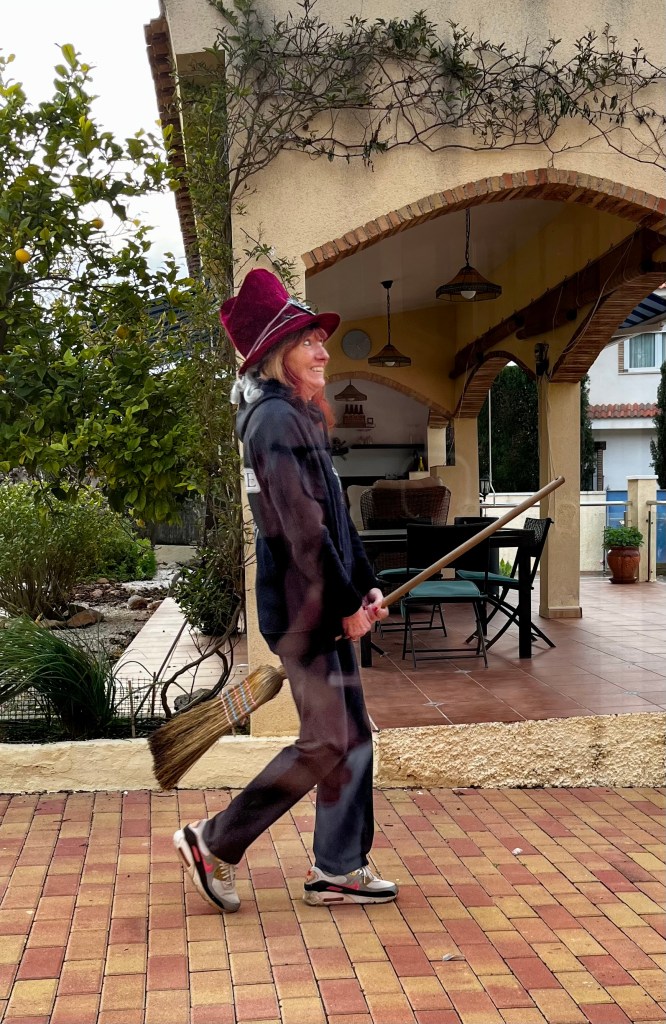
The photos below give you an idea of what they get up to, I did have some others but Cruella made me delete them! I am only allowed to show you these ones as Cruella is using them in his graduation album. Click on each photo for a larger view.























































































 Spanish Garden
You must be logged in to post a comment.