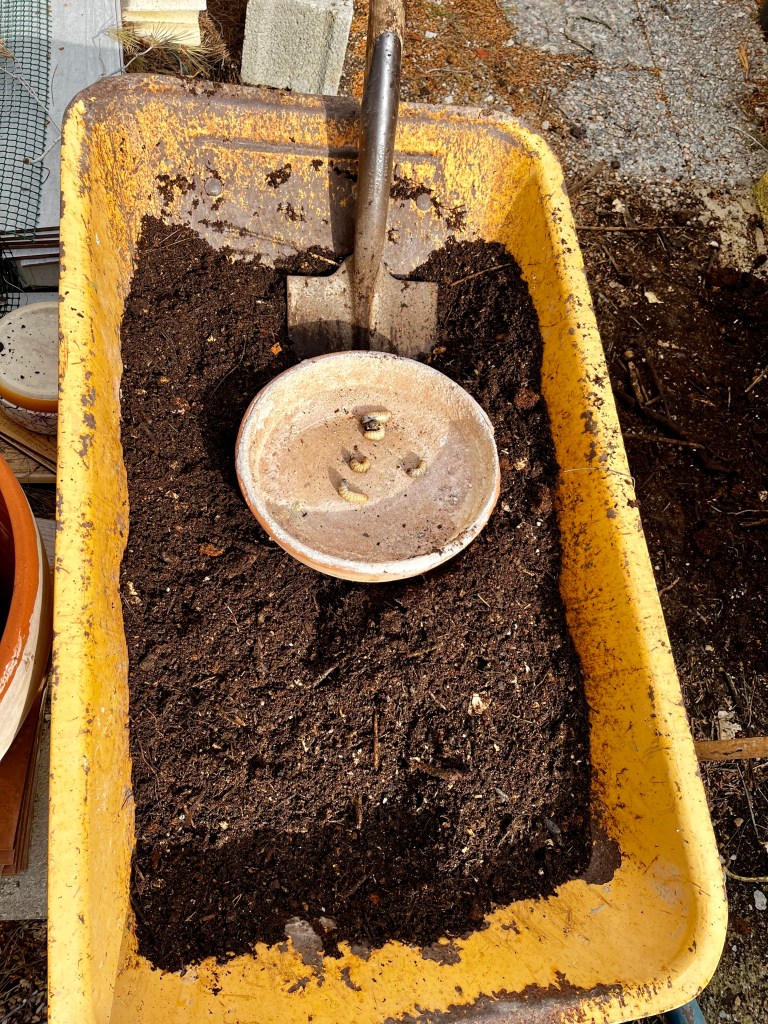
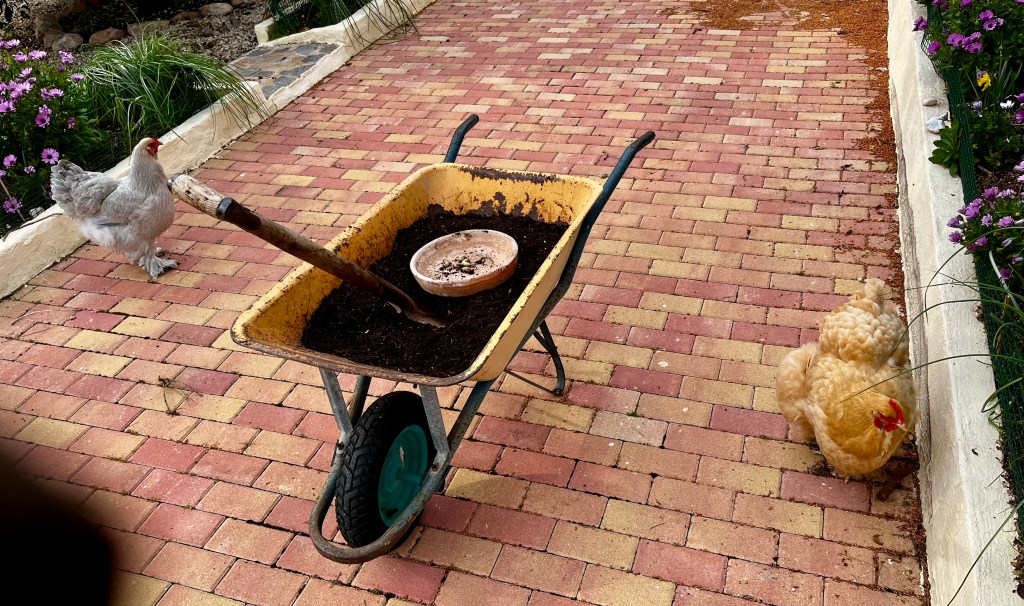
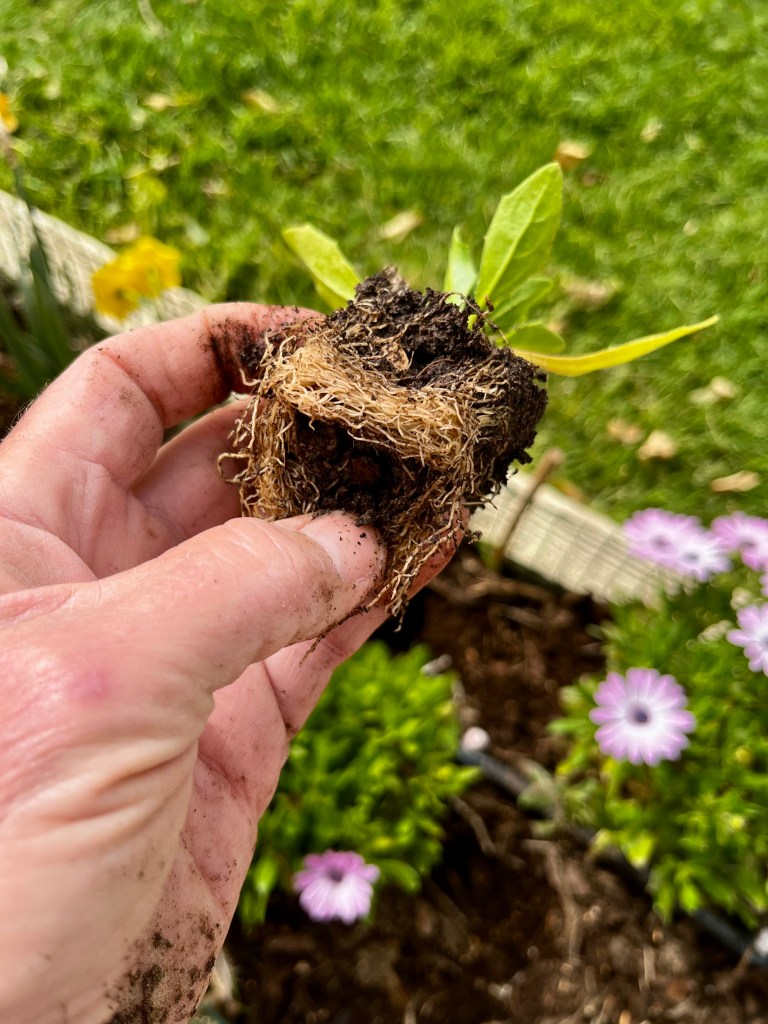
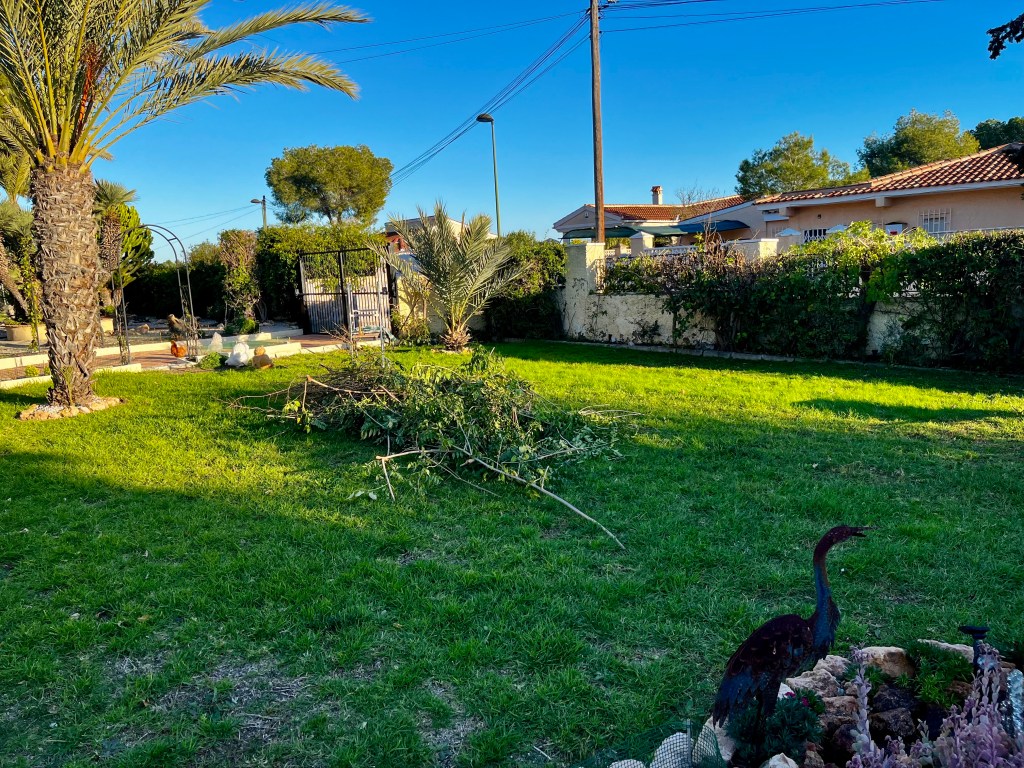
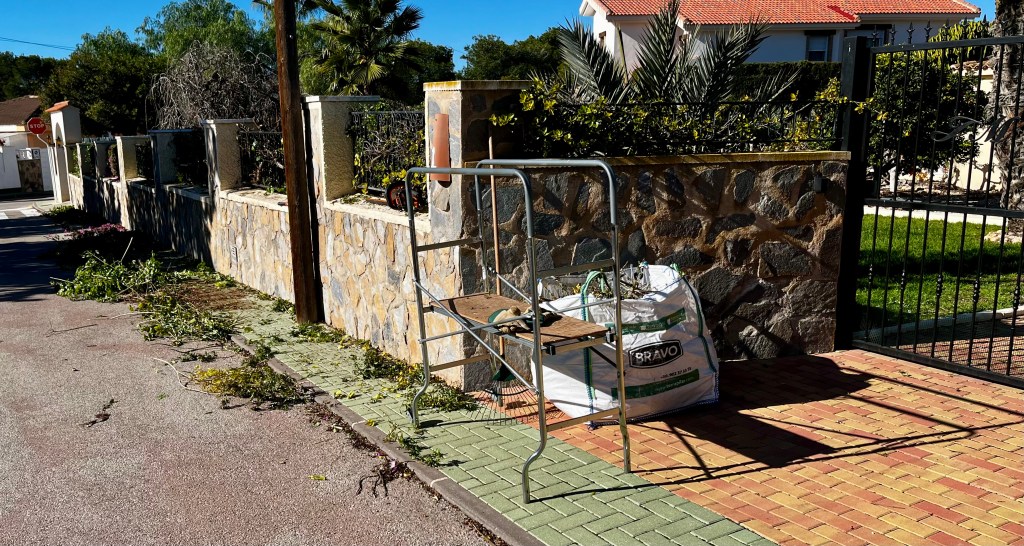
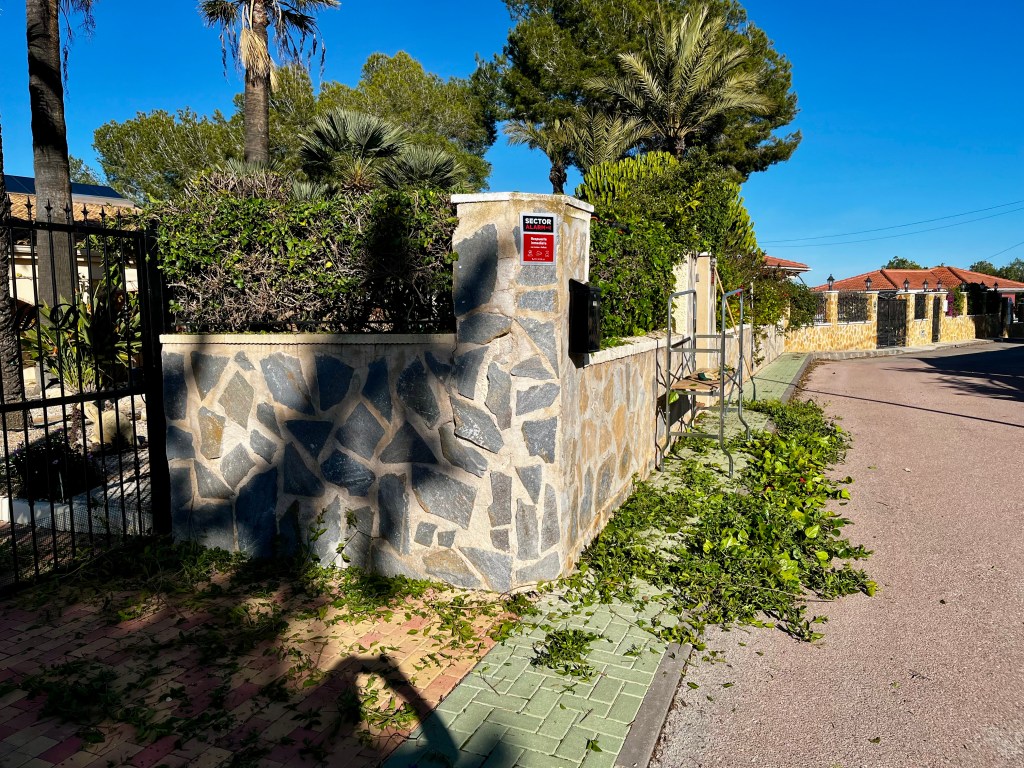
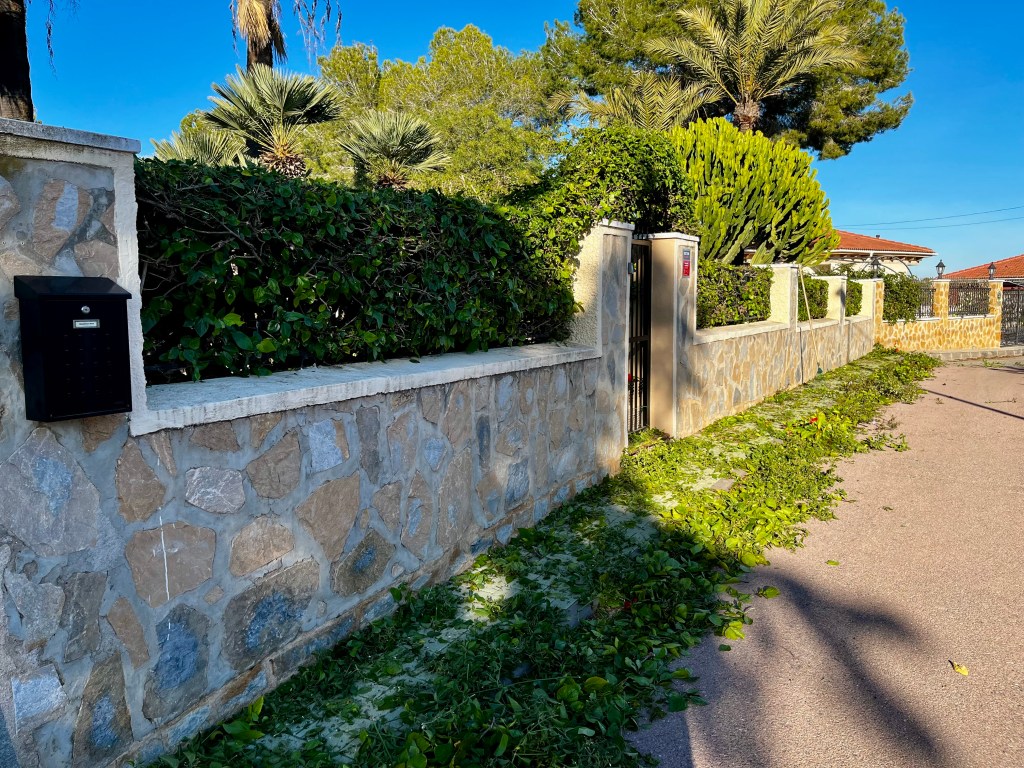
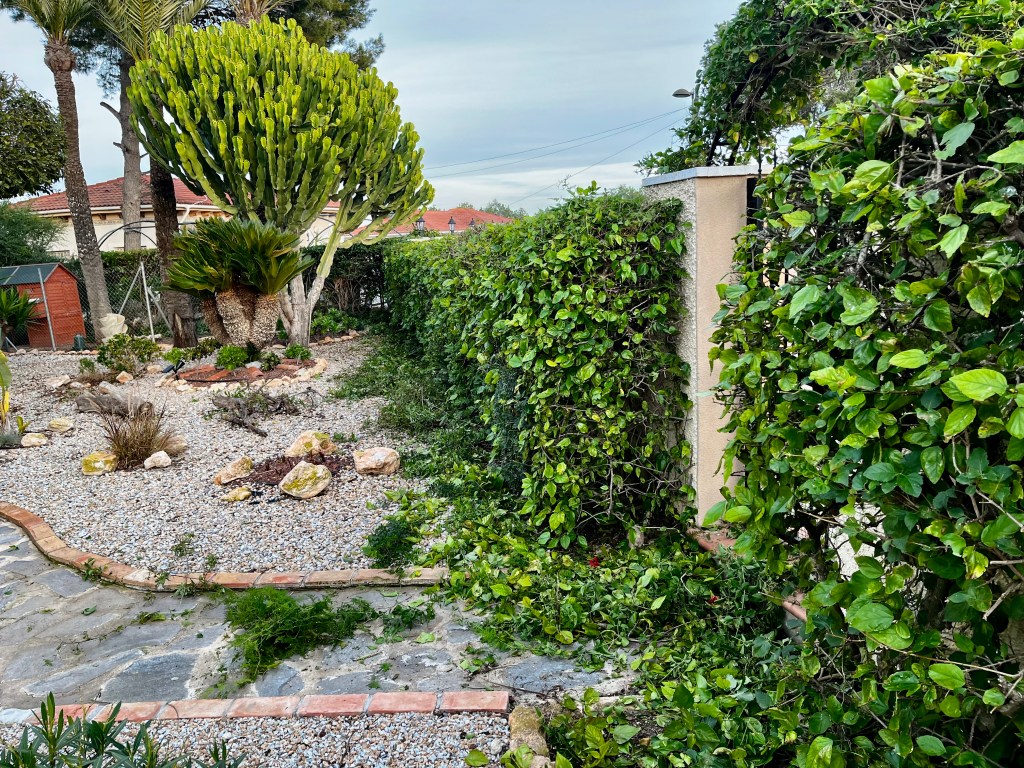
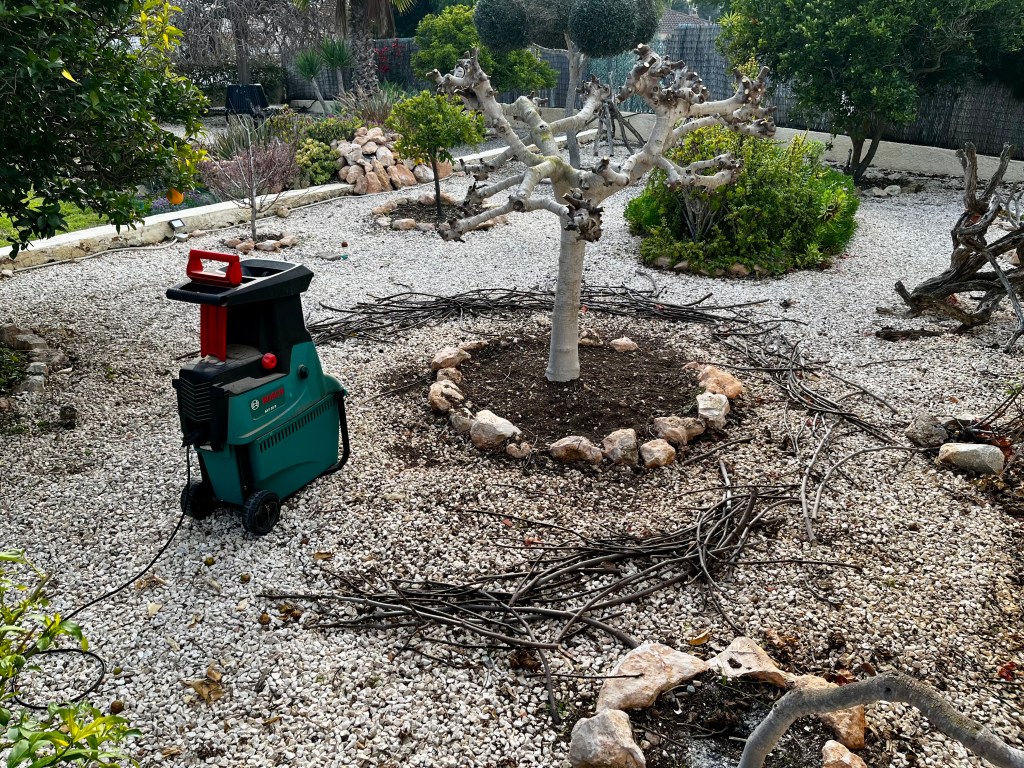
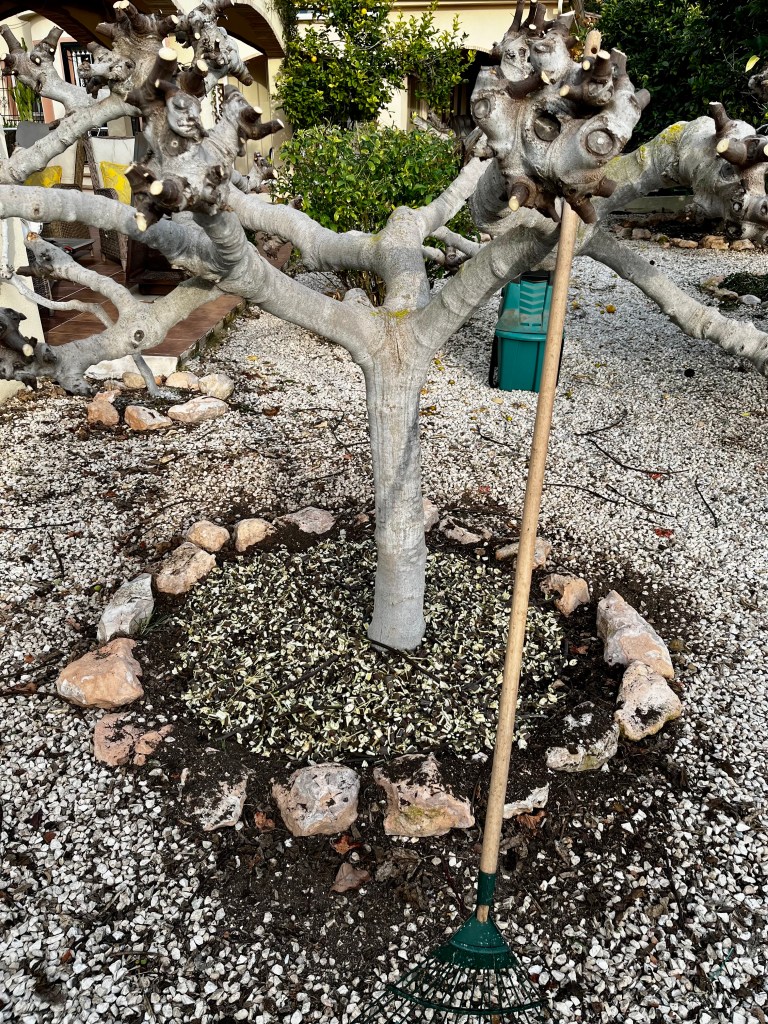
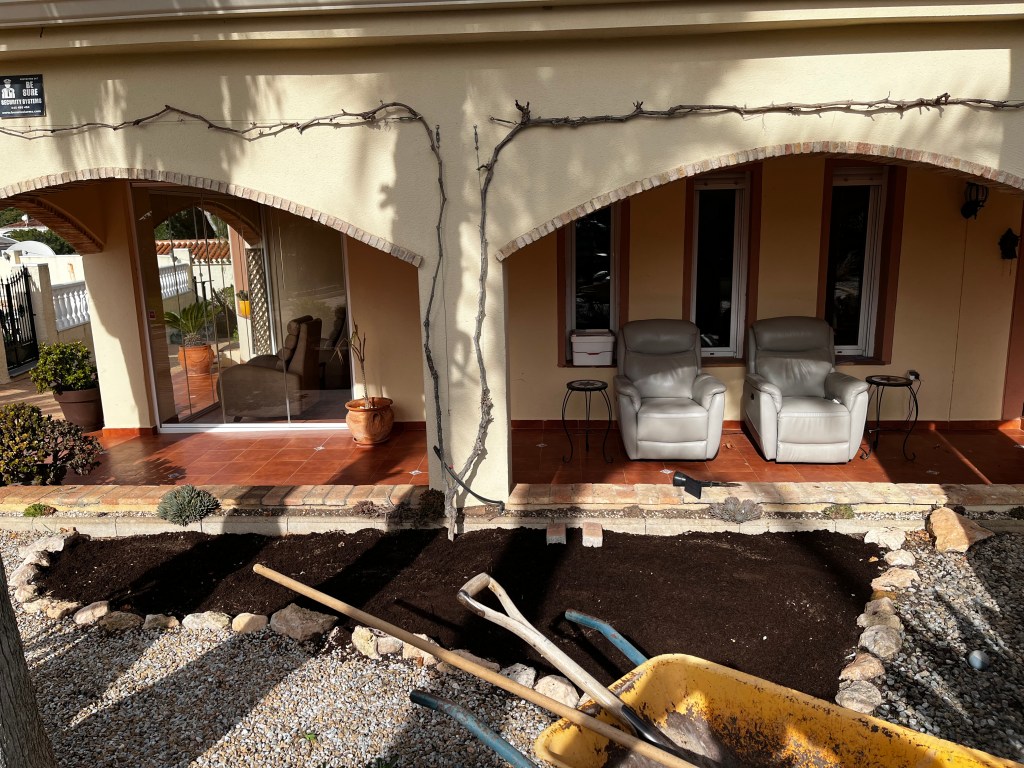
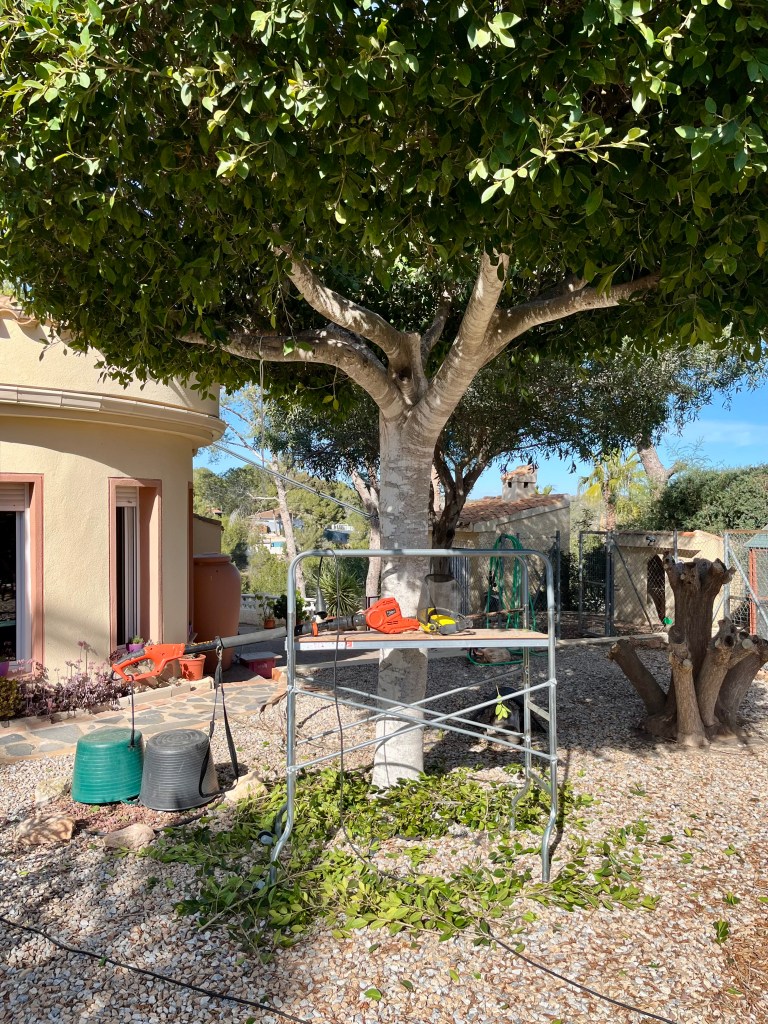
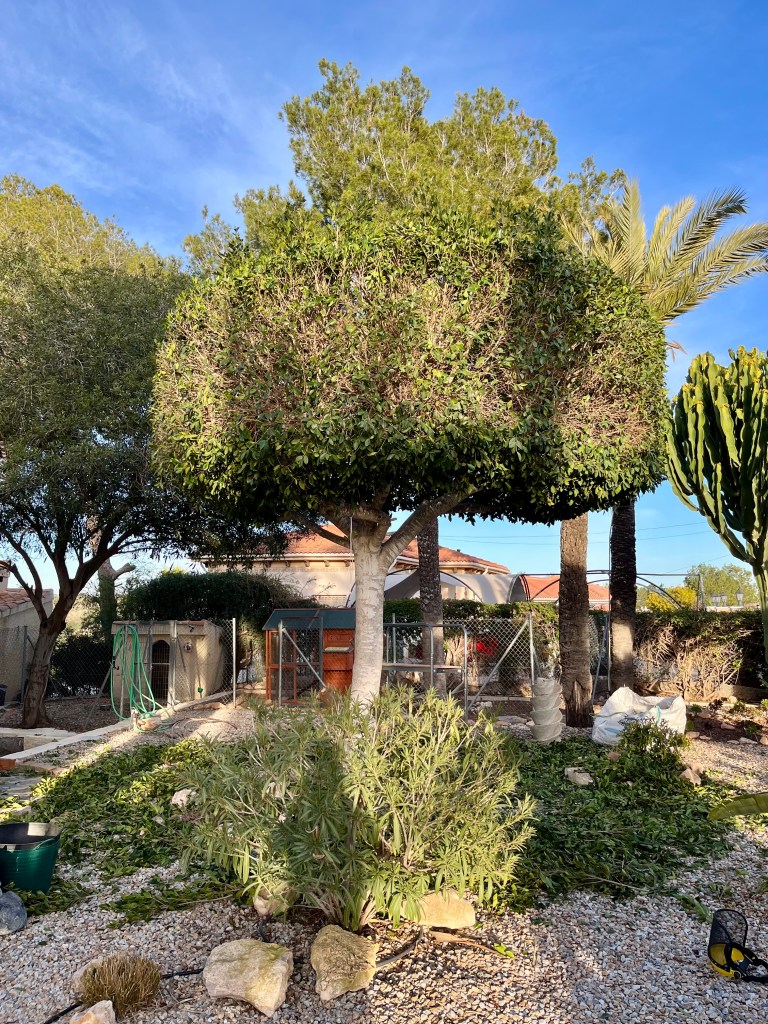
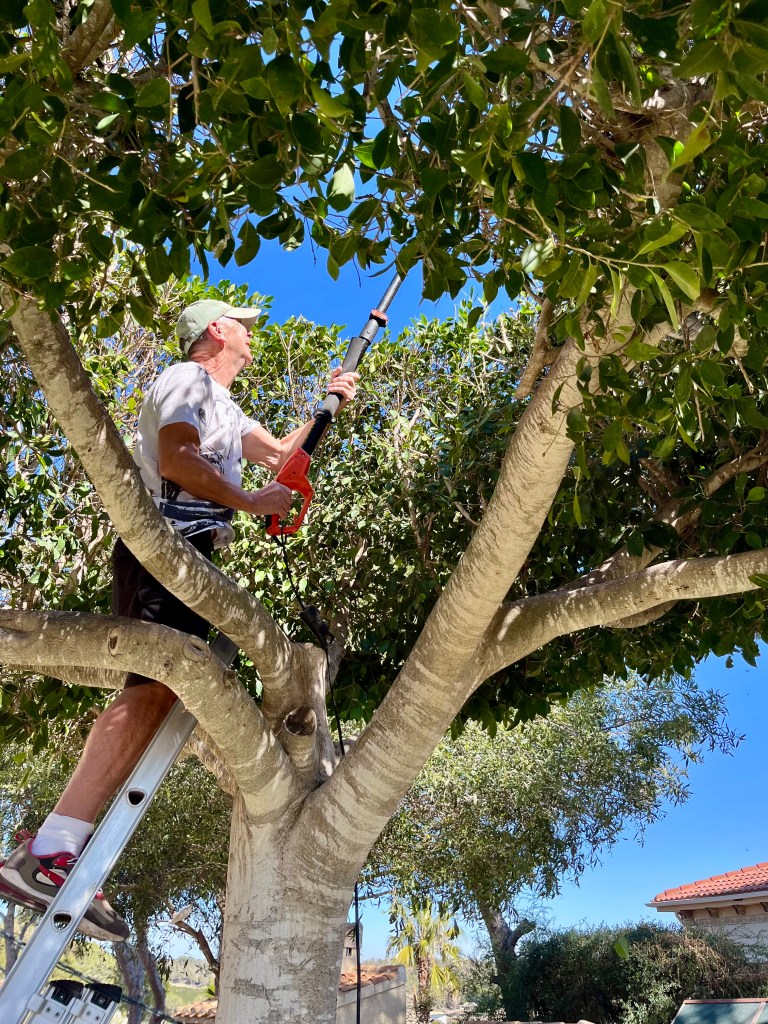
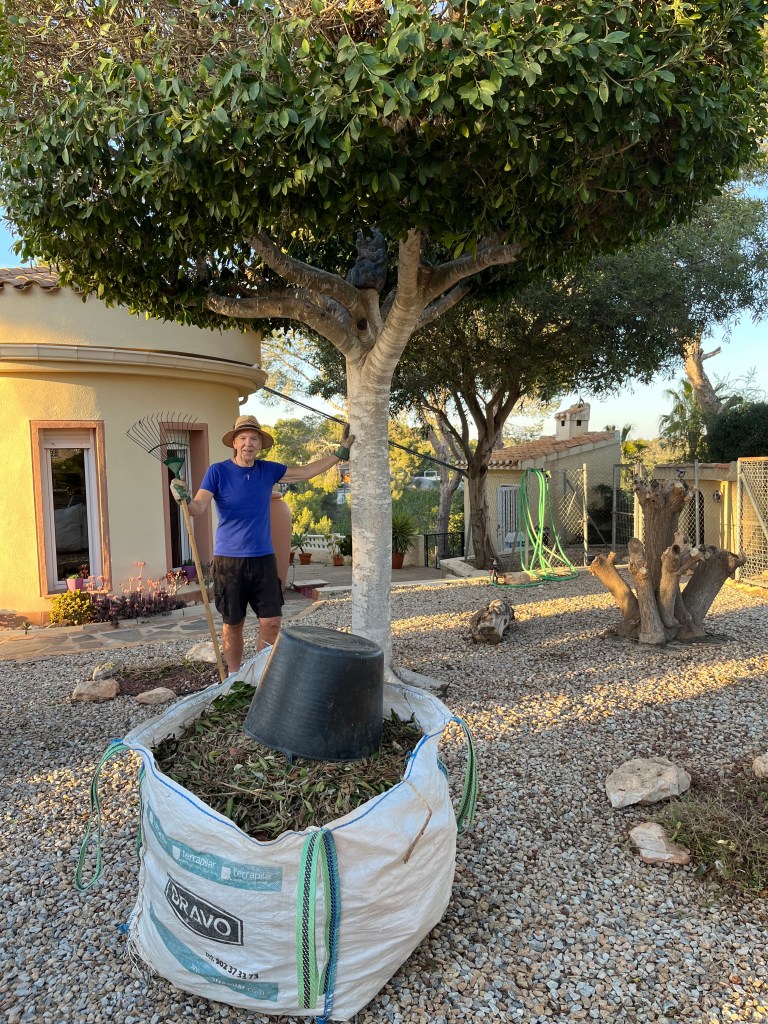
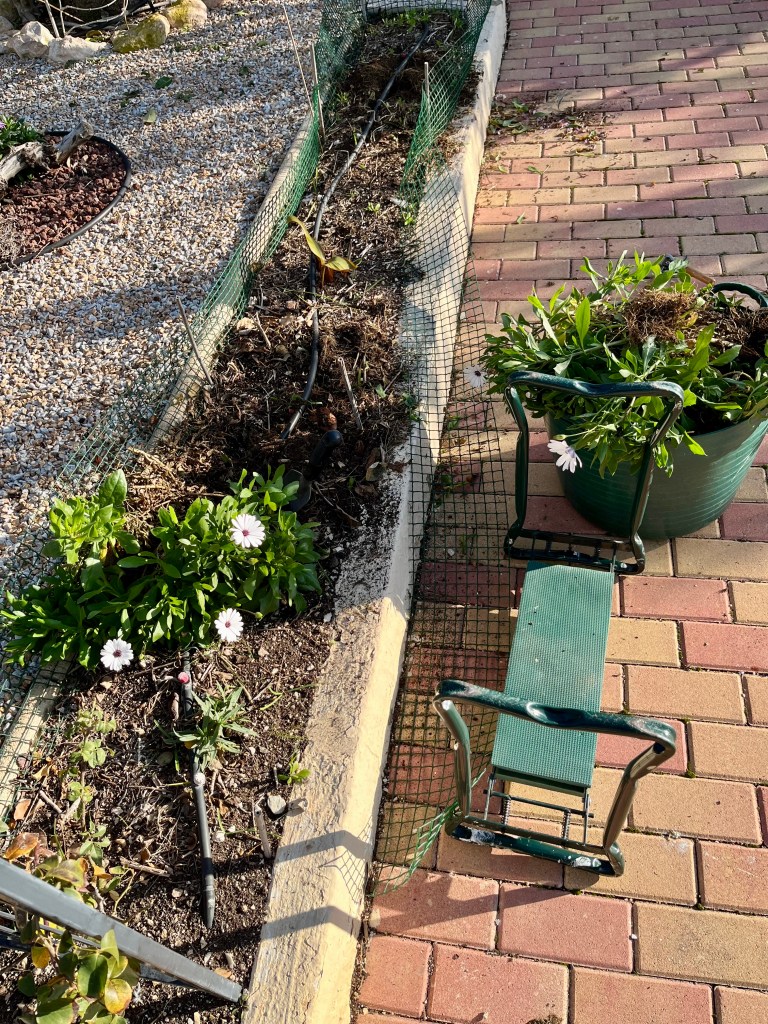
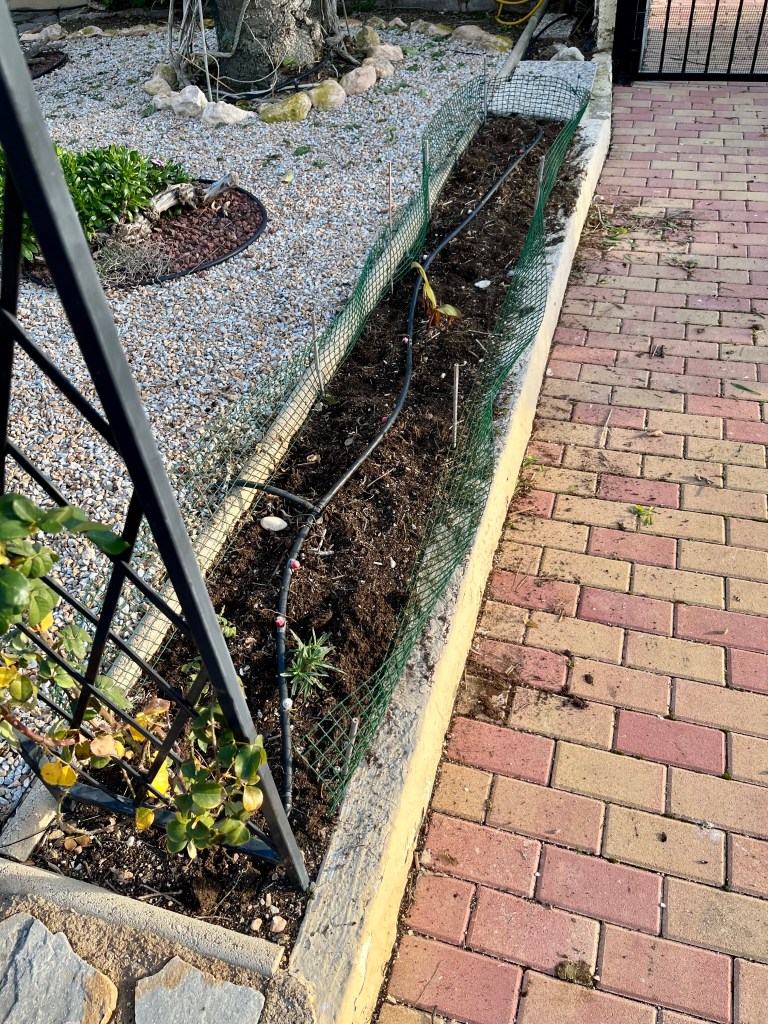
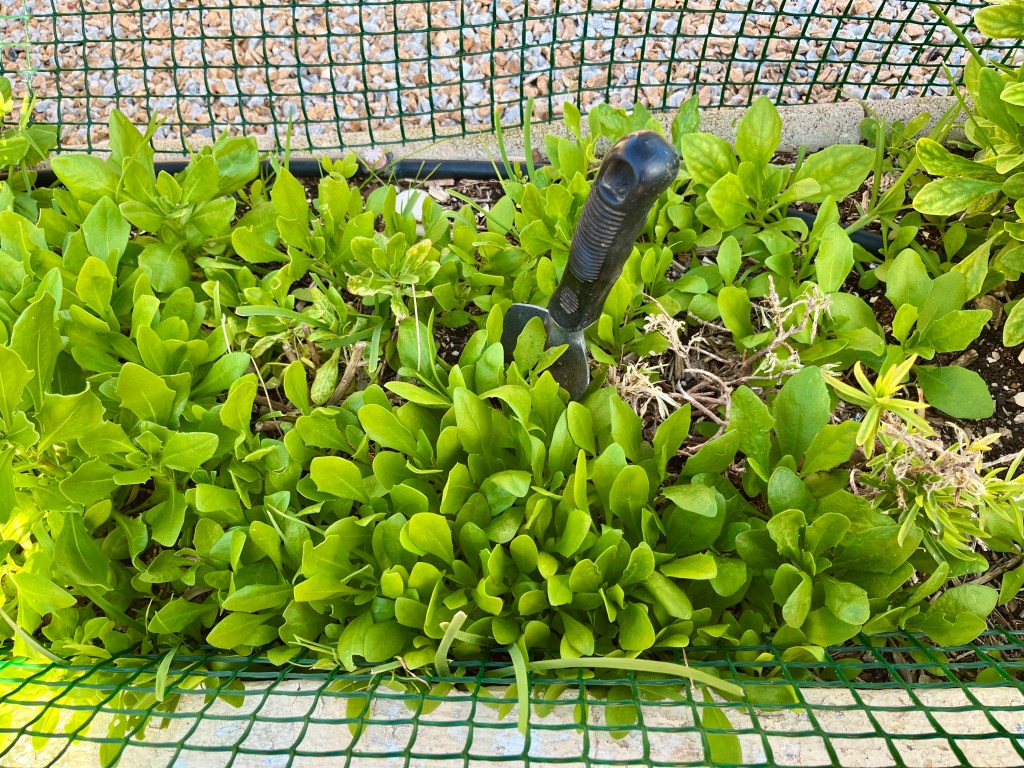
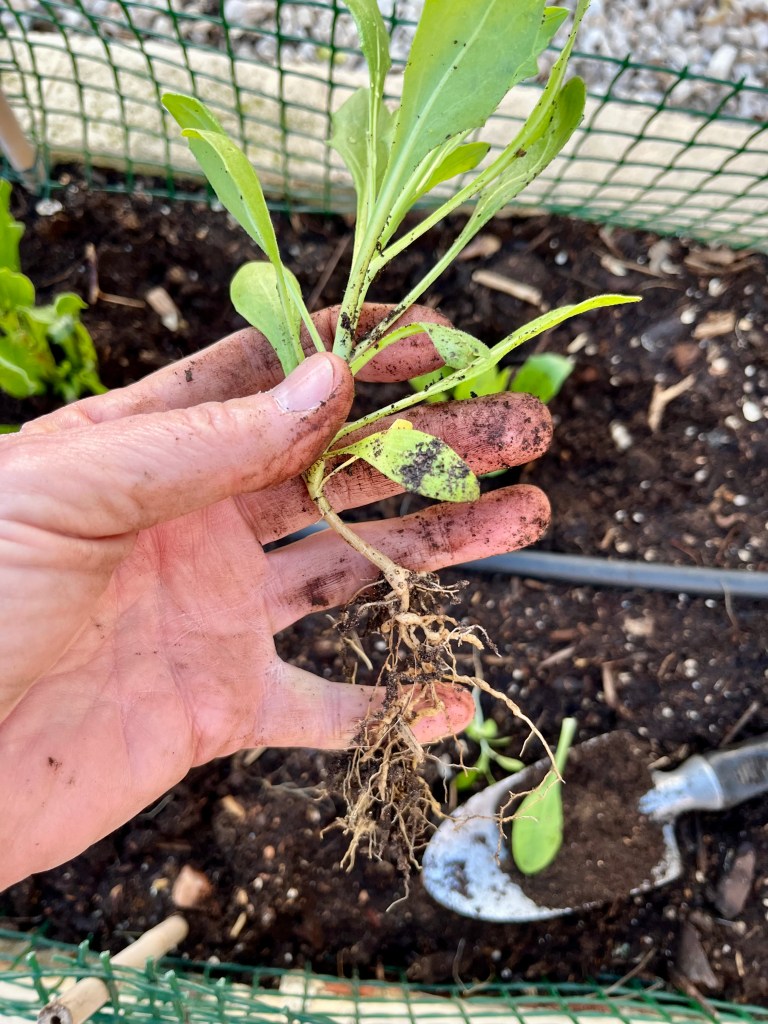
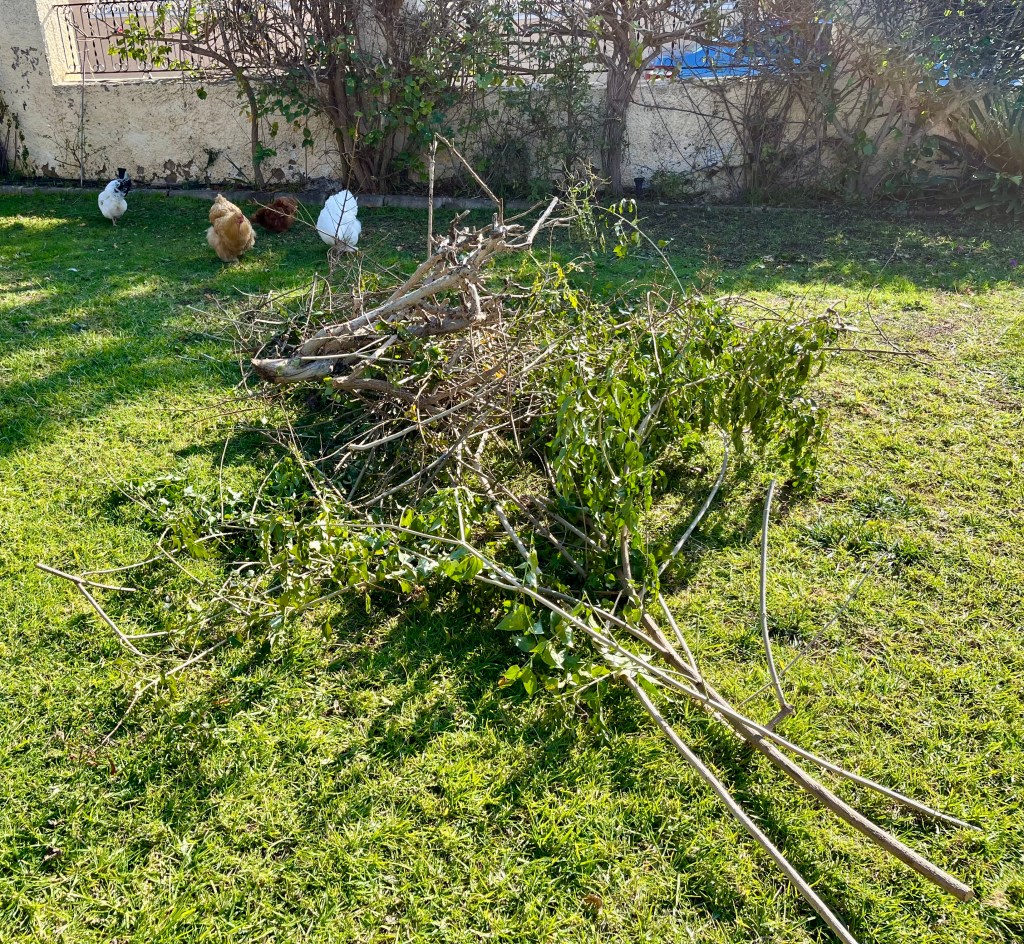
The big Winter cutback Part 1. and the chickens think we are having Tofu for Christmas dinner
Well it’s that time of year again when gardeners need to “stiffen up the sinews and summon up the blood…once more unto the garden, dear friends” yes, it is time for the big winter cutback.
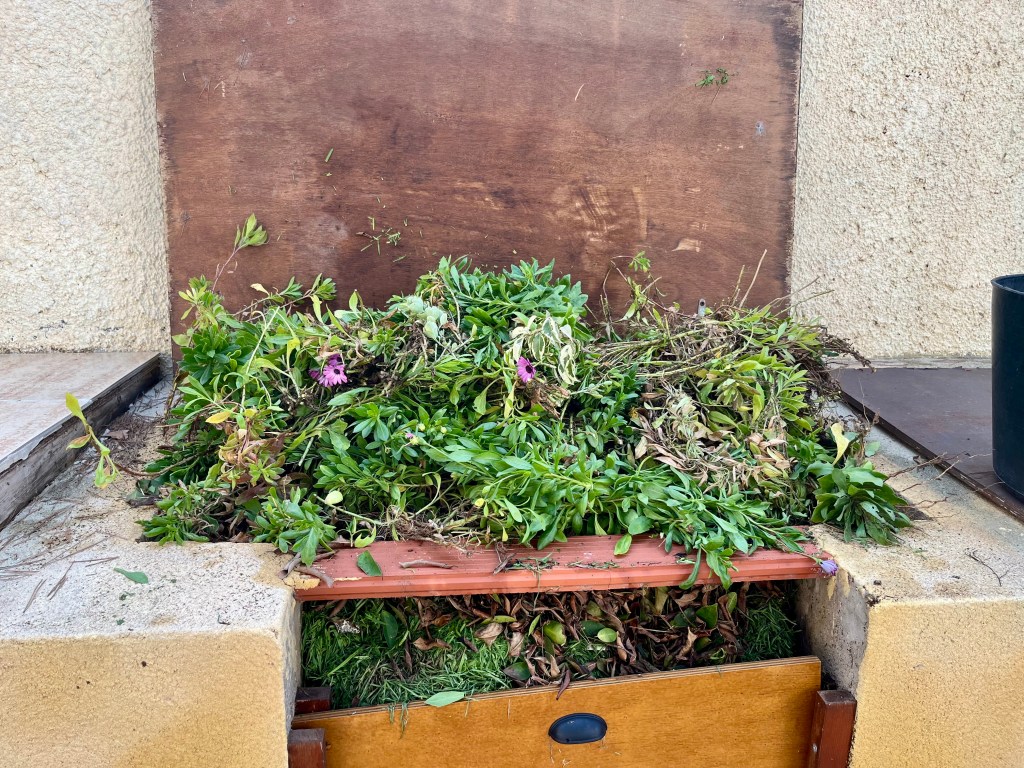
If you prune and cutback your garden now you will see amazing results in spring and summer; failure to do so will leave your garden tired and browning during the summer months. Over the next few posts I will be be cutting back my garden which is full of common Spanish plants that you will find in your garden, and if you follow me week by week then by the time we have finished your garden will be ready for the summer.

The only thing that will hold me back is the obvious festivities celebrating the birth of Christ and the fact that Cruella (my wife) is in paroxysms of ecstasy as she awaits the arrival of our idiot son. All week she and the chickens have been preparing for the return this has included a special Christmas song, a dance and a Japanese Haku – he speaks Japanese and a bit of English! I thought you might like to see the Haku:

Wings flare, voices rise – Our lost chick returns at last, – Yuletide clucks resound.

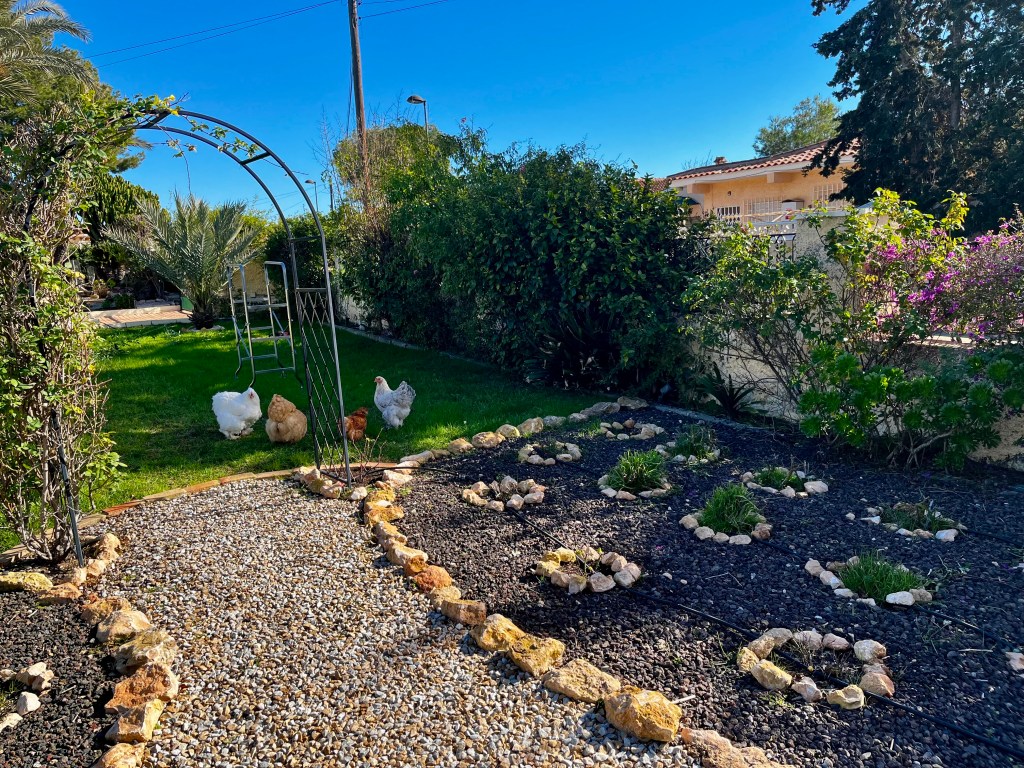
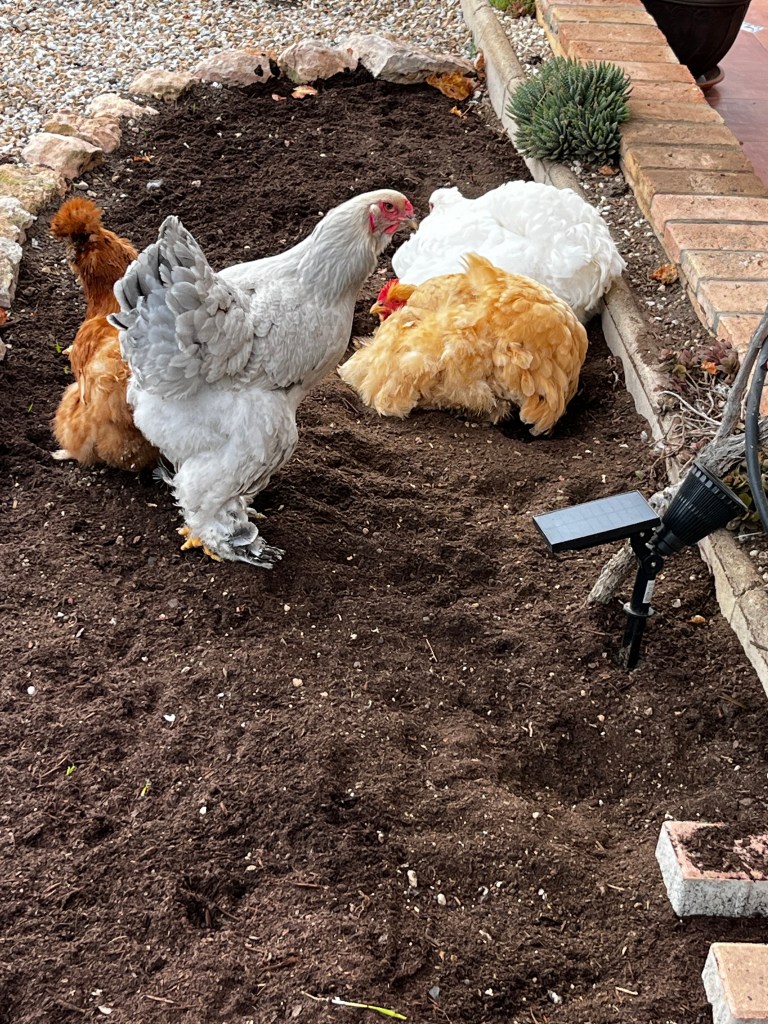
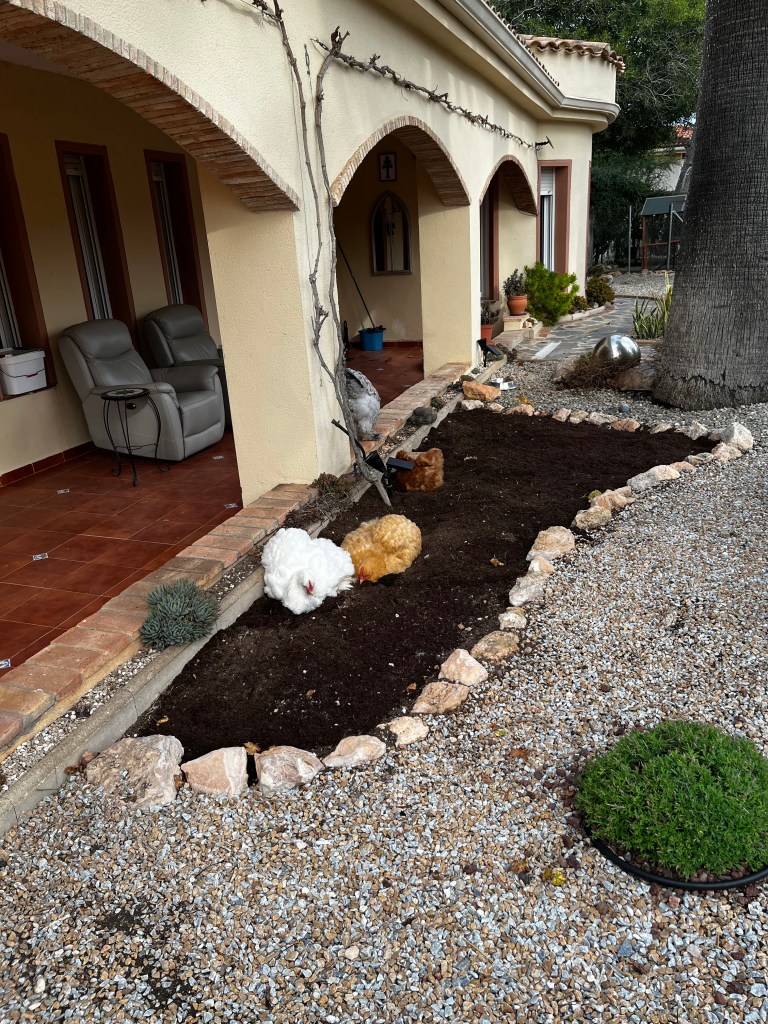
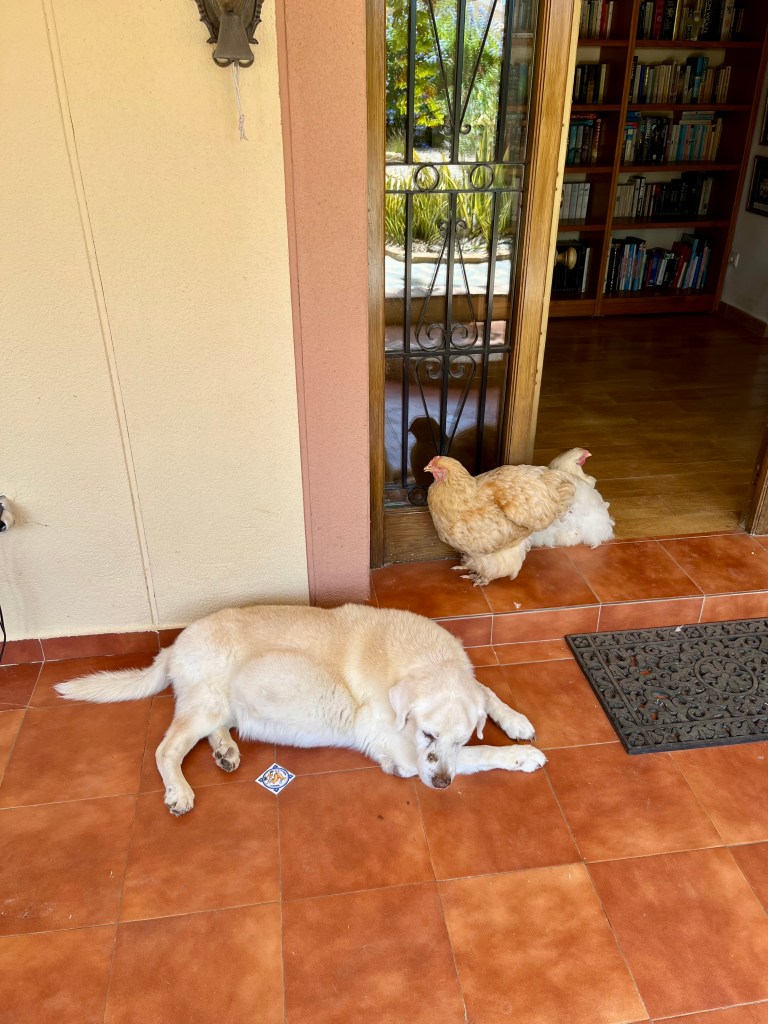
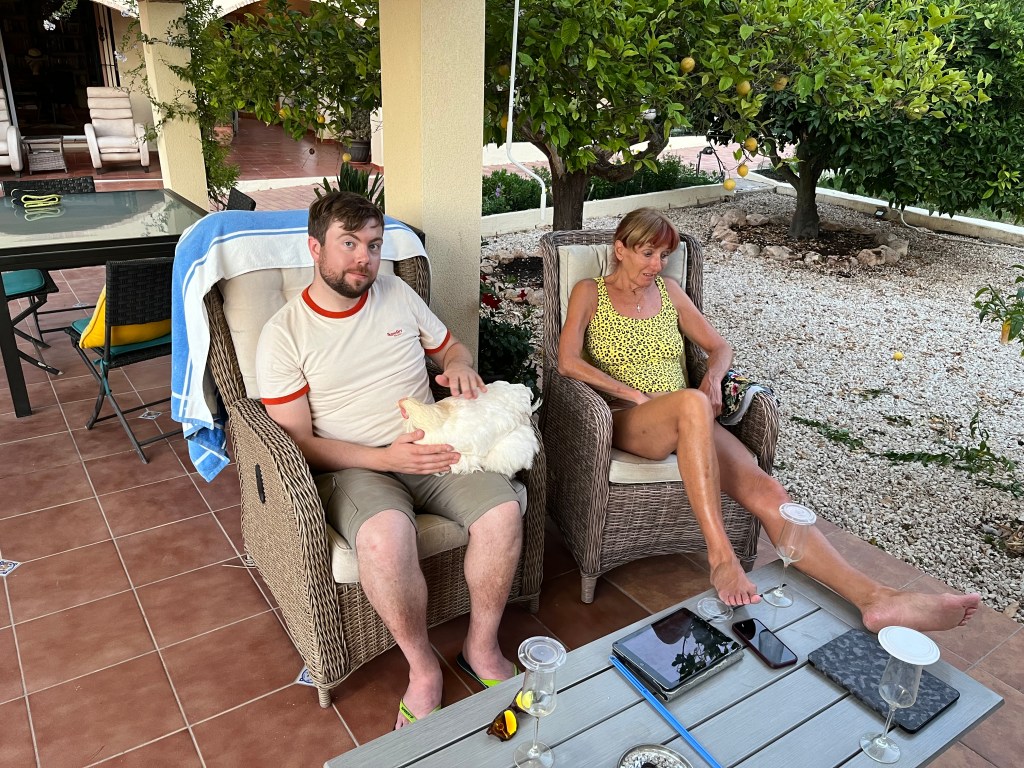
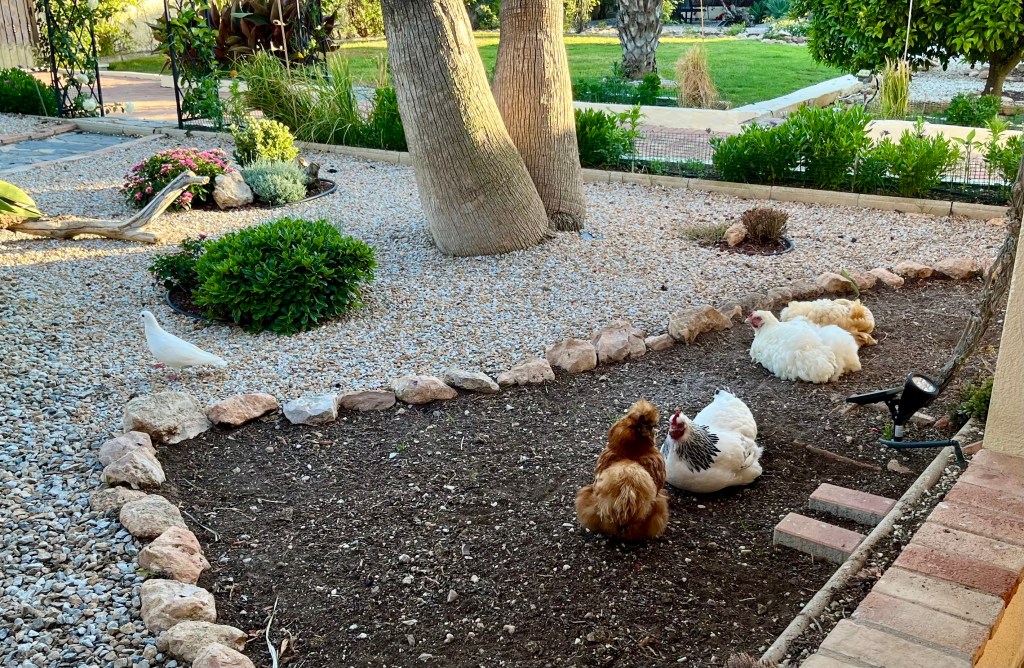
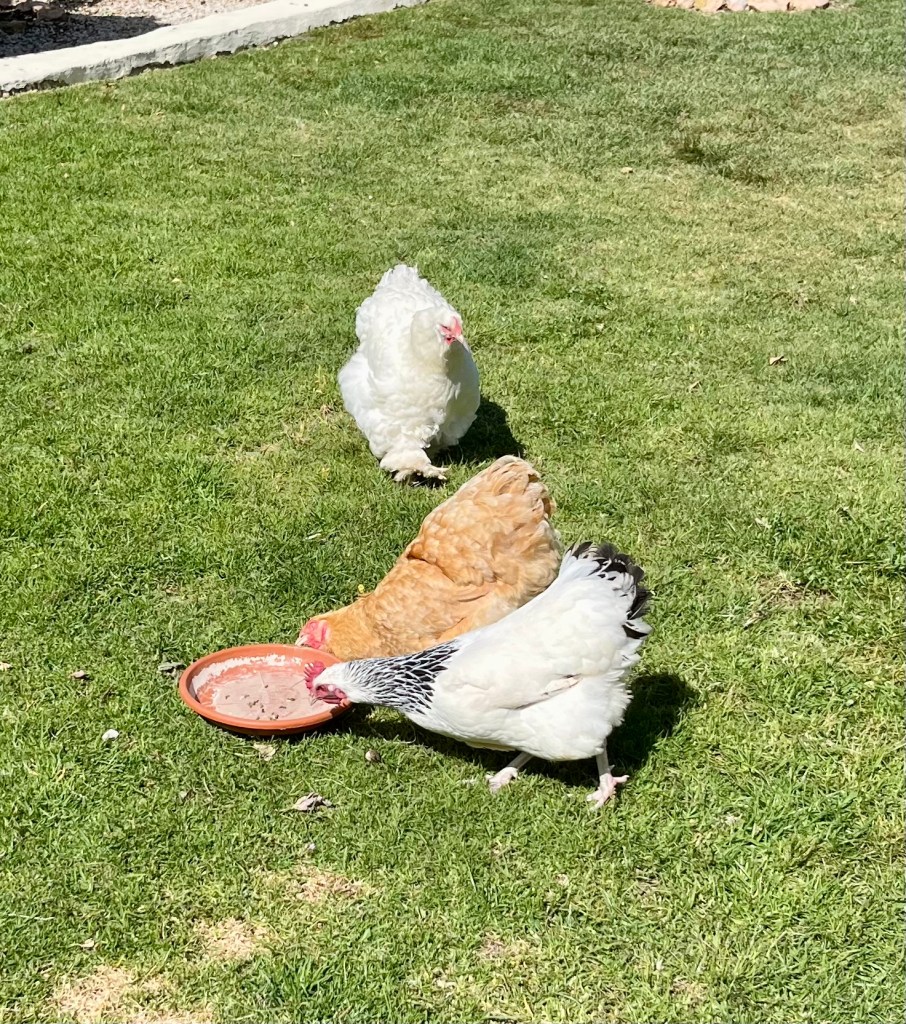
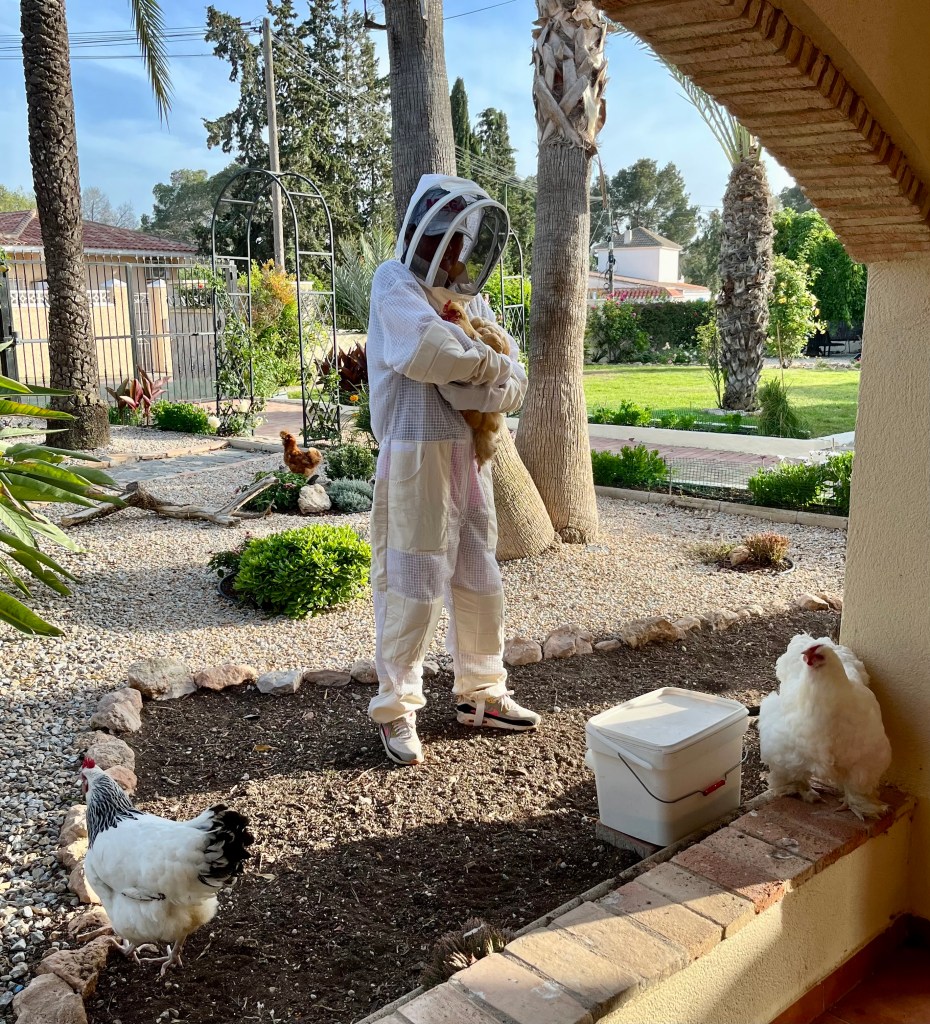
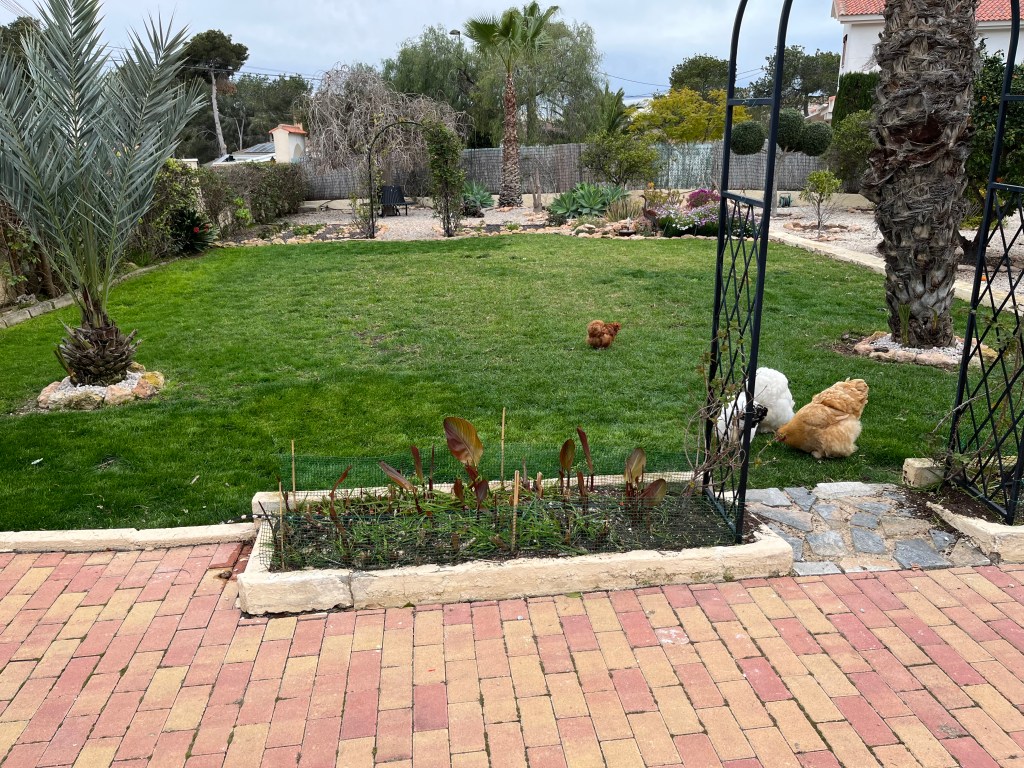
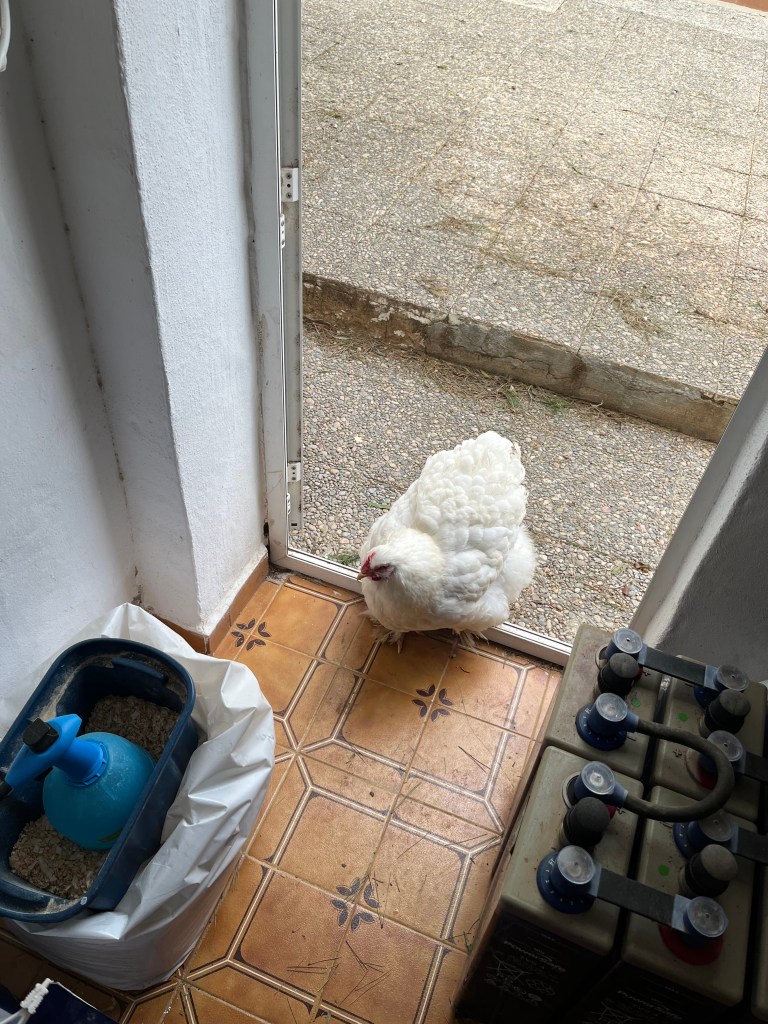
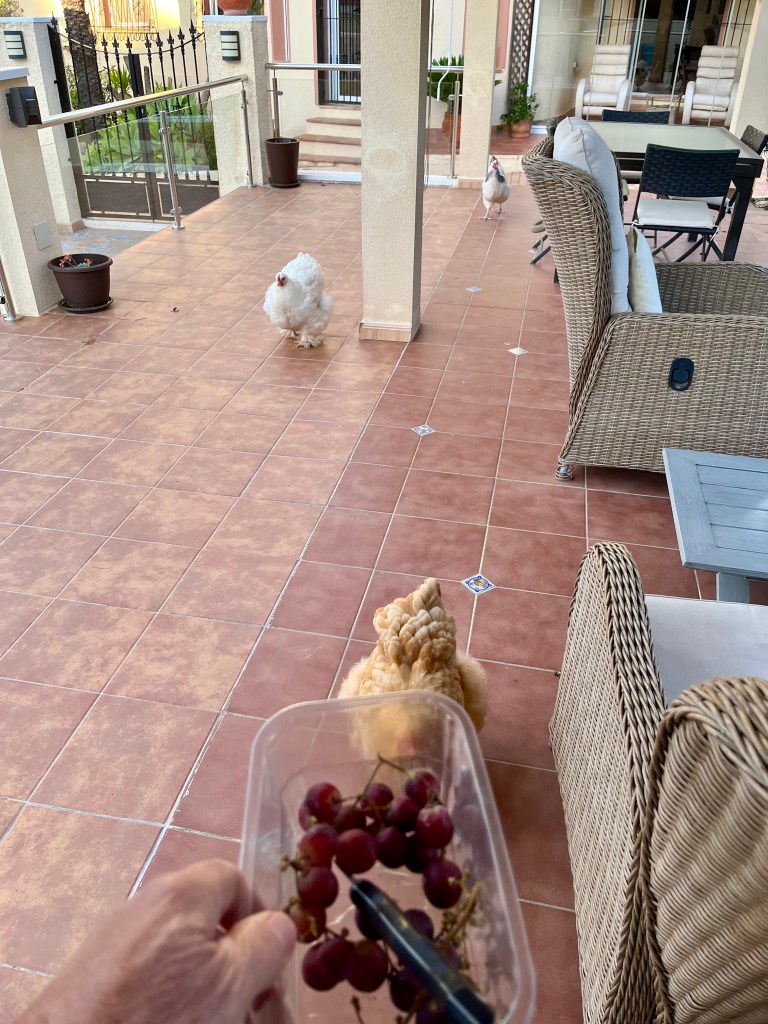
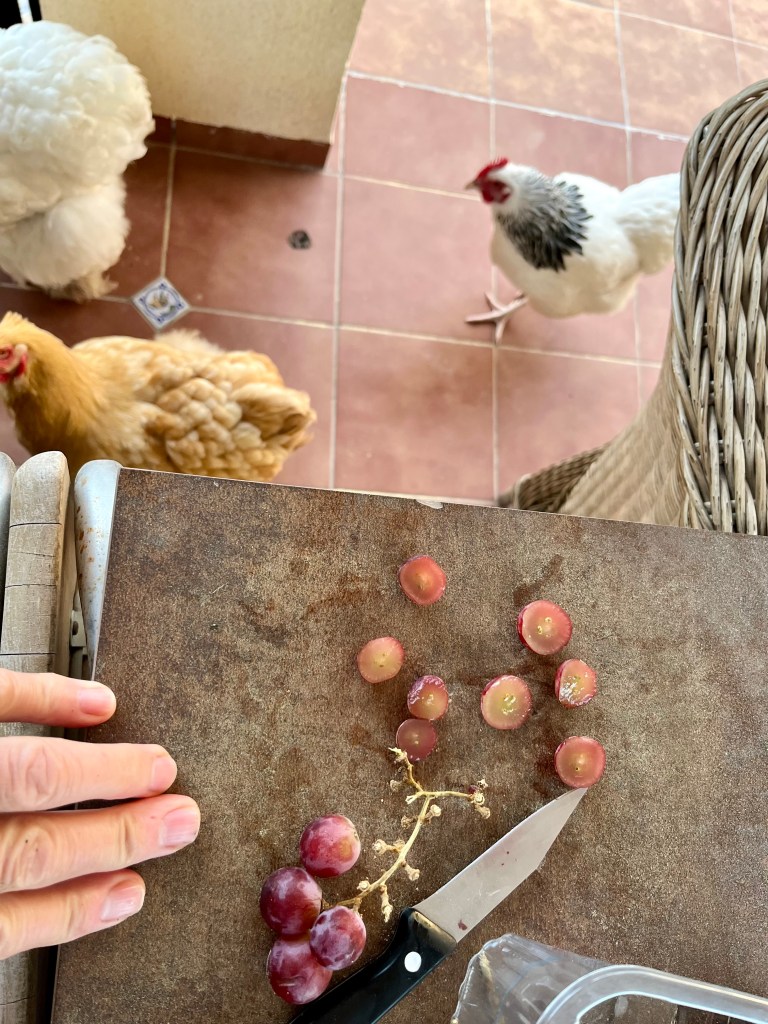
In addition she has told the chickens that we are having Tofu for Christmas dinner which is of course inaccurate as we are having Turkey; so I now have to call it the “T”word in front of the chickens. The photo below shows the chickens practicing the Haku.

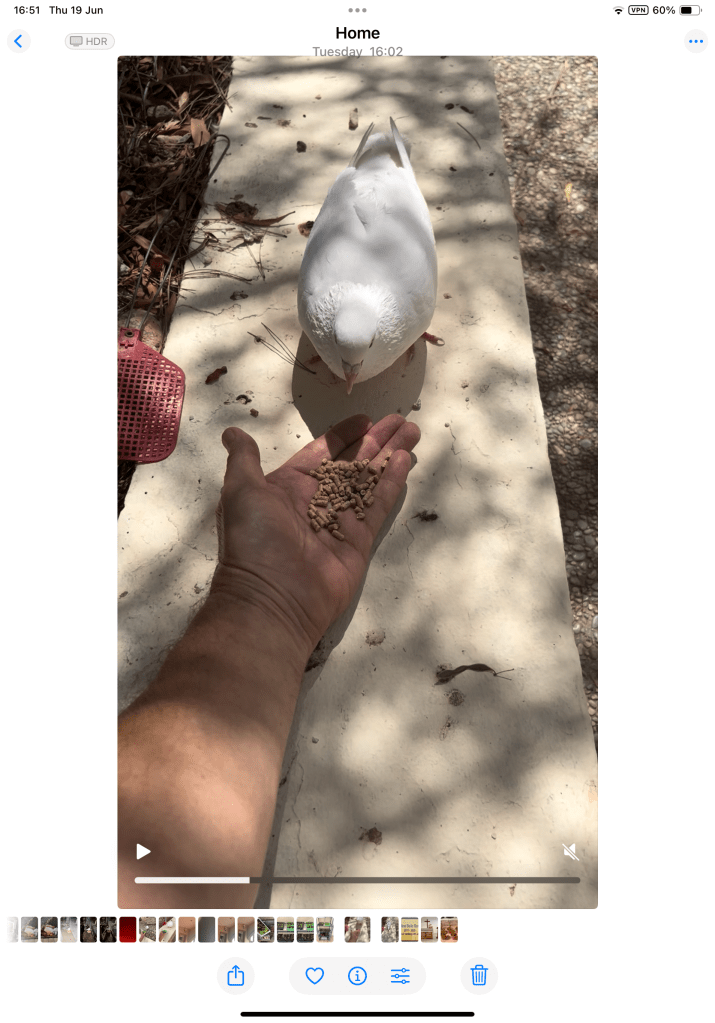
The little white dove leads the chorus

Anyway enough of this festive nonsense, on with the gardening.

13th December 2025. Things I have been doing lately:

  • Over wintering Chillis
  • Pruning Dame de Noche
  • Trimming Oleander
  • Cutting back my towers of flower
  • Pruning Mediterranean Fan Palms

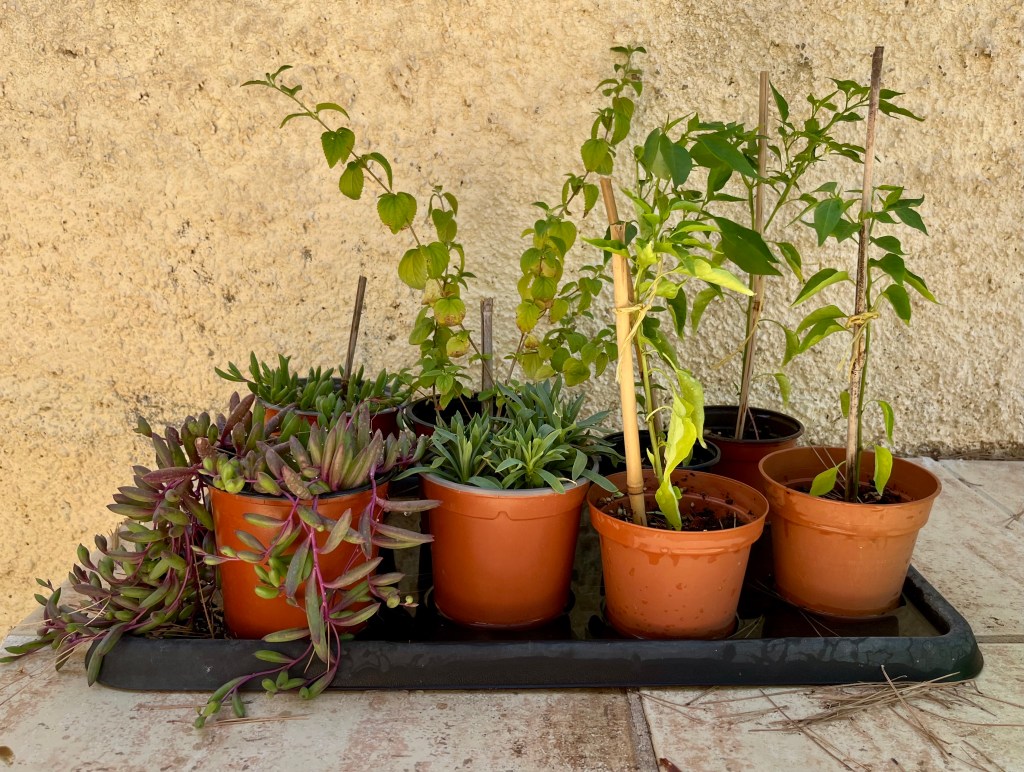
Over wintering Chillis. I do not grow any vegetables apart from Chillis, and if you do the same then it is time to overwinter them.

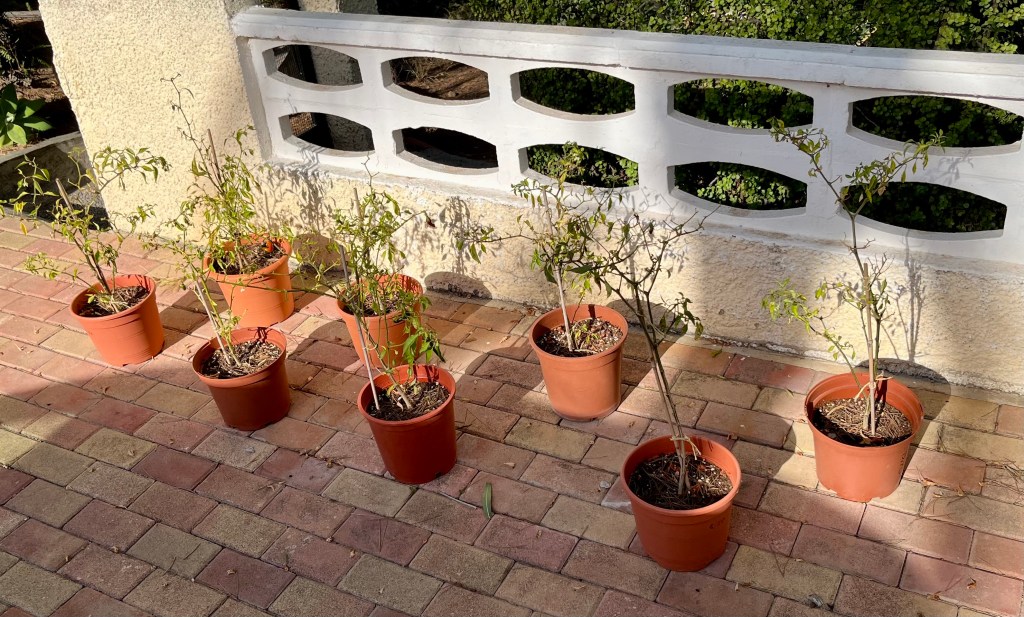
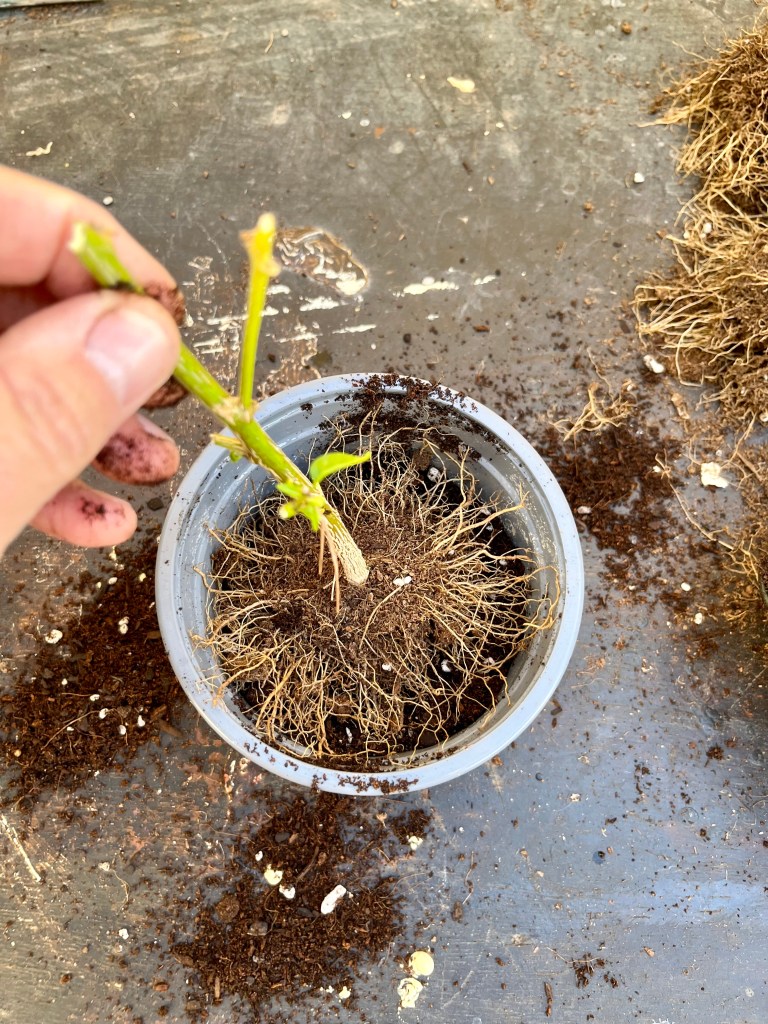
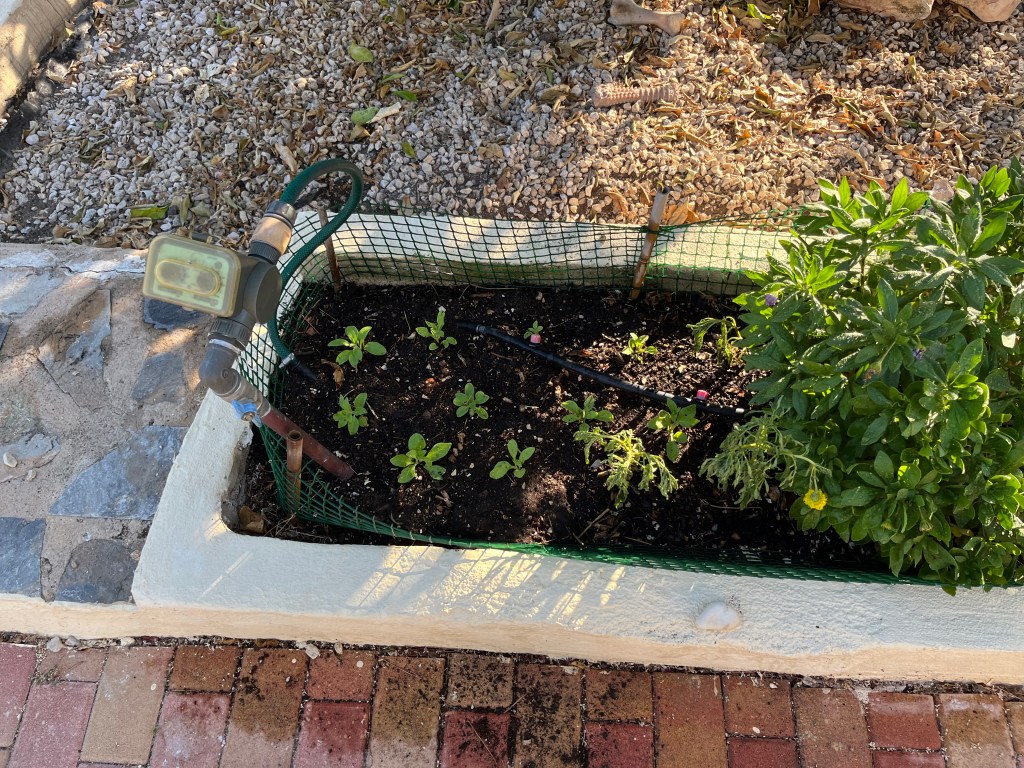
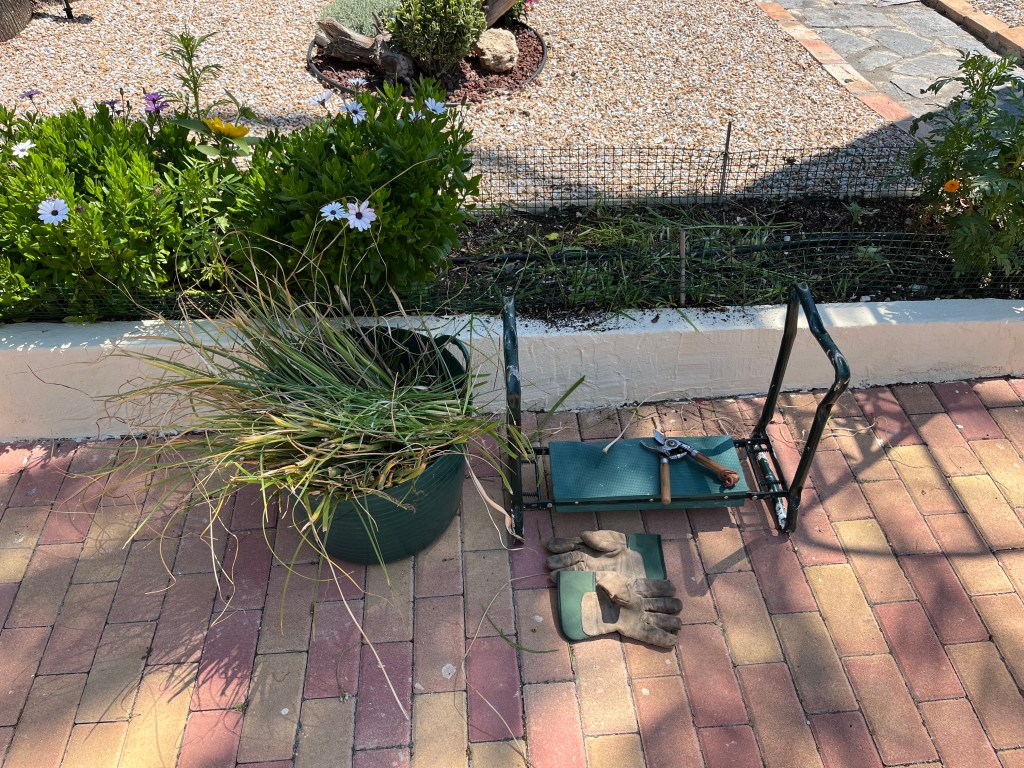
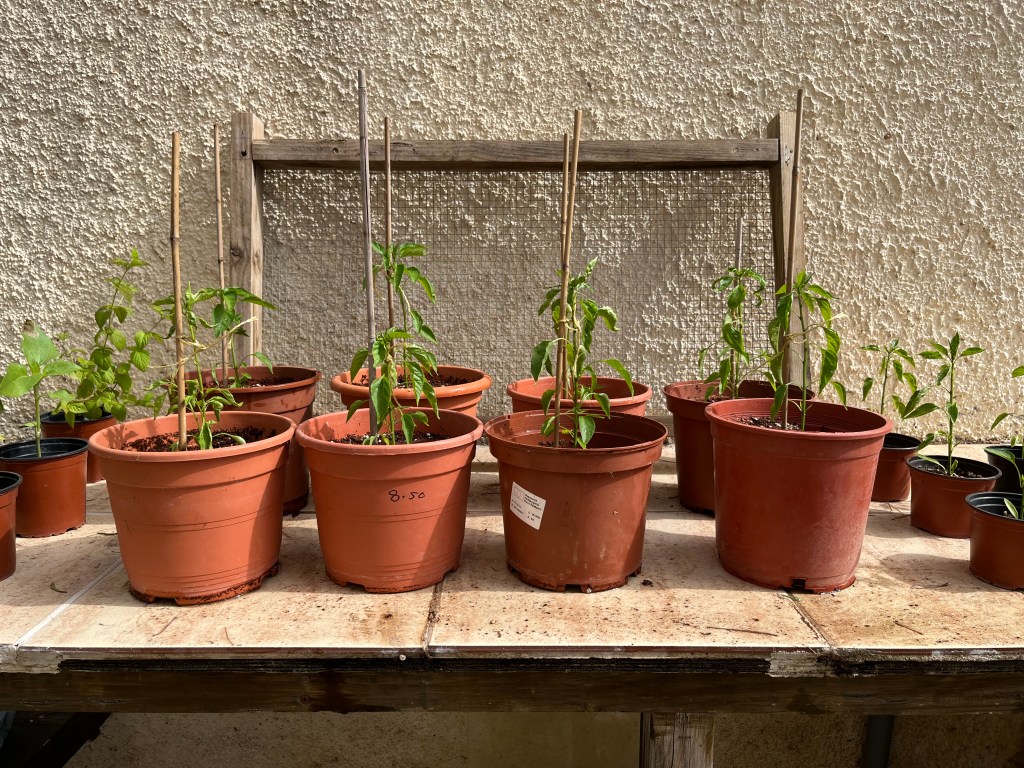
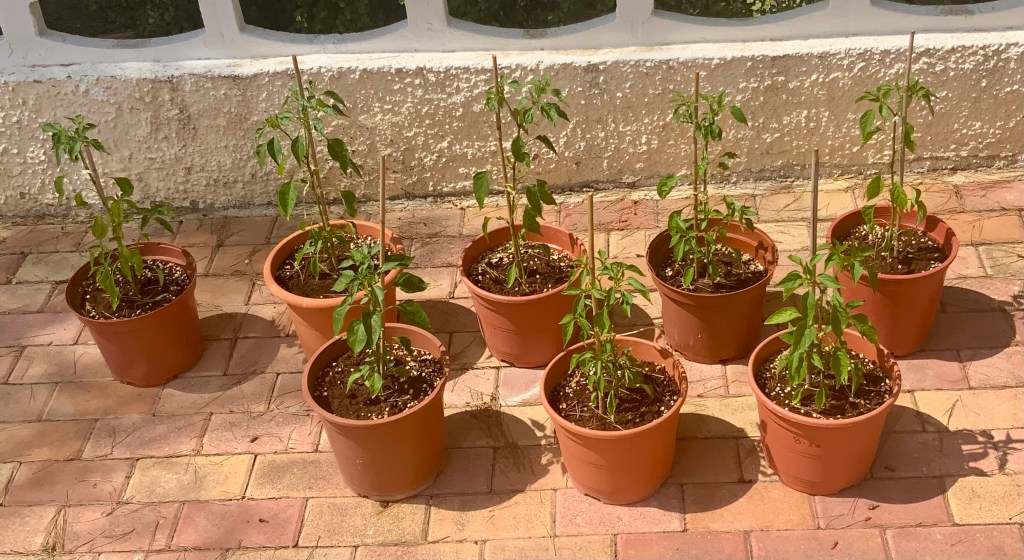
By now your Chilli plants will be looking tired and a bit ragged and their compost will be completely exhausted. If you leave them like this over winter then they will die. The photos below shows my exhausted Chillis before their cutback and after the big trim. To revive them you first need to cut the whole plant back leaving just a few leaves low on the stem.

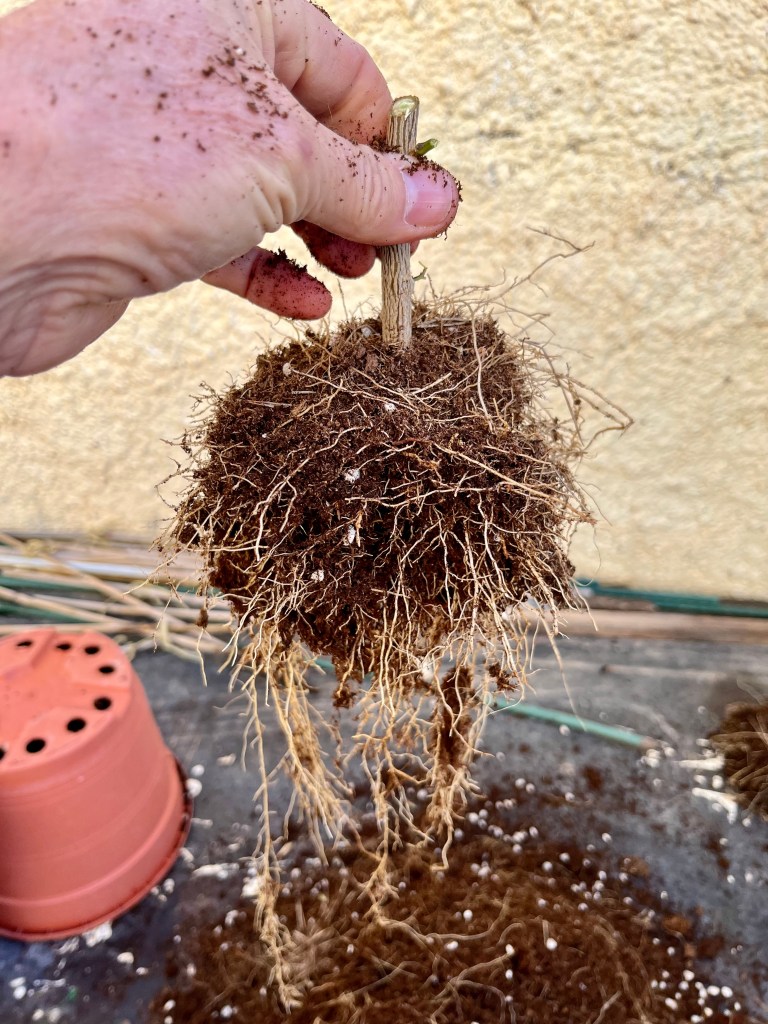
Once you have done this you then need to ease each plant out of its large pot ready to fit into a smaller overwintering pot. As you take each plant out radically trim its roots – it won’t need all these roots in a small pot. You then need to repot your plants into a much smaller pot. You need to use a good quality compost to refresh them. Water profusely then leave them sitting on your potting bench over winter. When they start to show new growth in the spring, ease them out and back into their bigger pots and off you go again.

The photos below show the chilli reviving process in action.

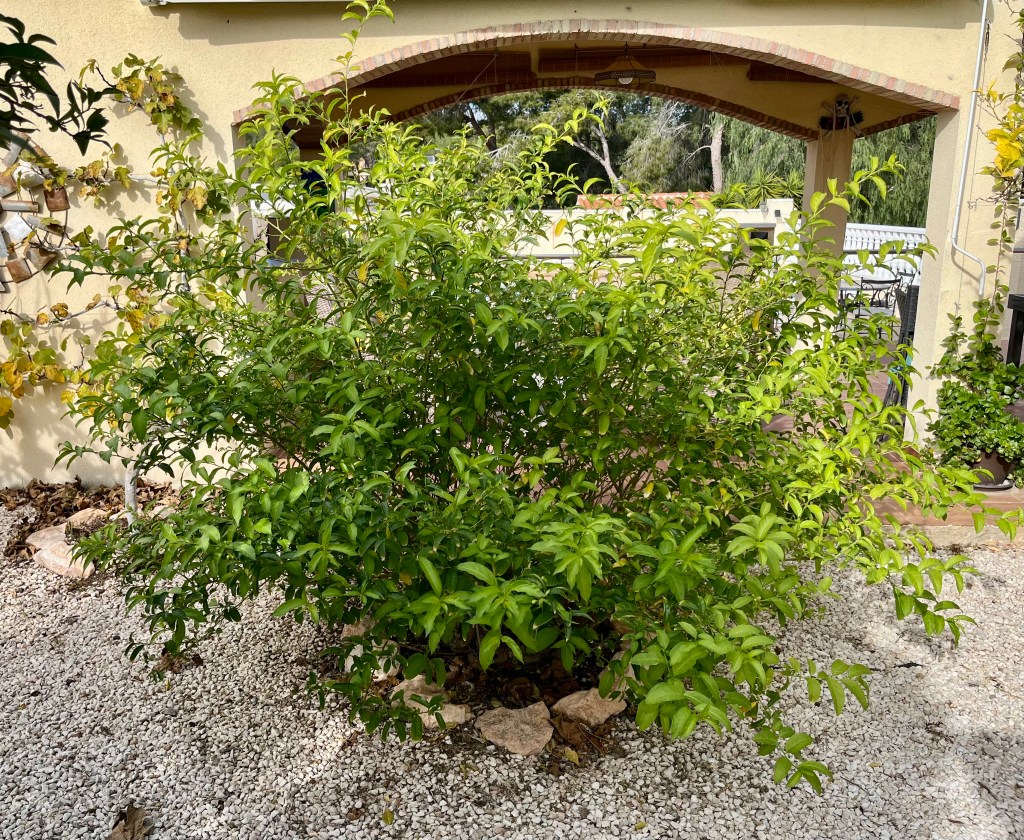
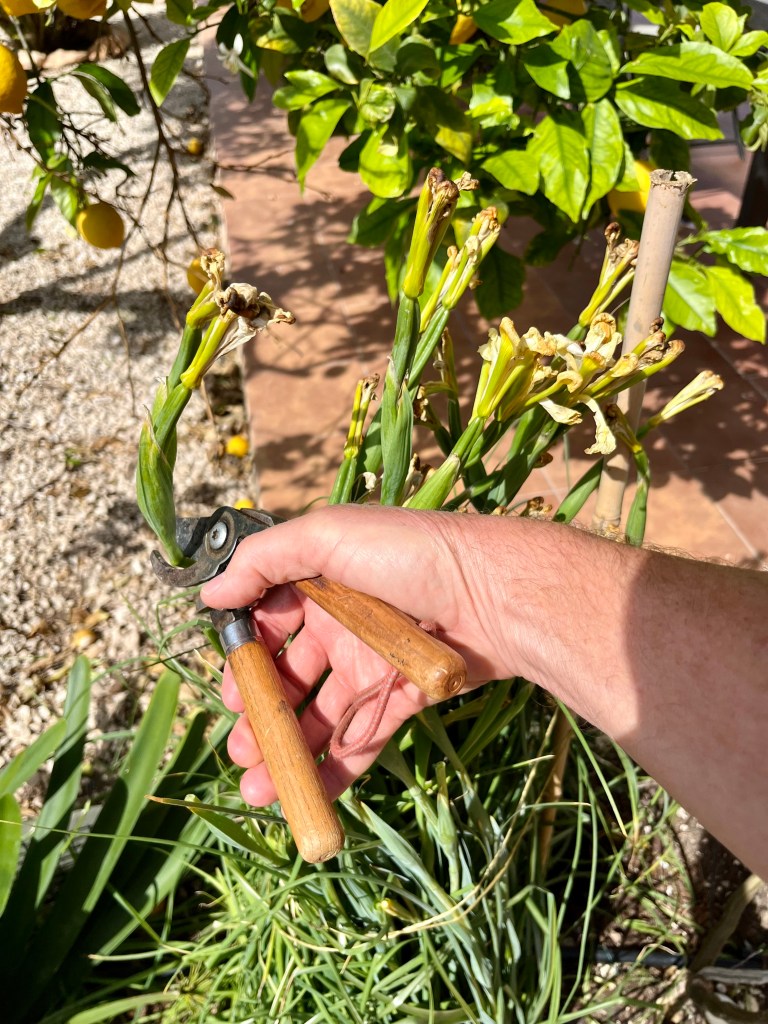
Pruning Dame de Noche. Night flowering Jasmine is a perennial favourite in Spanish gardens, prized for it’s beautiful night scent it is often situated by outdoor seating areas.

This plant can grow very tall if left to its own devices, but it benefits from two prunes a year. Prune once after it has flowered in June/July and it will re flower. Give it a final cutback to your preferred height in Dec/Jan – you can go as low as 18 inches. As I gave my plant a very radical cutback last year, I am leaving it longer this year. The photos below shows my plant before and after its haircut.

Trimming Oleander. Oleander is a Spanish favourite grown either as a single plant or as a hedge. I have a few dotted around my garden mainly as statement plants or part of a set area arrangement.

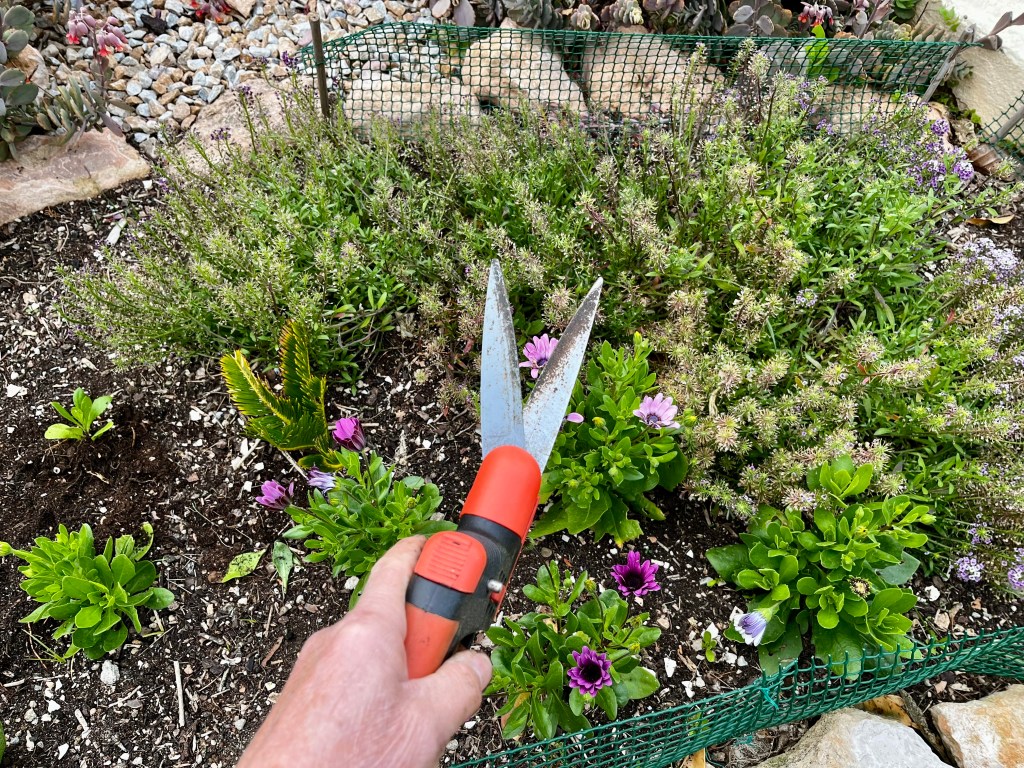
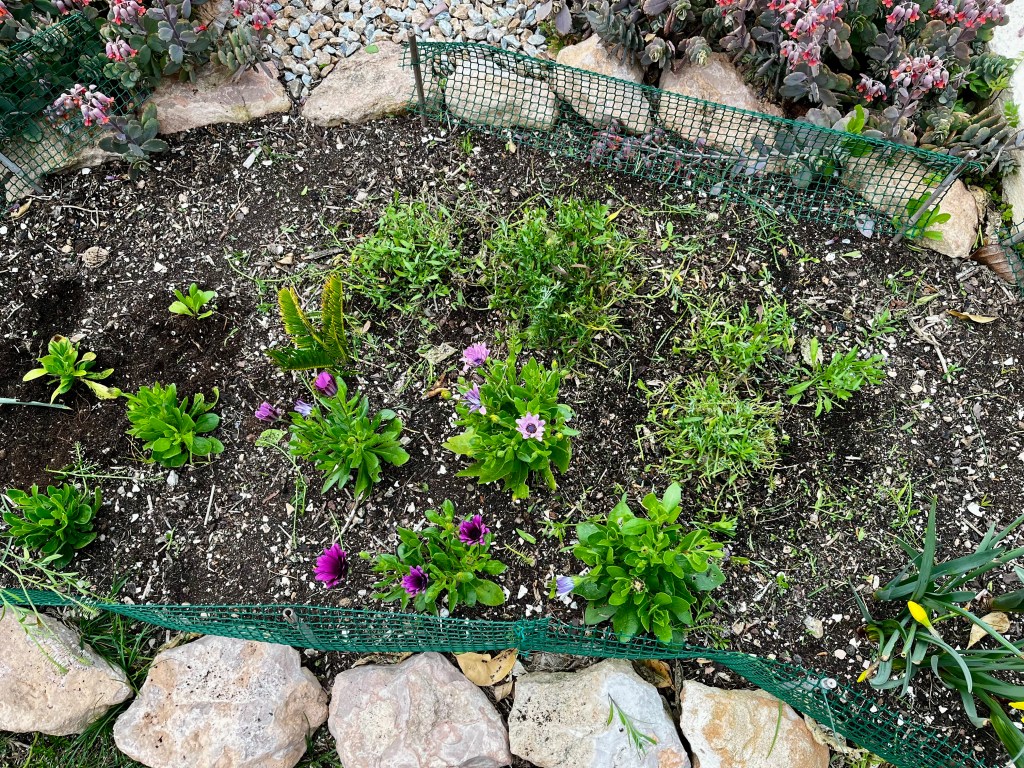
The first photo below shows an Oleander that I grow in my dry garden area as part of a set arrangement with Osteospermums and yuccas etc. If not cutback every year or so then the Oleander will overwhelm the other low growing plants and ruin the symmetry of this part of the garden. You can cut Oleander back quite radically and it will spring back within a year or so.

The photo below shows an Oleander that stands alone in another part of my garden as a statement plant. Here I only need to prune a couple of inches off the edge to keep the plant shapely.

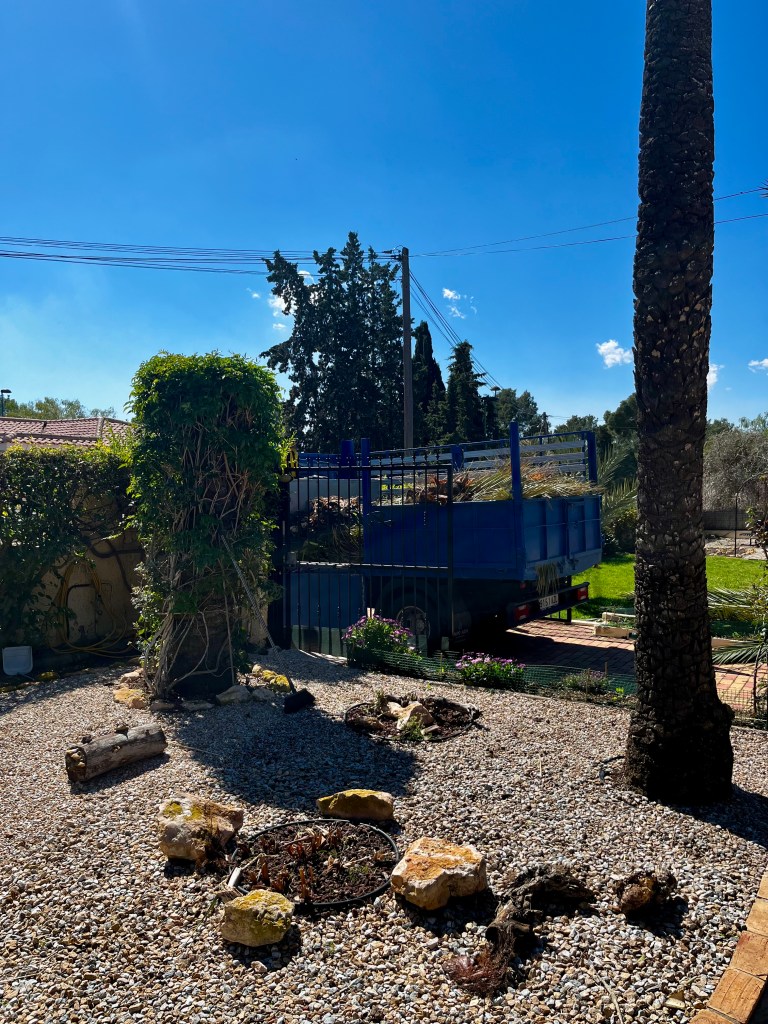
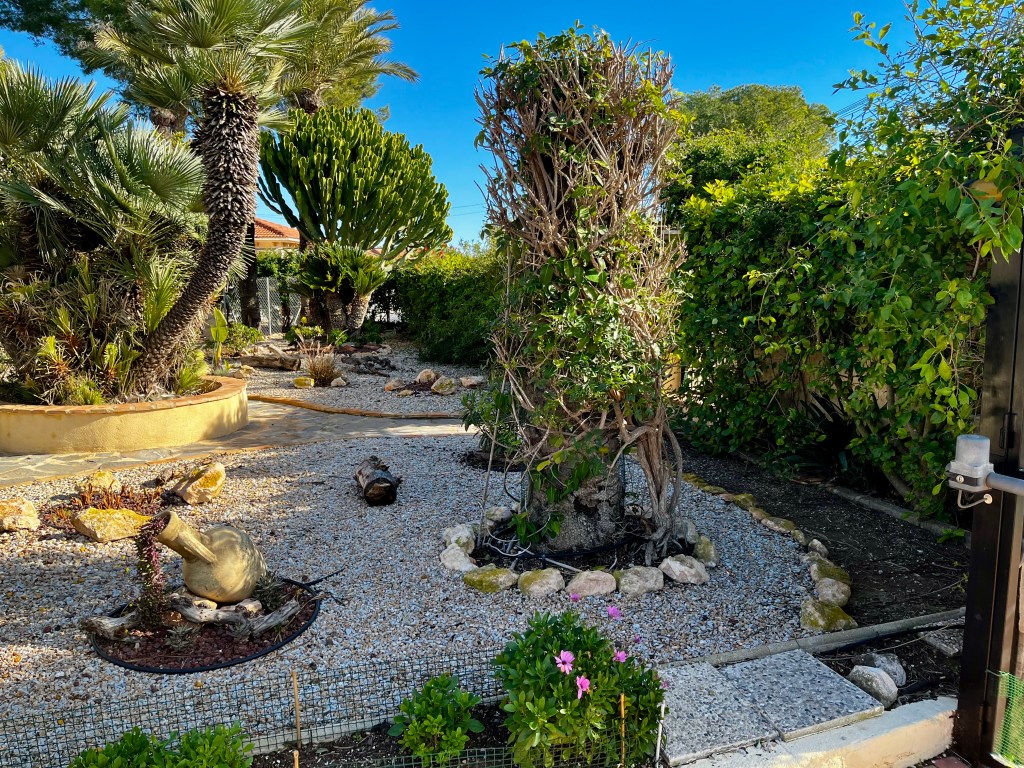
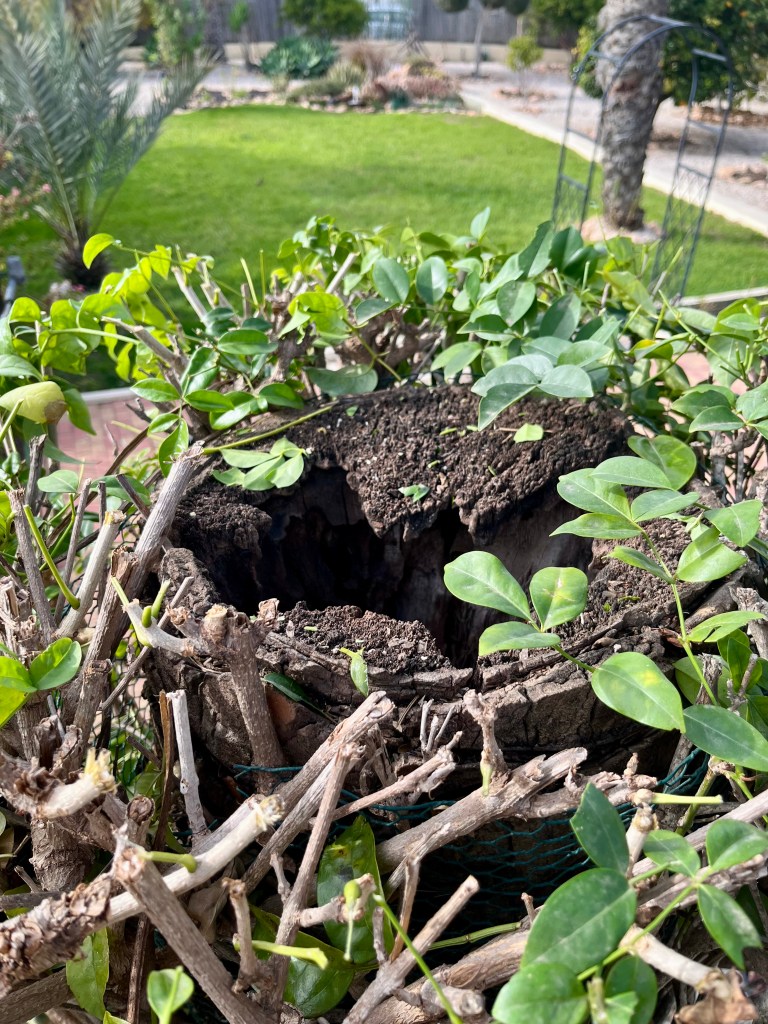
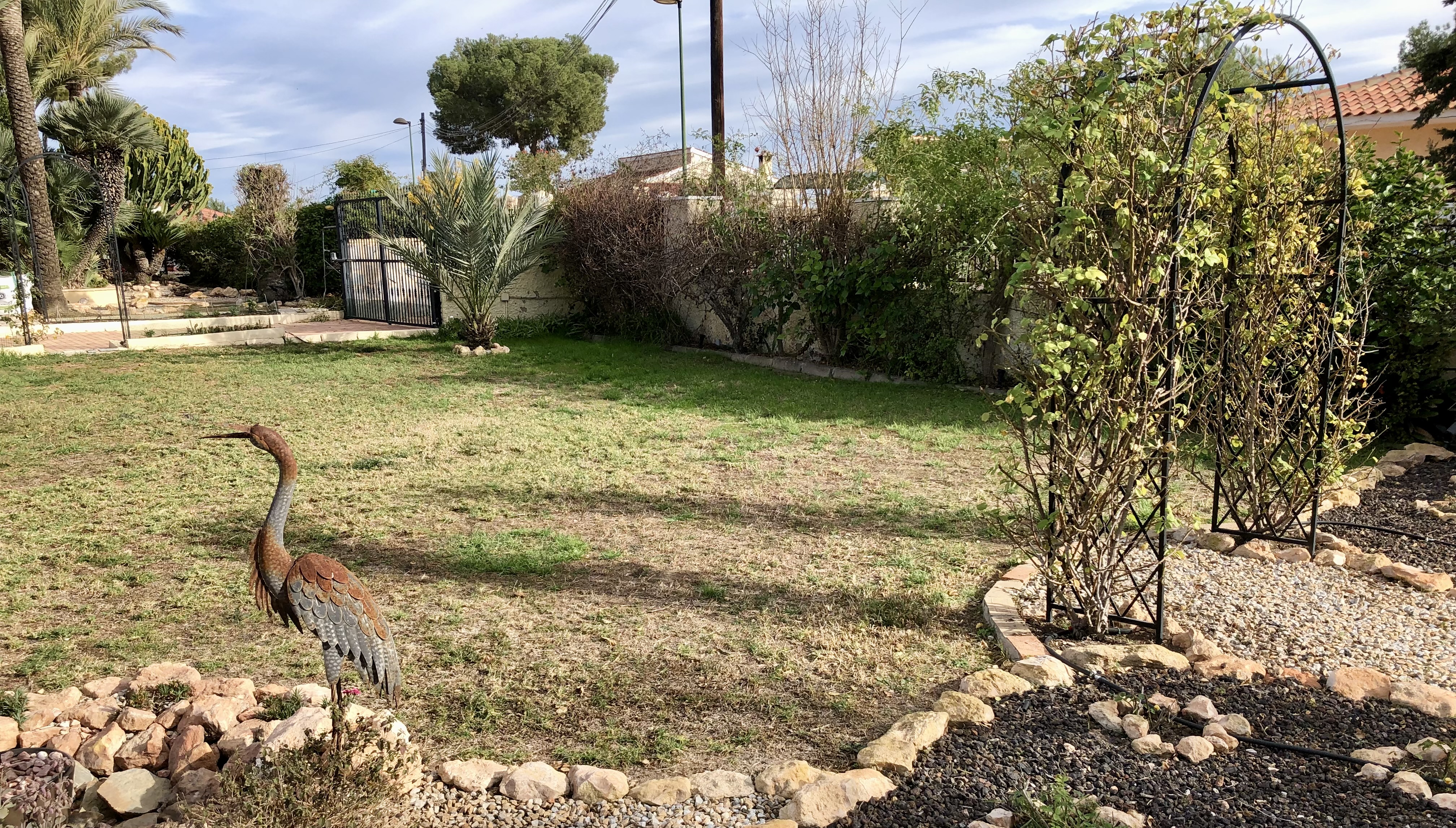
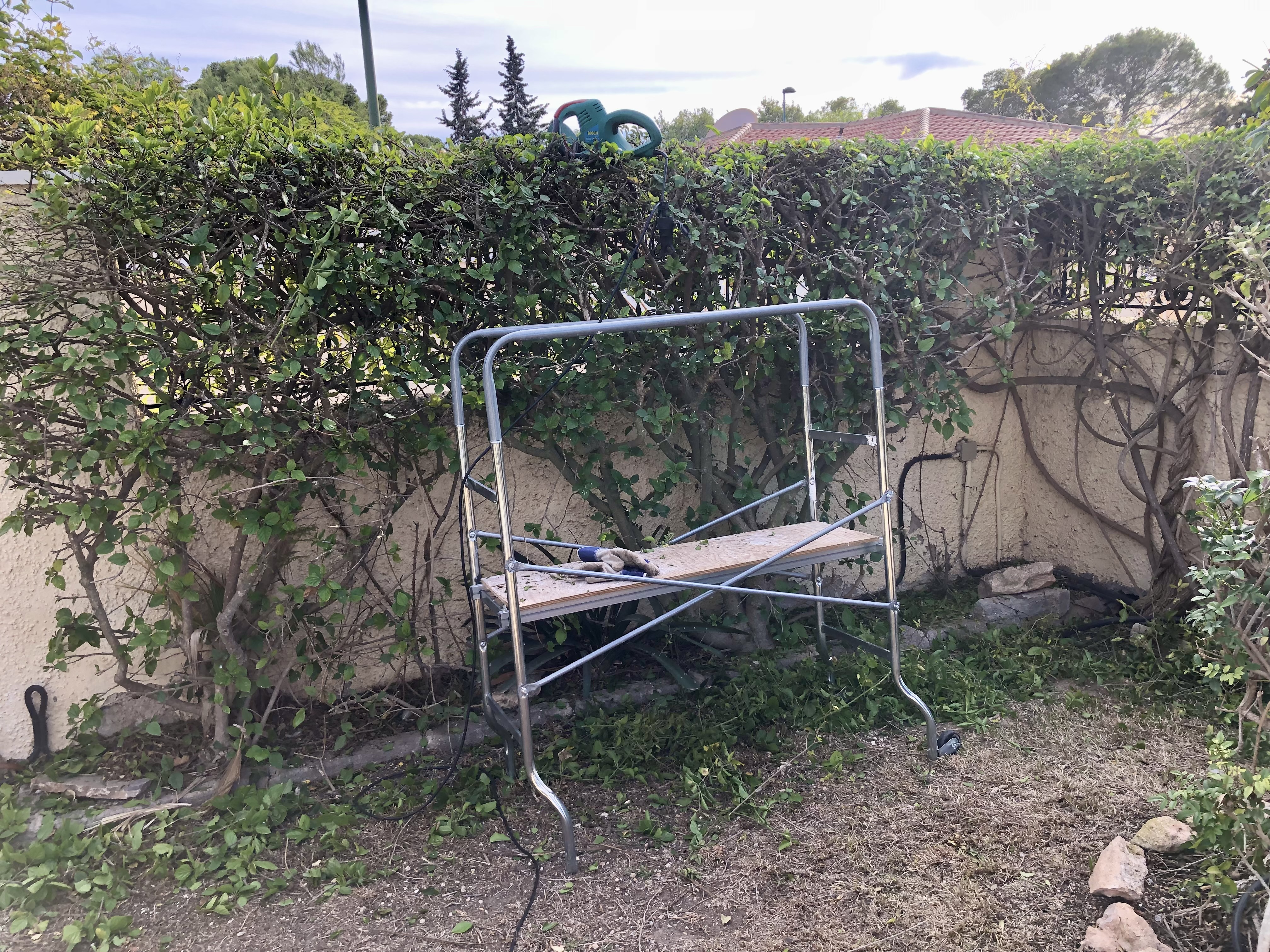
Cutting back my towers of flower. Regular readers of this blog will know that I grow a number of climbers up an old palm tree that I had chopped back a few years ago. This flowers profusely all summer and gives me a “tower of flower”. To trim this beauty back all I need to do is run my hedge clippers up it and it is ready for another year of flowering.

I would add a note of caution should you wish to copy me. At first you will be able to lean your ladder up against the old palm trunk as you trim. However, after a number of years the centre of the trunk will rot and it is not safe so you need to use a stepladder. Apart from that it is lovely as can be seen below with its seed pods giving winter interest before it is cut back.

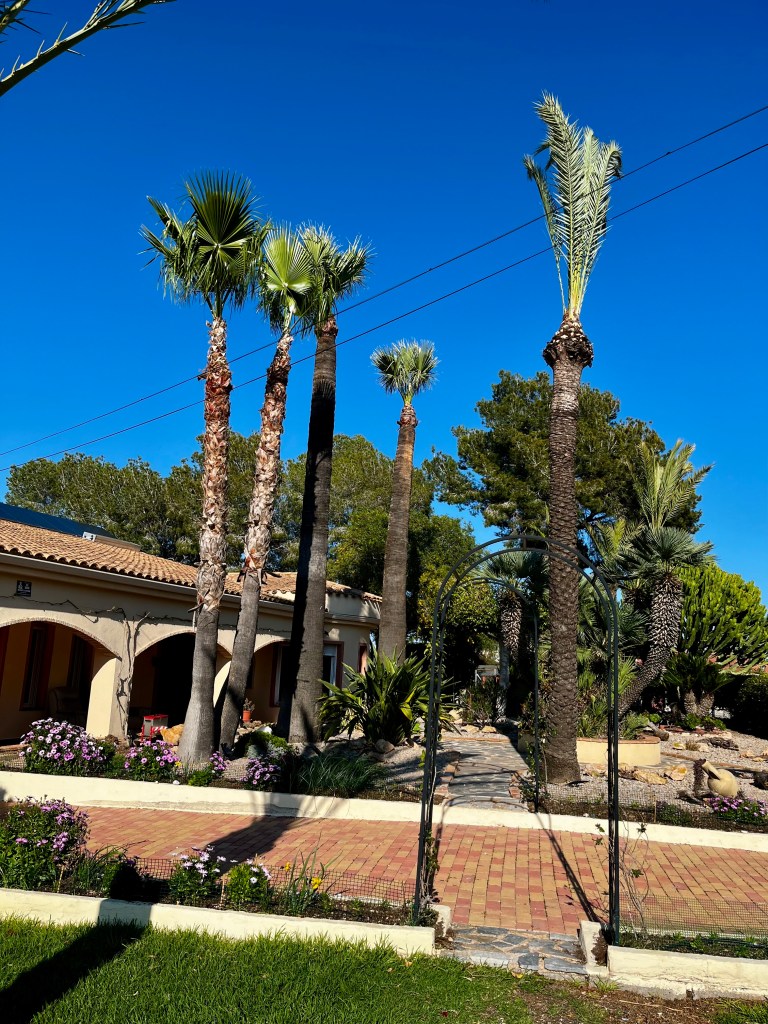
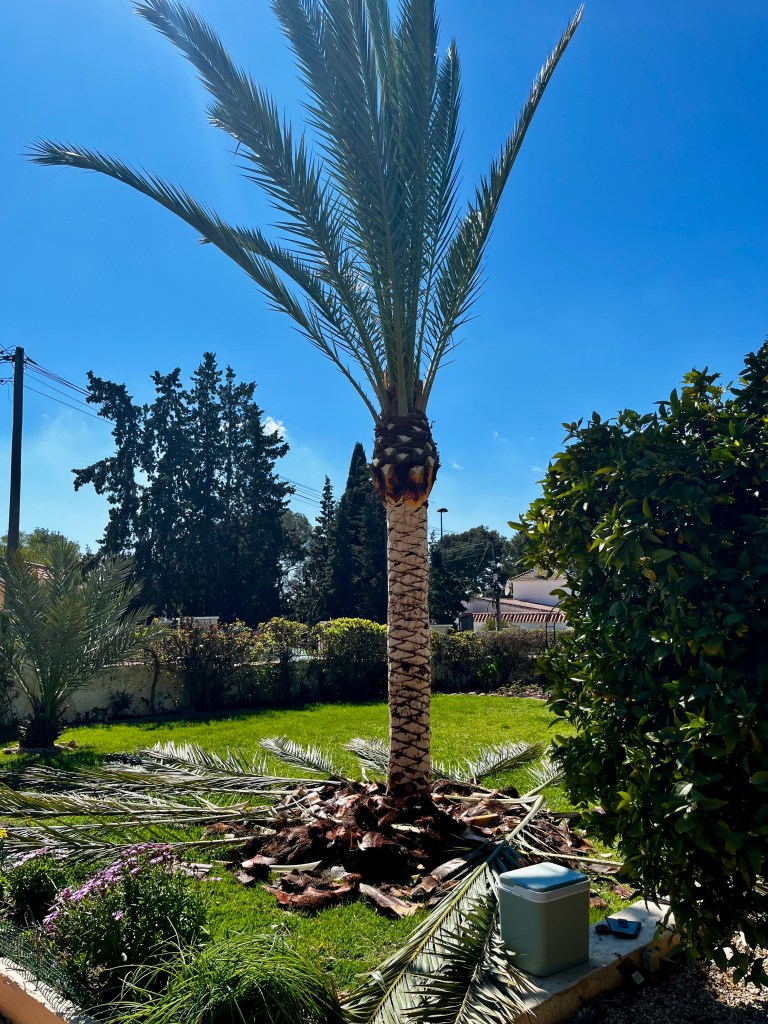
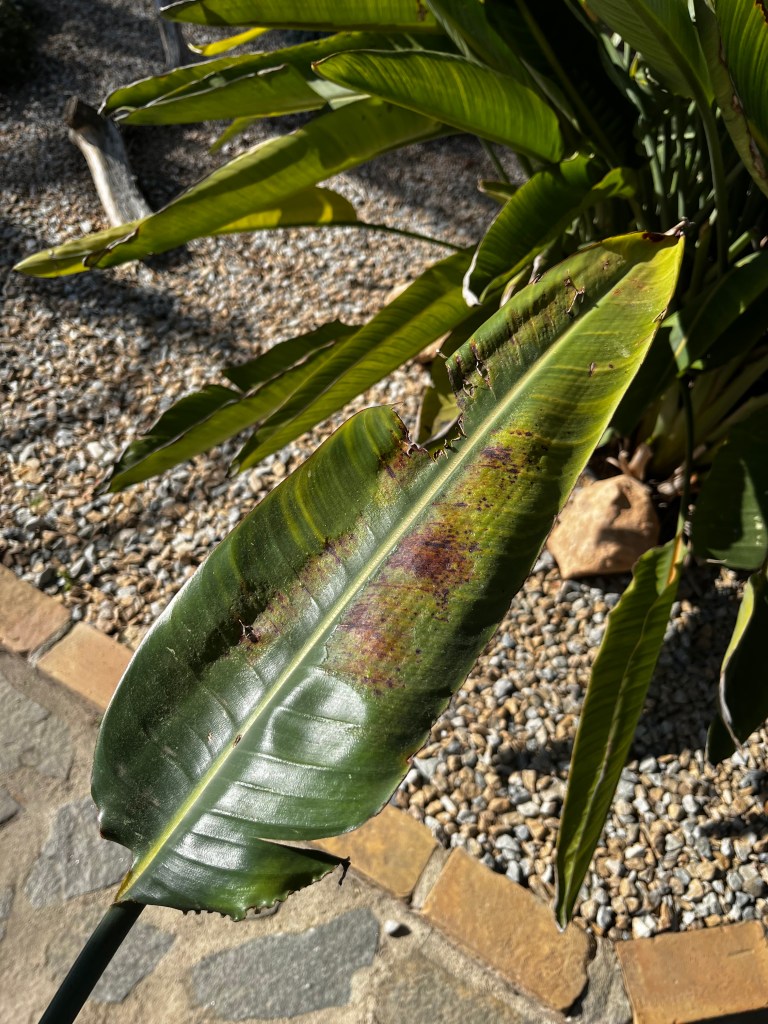
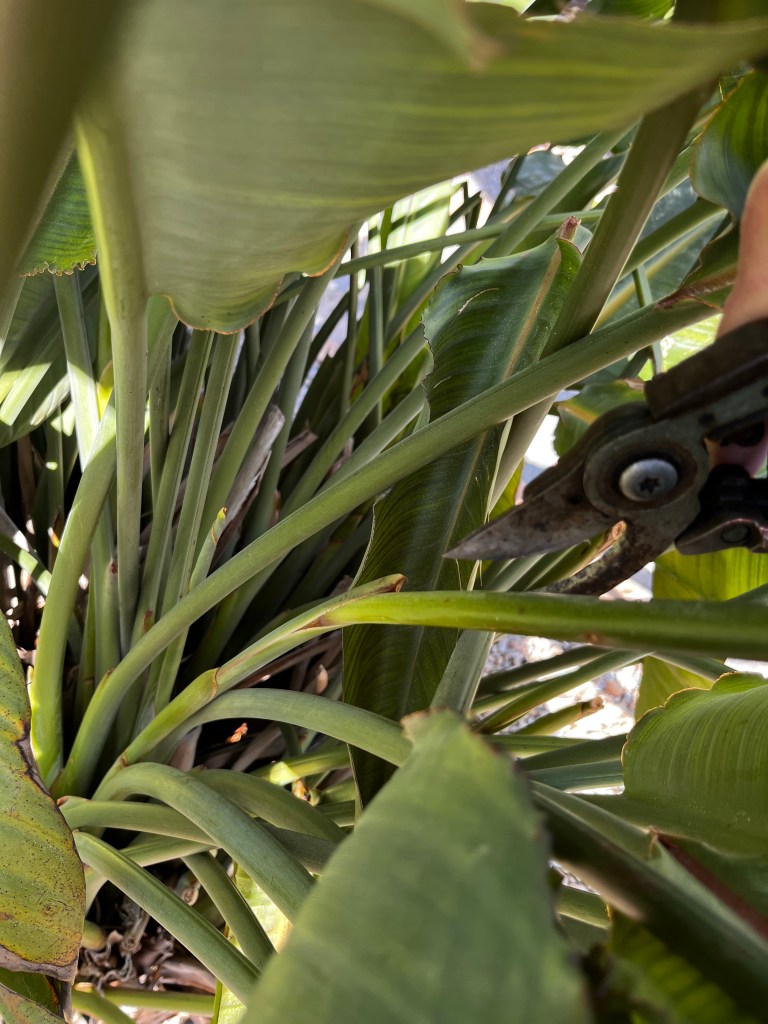
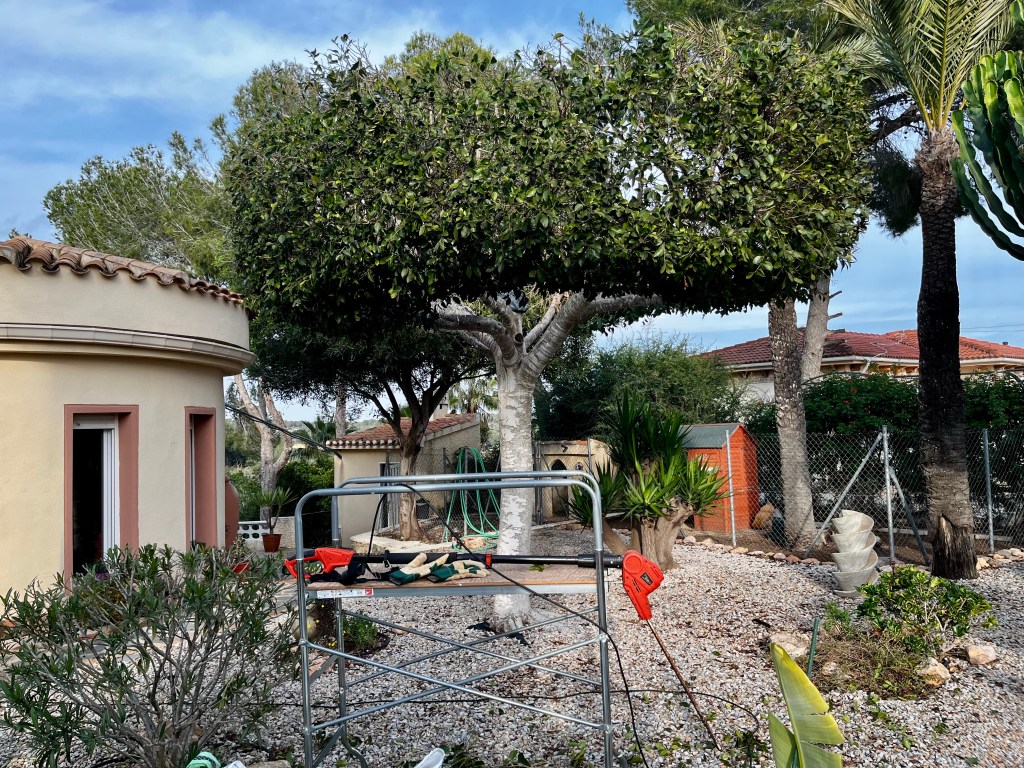
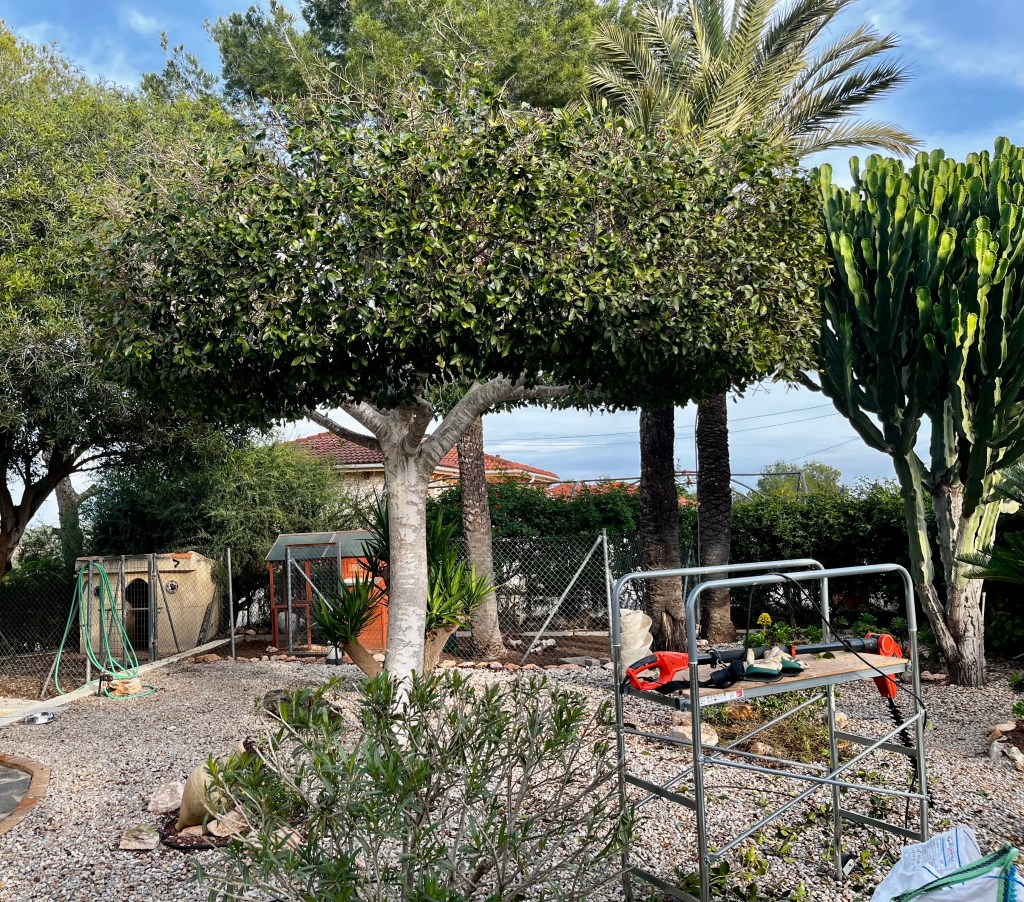
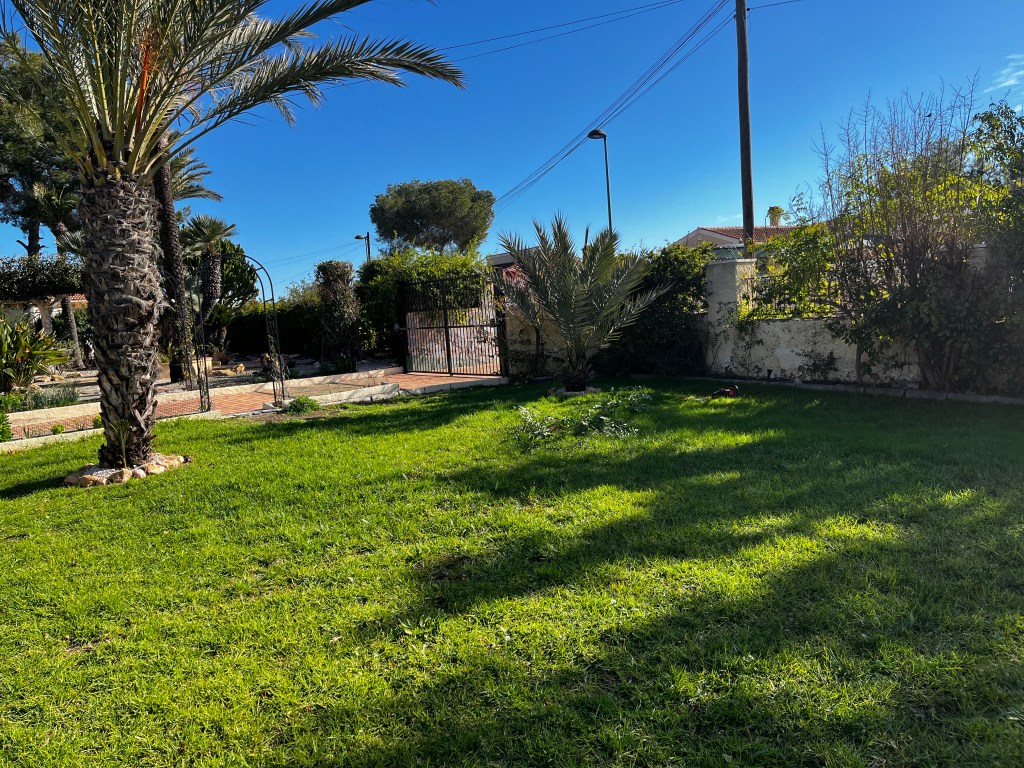
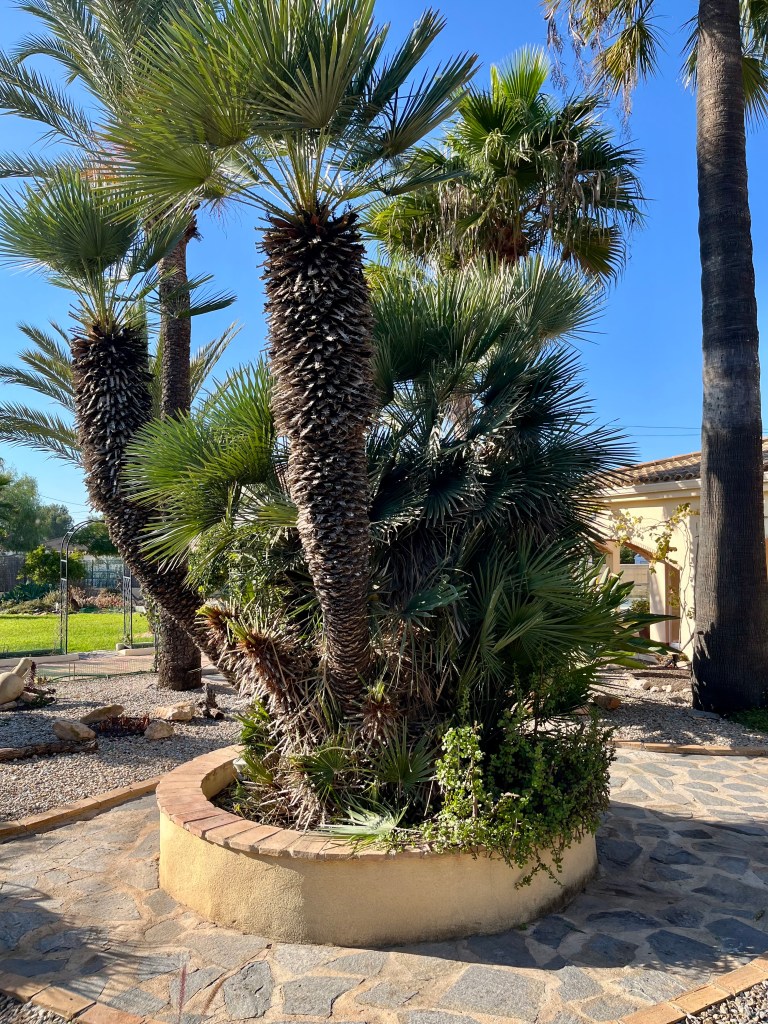
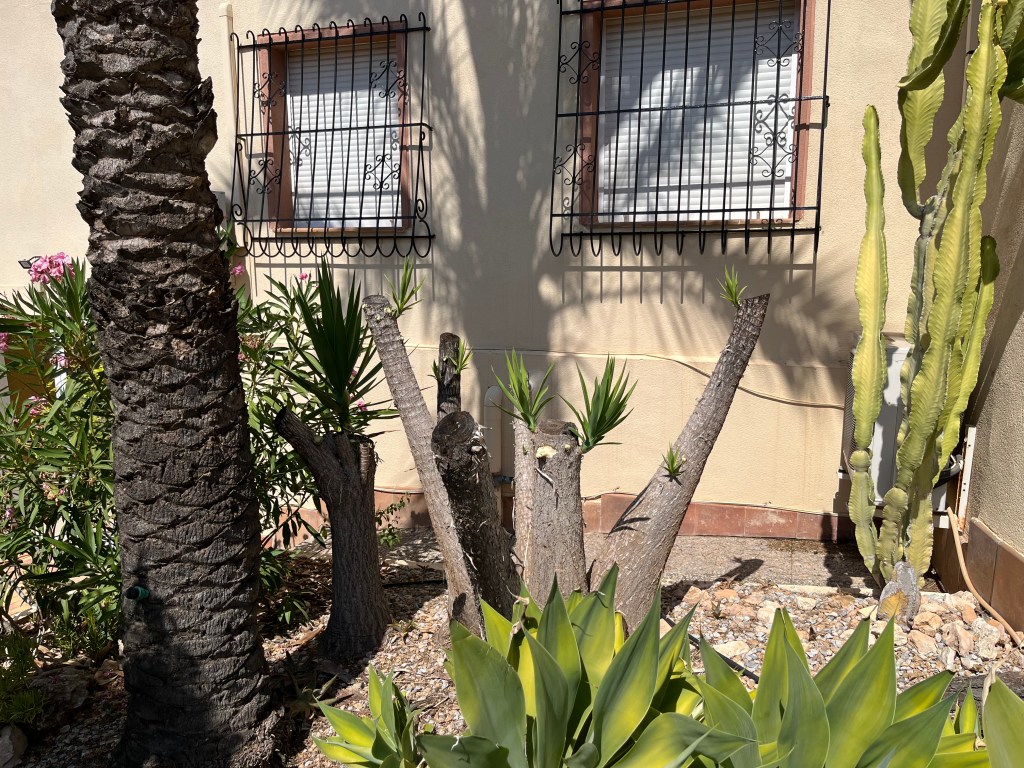
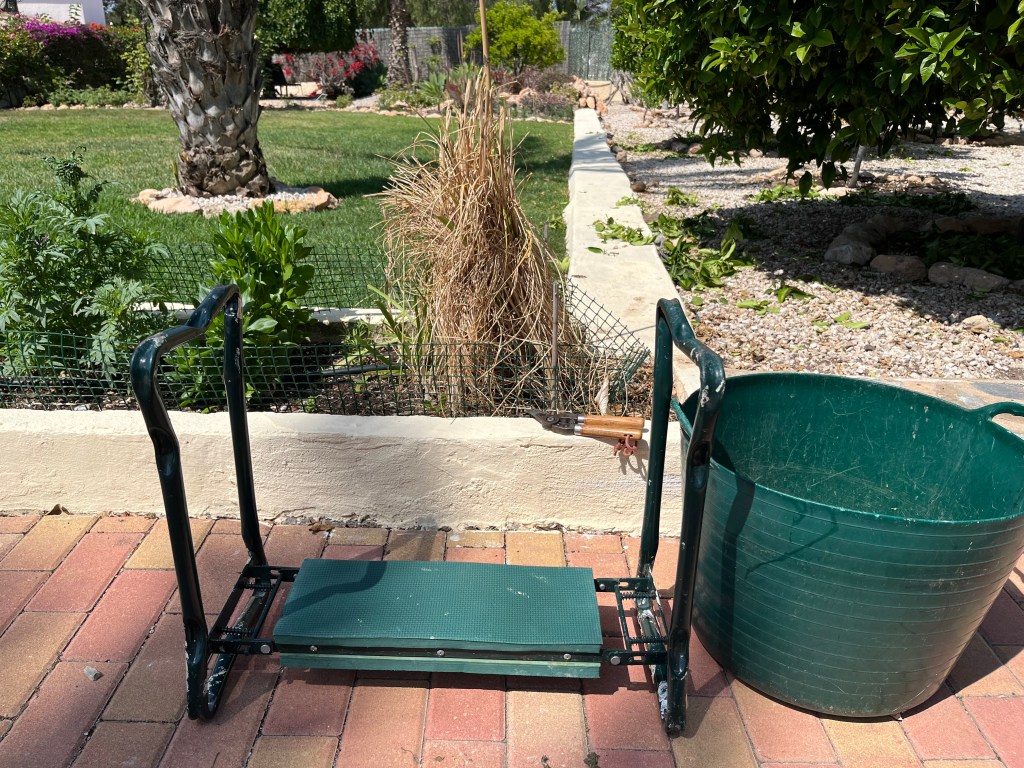
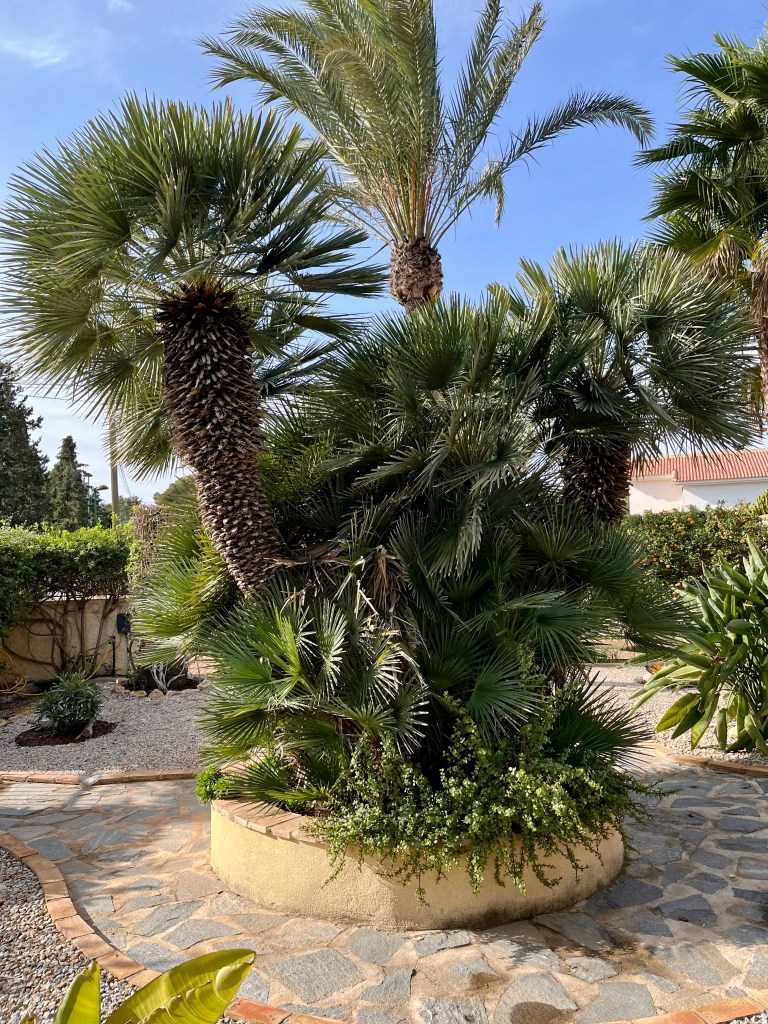
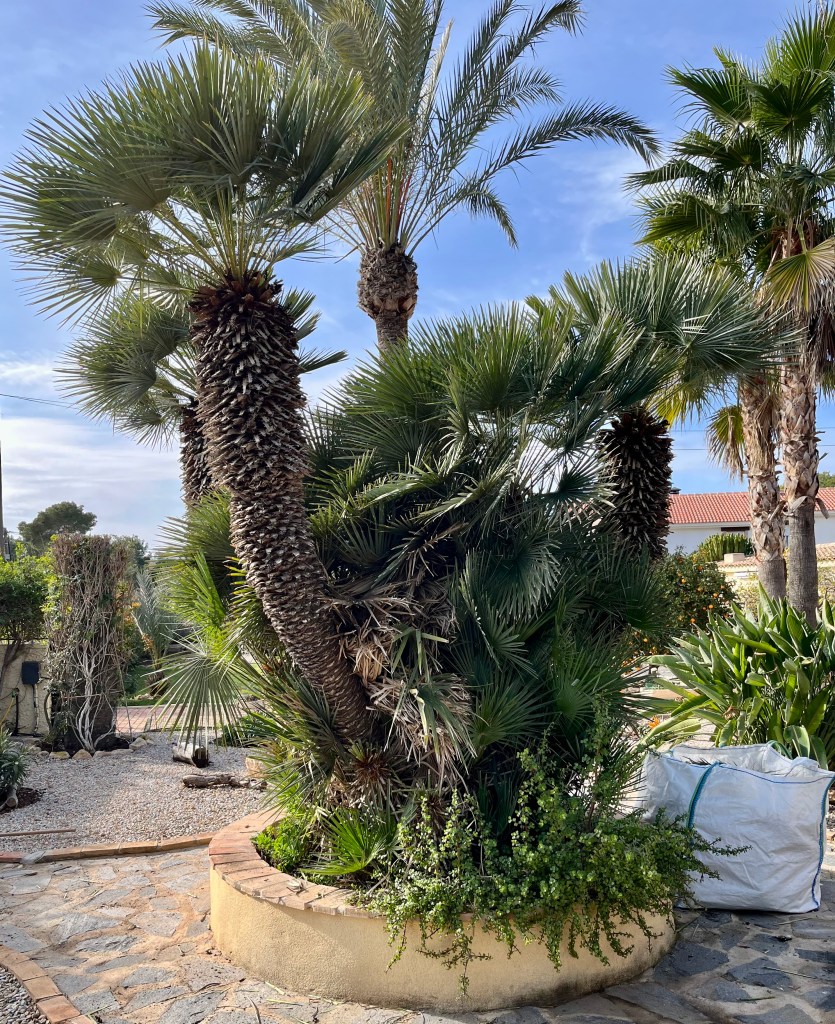
Pruning Mediterranean Fan Palms. December and January are the best time to prune palms as the dreaded Red Palm Weevil will not be flying. I have a professional Palmista for my large palms, but for a stand of Mediterranean Fan Palms I just get stuck in myself. The photo below shows the palms I need to cutback.

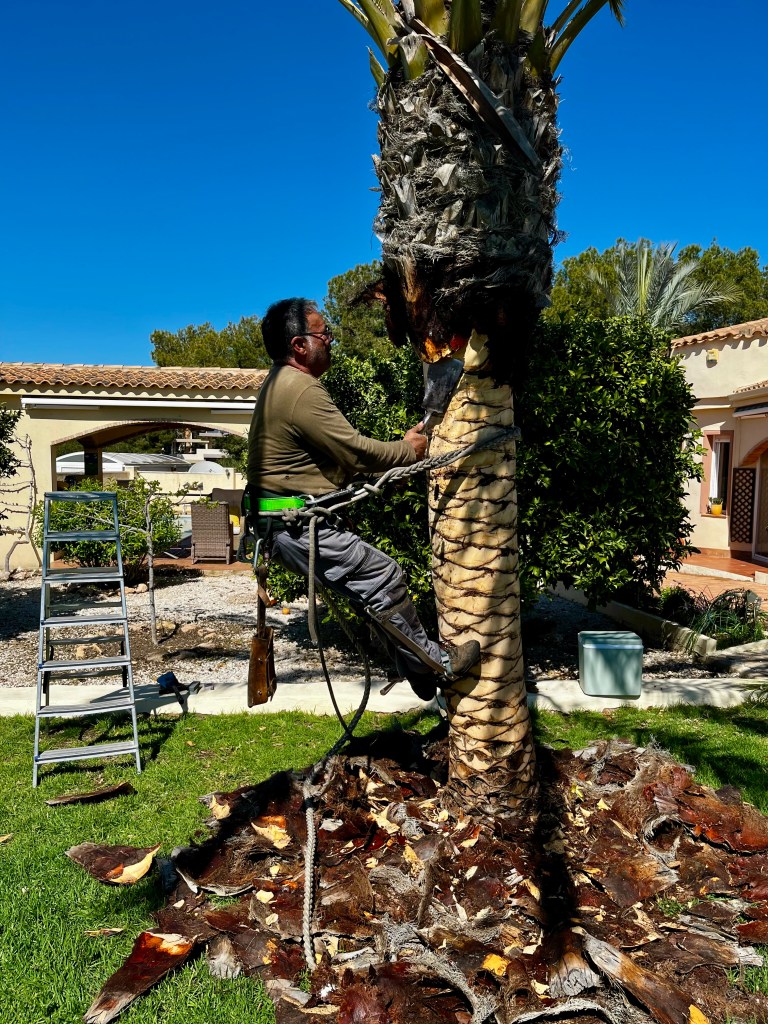
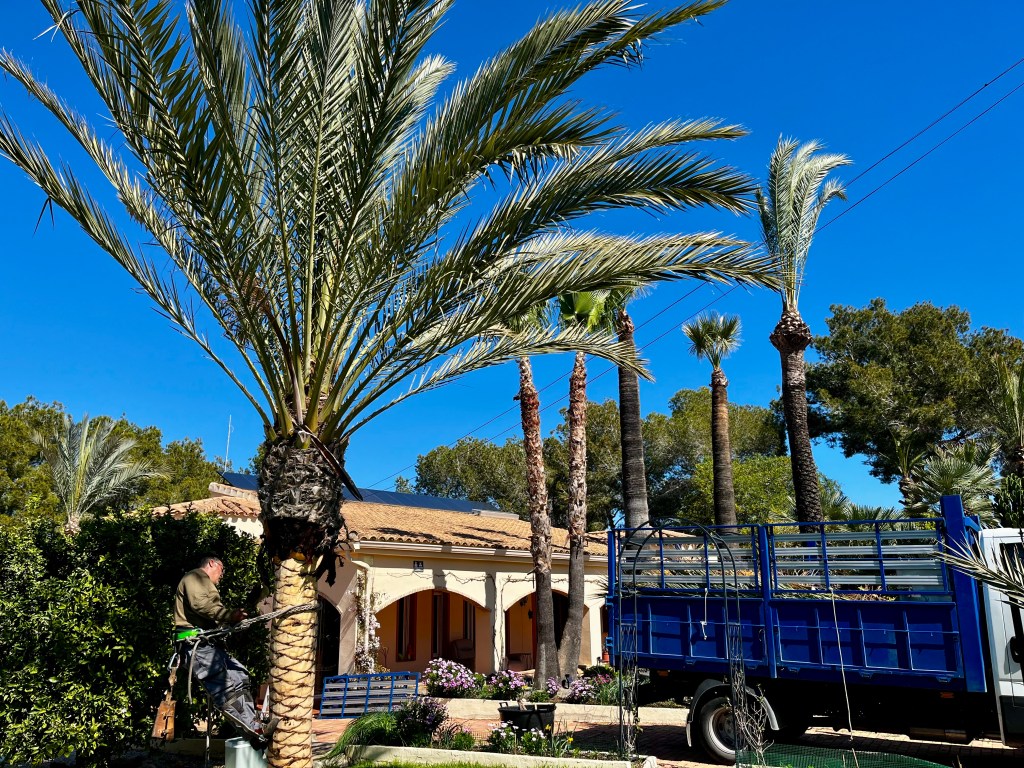
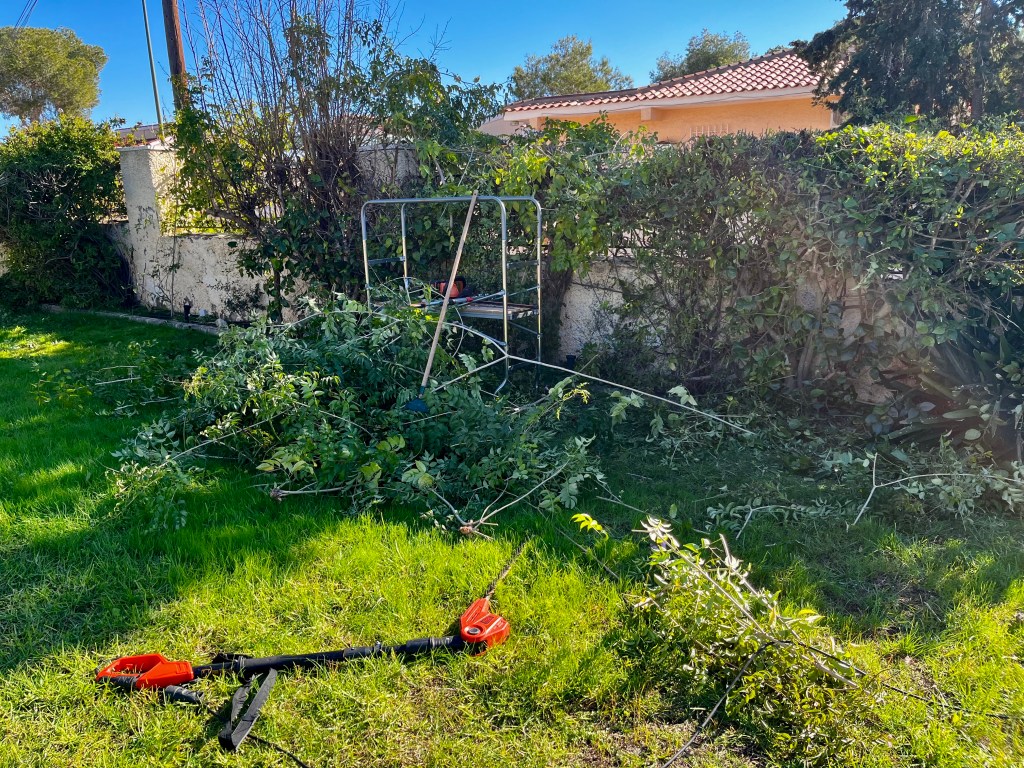
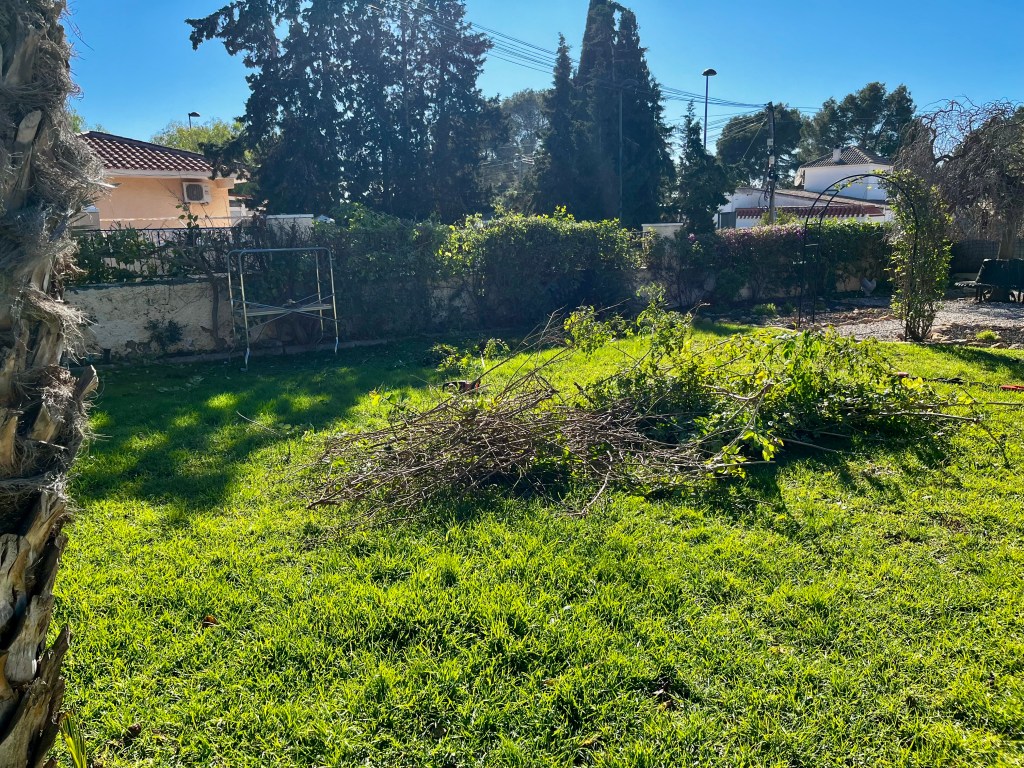
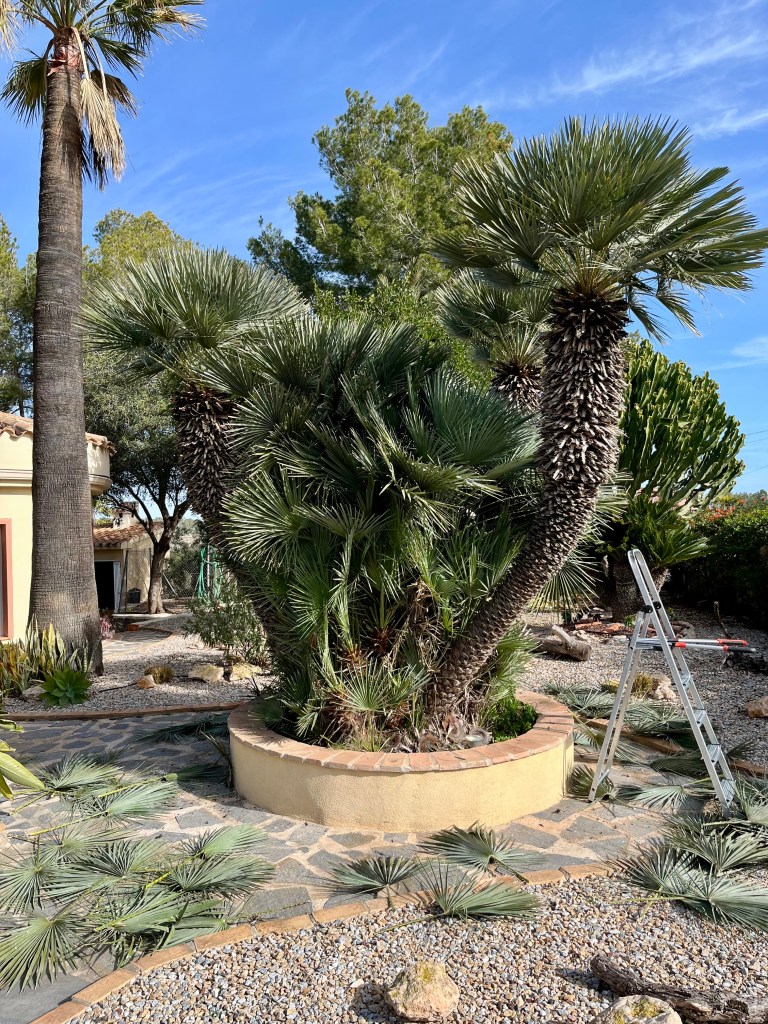
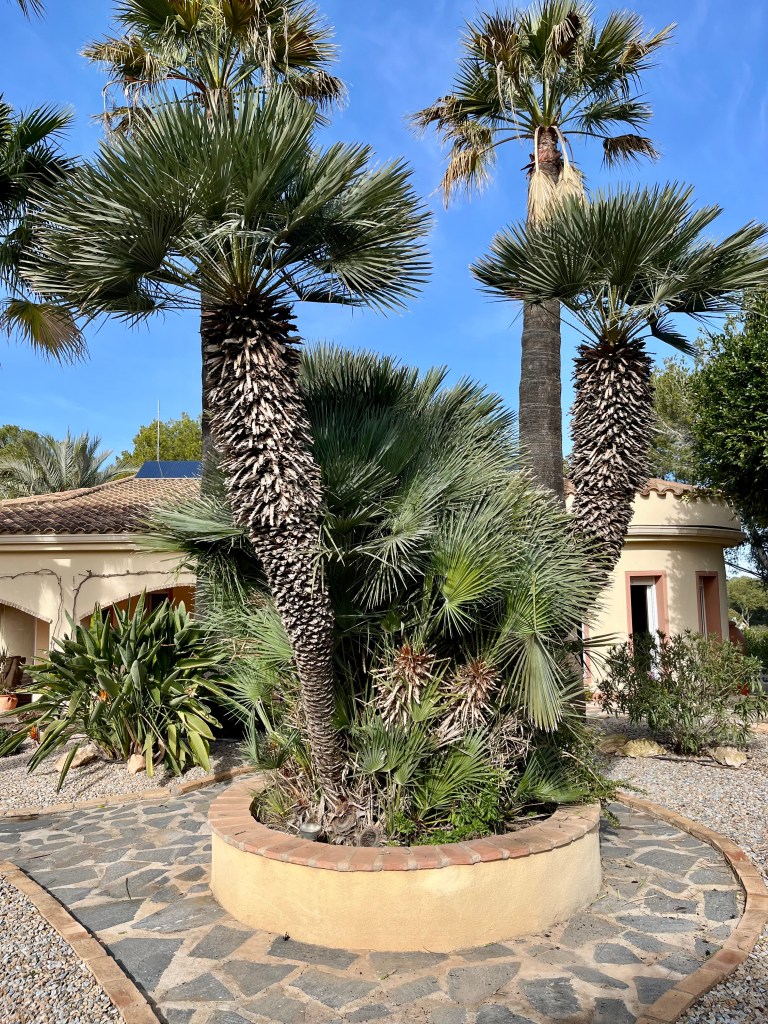
From these photos you can see that there are two key areas of pruning. Firstly the undergrowth of pups needs to be reduced so that you can successfully walk past the palms without being snagged. Secondly the crowns on the large palms need to be pruned back so that the top fronds stand up. When cutting back palms it is always wise to wear a thick jacket and make sure you wear goggles. Despite my best efforts I ended up with a Palm frond hanging by a thorn from my nostril – very painful.

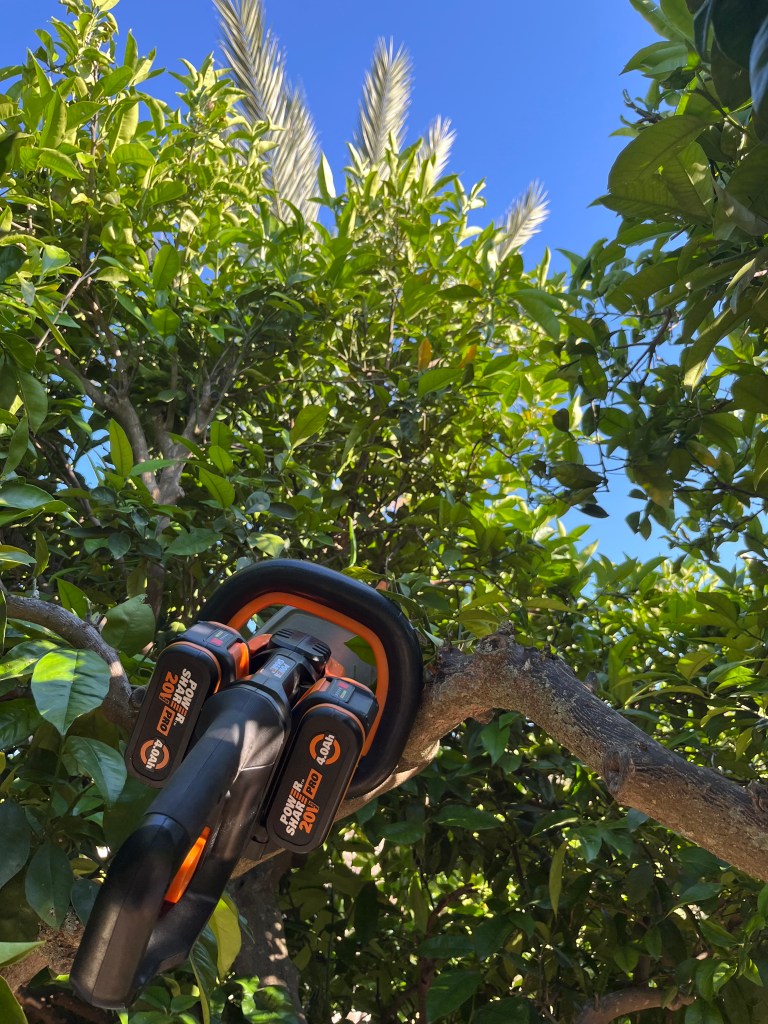
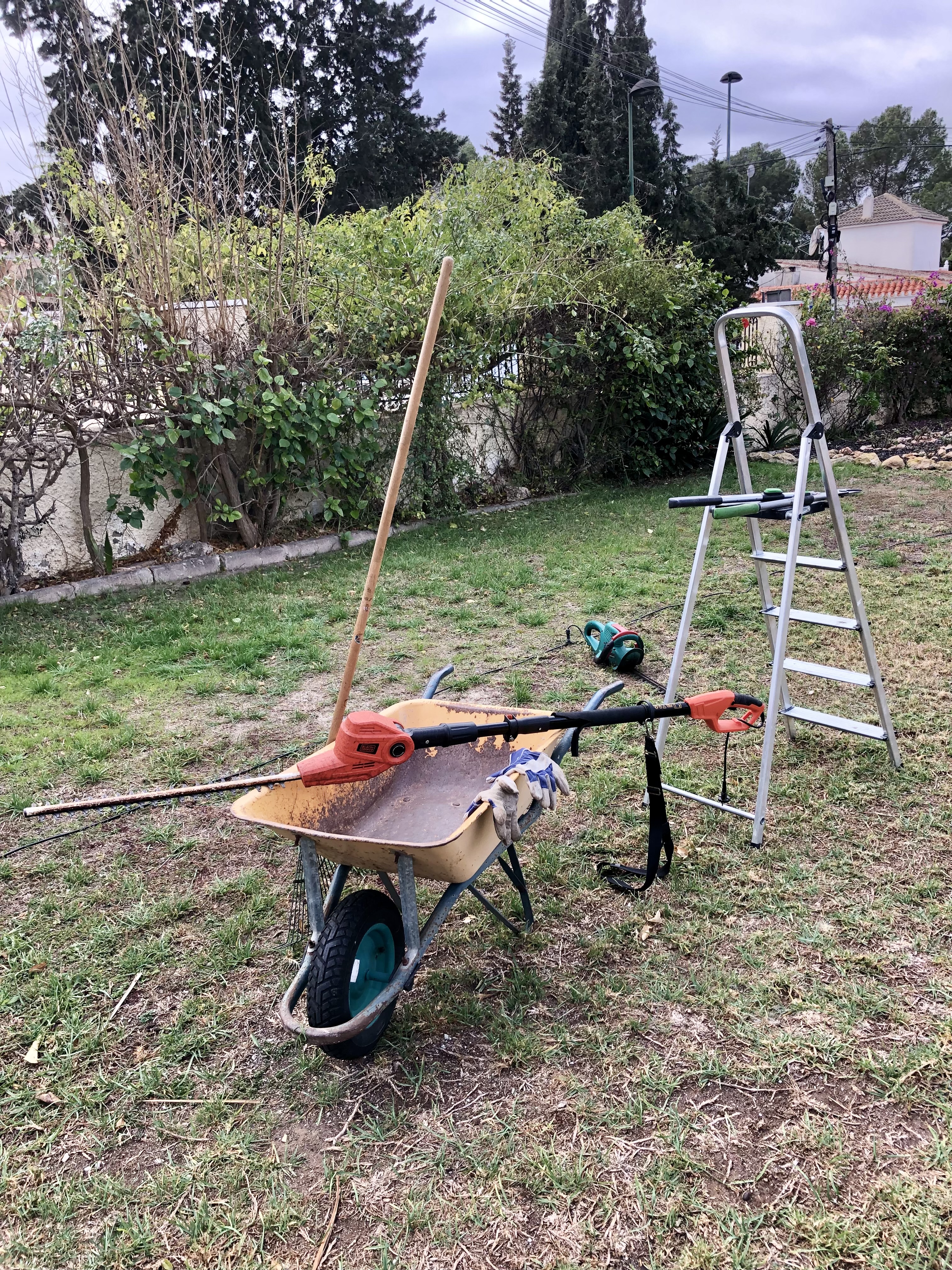
Normally I use short handled lopers for the low growth and my long handled lopers to reach the crown. However, this year I experimented and used my new electric hedge trimmers to cut most of it back. I must confess it was a lot easier although not as neat as normal. The photos below show my efforts.

The big composting special

Hooray it’s that time of year again when I regale you with advice on the merits of composting. For weeks I have been excited about this but unfortunately I mentioned my excitement to Cruella (my wife). Since then she has mercilessly mocked me saying that compost is smelly and that I am an idiot for getting excited about dirt. To make matters worse her chickens have taken to following me around pretending to hold their beaks and shouting smelly in chickenese (at least I think that’s what they are shouting.

But I’ve got my own back. Remember that Coca Cola advert that appears on the television every Christmas, where a large truck with a picture of Santa Claus on the side goes through towns accompanied by the sound track singing “holidays are coming…holidays are coming”. Well that has been me for the past few weeks I have been singing “compost special is coming…compost special is coming”. To say this has annoyed Cruella (my wife) would be an understatement, so much so that I now mumble it under my breath, and when she says what did you just say, I reply “nothing”. I know it’s not much, but I count that as a small victory.

Anyway, on with the show let’s keep the excitement bubbling.

1st November 2025. Things I have been doing lately:

  • Why compost
  • How to compost
  • What to compost
  • What not to compost
  • The key ingredients of compost
  • what should compost look like

Why compost. All garden soil gets depleted over time and lose micro nutrients either they just get washed away by the rain or the plants take them up and the soil needs replenishing. Composting can help improve soil by adding back these nutrients and encouraging helpful bacteria that will break down and improve your soil. When added to your garden compost will help suppress weeds, lessen the need for chemical fertilisers, retain moisture and give you a warm feeling that you are doing a “green thing”. So no matter what your motivation, by composting you will be improving your garden and it will make you a better person.

How to compost. You don’t have to make a big deal out of composting and any one can do it. Whether you have a large garden or just a little patio garden with pots, adding compost will improve your garden. The basic need is to have a compost bin, or compost heap where you can store your compost. This can be very basic such as a little patch of your garden where you tip excess produce and cuttings etc. You could just have a heap in the corner covered by an old carpet, or if you like make a basic container out of chicken wire.  It might be easier just to buy a compost bin from a store and there are thousands of them, from basic one simple bin, right up to multi-bin purpose built composting systems.

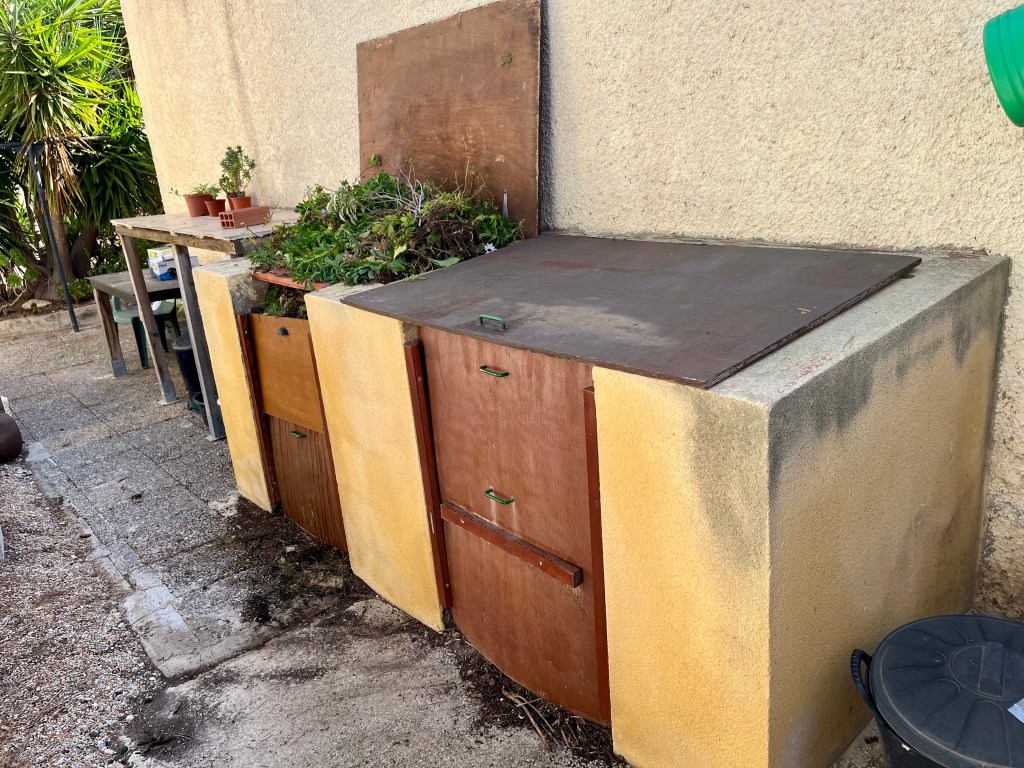
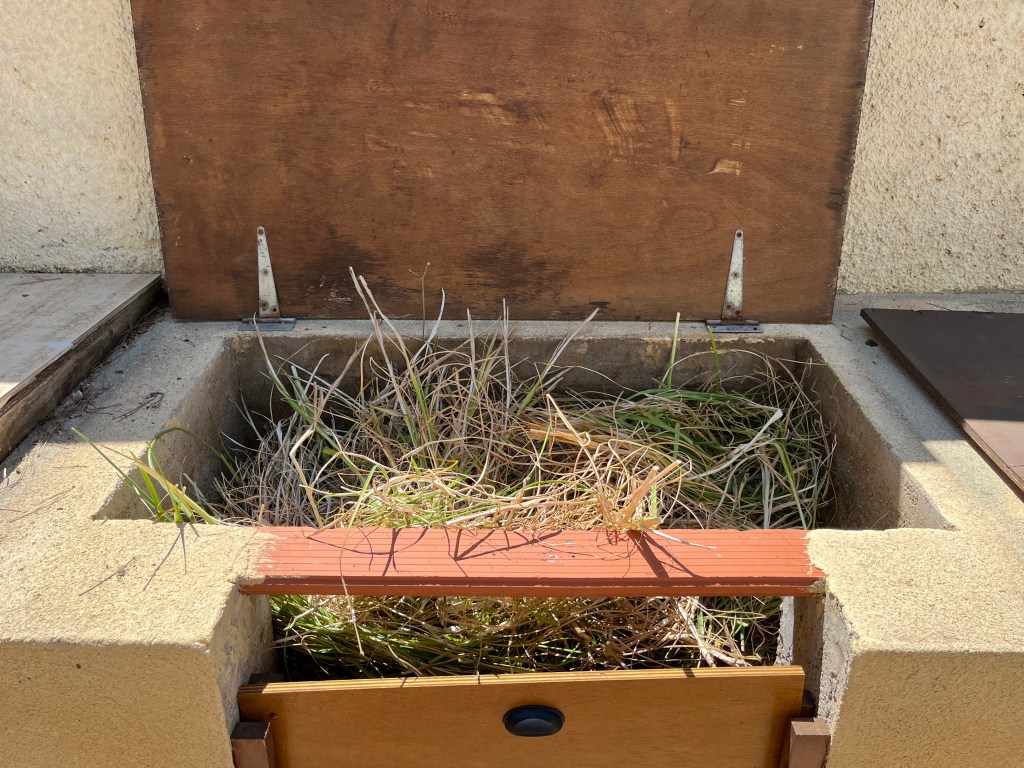
As you would expect, I have a purpose built composting system consisting of two large bins with lid for easy access and doors that can be raised to allow me to get at the compost from the bottom. The photo below shows my composting system.

Now, I don’t want you getting compost bin envy, that’s not the idea. I designed these and had them built when we first moved to this house because this size garden calls for this amount of compost. There are fruit trees to be mulched, lots of beds that need seasonal replenishing, lawns that need some topping and all the planting and stuff on the potting bench.

What to compost. Now you can compost most organic material. Examples would be:

  • all plant cuttings and mown grass
  • vegetable trimmings etc from your kitchen
  • old newspapers and cardboard
  • hair and fur from your dog, cat, hamster; even chicken feathers
  • twigs and branches up to about an inch thick
  • eggshells, coffee grounds and filters, tea bags
  • fruit, but not too many lemons or oranges as they will make the heap acidic

What not to compost. You must be careful not to compost the following:

  • cooked food of any sort (this will encourage rats and cockroaches). This includes: meat, bones, fish, fat or dairy
  • leaves or cuttings from plants that have been infected with disease or pathogens such as rust on Roses or mildew. If you compost these then you will infect the heap.
  • dog or cat poo; and don’t even think of human poo.

The key ingredients of compost. Quite simply good composting requires four things:

1. Green items: that add nitrogen (grass, leaves etc)

2. Brown items: that add carbon (twigs, branches, newspapers etc)

3. Water: to keep the heap moist but not wet (don’t let it dry out, but don’t over soak it)

4. Air: oxygen is needed to encourage the composting process, so once a month you need to stir your compost with a fork or spade to keep the air circulating.

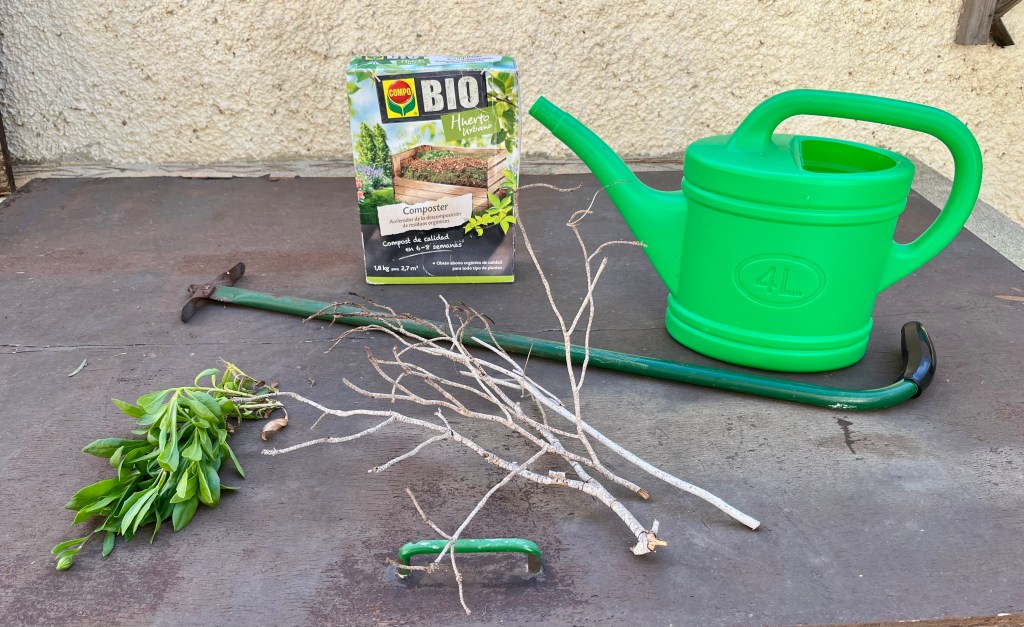
There is one other vital ingredient that you can choose to add to your compost heap, and that is “compost accelerator”. This is normally added as a powder which encourages the development of microbes in your compost heap and speeds up the composting process.

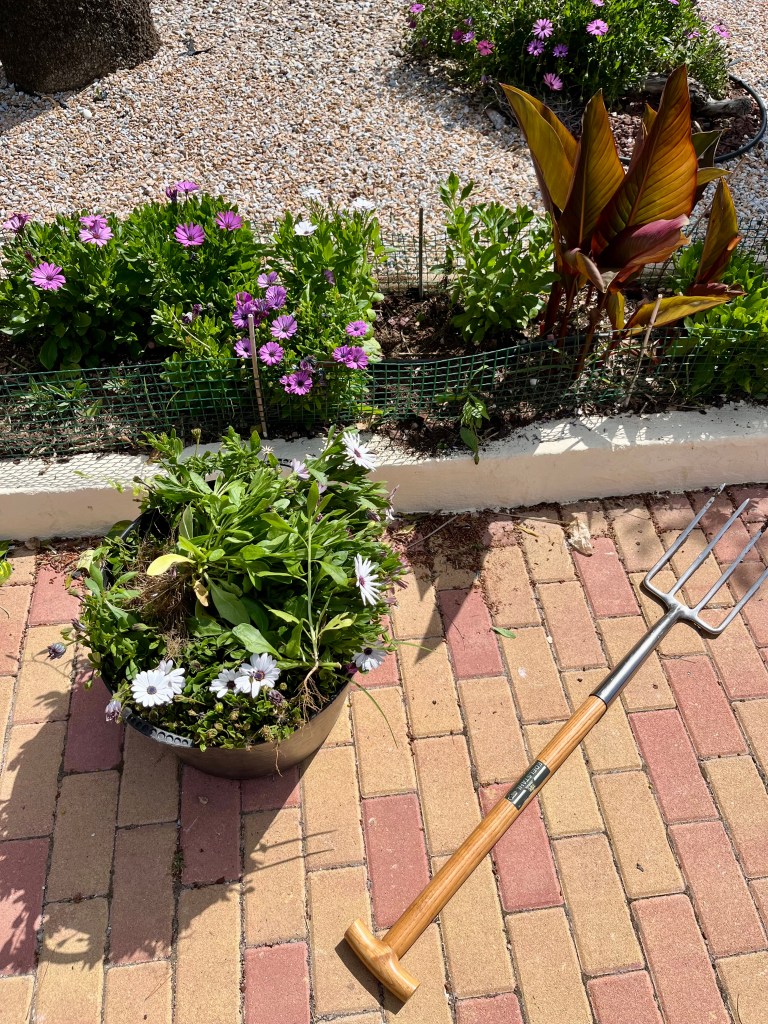
The photo below shows all the key ingredients apart from air; but I assure you it is there. In the photo you will also see a special compost turning tool that I bought some 20 years ago. You just push this into your compost heap then the two little wings at the bottom of the rod come out as you pull up and the whole heap is lifted and turned. If you can find one, buy it.

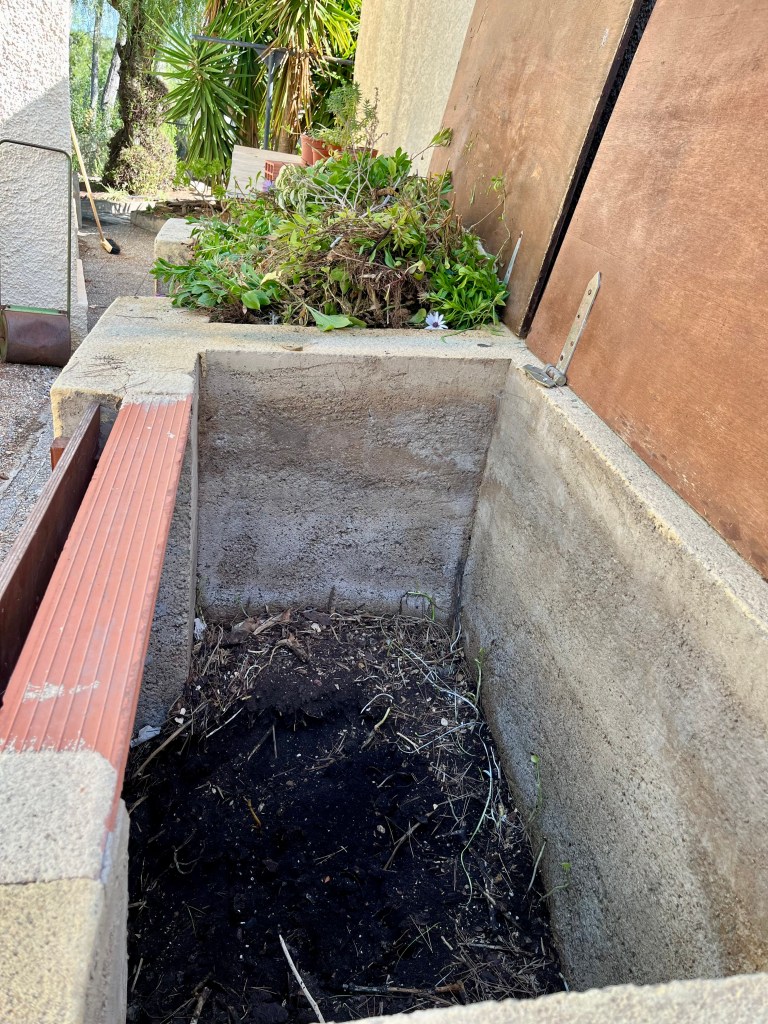
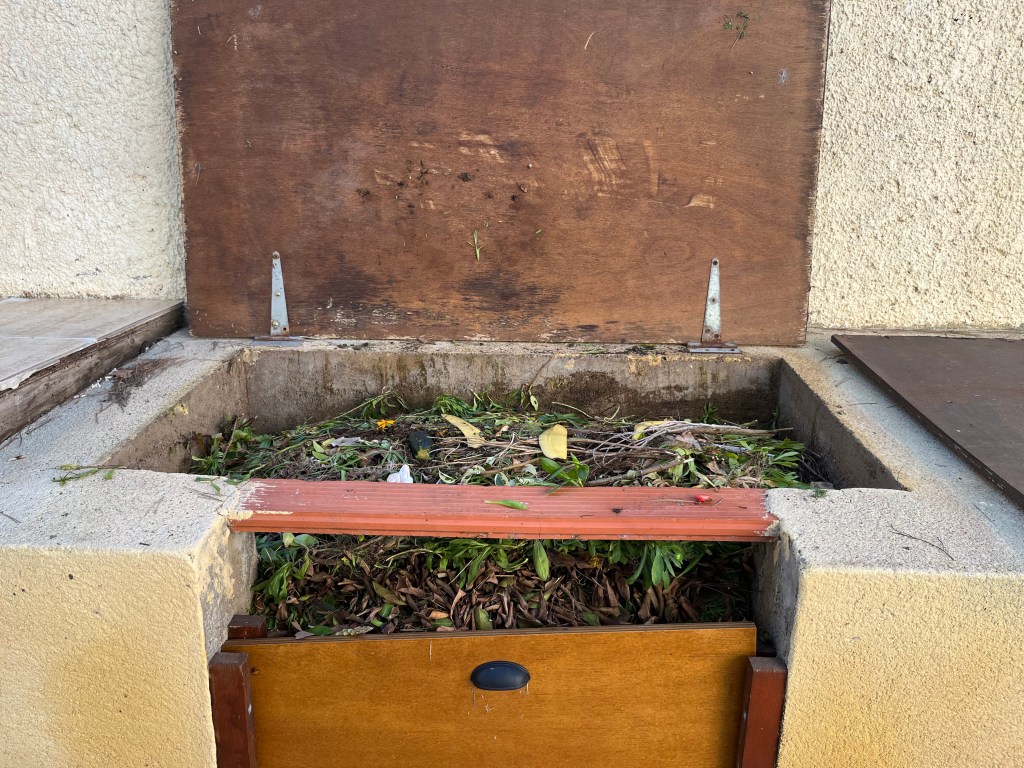
What should  compost look like? A question I am always asked (I lead an interesting life). The photos below show the current state of my compost bins. The first photo is the bin currently in use, and you can see all the ingredients I talked about above. The second photo shows the resting bin this has been in use for a few weeks that and has already had lots of compost removed. You can see from this photo that the bin is half empty, and this is because all the insects and beneficial microbes will have eaten stuff whilst making the compost. The final photo shows the finished compost; or as I call it black gold. Each of these bins will on average give me 20 wheel barrow loads of compost each year.

Gettting in the compost bin. One of the great joys at the end of a hard days gardening of trimming and cutting is to get in the compost bin and tread it all down. What do you mean you’ve never done this, just me then. One of the drawbacks of getting in the bin and stomping your compost down is that quite often you have cockroaches run up your legs which can be disquieting. To overcome this I have cut a board exactly the size of my bin which I fit into the top and then jump up and down on (patent applied for).

The photos below show my bin with the board in place, followed by a view of a reduced bin. Finally, I had to take a selfie of me in the bin as Cruella (my wife) refused to,come near because of cockroaches. Just after she took this photo, Cruella slammed the lid down and I was in there for two days. I must say they were the happiest two days of my life. She only got me out because the dishwasher needed emptying.

It is time to get out there and gather seeds

Gardening never stops, it just has lulls. Technically a lull is a time that is less frenetic, when you can take stock, look around and begin to plan for the future. Now is our autumn lull, summer flowering is over and it is not yet time for our big winter cutback.

This is the perfect time to wander round your garden and look for seed heads and potential self seeding seedlings. So come on let’s get gardening.

29th September 2025. Things I have been doing lately:

  • Assessing flower beds
  • Checking for seedlings
  • Gathering seeds
  • Planning my lawn renovations

Assessing flower beds. By now most of the plants in your flowerbeds will have gone to seed or just gone over and died right back. You should now be going through your flowerbeds forensically examining what to keep, what to cut back, what to put on the compost and what will offer you seeds for next year.

The photos below show my forensic trawl taking out what needs to come out and overall assessing space for upcoming plants.


Checking for seedlings. Once I have removed or cutback and assessed what potential there is for seedheads, then I look carefully for seedlings coming through. A mainstay of my flowerbeds is Osteospermum (Daisy). This a is a free flowering self seeding perennial champion that will never let you down. Each year I will take the floppiest specimens out, cutback those with potential, and leave space for their self seeded seedlings to come through. The photo below shows the lovely little seedlings peeping through.

In a month or so when these have grown a bit bigger, I will either pot them up into seed trays or sometimes, I just relocate them into the positions I want them. Either way, it is hundreds of free plants.

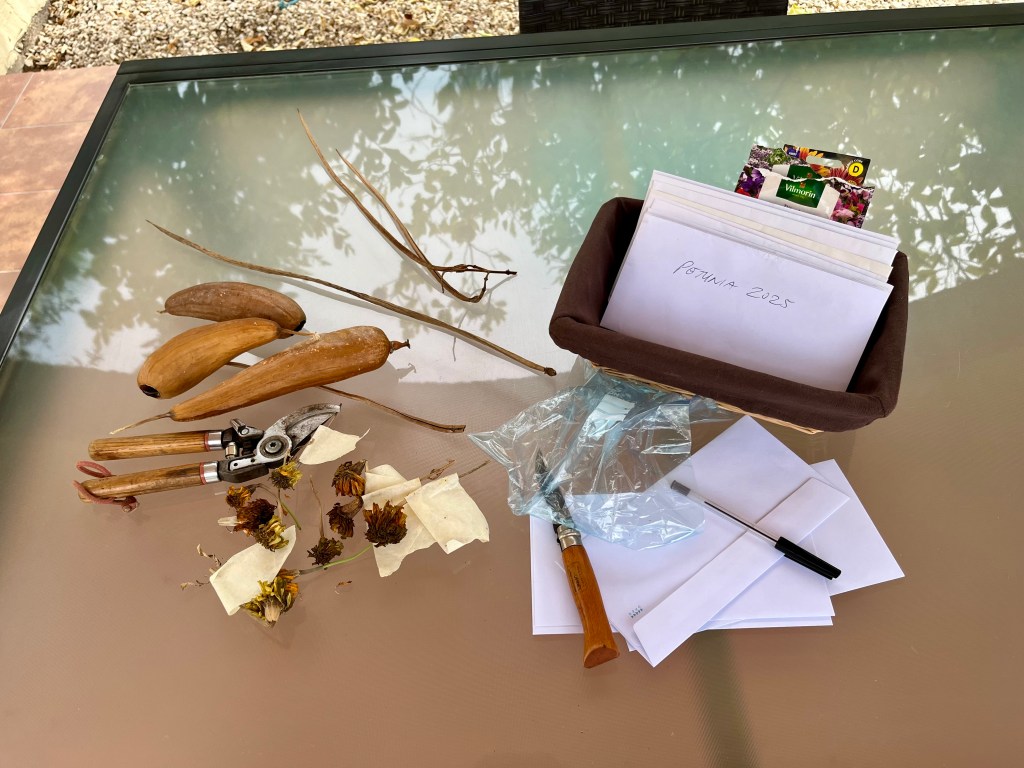
Gathering seeds. Once the flowerbeds have been examined it is time to begin looking around for seedheads. The photo below shows me setting off with my secateurs, gardening knife and plastic bag to hold seed heads.
If you just look in your garden there will be hundreds out there. I gathered the following:

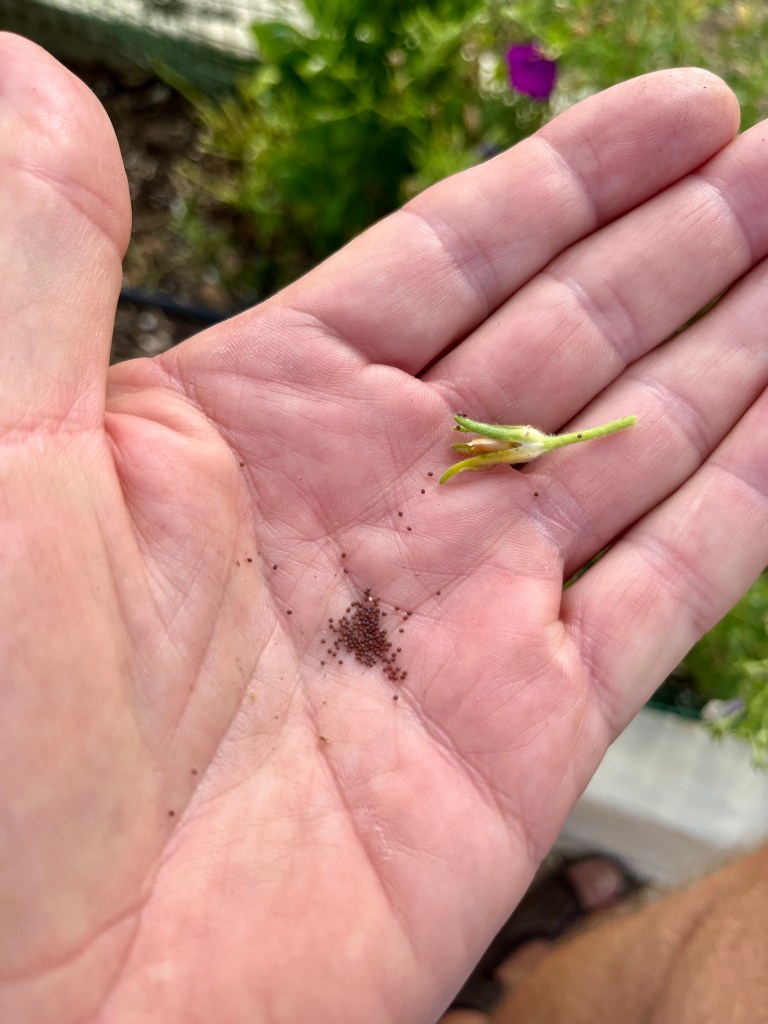
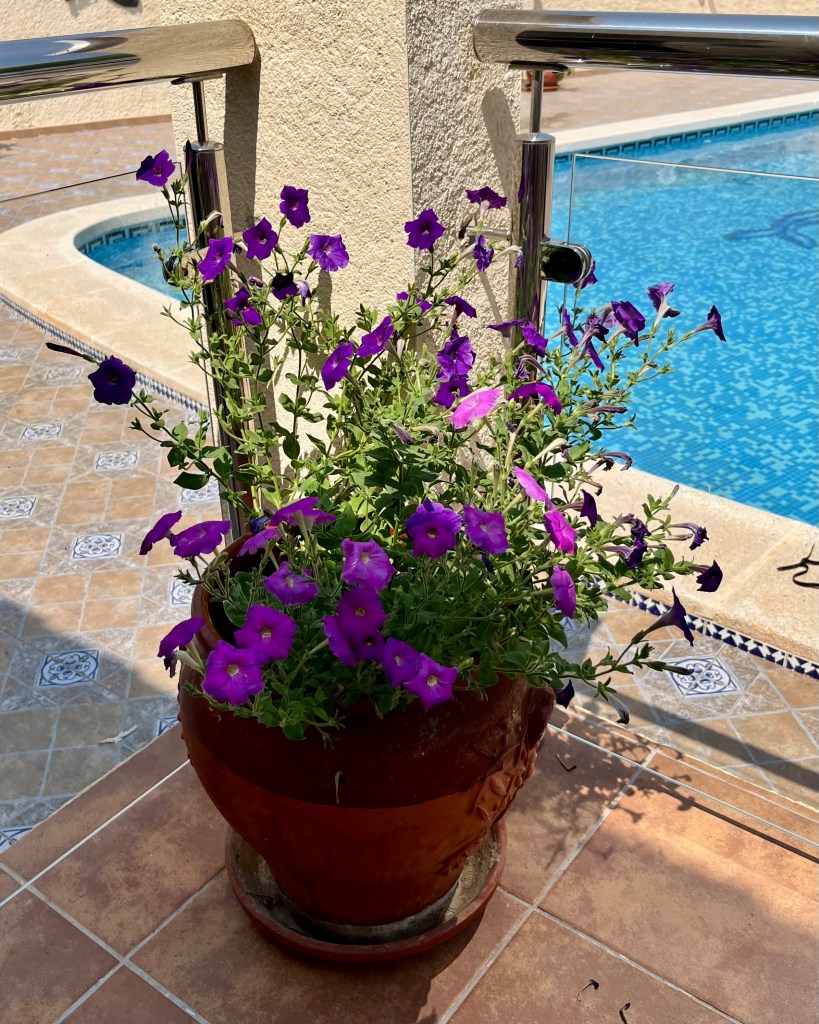
Petunias. This was my first time growing Petunia and they were a great success. The seeds heads are very tricky so don’t be put off. The seedheads are small and seeds are like dust. You need to get the seed head when it is just beginning to open and has a brownish look to its tips. See the photos below.

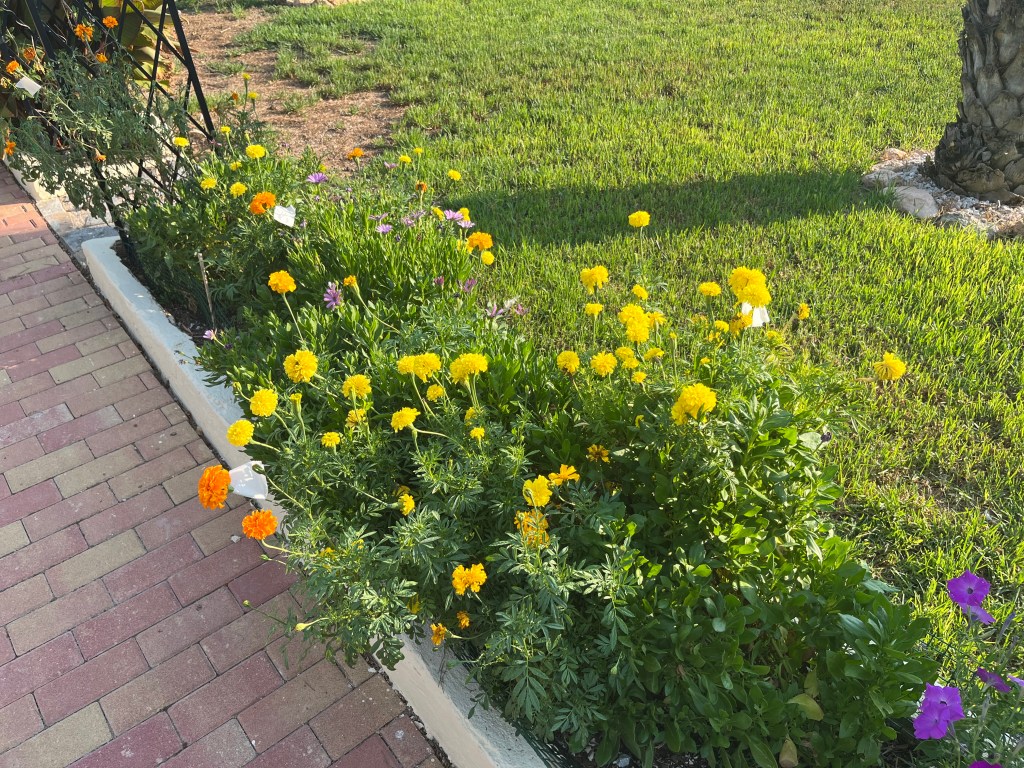
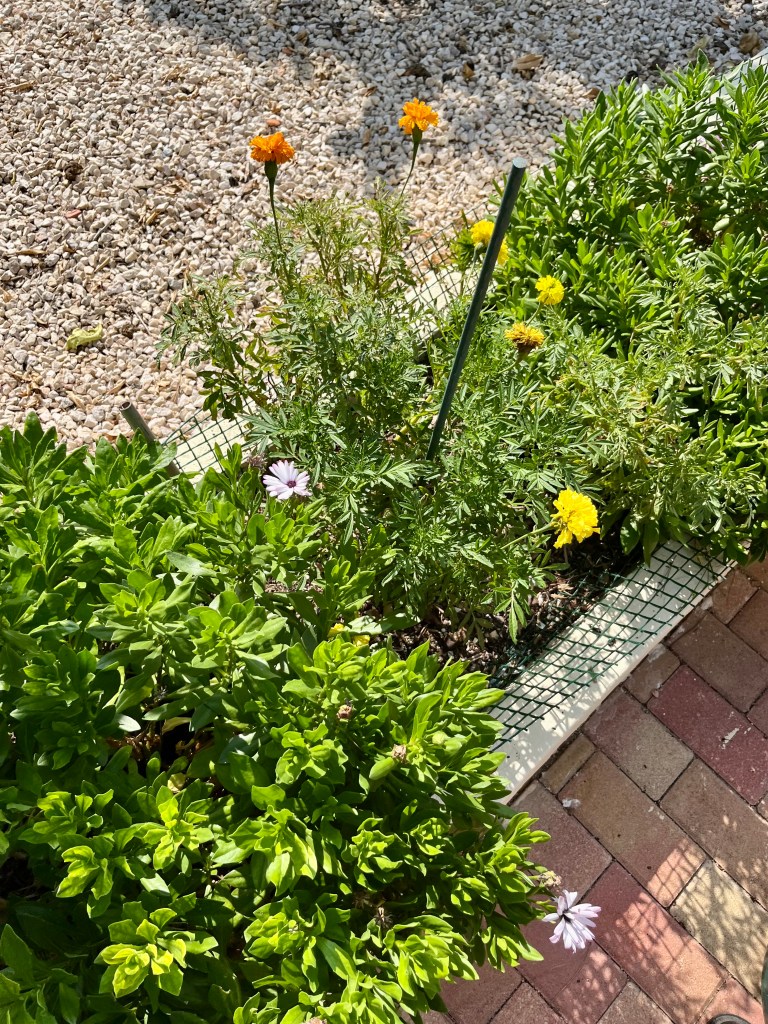
Marigolds. Another of my garden stalwarts and a great source of seed. I normally mark up the most promising flower with a piece of masking tape so that when it comes to collecting seeds, I can identify them. The photos below show my marked up seedheads ready for harvesting.

Each Marigold seedhead will provide you with hundreds of seeds. All you have to do is clean the seedhead up and then roll it between your thumb and forefinger and let the seeds cascade into your palm.

Pink Trumpet Vine. The pink trumpet vine has dramatic seedheads that are a decoration to the garden in their own right. Each seedhead is long and thin and can grow up to almost a metre in length. My tower of flower is covered in these lovely seed casings. See the photo below.

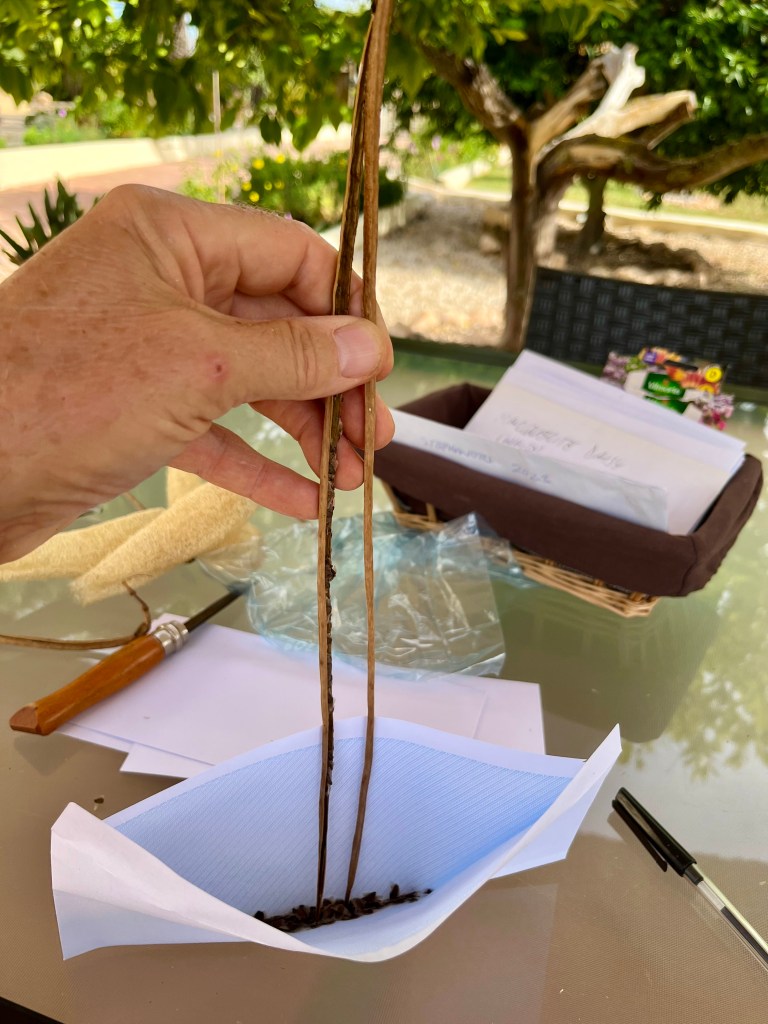
The secret with Pink Trumpet is to wait till the seed casings are completely dry and brown. Once they are ready they will easily split vertically to reveal their row of seeds waiting to be harvested. Don’t harvest these on a windy day as the seeds are meant to be airborne so will just blow away. Instead split the casings over a waiting envelope and let the seeds fall in. See photos below.

Loofahs. Some of your loofah seedheads should be ready by now, and again they must be fully brown and dry. In addition, to make sure they are ready, give them a little shake, and if they are ready you will hear the seeds rattling around inside. Don’t make the mistake of thinking your Loofah plants have died back, they have a habit of putting on another spurt of growth and producing new pods. The photos below show below shows some of my loofah ready to harvest.

With Loofahs you want to collect both the seeds and the pod itself. Regular readers will know that the pods have great exfoliant powers and are wonderful in your shower. I harvest quite a lot of these and sell them on to Cruella (my wife) and all the friends in her coven. They fly in from all over the netherworld as Loofahs are capable of removing even the most stubborn nose wart.

To access the seed crack open the top and pour the seeds into your palm. To harvest the pod just roll the pod between your hands till it cracks, peel of the dead skin and there you have it a loofah.

The final results of my efforts can be seen below. These will be safely stored in the dry and the dark, till God willing, I begin to work with them in the Spring.

I garden with tears in my eyes and the chickens gamble for Tango’s things

We all knew it was coming but it is now official; Tango the lonely blind Labrador is lonely no more and he can see. He has gone to be an Angel in God’s garden, joining his brother in chicken free glory.

We better get on with the gardening or this will end up as a tear stained blog filled with memories and no plants.

10th September 2025. Things I have been doing lately:

  • Giving hedges a little trim
  • A bit of messing around with trees
  • Beginning to harvest grapes
  • Using Cathie’s big pots
  • Tango bids farewell amidst unsightly chicken behaviour

Giving hedges a little trim. If you have hedges now is not the time to undertake a big cutback, that can wait till January. However, if your hedges are getting in the way of other plants or are stopping you walking round your garden, then now is not a bad time to get them back into shape as September is still warm and there will still be growth.

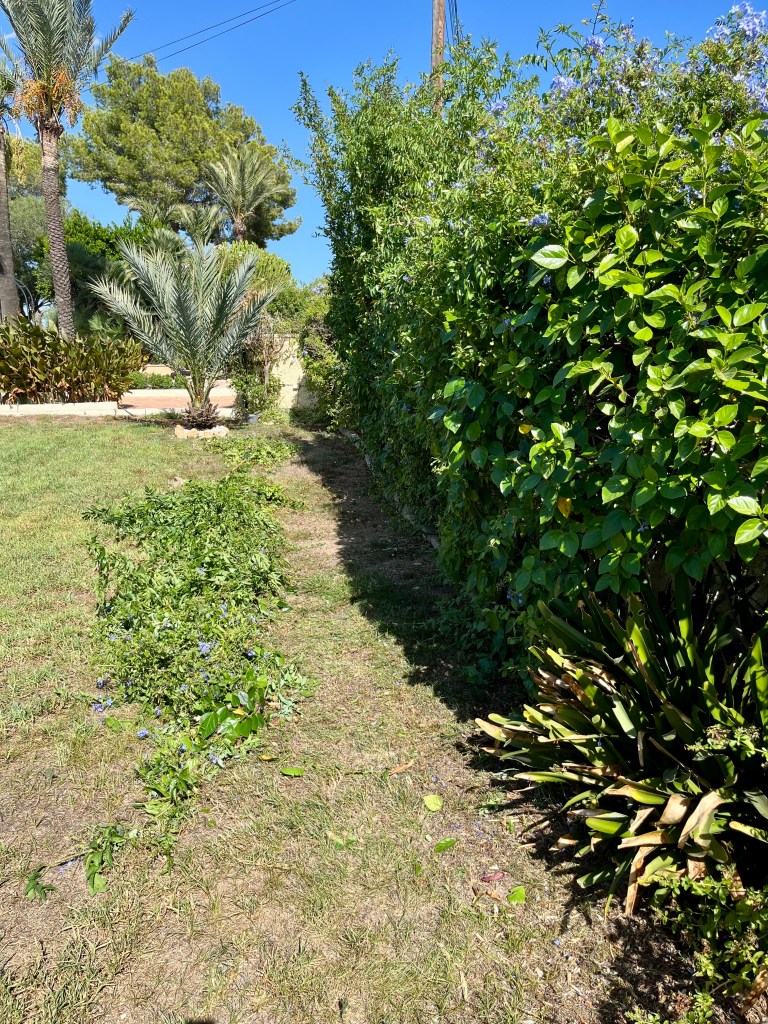
Some of my hedges overlook my lawn, and as such they shade part of the grass, more importantly they will impede my lawn work in October. The photos below show the problem.

Using my long handled hedge trimmers I just gently took off the ends of the main branches to expose the lawn ready for scarifying, top dressing, reseeding and feeding in October. See the difference below.

A bit of messing around with trees. Just like hedges, you shouldn’t really cut trees at the moment. However, there are two things you should be looking out for and dealing with.

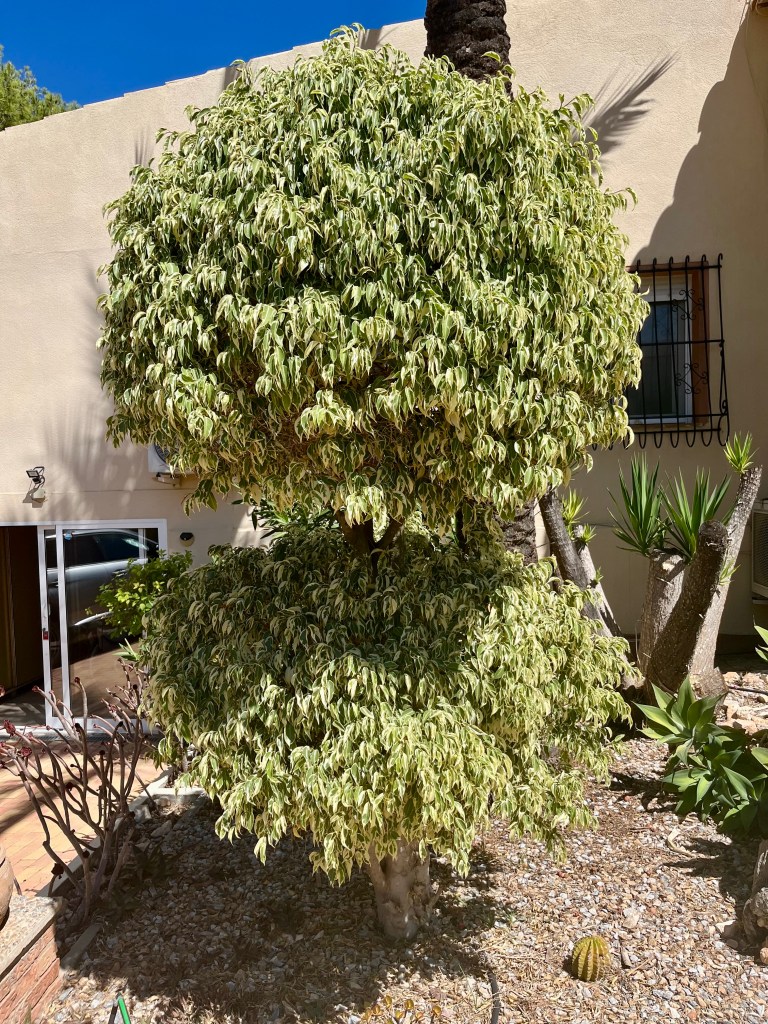
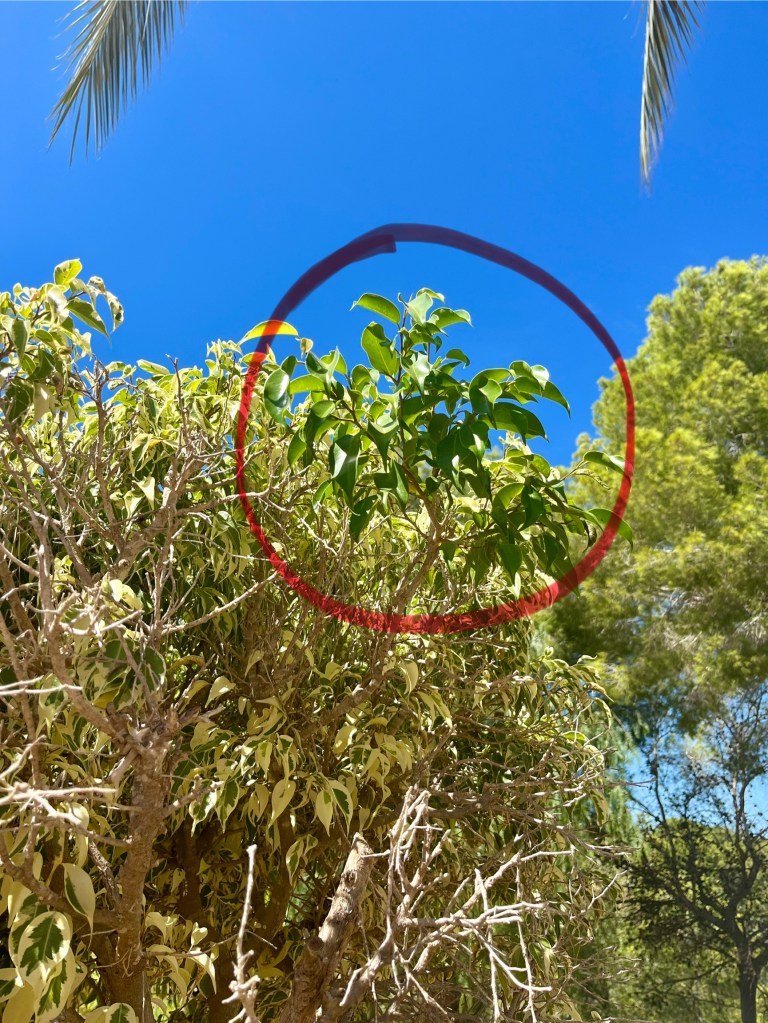
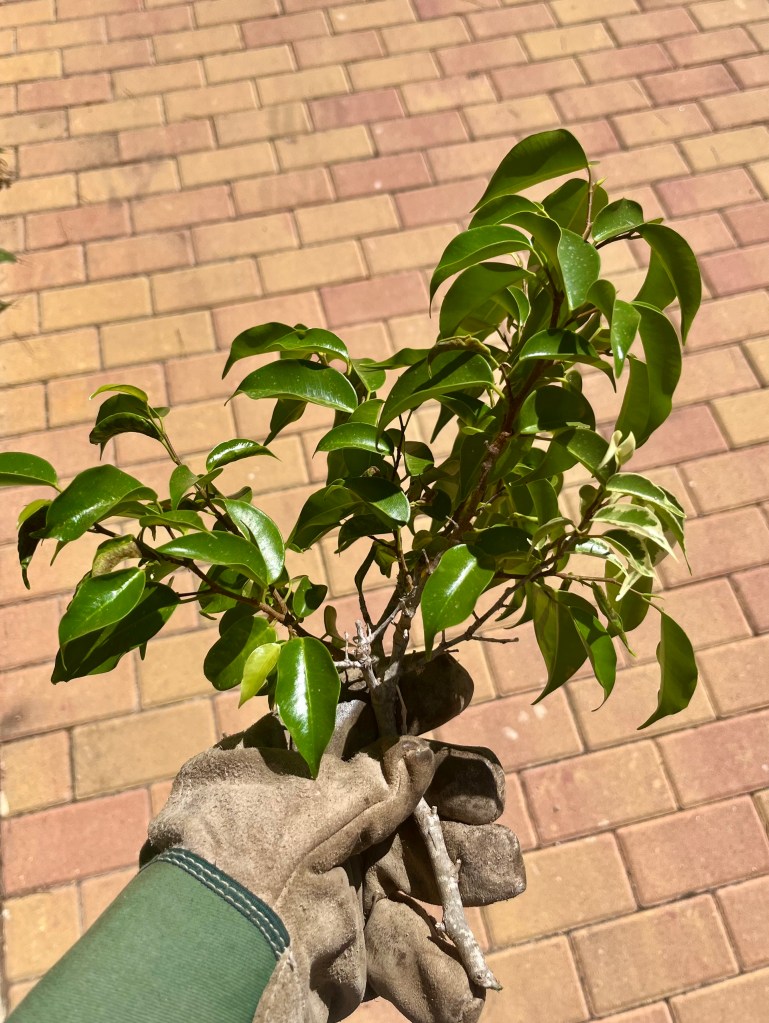
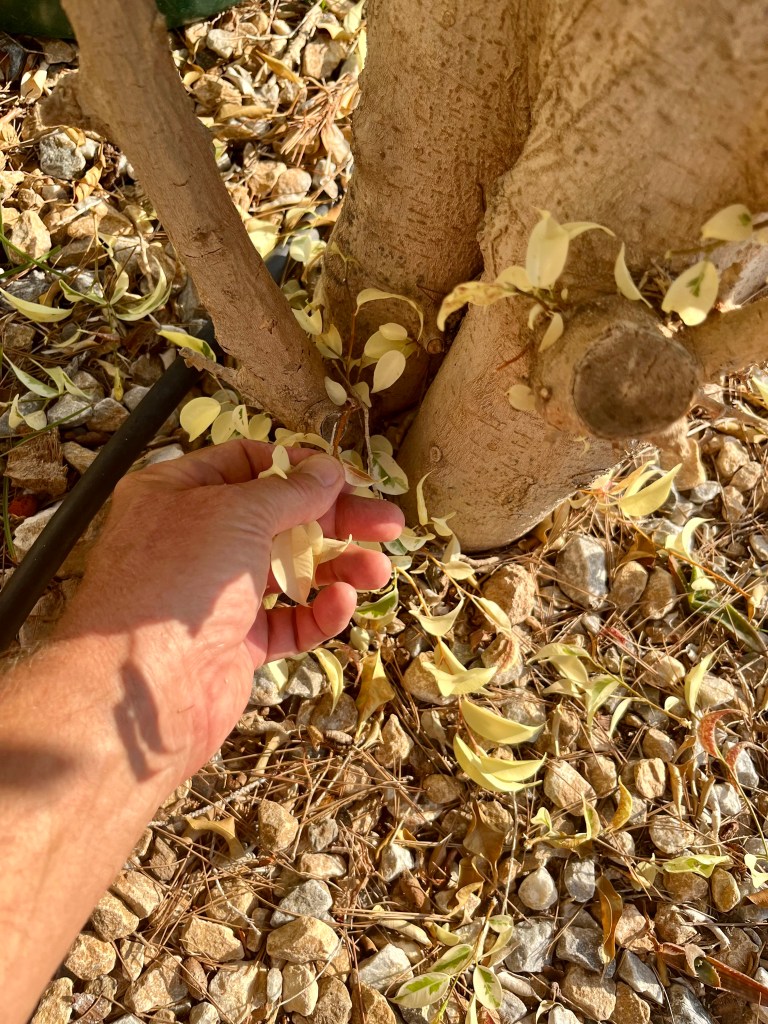
Firstly, if you have any variegated leafed trees then you need to keep an eye out for full green leafed growth. Fully green leaves have much more chlorophyll and are therefore better able to process sunlight than the variegated type. In effect this means if you do not cut out fully green growth then it will soon take over the tree and you no longer have variegation.

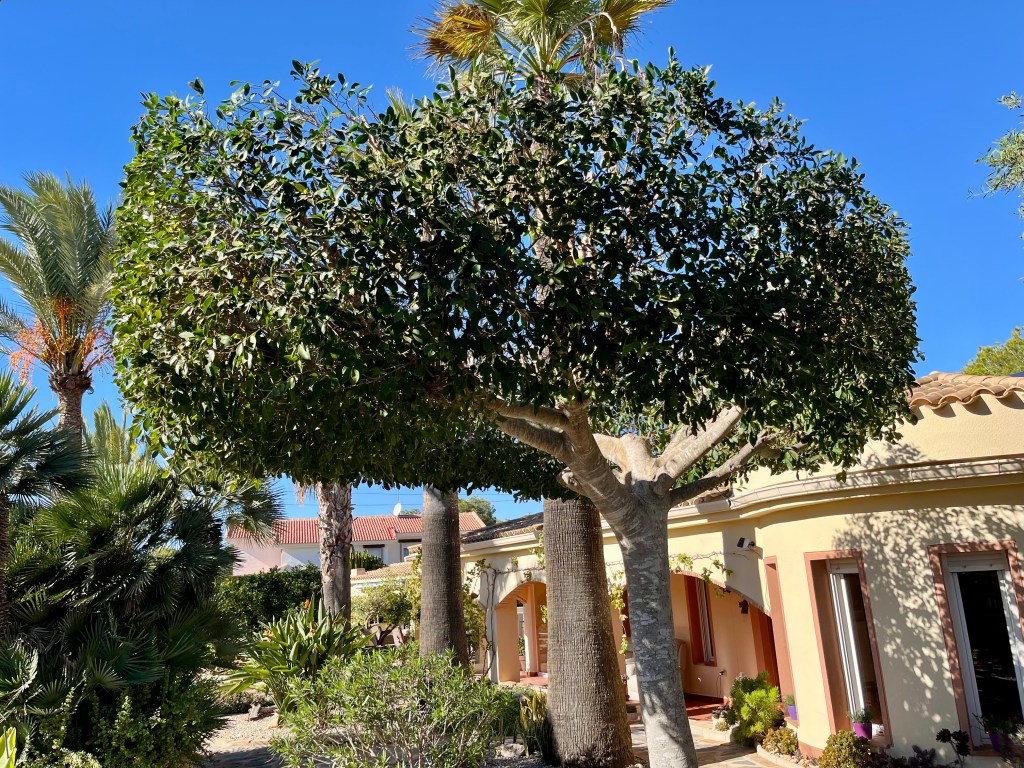
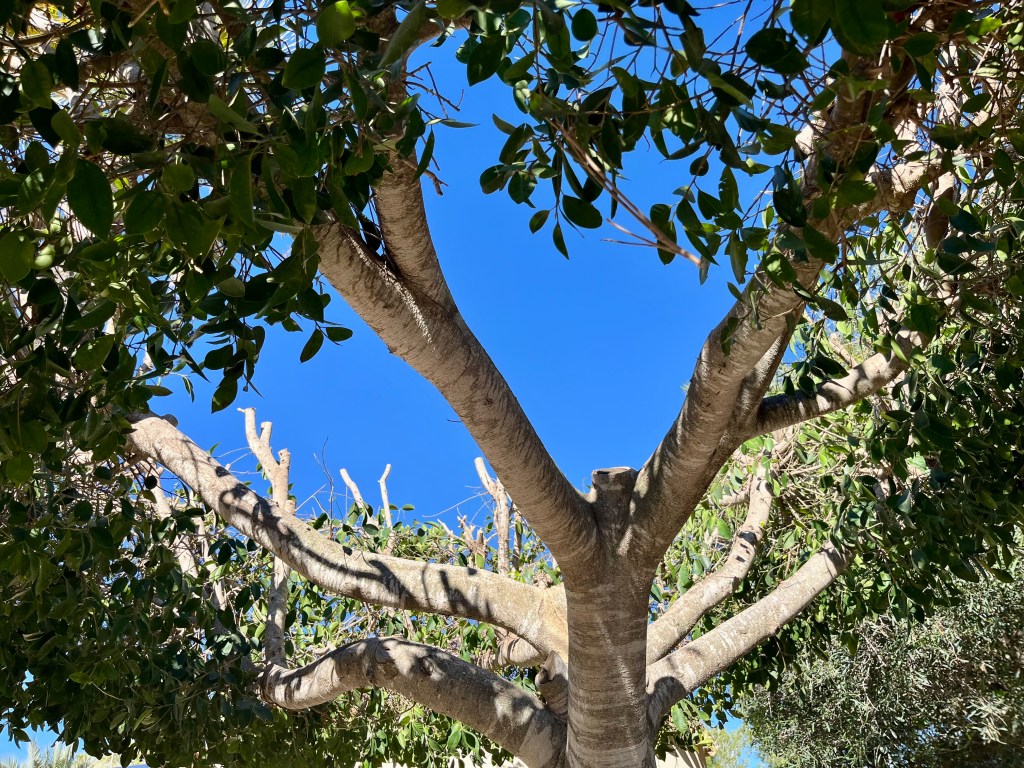
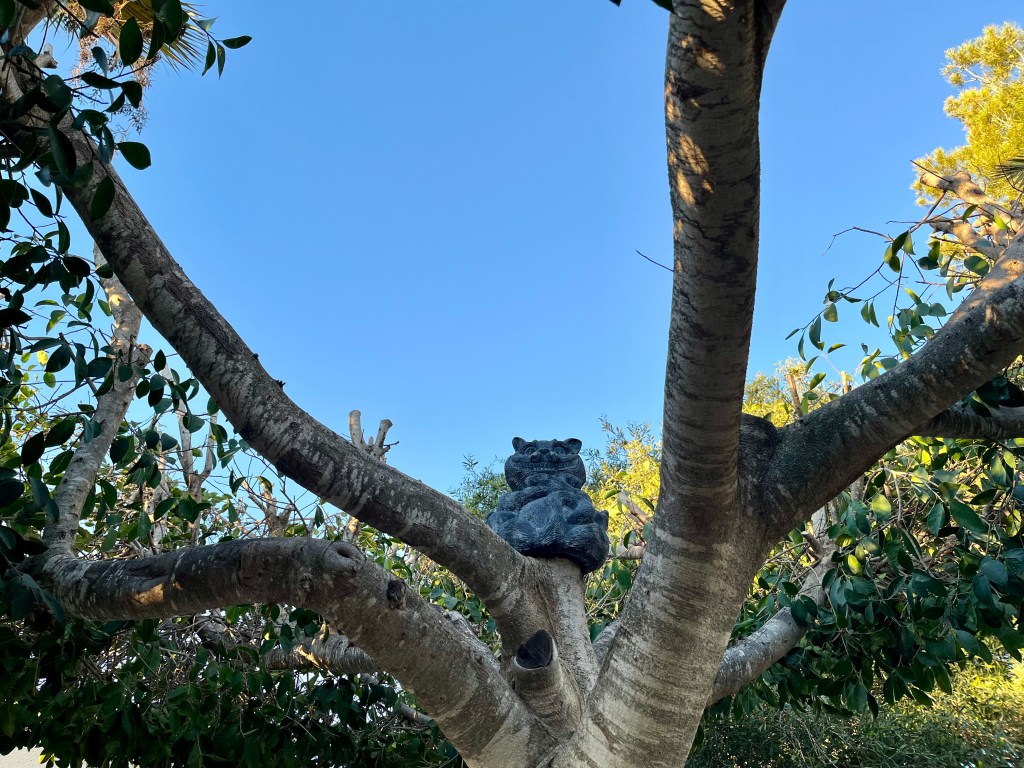
I have a weeping Ficus that I cloud prune, therefore I keep an eye on it for green growth. The photos below show my little tree, but then round the back I have discovered some full green growth. It had to go.

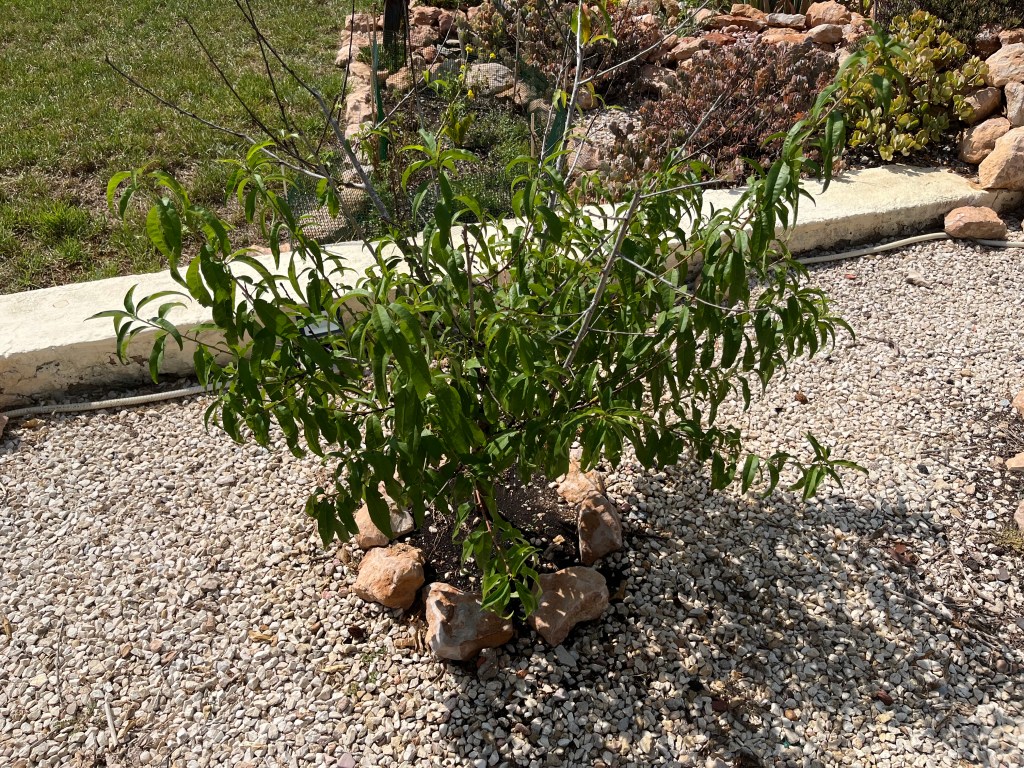
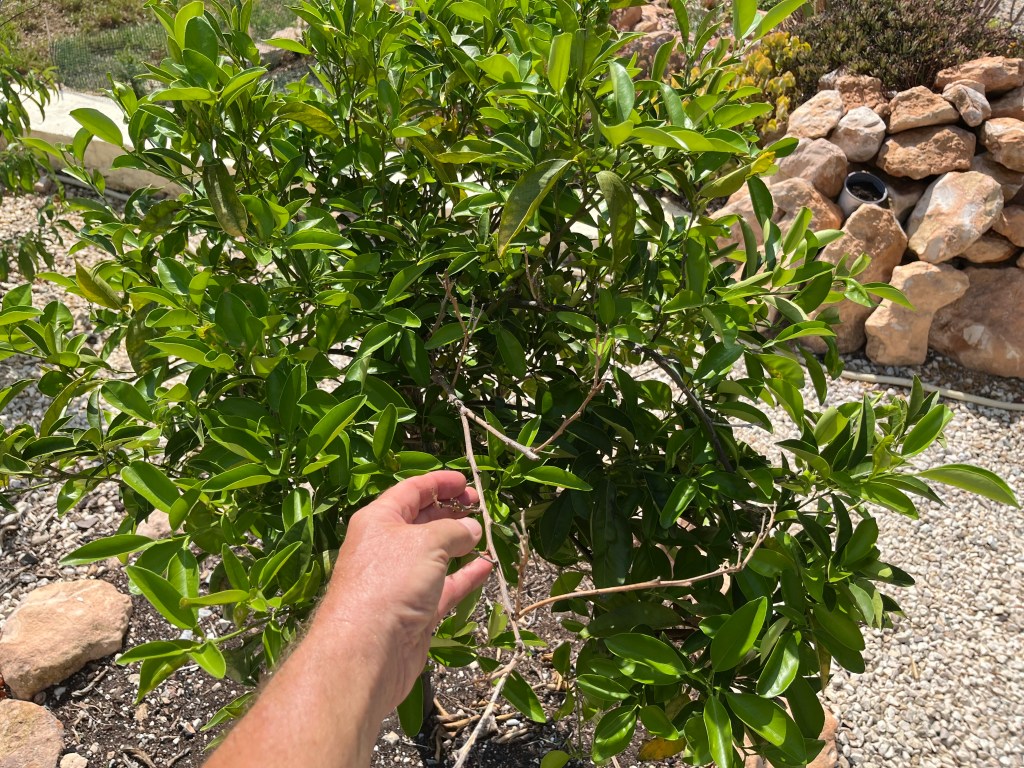
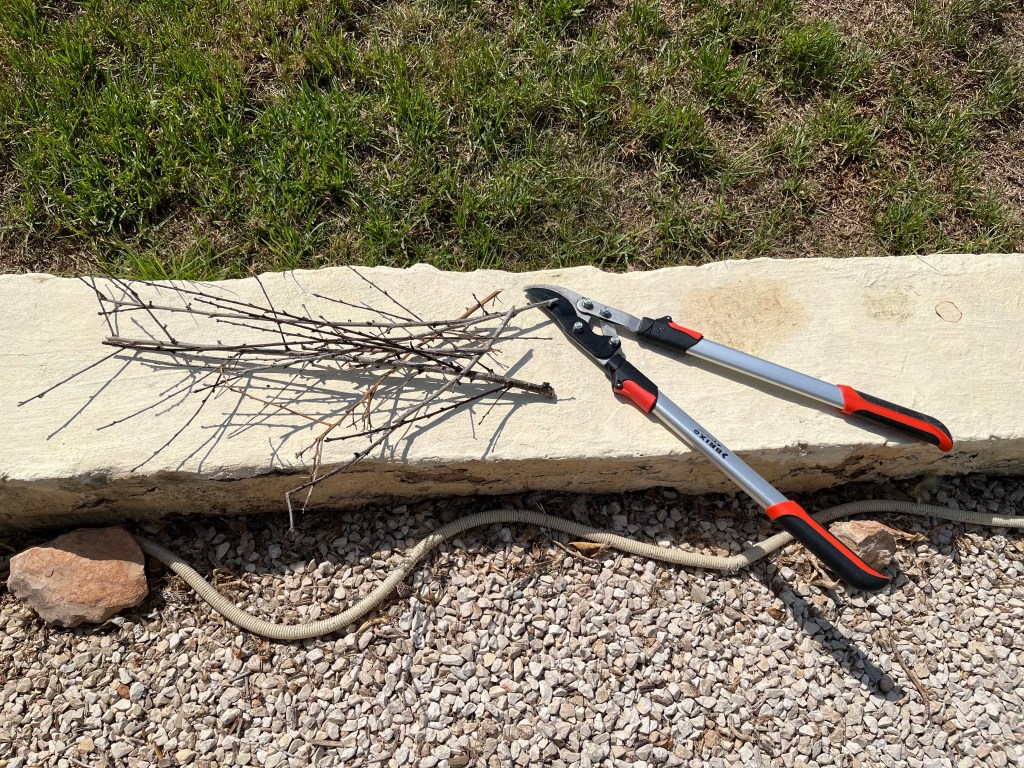
Secondly, If you have deciduous trees, that lose all their leaves in winter, then now is the time to look out for and cut out dead branches. Whilst the trees still have their leaves you are able to detect any branches that are totally leafless. Check that the branches are dead by scraping back the bark in a small area. If you see no green then the branches is dead. Just cut it right out at its base. The photos below show me taking out dead branches on a little peach tree.

Beginning to harvest grapes. You will remember in a previous post that I recommended that you bag up your grapes to save them from pests and disease. Well if you did so then now is the time to begin harvesting.

On a weekly basis go round and look inside each of your little bags to see how your grapes are ripening. I recommend that you do not try to harvest them all at once, as they will ripen at different times, and anyway you can’t eat them all at once.

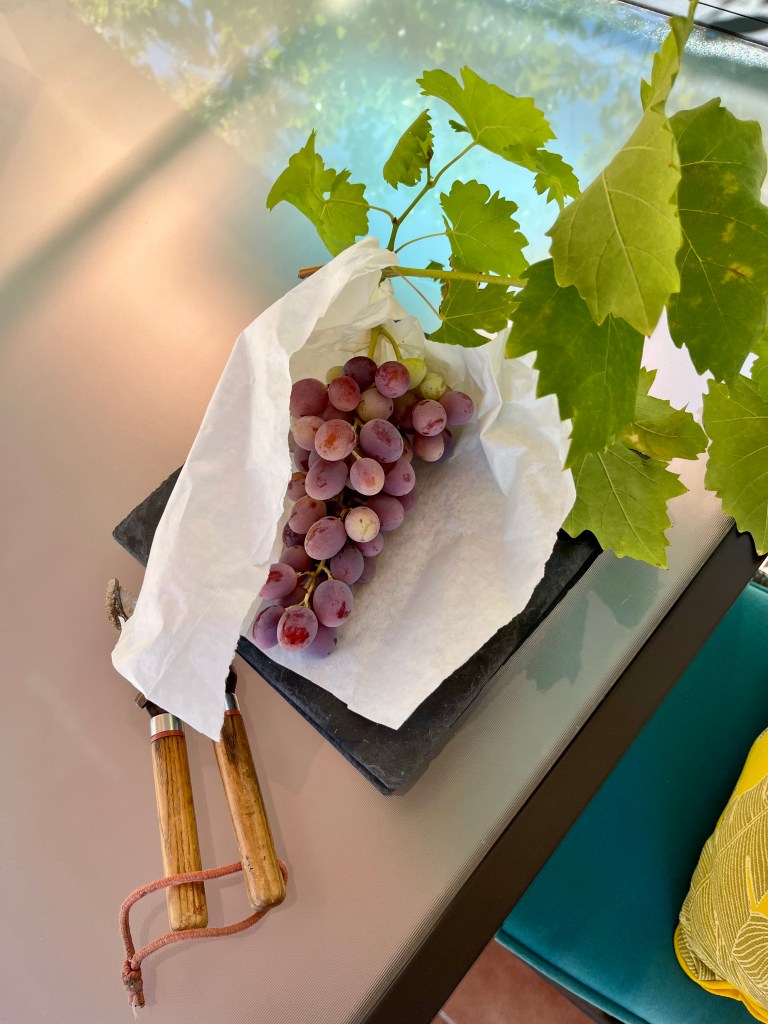
To harvest your grapes just cut the stem above the bag and remove your bunch. All you have to do then is give them a rinse, let them dry and refrigerate to eat at your leisure. See my efforts below.

Using Cathie’s big pots. My friend Cathie kindly donated two large interesting pots to me some 6 months ago. Cathie is one of those gardeners who has an eye for garden design, but an uncanny habit of killing any plant she touches.

Although I have pots, I never really consider myself a pot gardener. But these were too good to turn down so I have spent the past six months contemplating how to use them, what to plant in them and where to put them.

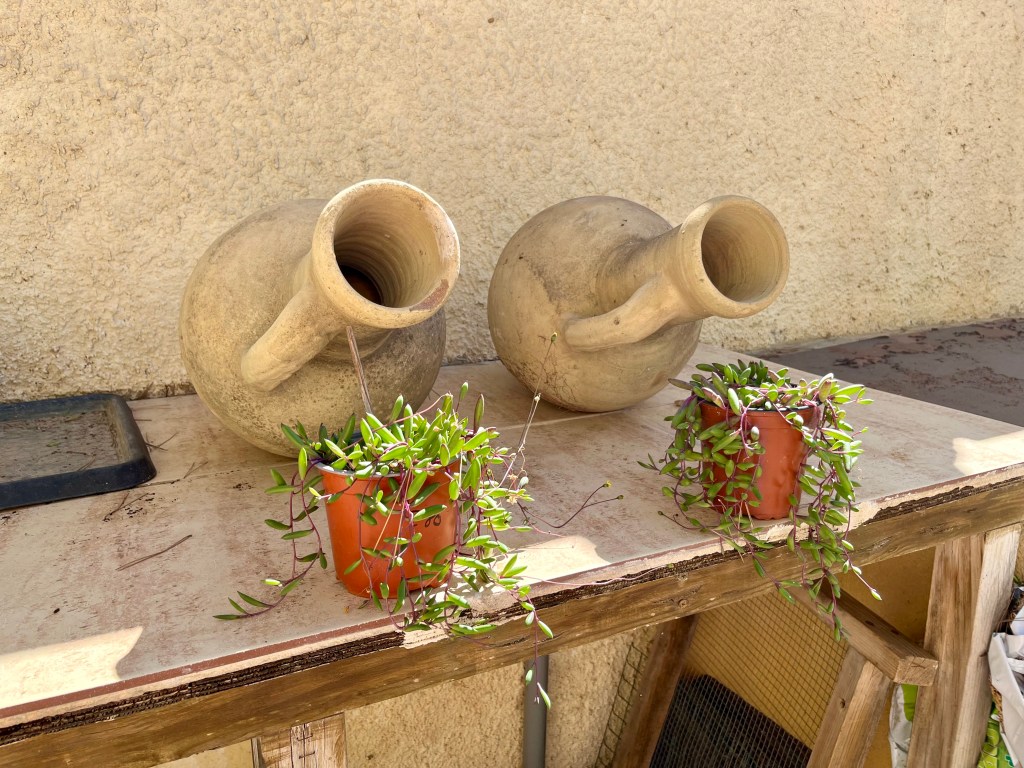
I have grown a variety of cuttings as potential pot residents, but eventually I have decided on “little pickles” as the tenants. The lovely pots and their potential new tenants can be seen in the photo below.

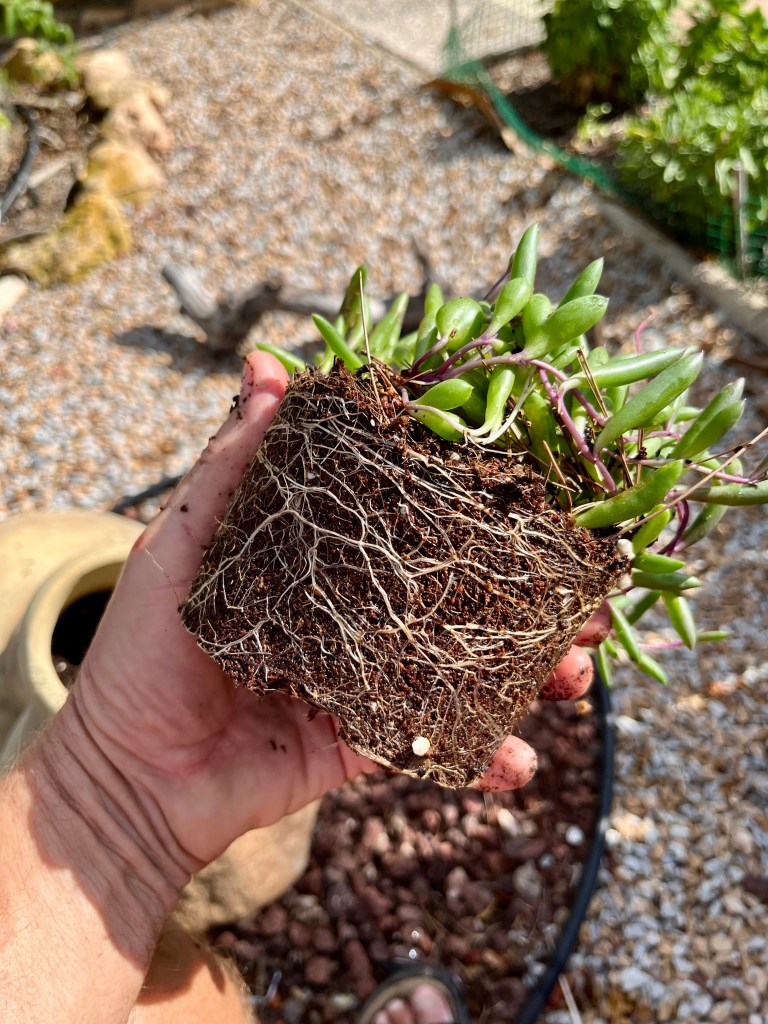
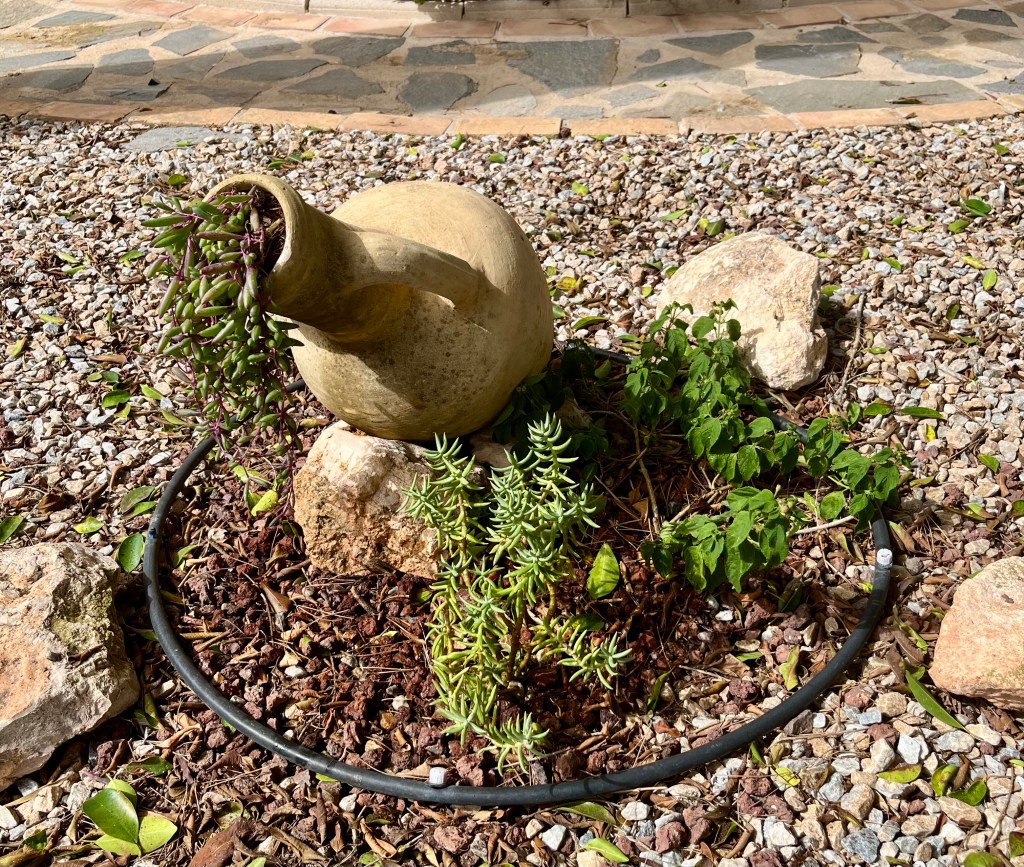
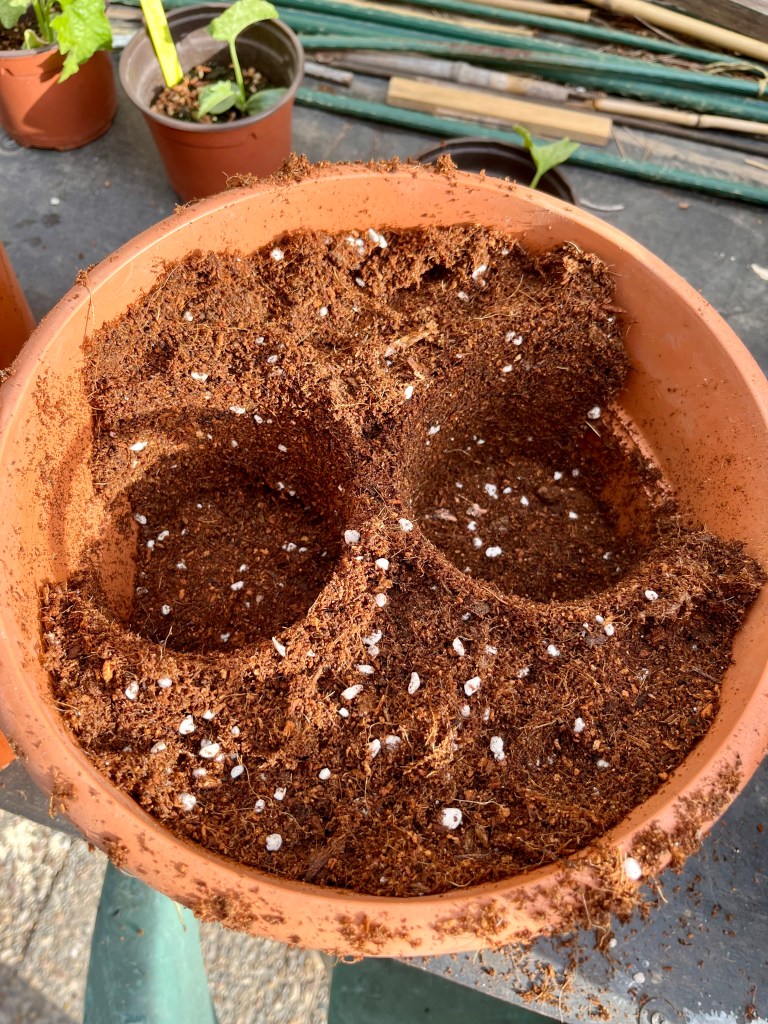
I didn’t want to just fill the pots with compost as this would have been a waste. So instead I stuffed half of each pot with old T-shirts and a few pots and topped up the remainder with compost rammed down. I then eased the little pickles out of their pots; both showed good root growth as can be seen below. I think they look rather nice in their final position. As they grow and cascade to touch the ground I will take some cuttings to give to Cathie to kill.

Tango bids farewell amidst unsightly chicken behaviour. We knew it was coming but it didn’t make it any easier. The vet duly called, Tango was sleeping and barely raised his head as the vet shaved his leg for his final injection. He passed so peacefully. Cruella (my wife) threw herself on his lifeless body in a fit of funereal histrionics, her chickens meanwhile gazed through the window at Tangos deathbed scene with blank eyed indifference.

The vet took Tango away and I went down to the Wild Wood to tell the bees. It is traditional when a member of the family passes away to go and tell the bees. I went to each hive and knocked three times and said the traditional words: “Bees, bees, hear what I say, poor old blind Tango has passed away.” The bees were very respectful and it gladdened my sad heart.

As I came up from the wood I could hear a cacophony of cackling Chickenese coupled with squabbling noises. As I rounded the corner of the house there was Cruella and her chickens throwing dice to decide who would get Tango’s various things. His bed, collars, brushes, dinner bowls and leads were all laid out in front of them as they gambled for them.

I rushed forward and gathered everything up and raced to my shed and locked myself in. They are out there now shouting profanities in Chickenese whilst Cruella keeps trying to get the door open. They have no respect, I think they’ve been drinking.

Tango when he was a puppy, he could see and he wasn’t lonely.


I pick seed winners, rescue a Leek and demand that chickens wear nappies

We are now in the dog days of Summer; the heat is intense, plants are wilting, water bills are high and Cruella (my wife) is refusing to fit nappies (diapers for US readers) to her chickens. I know it is all a bit surreal, but you should try living here. Anyway on with the gardening.

20th August 2025. Things I have been doing lately:

  • Selecting the best blooms for seed
  • Cutting back Petunias
  • Dealing with tree suckers
  • Rescuing a common houseleek
  • Petitioning for chicken nappies

Selecting the best blooms for seed. Now is the time to consider which blooms you are not going to deadhead, but instead save for next years seed. As you wander up and down your borders deadheading, look out for the best blooms and mark them for seed. To be honest I should have done this earlier in the summer but I have been just too busy.

The benefit of marking the best flowers for seed, is that you do not accidentally deadhead them. Just get some masking tape, select the blooms you want to save, and wrap a band of masking tape around the stem to remind you not to deadhead this particular flower. I do this because when the flowers shrivel and die they all look alike, but if I mark the best ones I will save them for my next years seed. The photos below show some of my marked blooms.

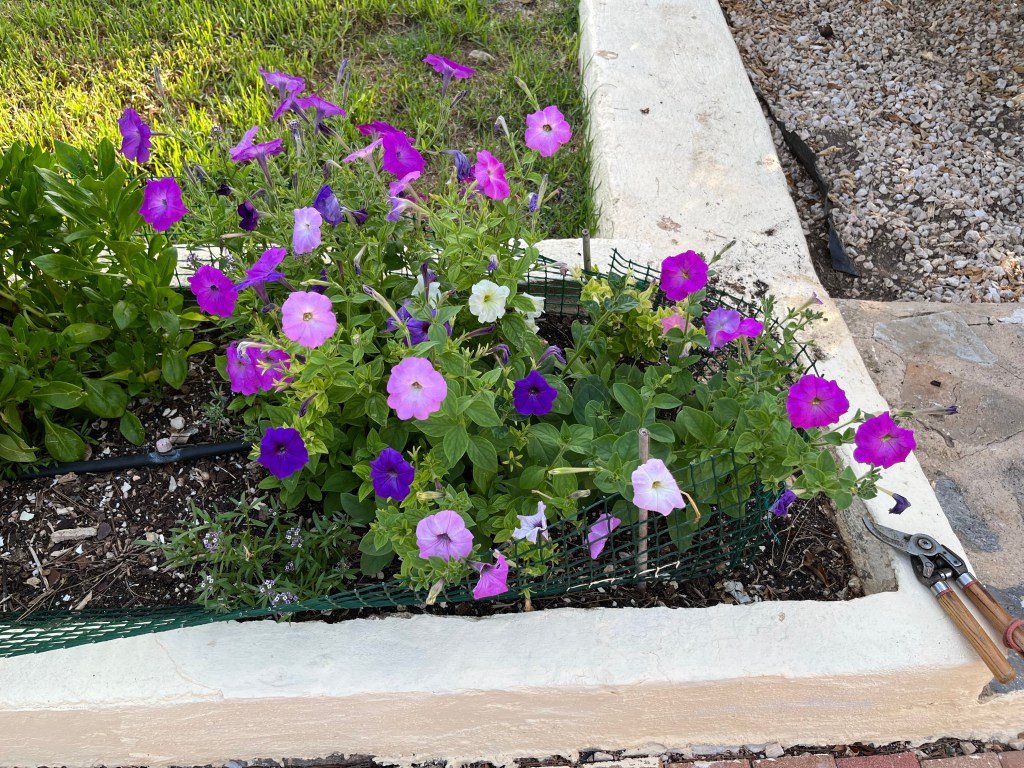
Cutting back Petunias. I have mentioned in recent post that I have been delighted with Petunias this year. They have flowered like crazy and given me much joy. As long as you deadhead them each day – by plucking off spent flowers – they will keep flowering. However, by now they are getting a bit leggy as you can see in the photo below.

For some reason this pot does extremely well

To keep them flowering then you need to cut back the longer stems by a third to half. Don’t do all of them just select a few each week and prune them with secateurs. The photos below show me pruning to ensure flowering all the way to October hopefully.

Dealing with tree suckers. Tree suckers are those little bright green shoots that you see sprouting from the bottom of the trunk on your trees. It is important that you remove these as they are in effect sucking the goodness out of your tree before it reaches the leaves and fruit.

Tree suckers are particularly a problem on older trees, especially those suckers that are growing from below the soil as these may be root stock suckers that are no good to anyone. You need to remove suckers on a regular basis. The simplest way is to pull sharply downwards on the sucker and tear it away from the trunk, this method is far better than cutting with secateurs, as it seems to inhibit further growth.

The photos below show a sample of my trees before and after with a variety of types of suckers. Click on each photo for a larger view.

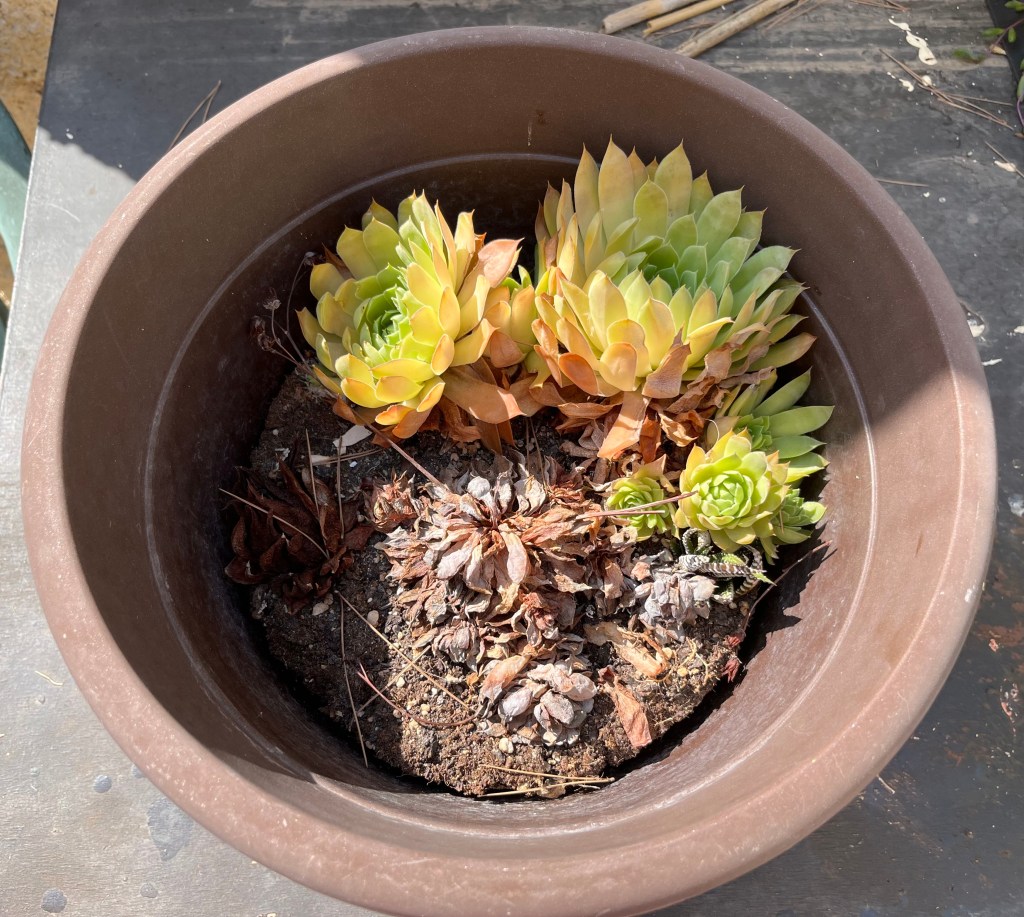
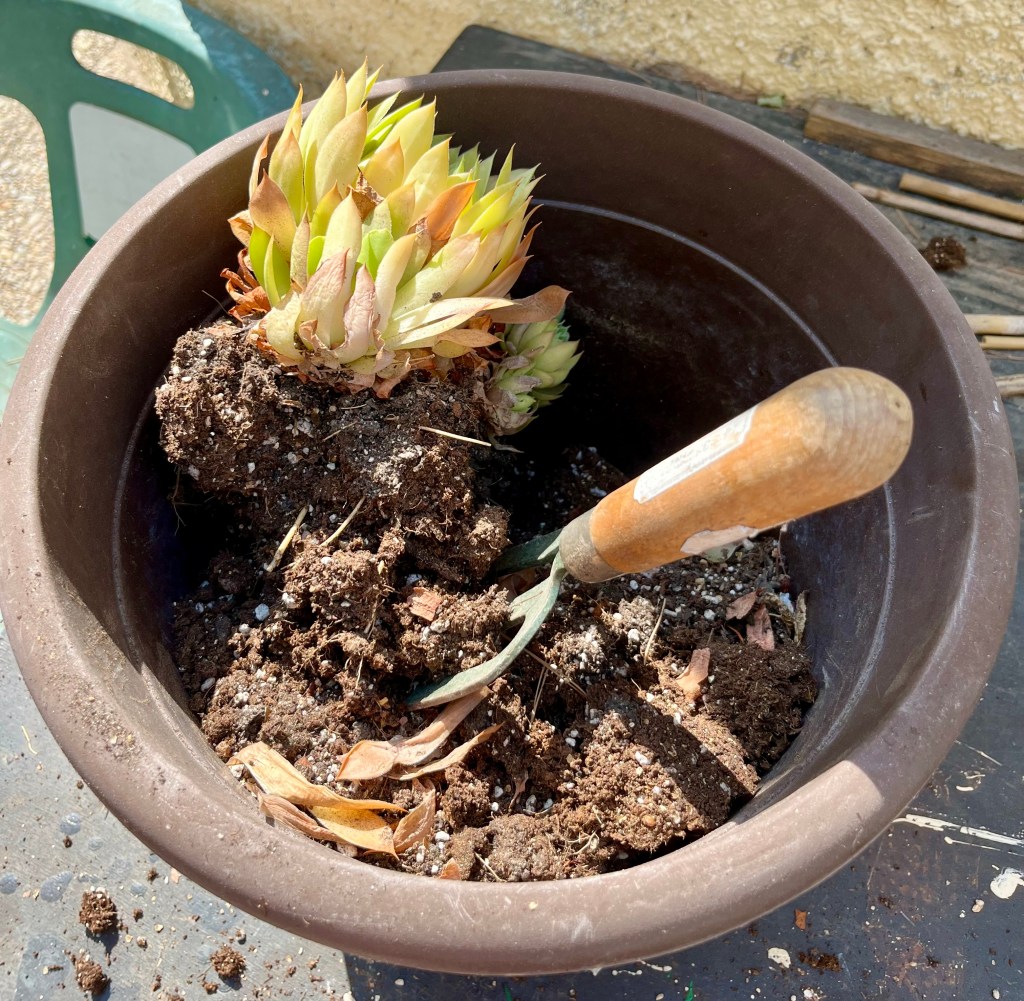
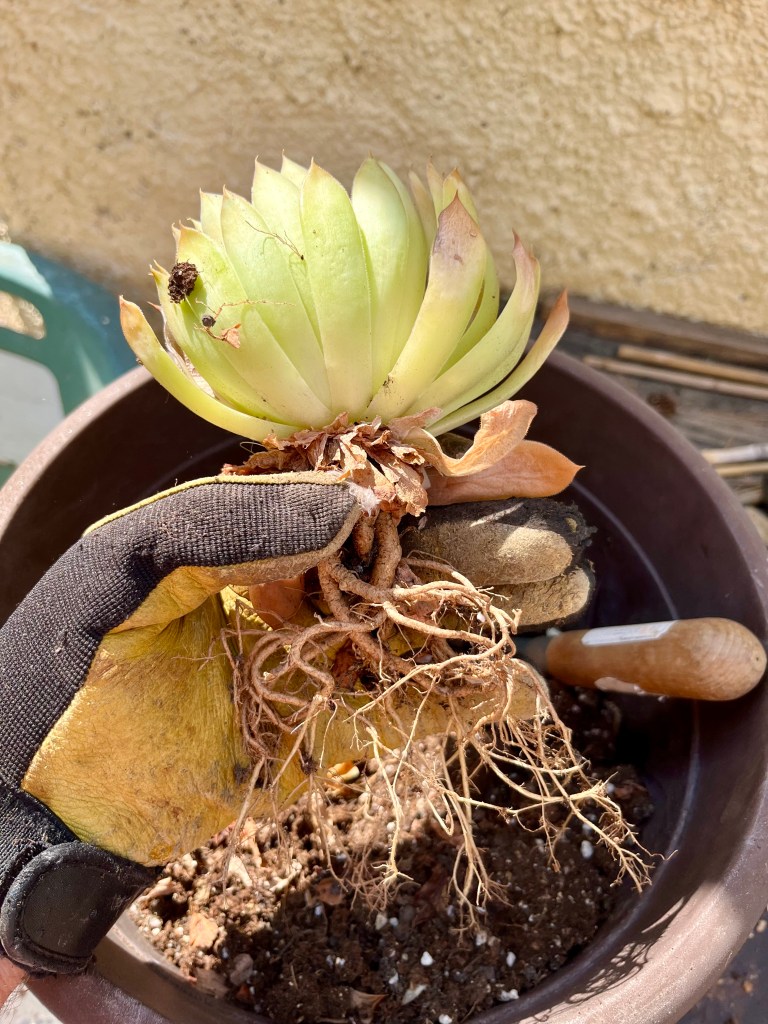
Rescuing a common house leek. I don’t have many succulents in pots, but a while ago I potted up some house leeks with a variety of other succulents and they looked rather nice. Well, they all started to die and rot and it was all my fault. It was simple really, my nice pot of succulents sat between two pots of petunias, and as I watered one pot of petunias and moved across to the next, I would just give the succulents a squirt of water. But never do this, or you will get what I got a pot of rot. See the photo below. Click on each photo for a larger view.

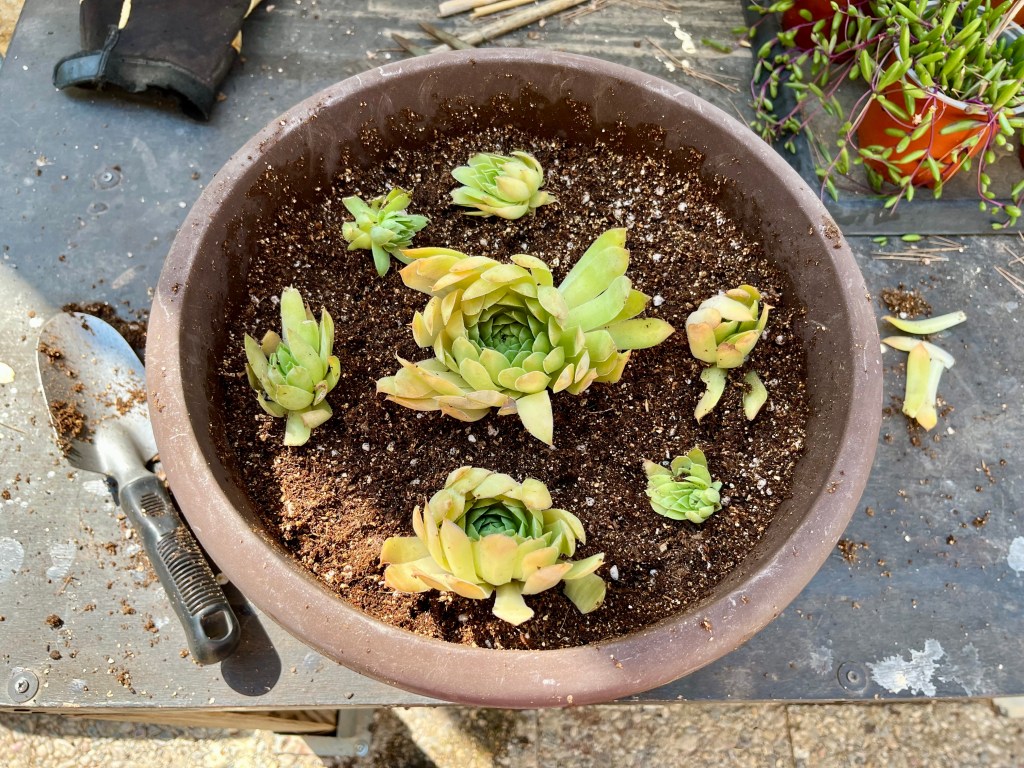
If you catch this in time, then the solution is simple, stop watering! Then you have to dig up the plants, clean them of dead foliage and rot and repot them in a nice free draining compost with added vermiculite. Once settled water them once a month if necessary The photos below show my little succulents being rescued and revived.

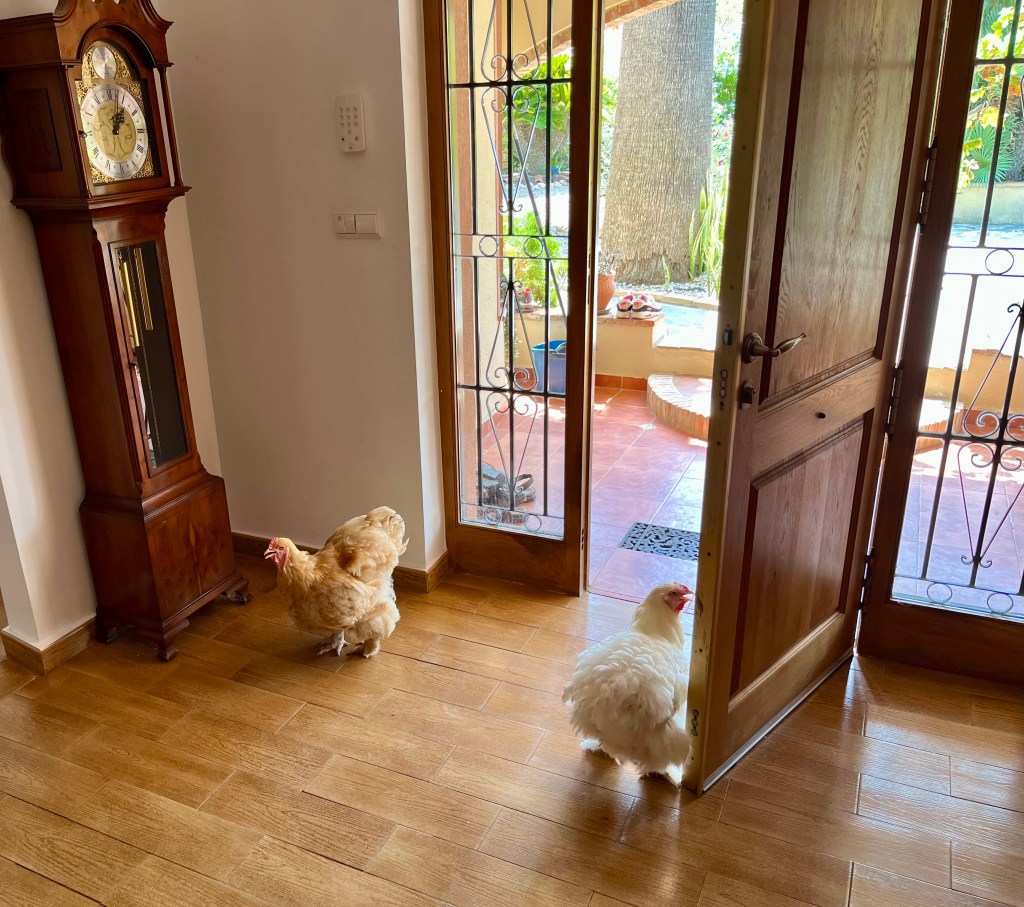
Petitioning for chicken nappies. I don’t know how to put this delicately, but Cruella’s chickens are poohing everywhere they shouldn’t. I expect them to pooh in the garden, in fact I welcome it. But lately they have been congregating on our Naya (veranda), covering it in Pooh and then sneaking into the house to torment Tango the lonely blind Labrador by poohing near him. He then rolls over to ease his many pains and ends up covered in chicken Pooh.

I approached Cruella (my wife) with the problem, but she flat out denied that it was her girls. She began to blush and exclaimed that her girls were too well brought up for such things and were well versed in “toilette”. Anyway I presented her with the photo evidence below. Click on each photo for a larger view.

At first she denied they were real photos and I must have photoshopped her girls in. When I insisted this was not the case she changed her story and said her girls were just popping in to see if Tango the lonely blind Labrador was ok!?

Anyway, she has refused my suggestion of chicken nappies and instead insisted that I should put up an old fly screen over the door. So far poor old Tango has got tangled in the screen and fallen out the door three times; the chickens just stand back and mock him in chickenese as he struggles to free himself. It is a bit like watching Samson being mocked in the temple of Dagon by the Philistines.

I am deadheading night and day, Cruella has a new broom and the chickens are disrespecting Tango

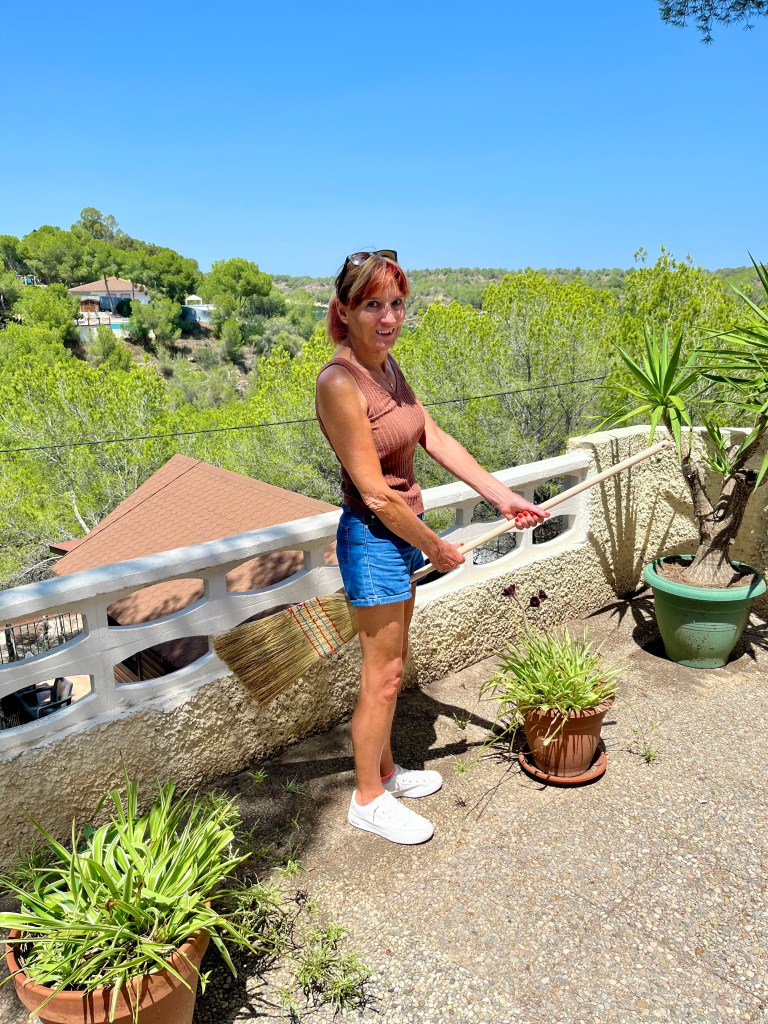
By now your garden should be at its peak, with flowers galore, soft fruits and figs etc coming out of your ears. And yes, I know it’s hot, but when the going gets tough, the tough get gardening. As if all this isn’t enough Cruella has upgraded her broom to a digital model, she says it is the equivalent of the Airfryer of brooms, but I don’t know what she is talking about. The photo below shows a delighted Cruella with her new broom.

If you look closely the handle has a hole in the top, Cruella tells me this is to hang your handbag when flying.

Oh! and the chickens are trying to make Tango the lonely blind Labrador homeless and are disrespecting him. Anyway, on with the gardening.

5th August 2025. Things I have been doing lately:

  • Deadheading
  • Harvesting and preserving figs
  • Dealing with the Chillis disaster
  • The chickens are disrespecting Tango

Deadheading. You have done all the hard work, planting seeds, potting on, planting out etc. And now you can enjoy your lovely summer flowers. Even if you shamefully went out and bought your plants, I can forgive you, as long as you deadhead every day.

Every plant will attempt to flower only once and then put all its energy into setting seed. The plants whole purpose is to fulfill its life cycle by setting the next generation. However, if you let this happen then all you will mainly get is a quick flush of flower then borders full of brownish wilting plant stems.

If you want flowers all summer then you need to deadhead daily. At its simplest this means taking off the spent flowers heads to encourage the plant to continue to flower.

Most deadheading is very simple. Take your secateurs to just under the spent flowers head, but don’t cut there. Instead, slide your secateurs down the stem of the plant till you meet the next flush of leaves, cut here. In this way your cut will be at a growth node and you will not be leaving behind deadwood that could get infected. However, sometimes you have to deadhead certain plants differently so I have outlined some examples below.

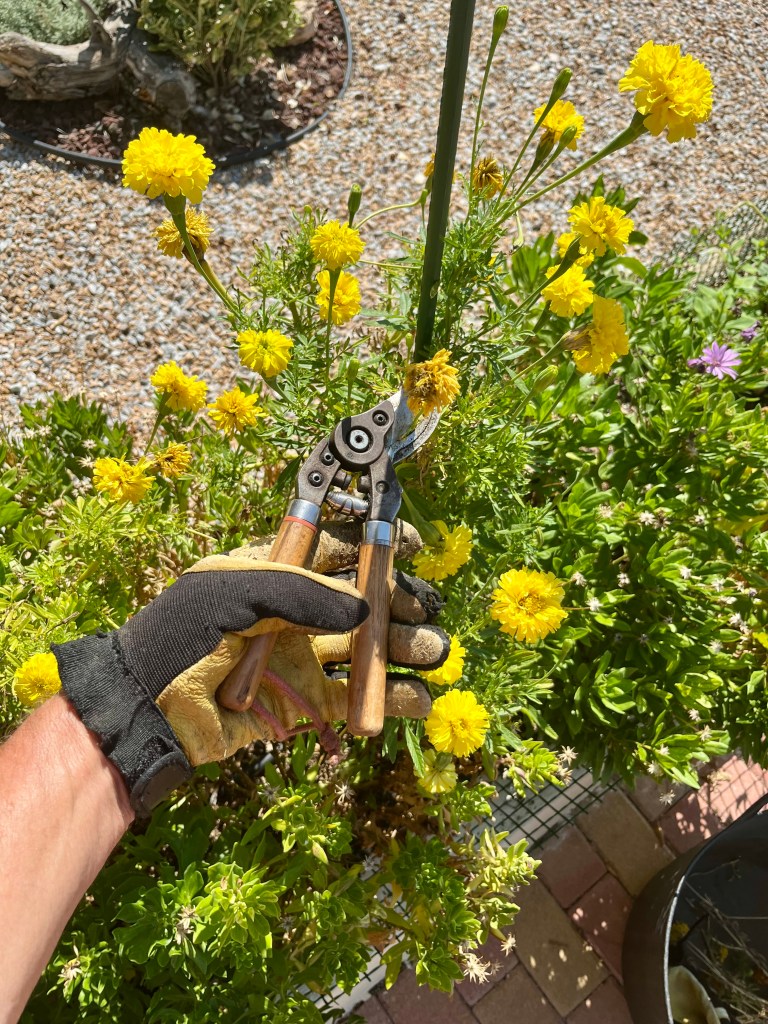
Marigolds. Marigolds are stalwarts in my flower beds and are wonderful flowerers all summer. You deadhead Marigolds in the traditional way by moving your secateurs down the stem. See photos.

Petunias. I have planted Petunias from seed this year and they have been delightful. Once they get going they flower profusely with new flowers every day. To get the best out of Petunias I deadhead them every morning and sometimes twice a day.

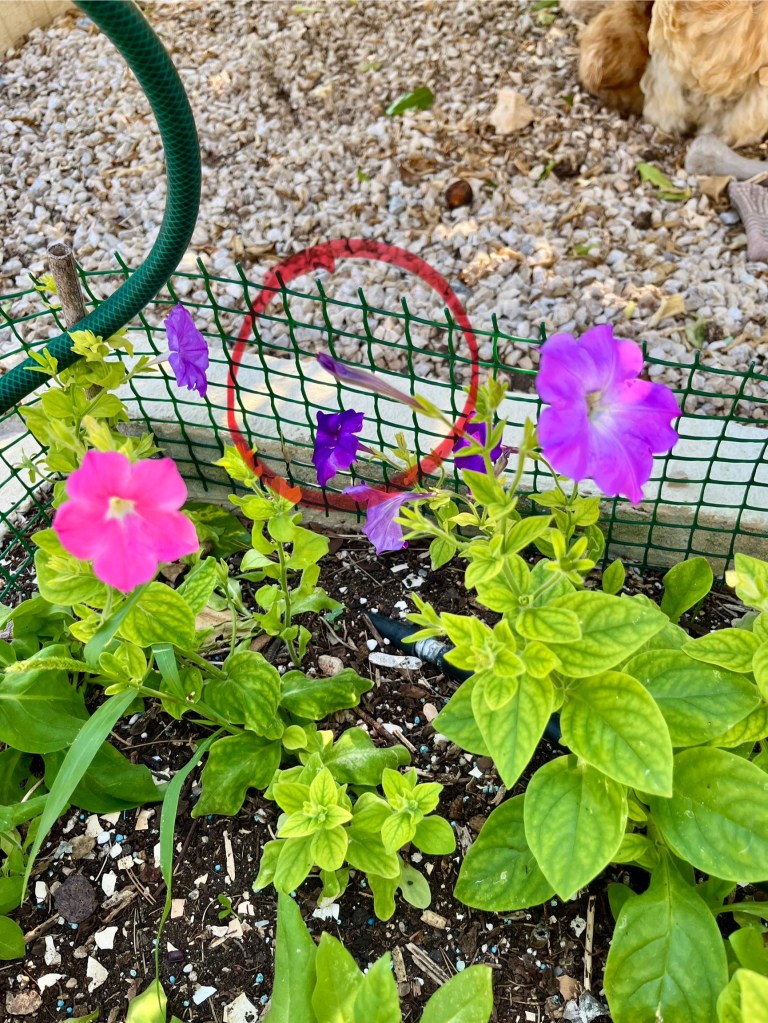
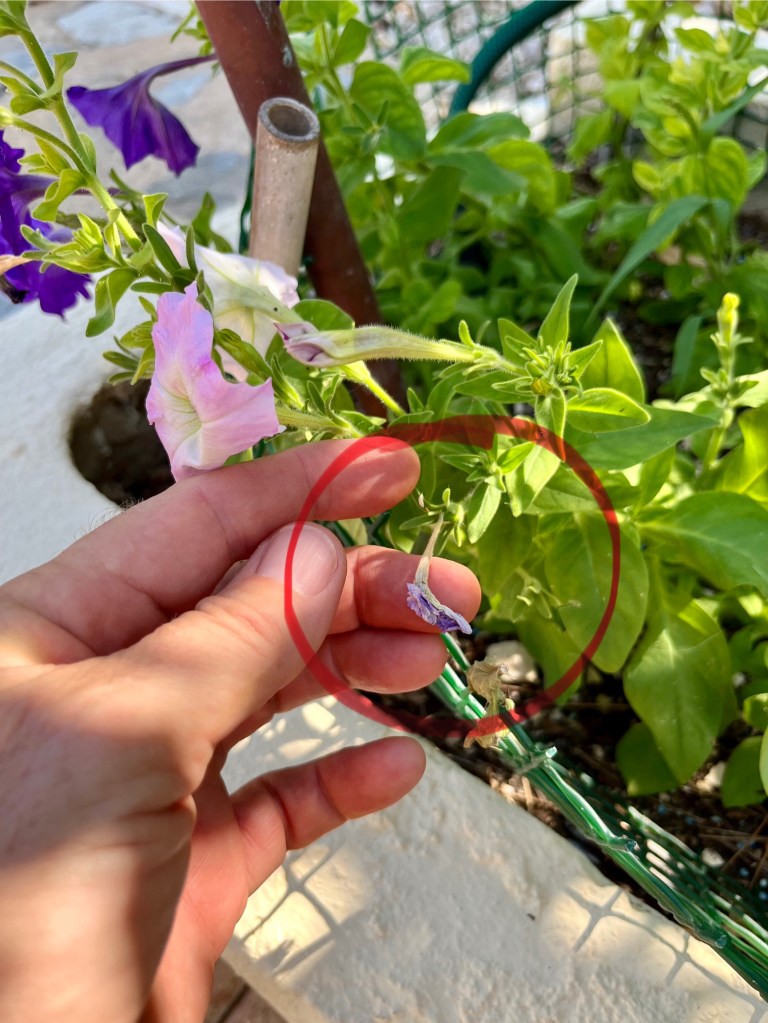
You do not prune Petunias, instead you deftly pluck out the spent flowers. However, it is difficult at first to tell which is a new flower and which is a spent flower. So you have to train your eye to tell the difference. A new unopened flower will come straight out from the stem as a closed funnel (which to be honest can look dead).

A spent flower that has been left and not deadheaded soon enough looks exactly like a new flower with the only difference that it has a slight curl at the end, and if you feel it, it will feel a little bit crusty. The first photo below shows an emerging flower, whilst the second shows a spent flower.

Cruella just looked over my shoulder, read this and said “nobody cares about your bloody flowers”.

Roses. Most of my roses are single bloomers and in the main it is all over by late May with another little flush roundabout now. The one exception is an old standard rose that I planted in a hedge years ago. This thrives on neglect and flowers beautifully all summer. To prune roses, wait until most of the colour has gone out of the individual blooms and then deadhead by sliding your secateurs down the stem as outlined above. The photo below shows my lovely old rose flowering away and how to deadhead.

Rain Lily. By now all of my bulb plants have flowered, been deadheaded and are happily sleeping in the soil till next Spring. The one exception is a lovely little pot of Rain Lily (Zephranthes Carinata). This lovely little plant flowers like crazy, but like all bulbs you just take off the seed head and let the stems die back naturally. It will be cut back to the soil in the autumn, but now it is time to just enjoy. The photos below show the little wonder.

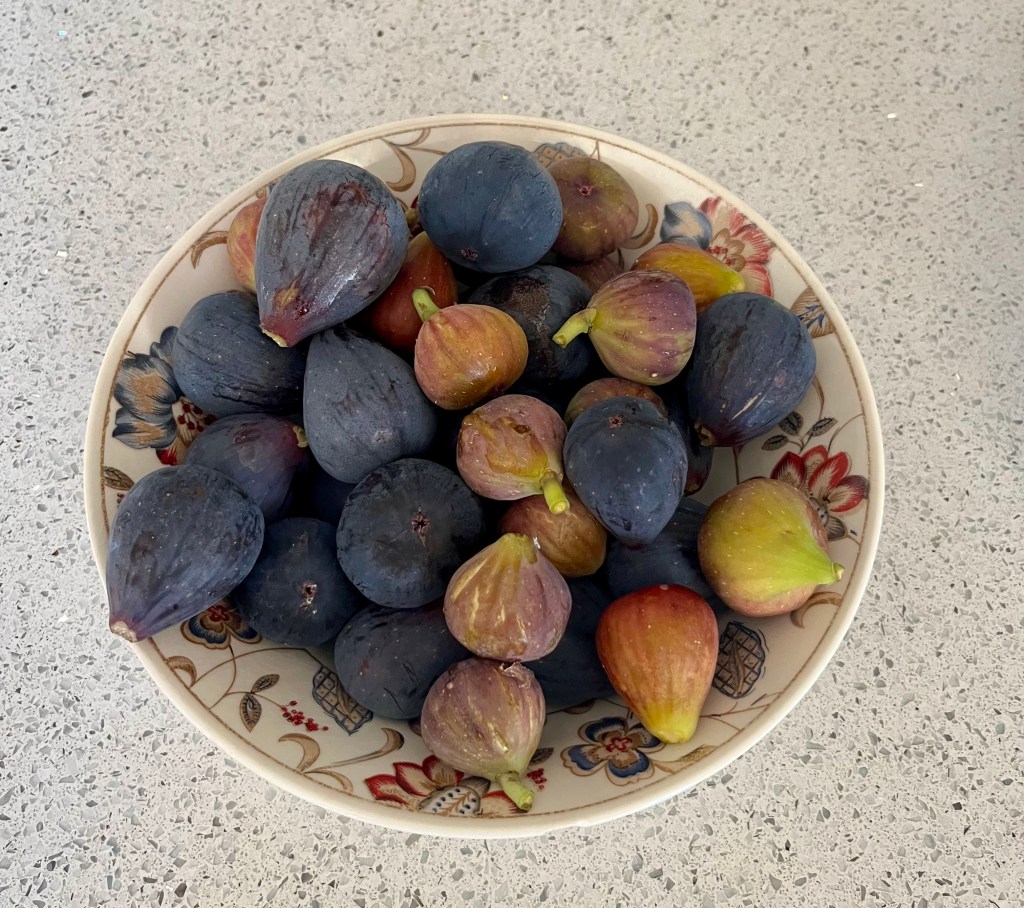
Harvesting and preserving figs. If you pruned your fig tree correctly, then by now you will be awash with figs. Luckily I love figs, but even I can’t keep up with the harvest. The photos below show my daily harvest from two trees.

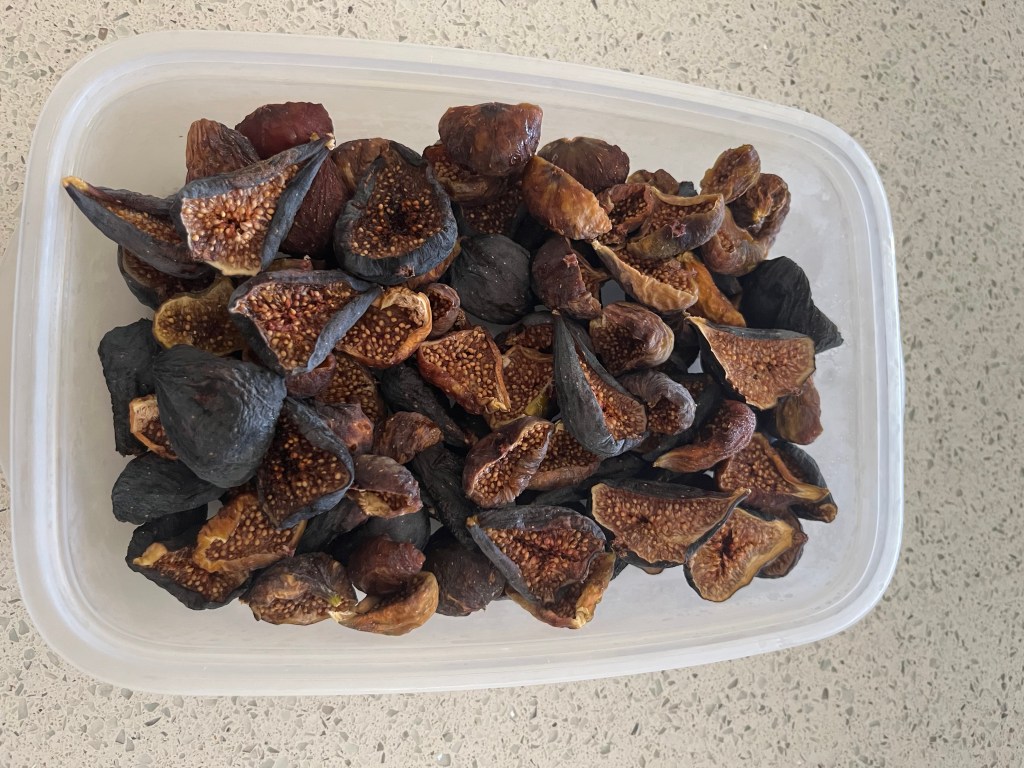
Now there are lots of things you can make with figs, so just look it up on the internet. But, if you want to preserve that luscious juicy feeling through till the autumn then I recommend drying your figs in the sun and then freezing them for use later.

It is quite simple as long as you remember that your figs will be under attack from ants, flys and birds, so you have to protect them. All you need is a few mesh baking type trays, fly coverings which you can get from most “China” shops (sorry those of you in the US, it is a common term in Spain).

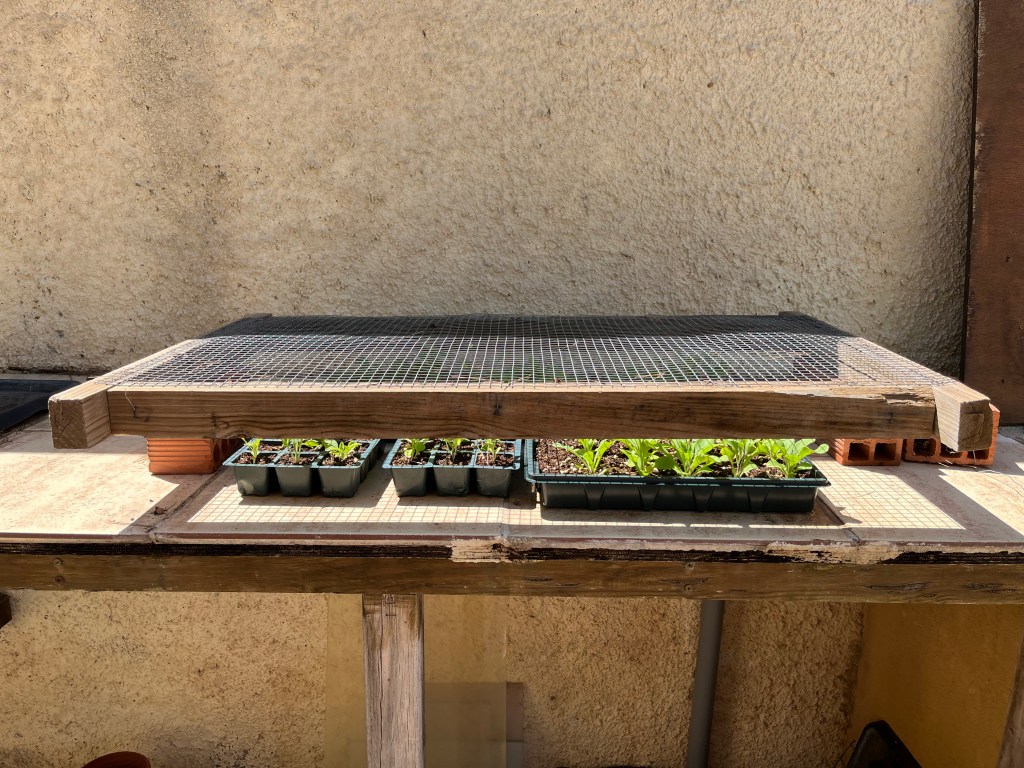
Cut your figs into halves and then space them out in rows on your mesh tray. Put this out into your garden on a table in full sun all day. You must place the legs of your table into pots of water to ensure that ants can’t climb up and destroy your figs. The easiest thing to do is just cut a plastic orange or milk bottle in two and fill the bottom with water.

Leave your figs in full sun all day, but take them indoors each night and keep them covered. It takes about two to three days to dry the figs. The first photo below shows my sun drying technique, whilst the second shows some figs ready to freeze. They can be used as a snack or used in cereals and porridge.

Dealing with the Chillis disaster. I have grown lots of Chilli plants from seed this year. I had so many that I kept 8 but have given lots away to friends. All was going well with plenty of flowers and nascent Chillis; that was until the chickens found them. I had placed them in pots at the rear of our house where the chickens seldom go, but I came out one morning to find the plants stripped of all flowers and the little Chillis and most of the leaves.

I was extremely distressed and complained to Cruella (my wife), but she just shrugged her shoulders and said “girls will be girls, you shouldn’t have left the stupid things there anyway”. In the end I put my plants up on tables out of the reach of the chickens, but then we had a terrible storm that blew all the plants off the table and removed all the new little Chillis. I have persevered and at last I have some Chillis. See the photos below for the hapless chilli plants and my little harvest.

The chickens are disrespecting Tango. Tango the lonely blind Labrador was for so many years top dog. Together with his late brother Nero he rampaged around the garden, guarded the house and was generally just lovely. However, lately age and ill health have forced him down the animal pecking order. Now 17, blind, deaf, only three good legs and a gigantic tumour he cuts a sad figure. To me he will always be a puppy, but Cruella and her chickens laugh at him, mock his infirmities and snigger when he can’t get up. He is a bit like Samuel chained to the pillars by the Philistines in the temple of Dagon.

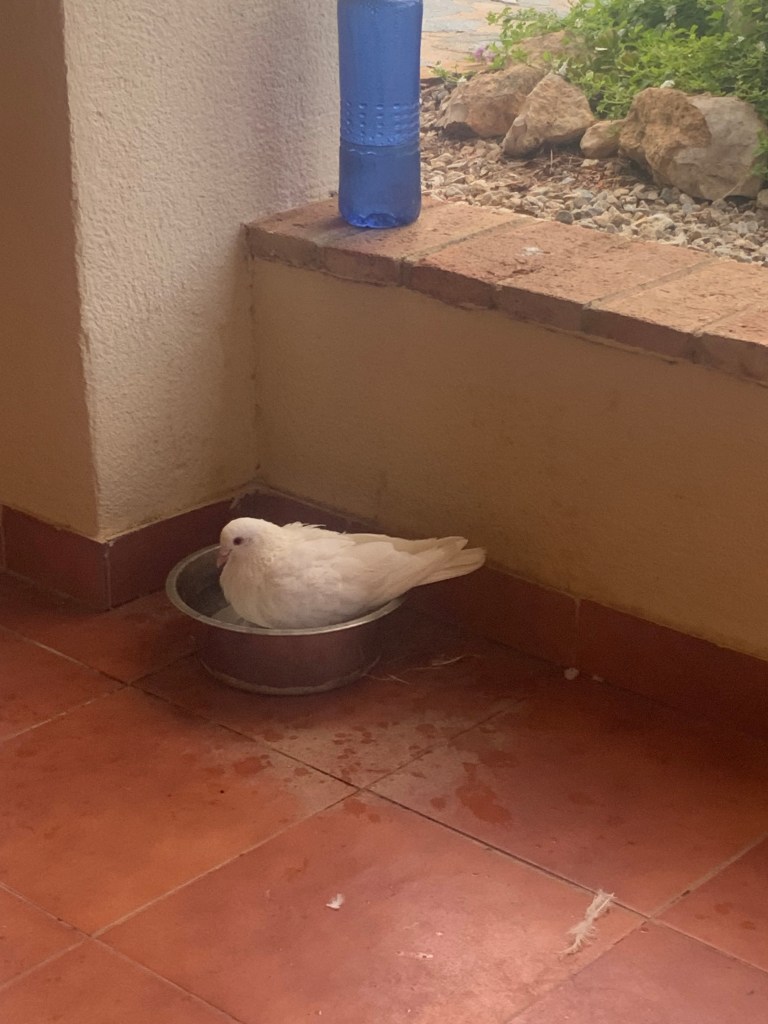
Tango’s situation has been made worse by Cruella’s new broom. She has been distracted with test flights and the chickens and their friend the Dove have started picking on Tango. They turn their backs to him every time he walks past and just snigger. They try and stop him entering the house by blocking the doorway. However, the latest indignity is the worst; the Dove has started bathing in Tango’s drinking bowl.

Tango has started having stress nose bleeds, so we are pulling together a “class action” to prove cruelty to dogs and Chillis. We are still working on the paper work, I will let you know how we get on. The photos below show Cruella starting one of her test flights, followed by various acts of cruelty.

She has already knocked the satellite dish off the roof

The idiot returns, chickens net figs, I style Yuccas and sing to orphans

All of the above is true, and in that order. I know we are stretching it a bit as a gardening blog, but all I really want to do is garden, but other things keep interfering.

Our idiot son returned for his birthday weekend. Cruella (my wife) and her chickens had spent days preparing. There were banners, a specially commissioned song in Chickenese and a Haiku poem as he likes Japan.

Welcome, dearest one

The house wakes to your presence

Sunlight fills the rooms.

When Cruella told me that her girls were going to perform a special Haiku, I thought she meant Haka that the New Zealand rugby players do; I was looking forward to seeing chickens dancing and sticking out their tongues, you can imagine my disappointment. Anyway, on with the gardening.

19th July 2025. Things I have been doing lately:

  • Netting figs
  • Styling Yuccas
  • Singing to orphans as I clear the potting bench

Netting Figs
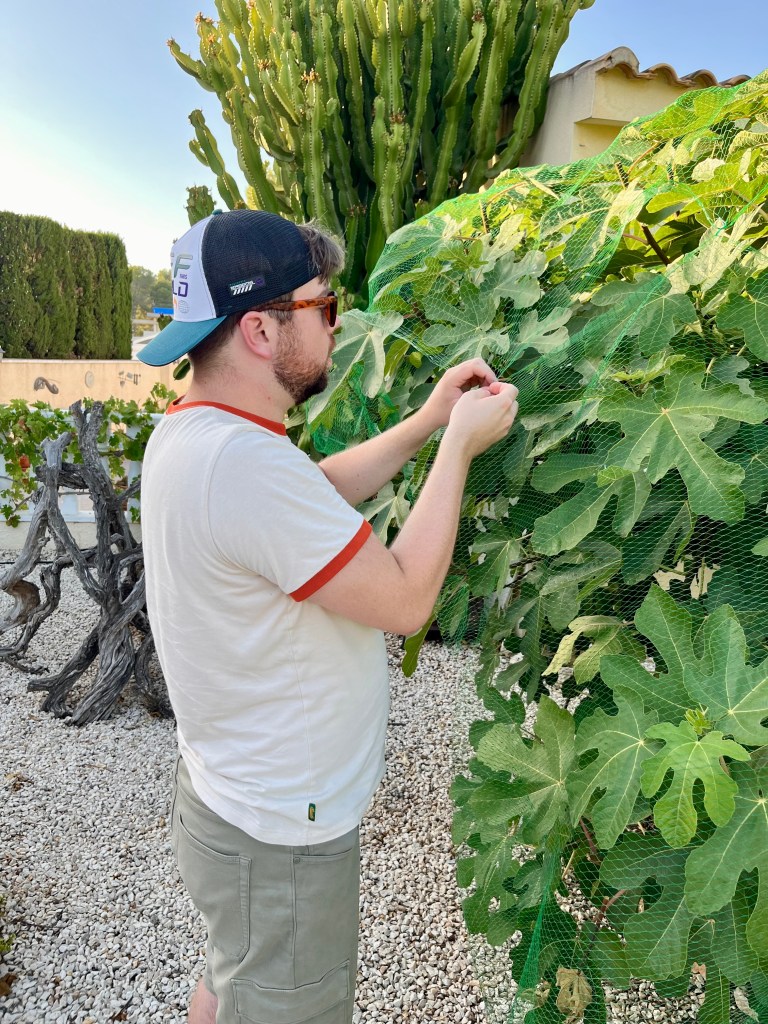
If you have fig trees then now is the time to net them. Even though your figs are probably not quite ripe, don’t postpone this necessary task as the birds can easily strip a fig tree of ripe fruit overnight.

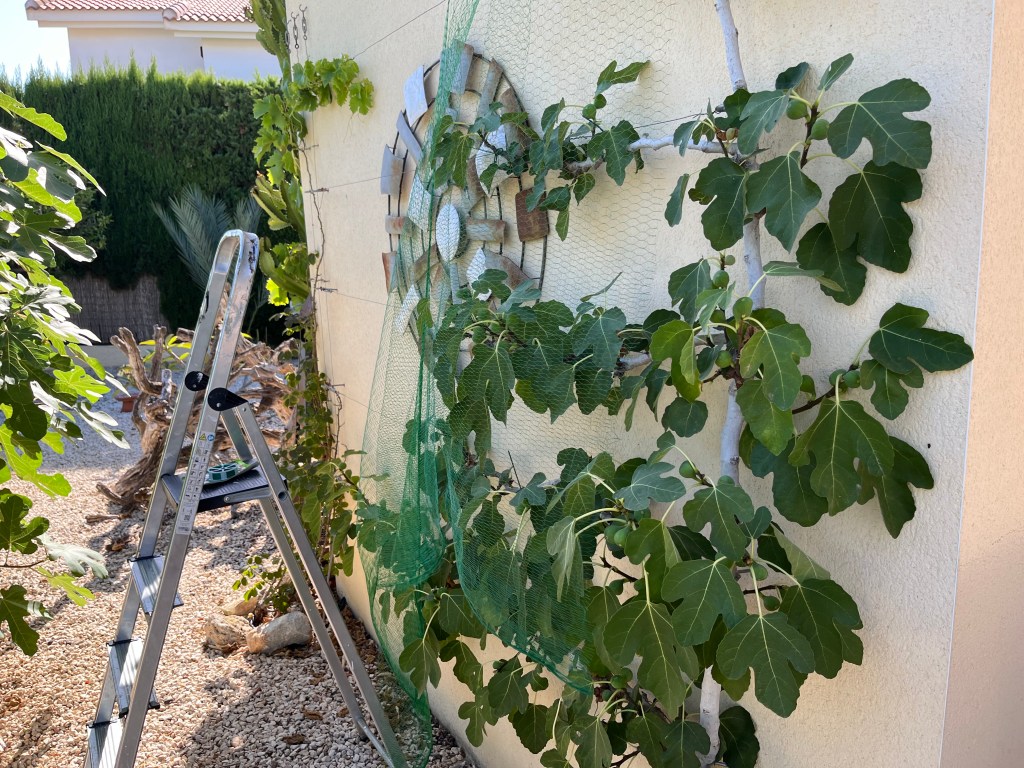
If you are going to net your figs or other fruits, then it is important that you use the correct small gauge mesh netting. If you use a larger open mesh then this will become invisible to the birds, they will fly into it and get caught. When you come out in the morning to inspect your figs you will find a flock of fat birds hanging upside down and flapping. The photo below shows the netting I use.

I have two fig trees, one of which I have espaliered along a wall. My normal approach is to invite different friends around to assist with this task. But Cruella insisted that it would be a good bonding activity for her girls and their brother (the idiot son). Despite my protests that chickens could not net, she insisted her girls had been raised to do anything a man could do.

I netted the espalier fig myself and would have gone on to try and net the big fig myself, but Cruella saw me and insisted I was denying her girls a “learning experience”. Anyway the photos below show the espalier being netted.

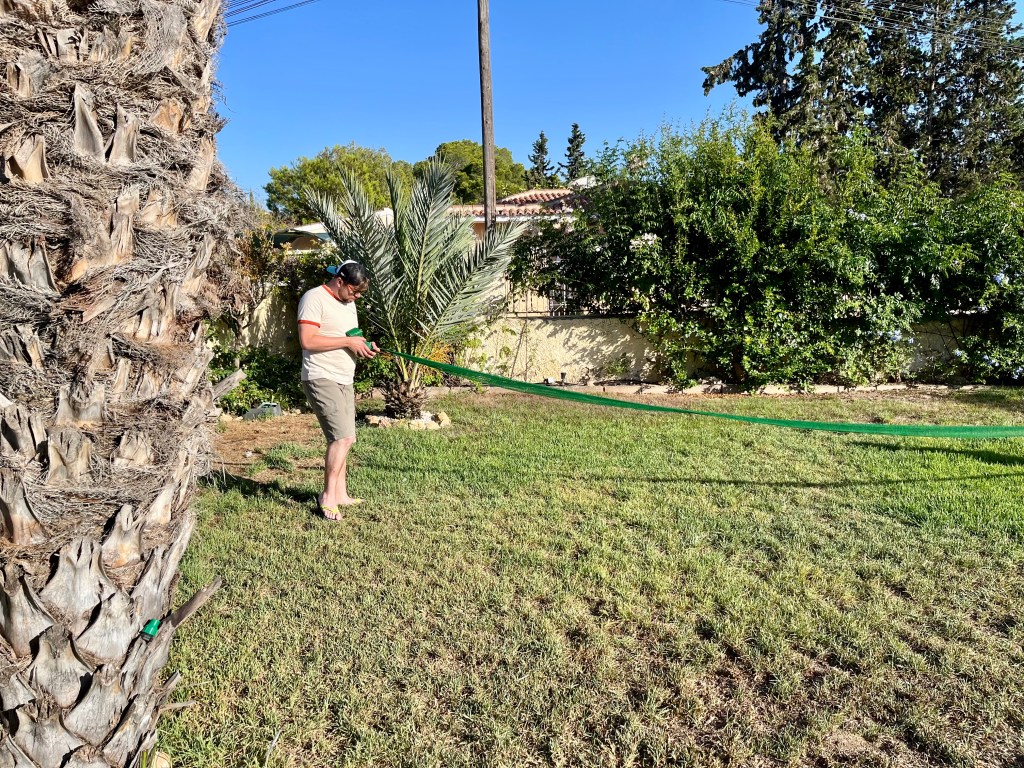
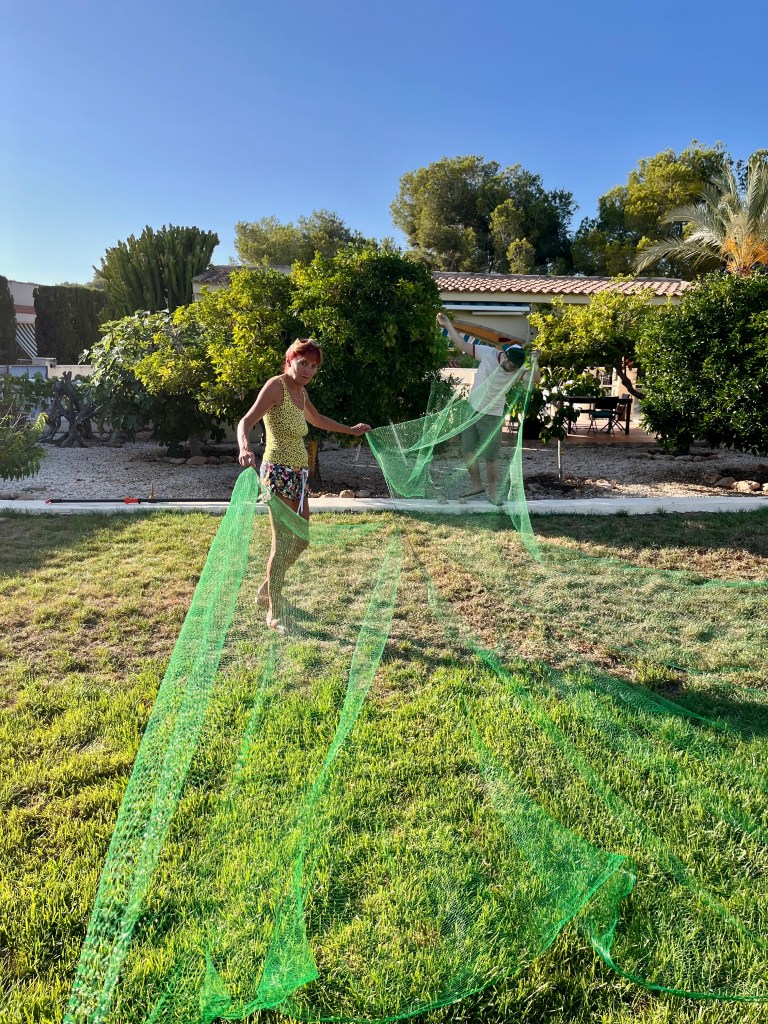
The first part of netting the big fig is to measure out and cut the amount of net needed. Once this is done you need to join together the two halves of the net as most nets are never wide enough to completely cover the tree. The photos below show Cruella and the idiot boy in action. I was in charge of strategy and Cruella decided it was too hot for the chickens and they should remain in the shade.

Cruella had already smothered them in sun screen

The photos below show the measuring out stage followed by the joining together stage.

The next stage is hauling your net over the top of the tree without it becoming ensnared into the branches at the top. I have developed a technique over the years that requires two people to manoeuvre the net down the side of the tree whilst I hoist the middle of the net up using an extendable pole. The photos below show this process in action.

The final stage is tieing your net down around the tree to lower branches. The photos below shows the idiot son in action tying in, followed by a triumphant photo of me.

None of this would have been possible without my technical,expertise

When we had finally netted and tied down the tree, Cruella insisted that we should have a party to celebrate her girls first time netting; I pointed out that they hadn’t done anything but she accused me of nitpicking or possibly a “hate crime”. Anyway the party photos are below.


Styling Yuccas
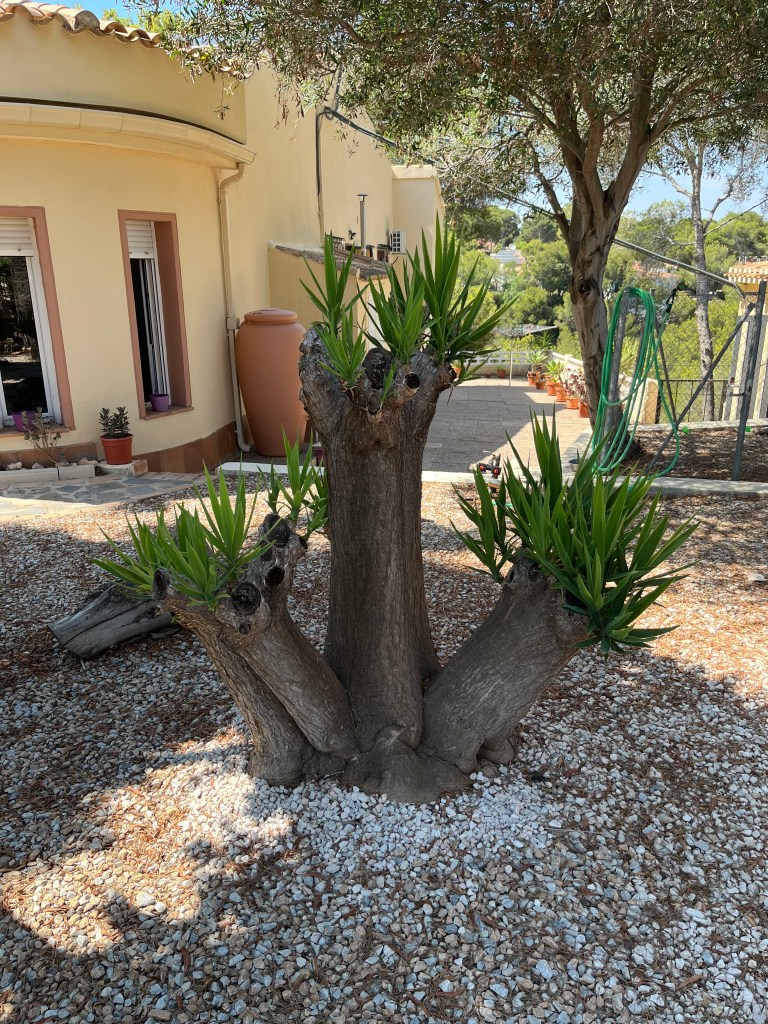
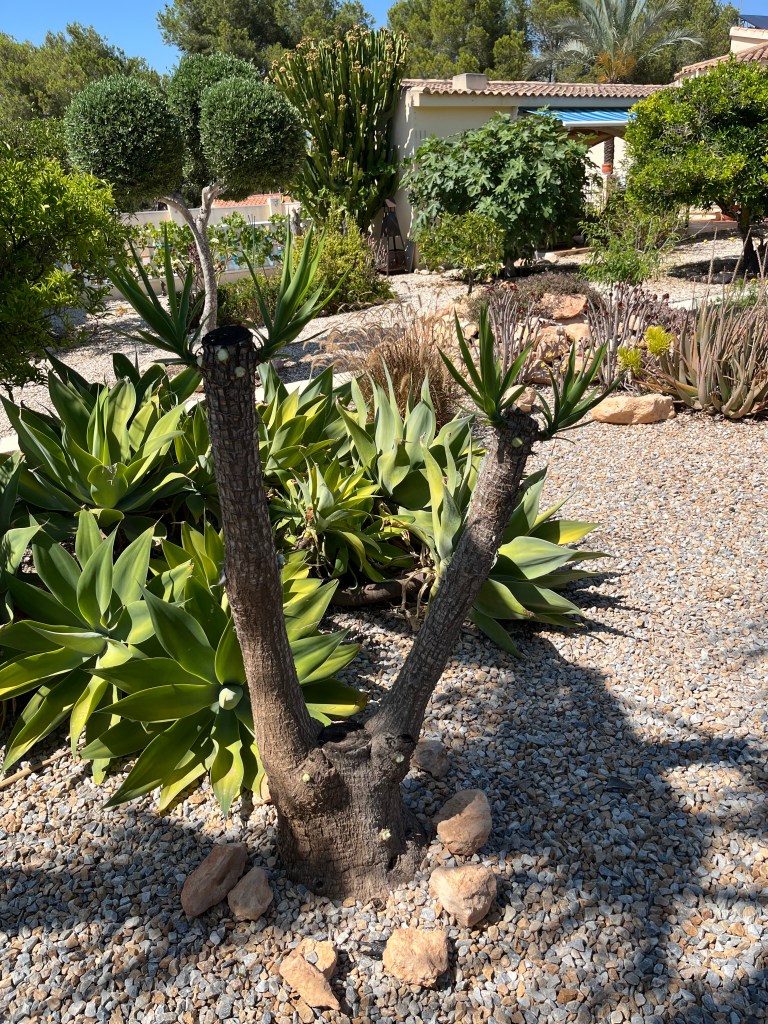
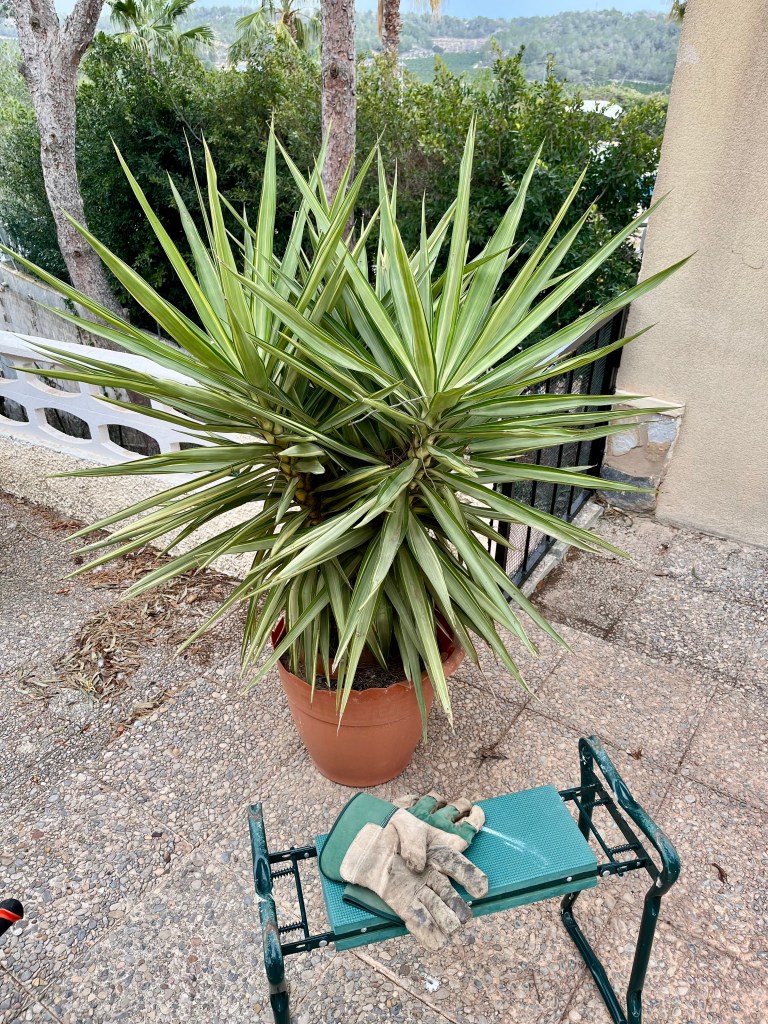
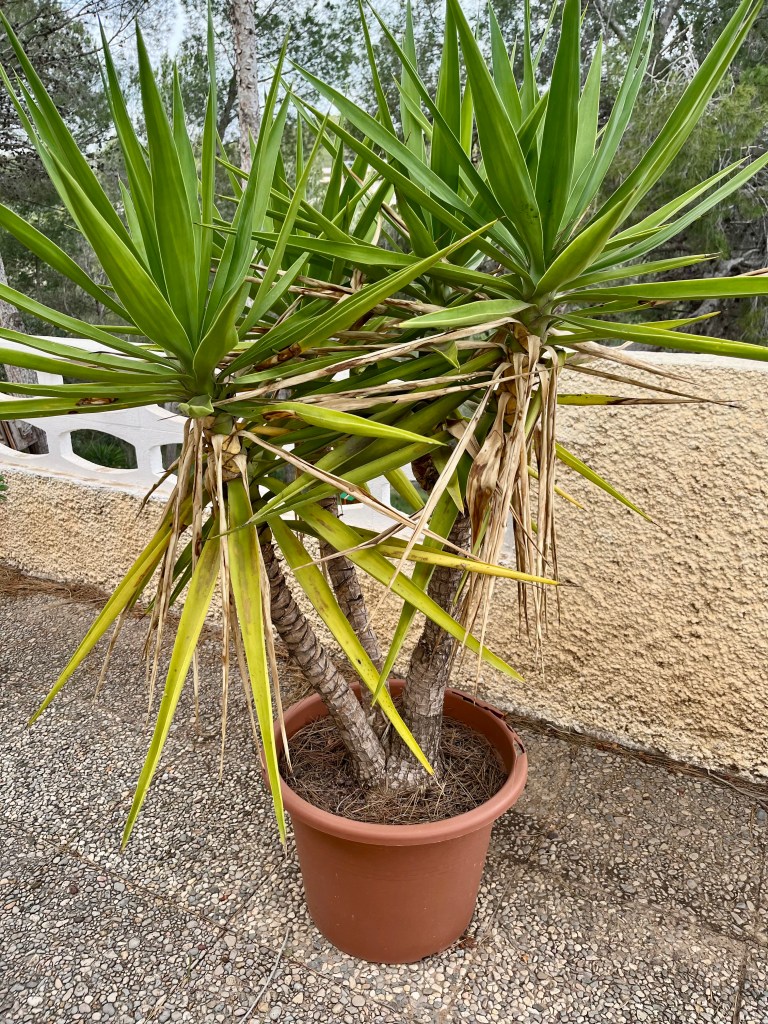
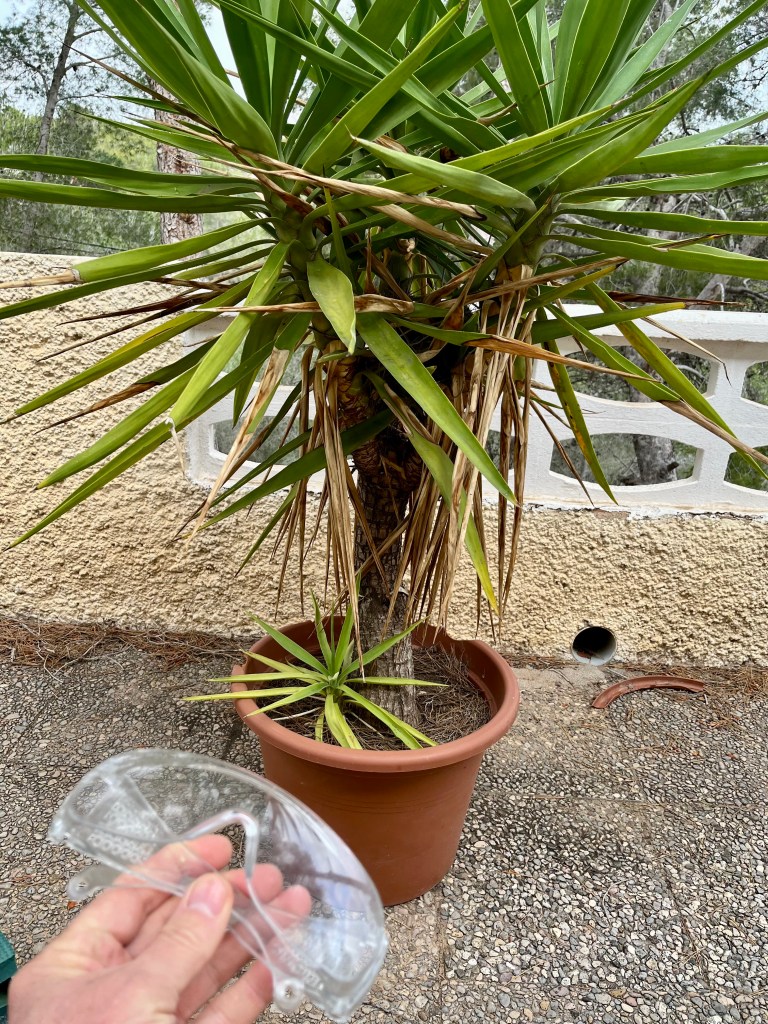
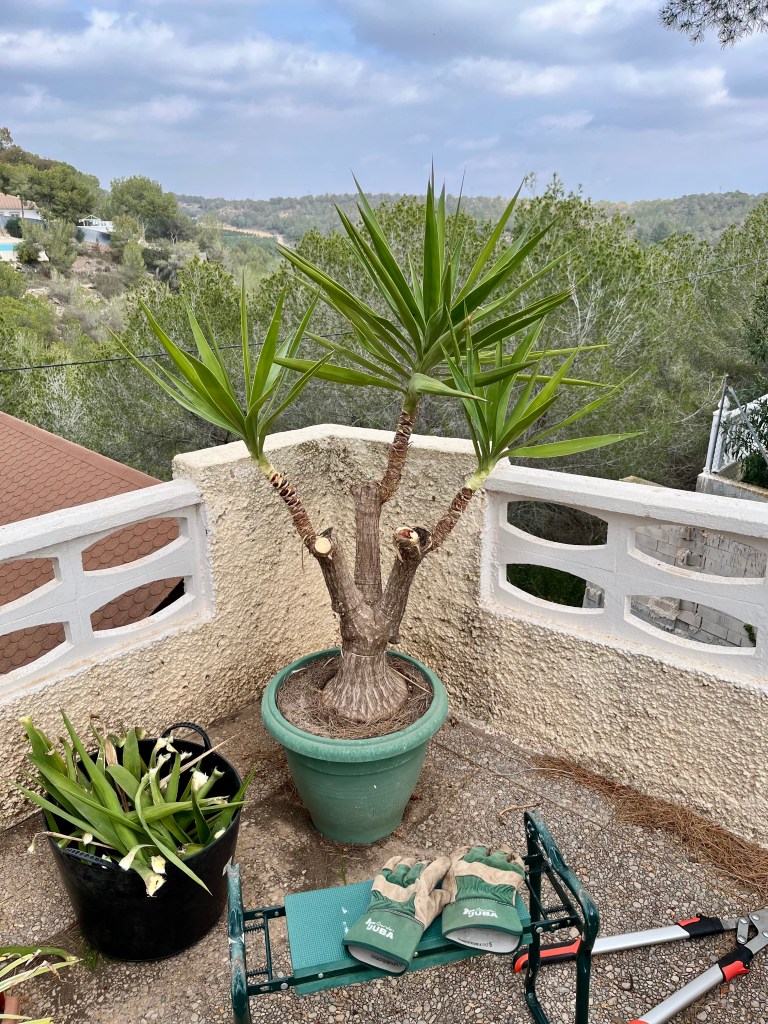
Those of you with Yuccas – and this means everyone in Spain – know that these can be useful, hardy, statuesque plants that can add height and interest to your garden. However once Yuccas get too tall or messy then they detract from your garden and end up looking like extras from those bad 1960’s westerns. It needn’t be this way. As Yuccas are canes they can be cut back and shaped to your desire and they will normally regrow from around your cut area.

Every 5 years or so I chop all my yuccas back to a manageable and interesting height. I then leave the cut plants for about 3 months or so till I start seeing regrowth. Usually there will be far more sprouting shoots than you require and some will be in the wrong place. All you need to do, is take your gardening knife, wander round the plant and choose the shoots that you wish to retain, those you don’t want just cut back cleanly where they join the trunk.

The photos below show where to prune and my various yuccas before and after their restyling. Click on each photo for a larger view.


Singing to orphans as I clear the potting bench

One of my saddest jobs as a gardeners is telling the plants that remain on the potting bench that unfortunately they won’t be going out in the garden. These are the orphans who have failed to be chosen, either because they are just not pretty enough or are just too immature. Now with the hot weather they won’t be able to be planted out.

I always start the talk the same way; I tell them they are “special”, and just because they haven’t been chosen doesn’t mean they can’t be happy. I talk about all their friends who are now growing in the garden and how they are getting on. Sometimes we cry, but that’s only to be expected, though I try not to break down in front of them.

I always end my talk the same way by telling them I have been proud to grow them, they haven’t let me down and God loves them for what they are. After my talk, and when everyone has dried their eyes, it’s on to the annual sing song.

This is my favourite part. I sit on the compost bin lid with my legs dangling over the edge and beat out the music to all their favourite songs. Mainly they like songs from the shows: Evita is one of their favourites as they like the drama. My absolute favourite is “Nelly the Elephant”, I bash this out really loudly and we all belt out the chorus. Cruella came round the corner and asked me why I was singing “Nelly the Elephant”. I explained it was our annual singing. She said “I didn’t hear any singing only you” I didn’t tell her you need a Soul to hear it.

Our finale is always the same song “The Sun will come out tomorrow” from the show Annie. It is always good to end on optimism. I kiss them all goodnight and slowly walk away. I postpone the compost bin till tomorrow!

The sun will come out tomorrow

Grapes in bags, Figs weeping acid and Sussex died in front of me

Let me start with the non gardening bit; Sussex is not related to that “Meghan”, but the chicken Sussex, who unfortunately has died in the heat. I was walking past her and she just keeled over and died. Cruella (my wife) has accused me of being involved and has contacted the police, she refers to me as “the perp”. Technically I am on the run so don’t tell anyone where I am. On with the gardening.

4th July 2025. Things I have been doing lately:

  • Dressing grapevines and bagging grapes
  • Getting my figs ready for netting
  • Succession planting with Petunias
  • Goodbye to the mini greenhouse till next year
  • The death of Sussex

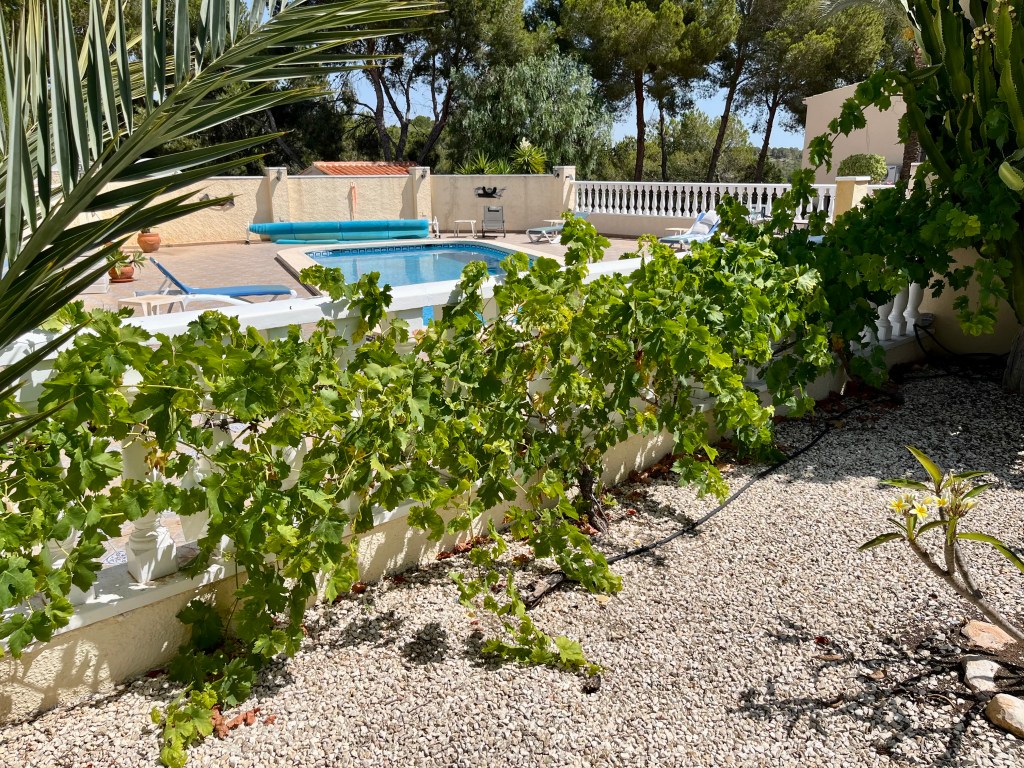
Dressing grapevines and bagging grapes. At this time of year your grapevines will be overflowing with leaf growth and hopefully some bunches of grapes. The photos below show my grapevines as leafy behemoths.

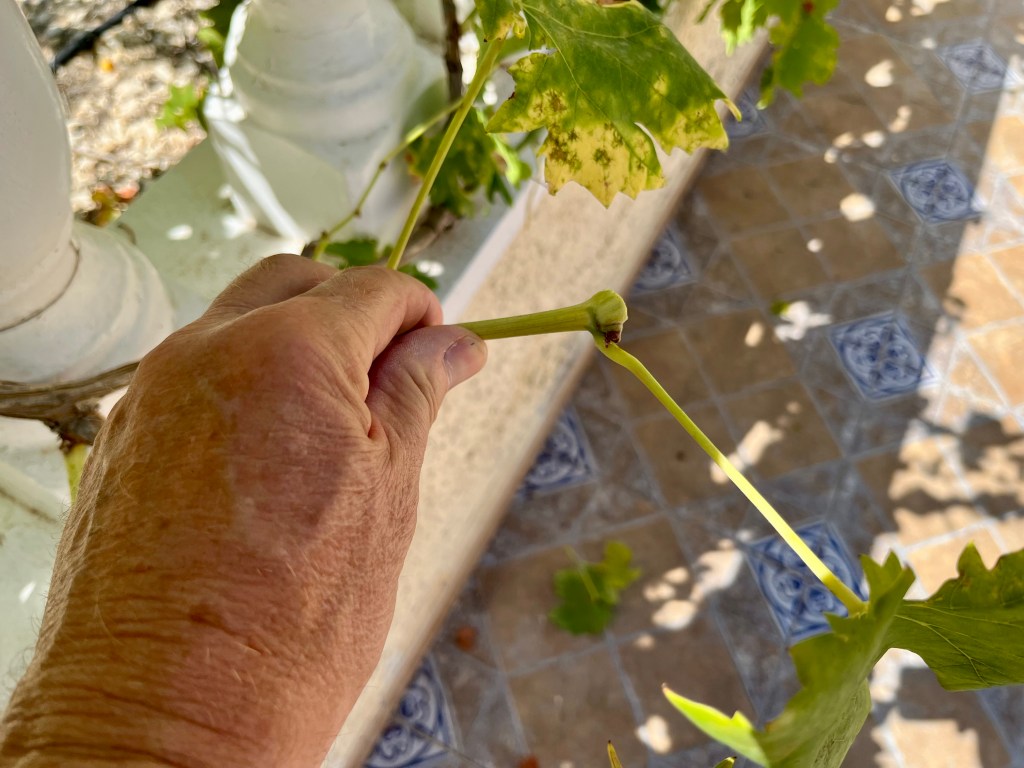
Now if you are growing them to be ornamental – like the one at the front of my house – then this is fine. However, if you want to maximise grapes, then you need to dress your grapevines. This process has been going on for centuries and is even mentioned in the Bible. In effect it means, pruning, tying in, removing suckers, thinning leaves and generally maximising your opportunities for grapes.

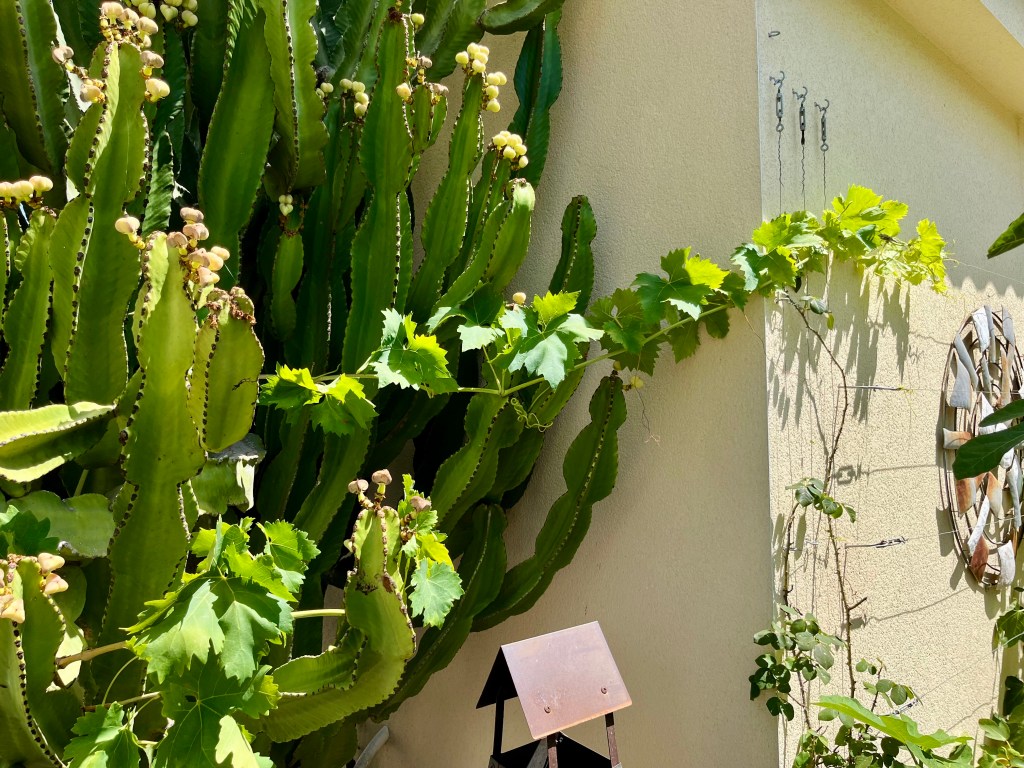
At this time of year your will need to cutback the unproductive growth on your grapevine as this will take energy away from grape production. Just cutback to a leaf node on the longest branches and make sure you let light into the grapes. The photos below show firstly, where to cutback and secondly you can see that I am training a vine to go through an existing Euphorbia and along a wire ( just for fun).

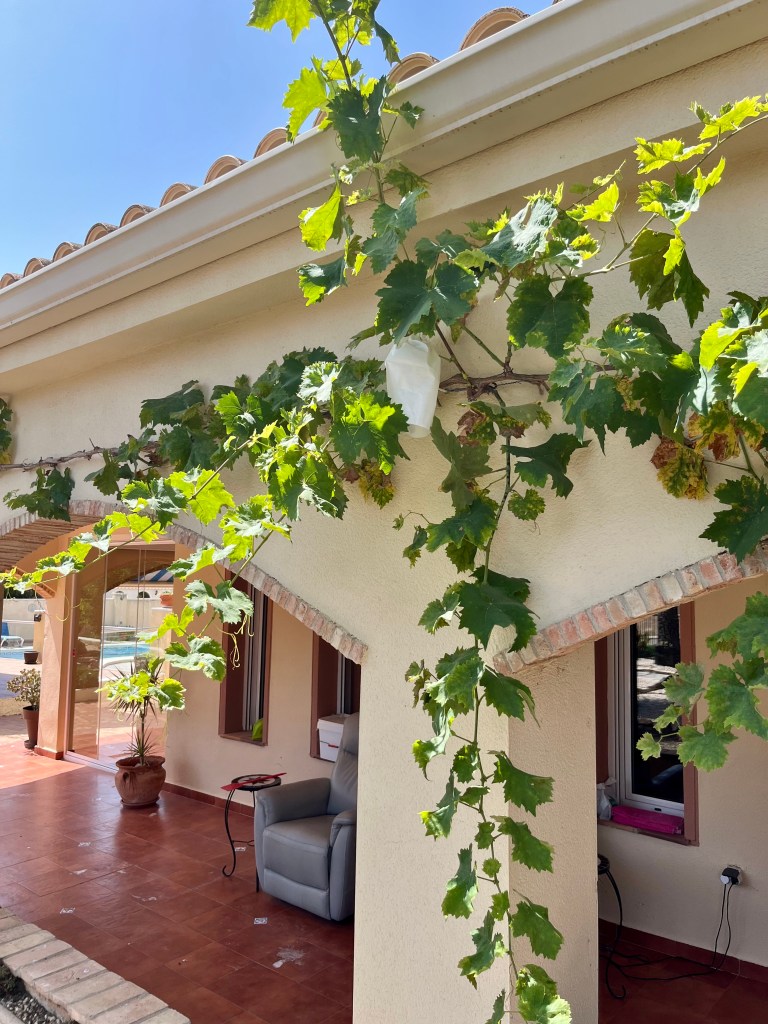
Finally, if you really want to get serious with your grapes, bag them into horticultural bags. This saves them from wasps, too much sun and other baddies. You can buy these bags in most garden centres in Spain and on Amazon. All you do is pop the grapes into the open end of the bag and then tie the bag at the top. By leaving the bottom open the grapes get air, and you get to check them occasionally. When they are ready just cut them off at the vine, turn the bag upside down and you have a ready made bag of grapes – enjoy!

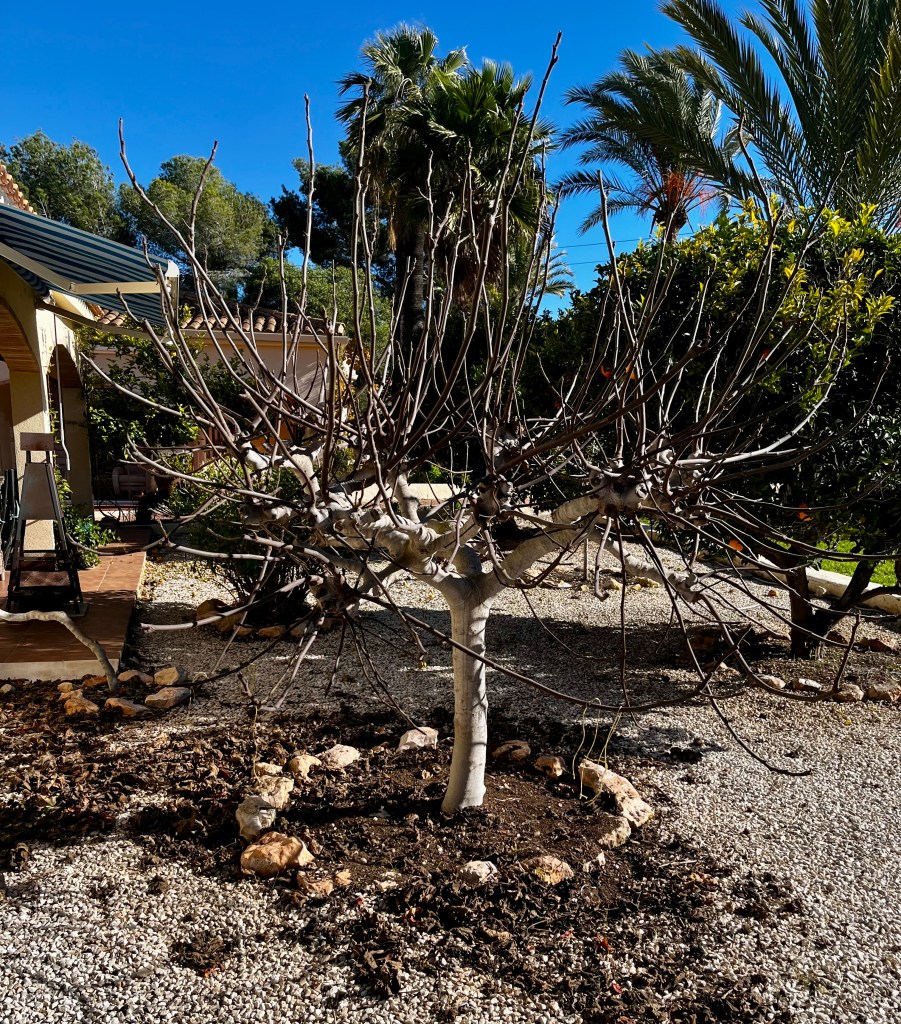
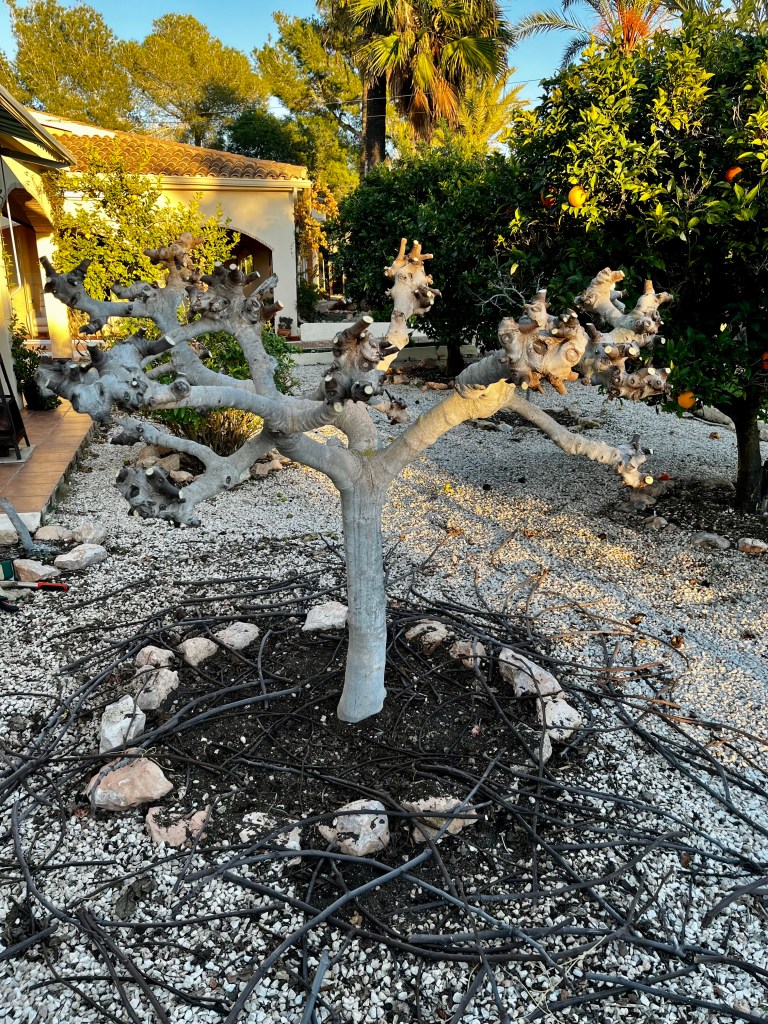
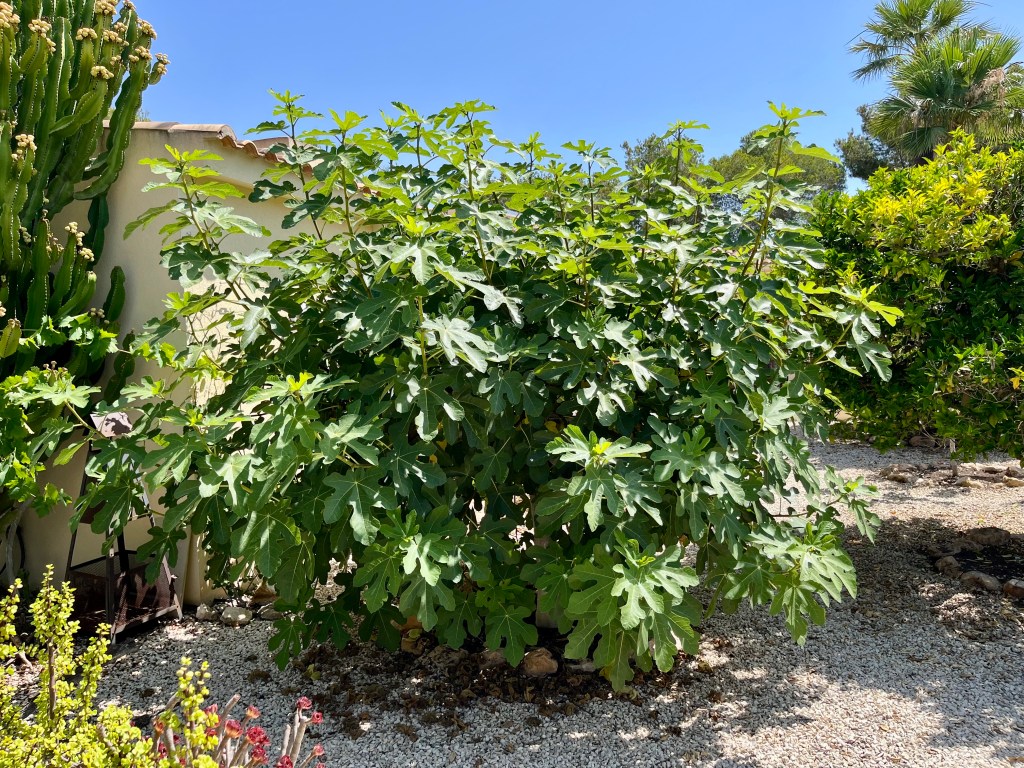
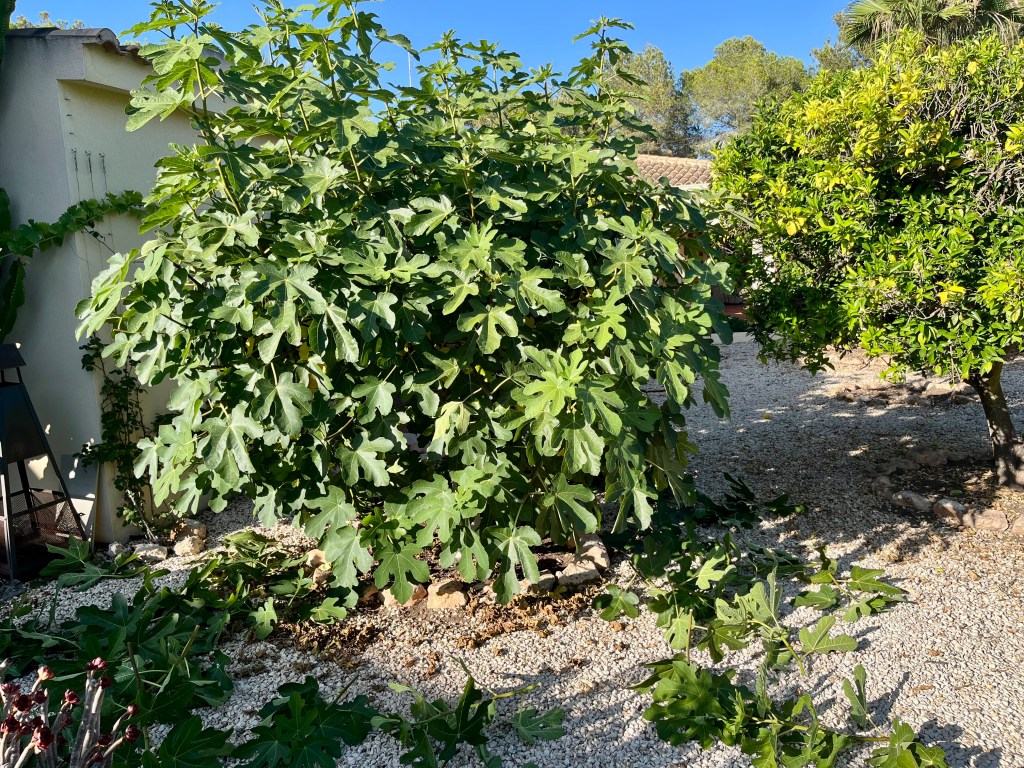
Getting my figs ready for netting. Regular readers of this blog will know that I prune my figs back very hard each January in pollarding style. They always come back with tremendous growth and hopefully give me two flushes of fruits. The only slight setback with this method is that the new growth can hinder the necessary netting of the figs to stop birds eating everything. The photo below shows my very leafy figs

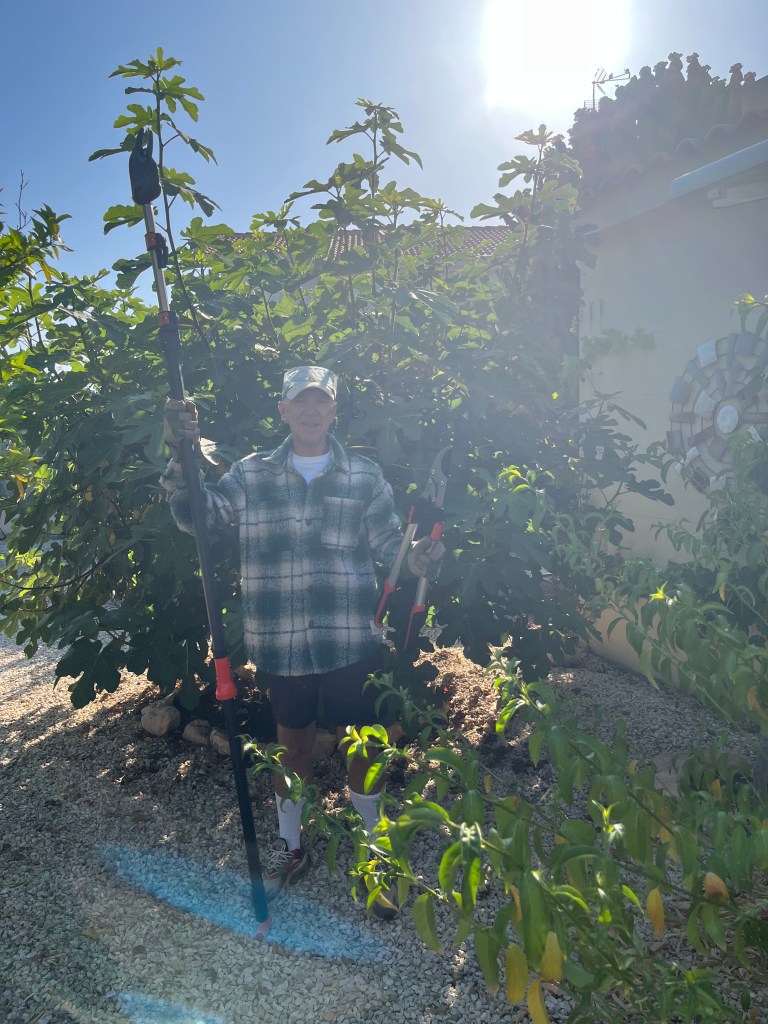
To successfully net the figs requires me to take off the longest branches. The danger in doing this in Summer is that when cut, figs weep a very caustic sap which will burn flesh quite severely. So before you cut, gear up with long sleeved jacket, proper shoes and socks a hat and preferably eye covering as well. The photos below show me dressed in my extreme winter gear ready to get cutting( I had to wear shorts it was so hot).

When you are cutting the fig, start from the bottom and work your way around the tree to the top. In this way you will not have caustic sap dripping on you as you work. The photos below show my working from the bottom and the caustic sap dripping from a cut branch.

Finally don’t try and clear anything up for at least 24 hours, this will ensure that the sap will be completely dried both on the cuttings and the tree branches.

Don’t you dare touch this for at least 24 hours or off to A&E you will go

Succession planting with Petunias. A good gardener will have a succession plan for their garden to ensure that they have seasonal flowers nearly all year. Now I know that you are all good gardeners and you wouldn’t consider just going out every weekend and buying more plants from garden centres!

My final part of succession planting for this year is Petunias. These go into the spaces left by early bulbs and various Irises. A packet of Petunia seeds will provide you with hundreds of plants for just a few Euros. The photos below show the various stages of my little Petunias as they make their way to the planting beds.

With all succession planting the key is to reinvigorate and prepare the soil between each round of plantings. In this case it means lightly digging over the soil with a trowel, removing spent bulb stalks and them most importantly replenishing the soil with a layer of fresh compost from your compost bin. The photos below show this process.

Lovely free compost

Finally it is time to plant out the new seedlings. Remember you can only plant now with plants that you have grown from seed and fully acclimatised; plants bought from garden centres and planted now will usually die. The photos show some of the many seedlings I planted followed by a photo of the first flowers.

They will flower all the way through till October as long as you take off spent flowers by plucking not cutting

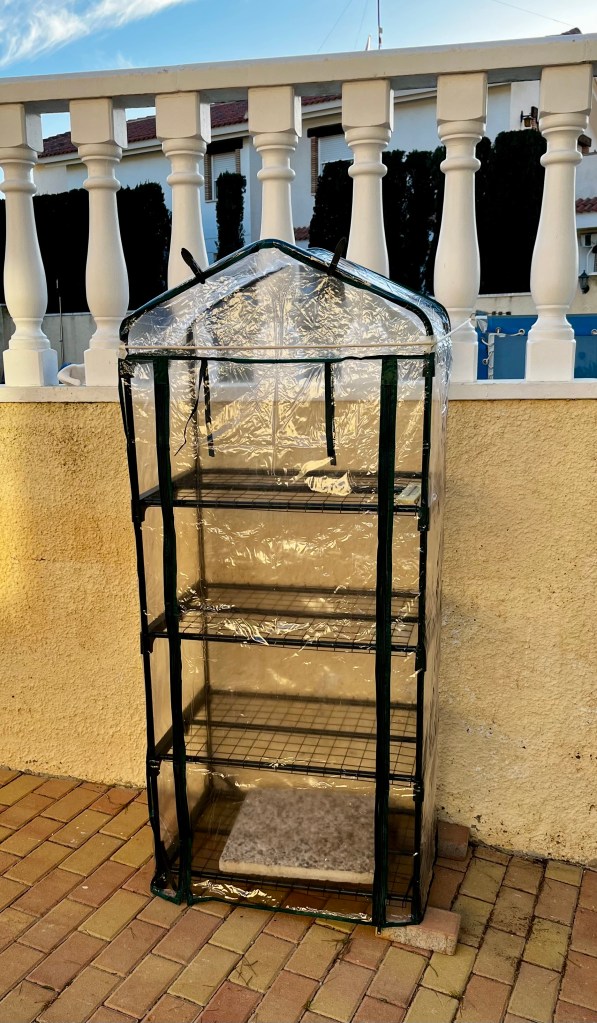
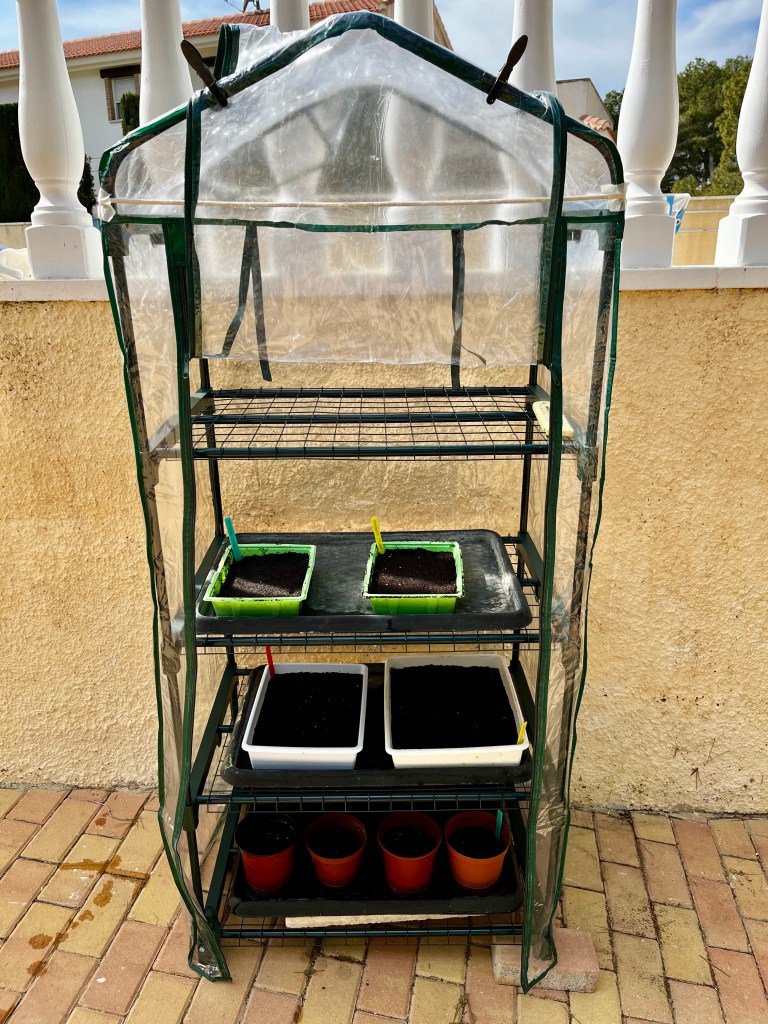
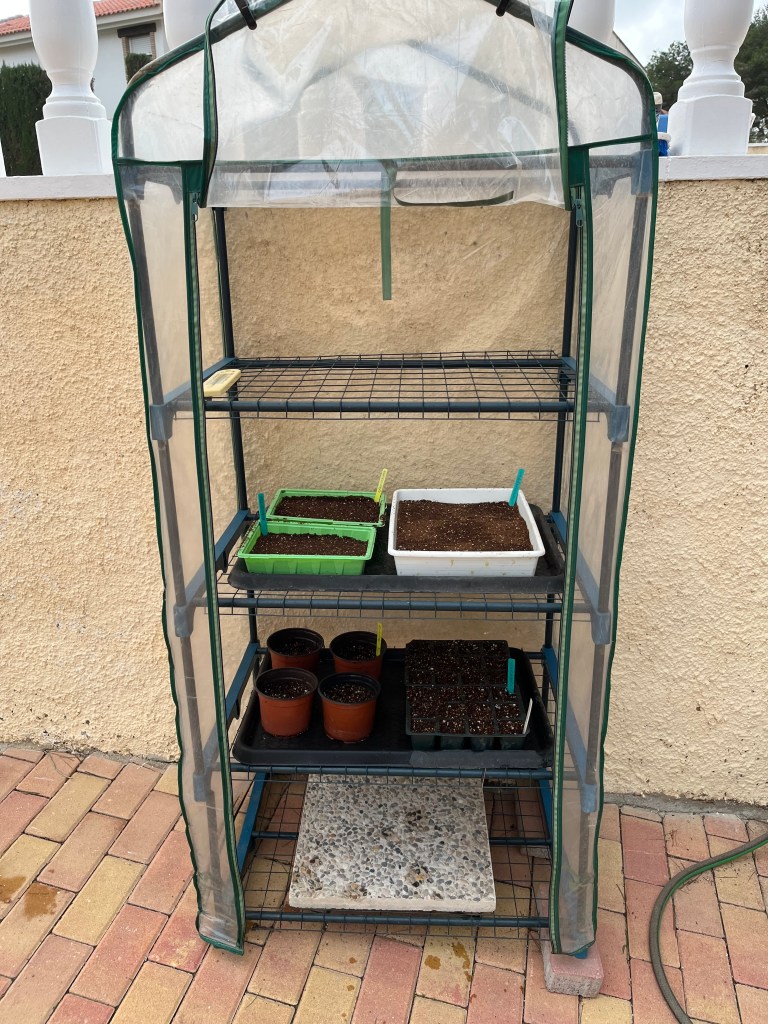
Goodbye to the mini greenhouse till next year. With just my cheap little mini greenhouse and packets of seeds I have managed to keep my garden in flower all year. It is now time to put the little greenhouse away together with all my seed trays. Remember you could easily do this starting from next January. You would not only save money, you would have the joy of nurturing your own plants from seeds to planting and see the wonders of God at close hand.

The death of Sussex. I was just walking up the drive to deadhead some Marigolds, when I heard a squawking from under an Orange tree. I looked round and Sussex (the chicken) just keeled over and died. When I informed Cruella (my wife) she screamed “what have you done”. Despite all my protestations she insisted on gathering what she termed forensic evidence; she watches too much CSI type programmes.

Anyway, she swabbed the inside of my mouth with a cotton bud, took scrapings from under my nails and plucked a load of hair from my head. She has informed me that this is going off to the Lab and that I shouldn’t leave the country. She tried to get me to report to her every evening and surrender my Passport, but I refused.

So technically I am on the run. I mainly hide out in the shed and at night sleep in the compost bins. I only sneak out in the late evening to do a bit of deadheading or sometimes prune a few things back. She knows I am still here as she has placed police tape across all the gates to stop me getting away.

The photo below shows Sussex involved in a delegation lobbying me on some chicken rights issue.

I am gardening through all sorts of adversity and the chickens won’t go to bed

I know this is a gardening blog, and most of you will have little sympathy for my current animal problems. But bear with me I haven’t been able to blog for weeks because I have been overwhelmed by non gardening issues. All of this has been caused by Cruella (my wife) heading off to our English house to oversee the purchase of a new house for the idiot son.

She took off about three weeks ago. It was bad enough that she scorched the lawn on take off (new broom problem), she also left me in charge of all the animals. Amongst other things I currently face the following problems.

  • Tango the lonely blind Labrador can no longer walk properly or get up from lying down. This means I have to lift up his back end whilst he scrabbles to get lift off from the floor. We then comically stumble outside me half carrying him whilst he trys to maintain his dignity.
  • The bees are making wonky comb in one of my hives and I can’t find the Queen. All the frames are stuck together and the bees have made a large wax football in their hive.
  • The chickens have become truculent and won’t go to bed at night. They are demanding to be carried to the coop individually and kissed good night.

Now do you see my problems.; but don’t worry I am still gardening furiously every day.

22nd June 2025. Things I have been doing lately.

  • Cutting back dead Iris
  • Feeding and scarifying the lawn
  • Gently trimming fruit trees
  • Potting up Chillis
  • Mistreating chickens

Cutting back dead Iris. It is all over this year for Iris and if you have followed my advice you will have deadheaded the flower head and left the stems to go fully brown. If you have, well done, as you are guaranteed lovely flowers next year from your replenished bulbs.

All you have to do now is give a good compost mulch over the area previously occupied by the Iris. This will replenish the soil and prepare it for your succession planting. I will be putting Petunia And some sun flowers in these areas.

It is important that you thank them for all their lovely flowers, wish them goodnight and a safe sleep and promise them that God willing you will see them next year. The photos below show the process of saying goodbye to the Iris for another year.

Feeding and scarifying the lawn. I know not many of you have lawns in Spain but if you aspire to one, this is what you need to be doing now.

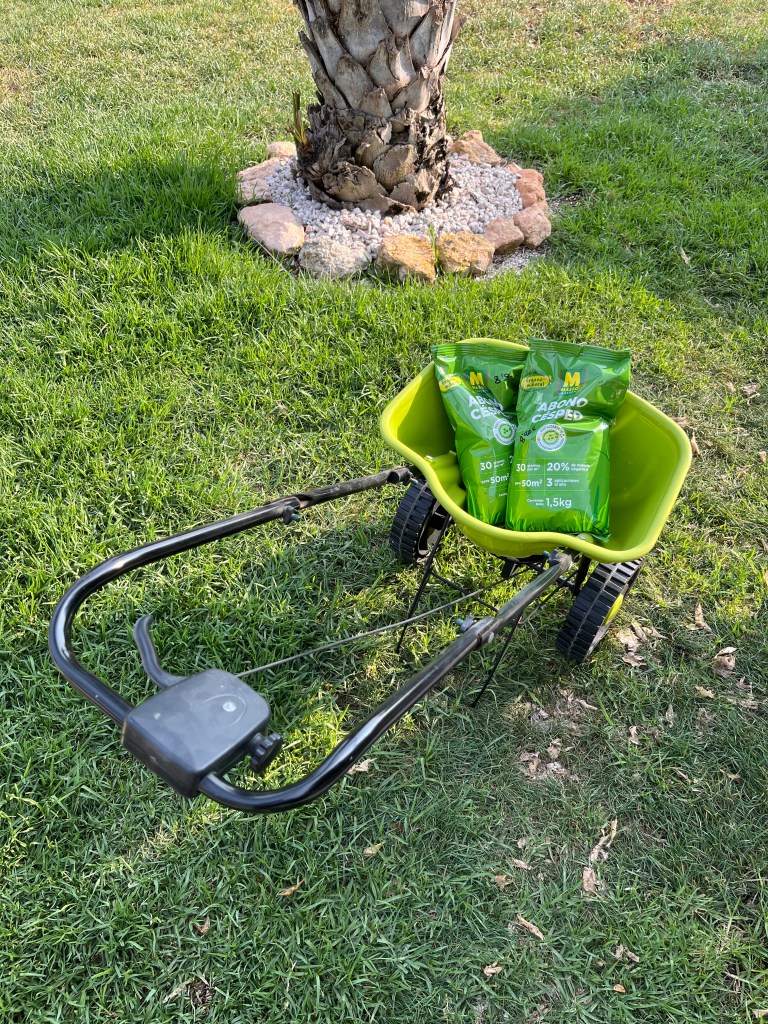
Firstly, set your mower on the very highest setting and don’t be tempted to bring it down till October. If you cut your lawn too short it will undoubtedly get scorched in the summer heat. Next you may need to give your lawn a very light scarifying with a rake. This is not the big winter scarifying and you should not use a machine. The aim is to stop any thatch developing and inhibiting new growth. Finally give the lawn a feed. The photos below show the process.

Gently trimming fruit trees. Trimming fruit trees is a controversial topic at this time of the year. Some gardeners would balk at the fact that you may lose some setting fruit. But hey ho we rogue gardeners don’t mind pushing the gardening envelope.

The basic idea is that all the old fruit is more or less off your citrus trees, you now have two main jobs. Taking off any suckers and opening the centre of the tree up to let in light and air. If you look at the two trees below you can see the problem. Their centres are congested and they have branches that are too high to properly pick fruit. Click on each photo for a larger view.

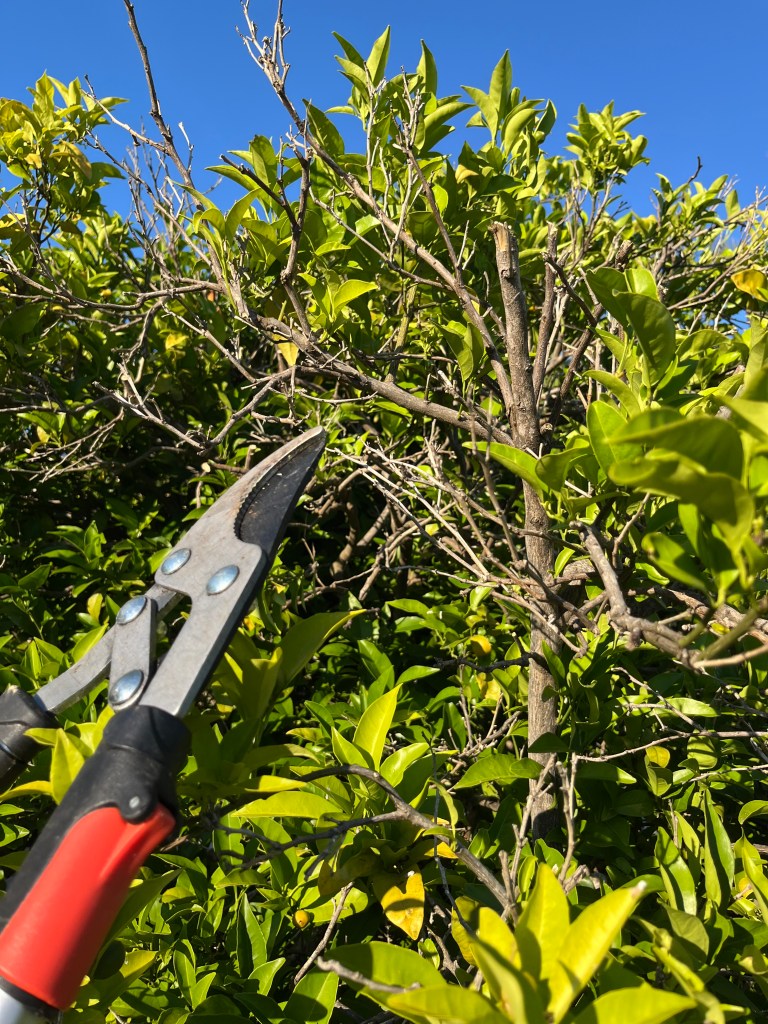
The first thing to do is open up the centre using a hedge trimmer or shears/lopers. The process is shown in the photos below and the outcome.

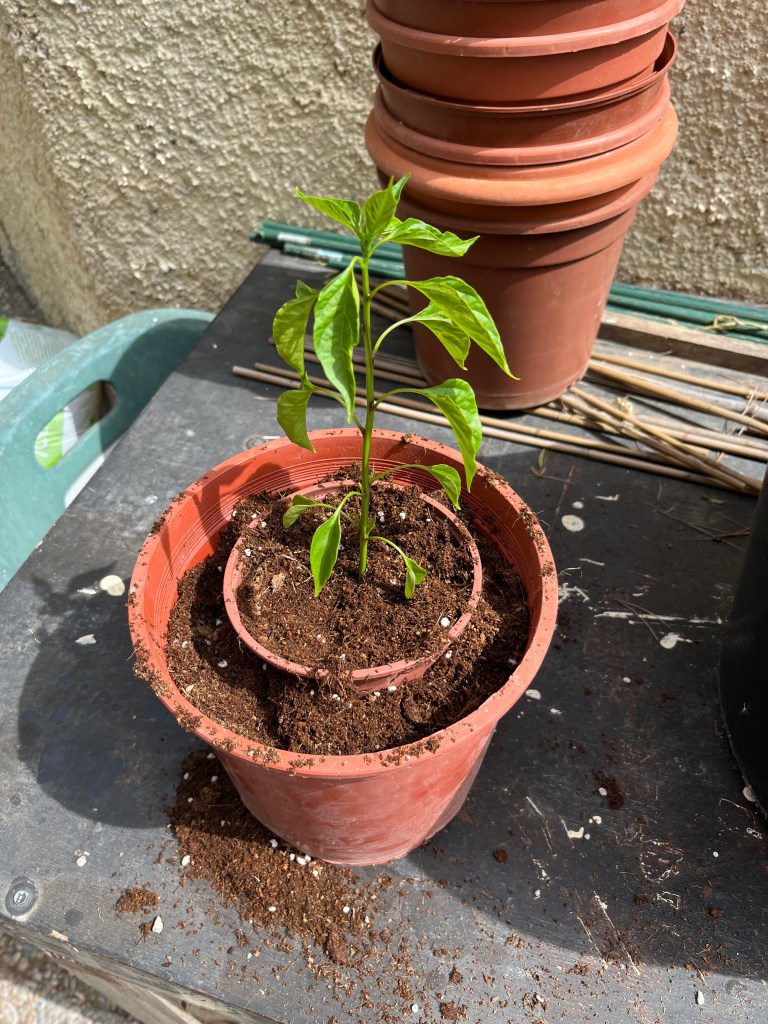
Potting up Chillis. The process of potting up seedlings is the same whether it is Chillis or otherwise. So if you haven’t grown some Chillis this year (although they are easy to grow from seed), don’t worry just apply the technique to all potting up. See description and photos below.

  • Place your plant inside its existing pot into the larger pot then back fill with compost. In this way you will prevent root disruption.
  • Once you have backfilled the new pot, ease the plant out of its old pot and gently firm it into the plant shape hole in the new pot.
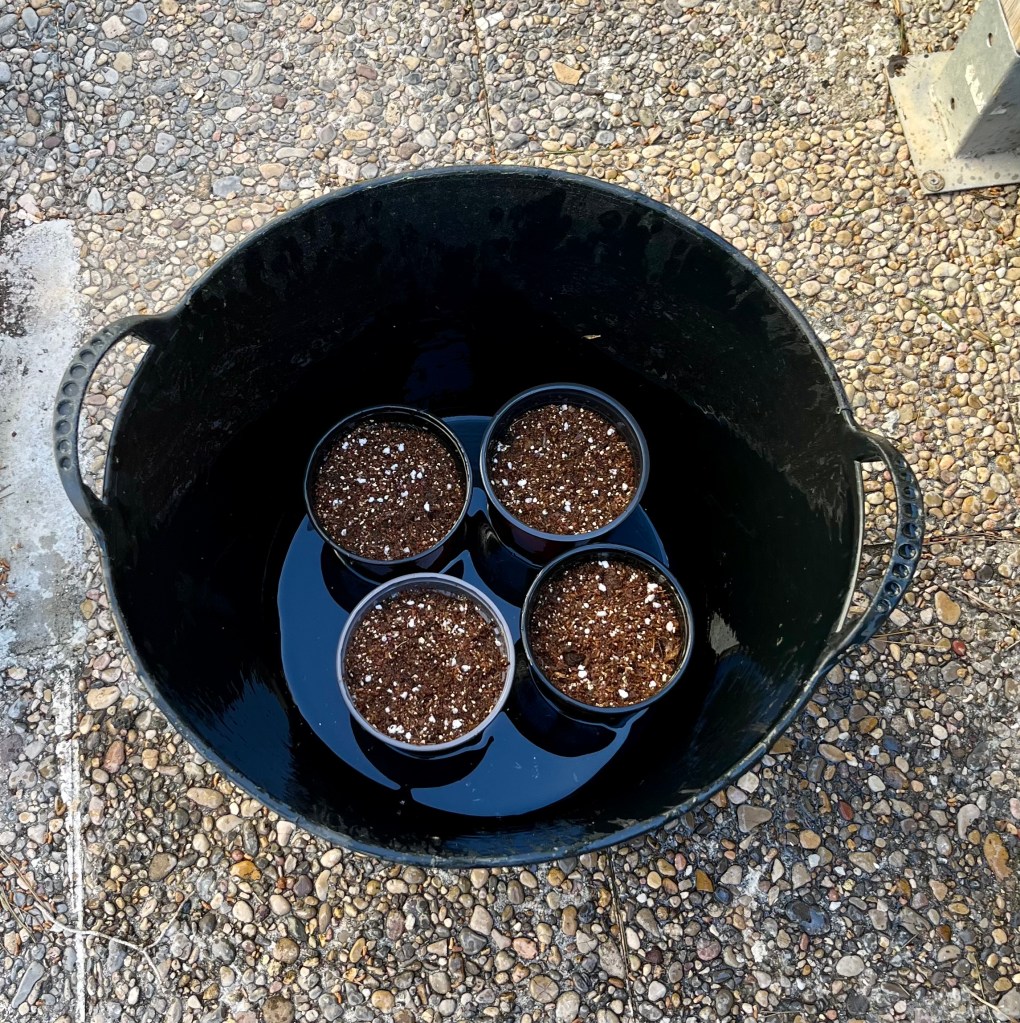
  • Water the pot by standing it in a trug so that it can absorb water up through its roots.
  • If necessary tie the new plant up to a cane. Always tie in a figure of 8. First around the cane then loop around the plant this stopes the stem rubbing on the cane.
  • Stand the pot in the semi shade for a day or two, then get it out in the sun.

Mistreating chickens. At the start of this post I mentioned my chicken problem, it all comes down to the fact that they won’t go to bed in their coop at night, instead they insist on sleeping in a big huddle just outside the front door on the Naya.

When I told Cruella (my wife) about the problem she told me I was mistreating them and that they had to be carried to bed individually, sung to and then kissed on the head before being put gently into their place in the coop. I of course demurred and have developed my own technique.

This involves two stages. At dusk, when I find them in a huddle just going off to sleep, I brush them all awake by nudging them with a broom. They all then start to panic and run around I pursue with the broom and guide them all into the coop.

After dark, they have then formed a huddle by the door of their coop and are fast asleep. I then grab them one by one and stuff them through the coop hatch. I start with the largest all the way down to the smallest and as I push them in they fit together like one of those Russian dolls. The photos below show my technique.

The dusk chase down.
My approaching shadow installs terror before I stuff them up one by one.

But don’t worry, I am not an insensitive beast; just to prove it I have taught the little white Dove to eat out of my hand.

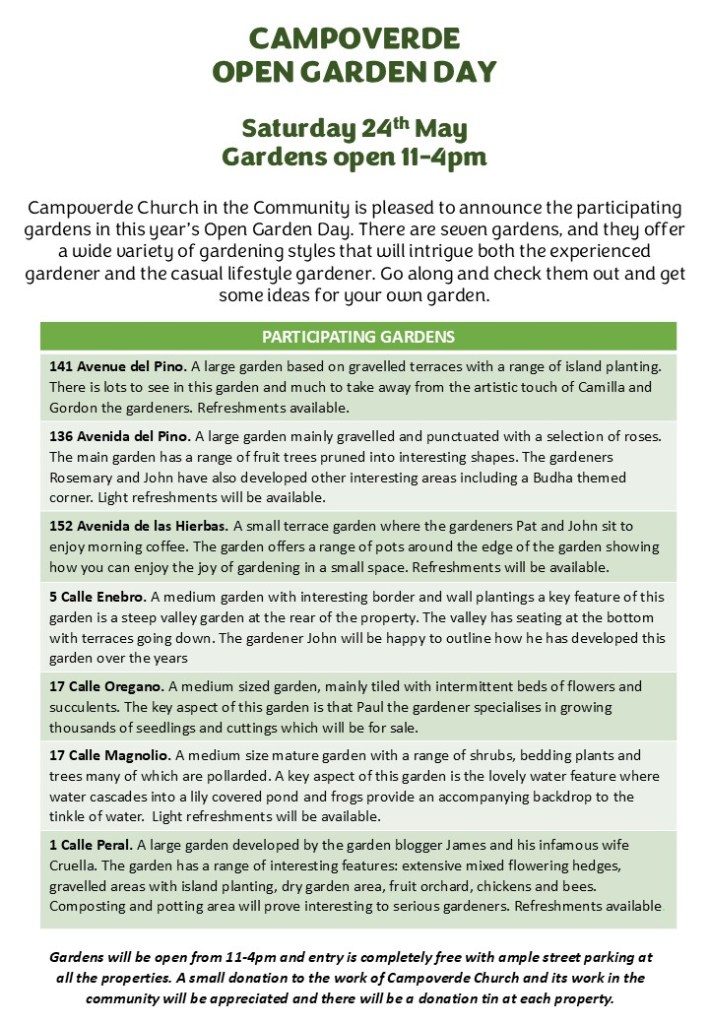
Campoverde Open Garden Day 2025 – Morris dancing chickens and a bee fly past

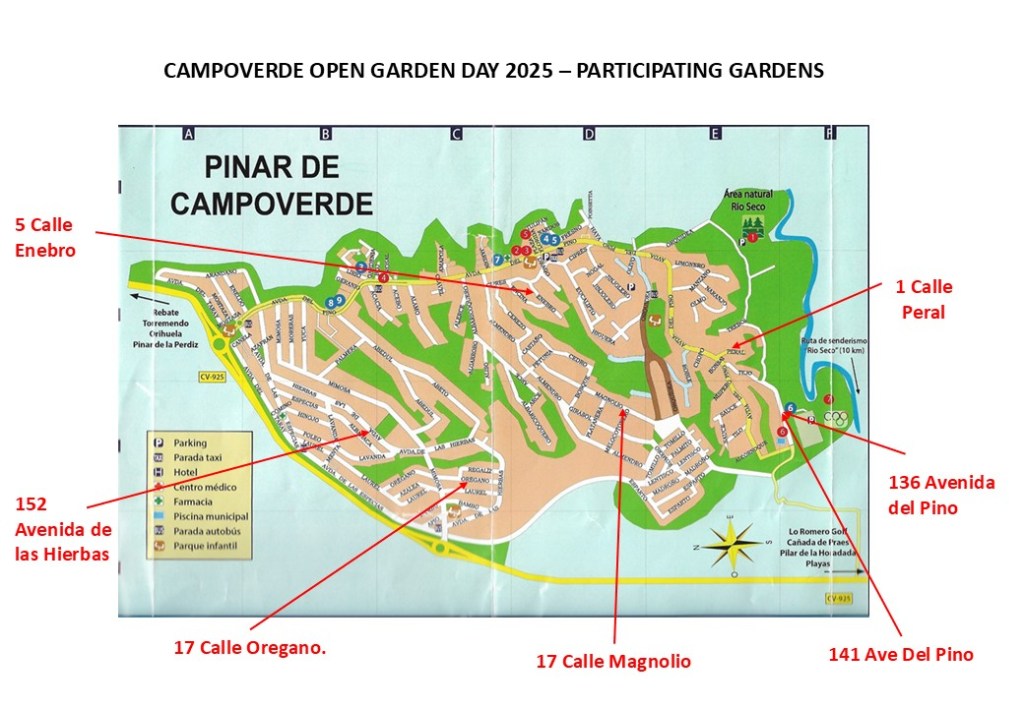
Yes it is true that Campoverde Open Garden Day is this Saturday 24th May, the weather is predicted to be fantastic, and there will be 7 gardens open from 11-4pm. But I can’t vouch for the veracity of the rest of the claims in the above title.

The problem is that Cruella (my wife) insisted that she should be in charge of marketing for Open Garden Day. At first I resisted this, but I eventually gave in when she threatened to set fire to the compost bins.

Her big marketing plan revolves around stunning feats performed by the chickens and the bees. She promises to start with the chickens performing complex Morris dances. This mainly involves Cruella scattering lots of chicken feed on the ground and as the chickens scurry to and fro to get it, she leaps around banging a tambourine calling out the time.

Whilst all this is going on she promises the bees will fly past overhead in formation and eventually swoop down to spell out “Don’t worry, bee happy”. The big finale involves a mixed chicken and bee fancy dress parade. Some of the bees are coming as Buzz Light year, whilst others will be dressed as Beeyonce. The chicken costumes include Hen Solo and the Beak Rider.

To be honest, I don’t know if Cruella will pull it off. So don’t come to Open Garden Day for Cruella’s spectacular. Instead come along and visit seven interesting gardens, talk to the gardeners, share knowledge and indulge in some light refreshments.

The best thing is that it’s all free, all we ask is that you make a small donation to Campoverde Church for our work with children. All the information you need is below. See you there.

The end of dance practice. I am told the dove has a starring role. The bees are just out of camera shot.

The Campoverde Sawfly massacre and the bees and chickens have a pamper day

I like the Sawfly bit in the title, I know it doesn’t have the same sense of menace as the famous Texas chainsaw massacre, but it gives a frisson of excitement to gardening. Anyway, there is much to do as we are at the time of year when the garden explodes with growth and unless you are out there every day it will soon get away from you.

7th May 2025. Things I have been doing lately:

  • Harvesting the last citrus fruit
  • Starting deadheading
  • Planting out seedlings
  • Potting up Loofahs
  • Dealing with Sawfly
  • The bee and chicken pamper day

Harvesting the last citrus fruit. By now your citrus trees should have blossomed and now be setting fruit. This is a good time to take off all of last years oranges. You don’t have to do this as the tree will eventually reject last years fruit, but why let the tree waste energy that could be going into this years fruit. So get your ladder out and pick off those high up fruits you have been leaving. The photo below shows the last of my crops. Lemons I leave a bit longer.

You can’t see me as I am in the tree.

Starting deadheading. This is not the main deadheading season as this will really hot up as we go through mid-summer. But now is the time to deadhead spring flowers and early summer flowerers like roses etc.

I normally start by deadheading and tieing up spring flowering Iris. I have both Spanish and Dutch Iris, but their treatment is the same. Deadhead the flowers individually as they are spent, and when most are finished tie them up to let the stems and leaves decay and return the nourishment to the bulbs.

The photos below show where to deadhead these particular plants.

Once the Iris are out of the way the next job is to prune both Dianthus and Ice Plants. Both of these will have flowered early and provided you with lots of joy. Take off the spent Dianthus and Ice plant flowers using either shears or long one-handed shears. The benefit of this particular tool is it allows you both to shear lots of dead flowers at the same time, whilst being able to deadhead individual blooms.The photos below show me in action.

The final early summer bloomer is roses. Try to deadhead roses every day as this will encourage repeat blooming. Depending on your rose variety some will bloom once and others will repeat bloom throughout summer. For both types the deadheading is the same. Move your secateurs down the stem of the rose you want to deadhead until you meet the next leaf node; cut here as it will leave as little dead stem as possible. The photos below show the process.

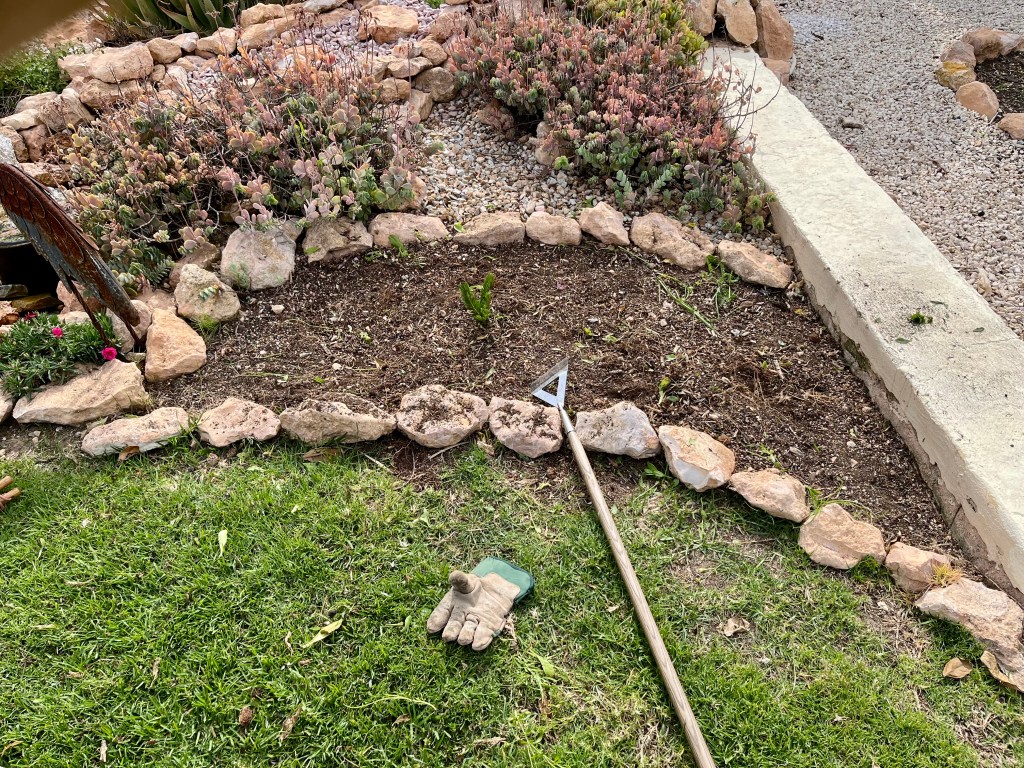
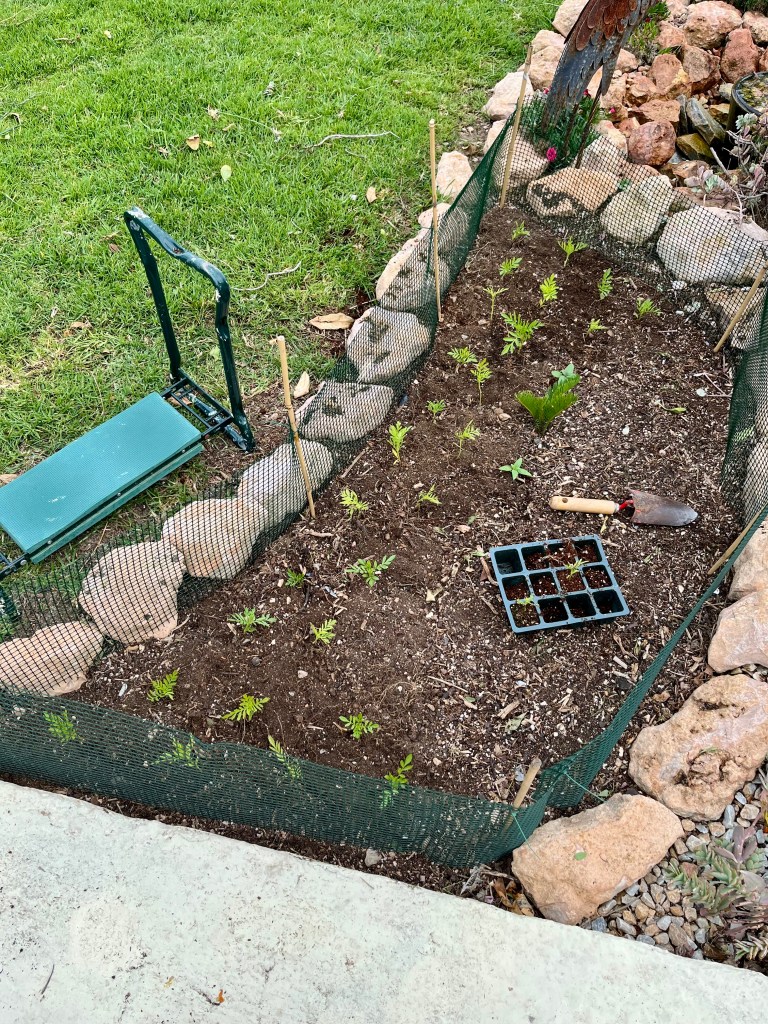
Planting out seedlings. May is the last month when you should be planting out seedlings. After this month it will just be too hot and they will wither. When I plant out seedlings, I first make space in my flower beds by ruthlessly taking out plants that have just finishing flowering. If I waited till everything finished flowering it would be too late for seedlings. So be brave and make space.

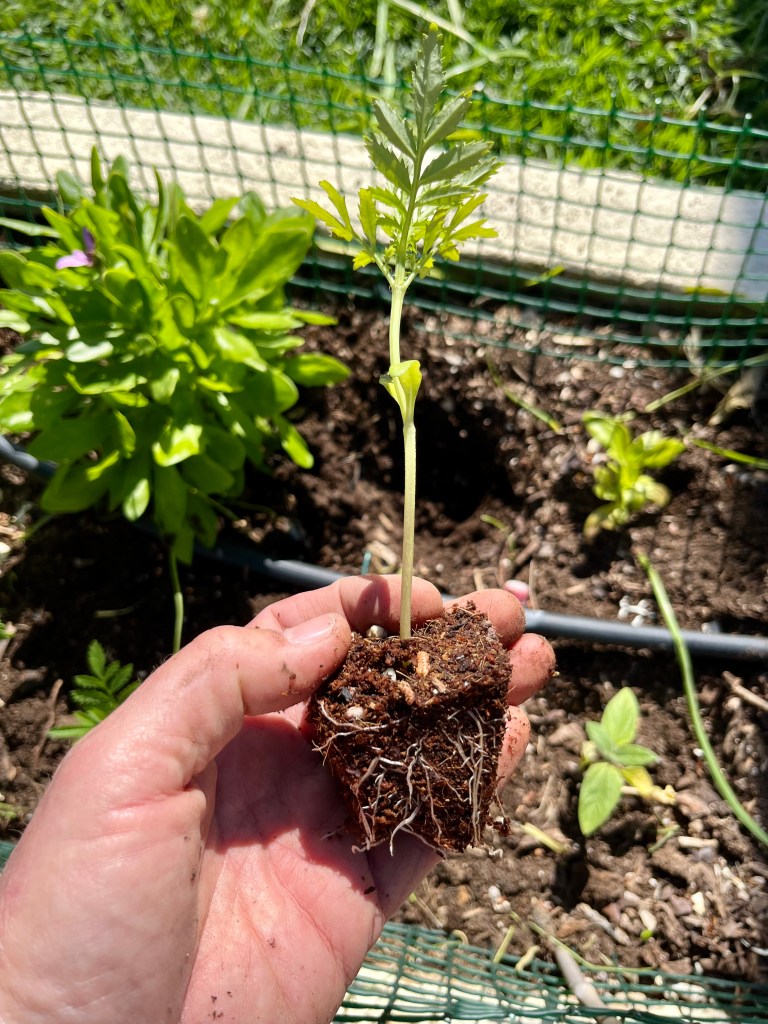
To make room for seedlings I take out huge clumps of Osteospermum. I then plant Marigolds, mini sunflowers and Alyssum in the new space. These will eventually grow and fill my flower beds with blooms all the way through till October. The first photos below show the removal of the lovely Osteospermum. These are followed by examples of the various seedlings going in.

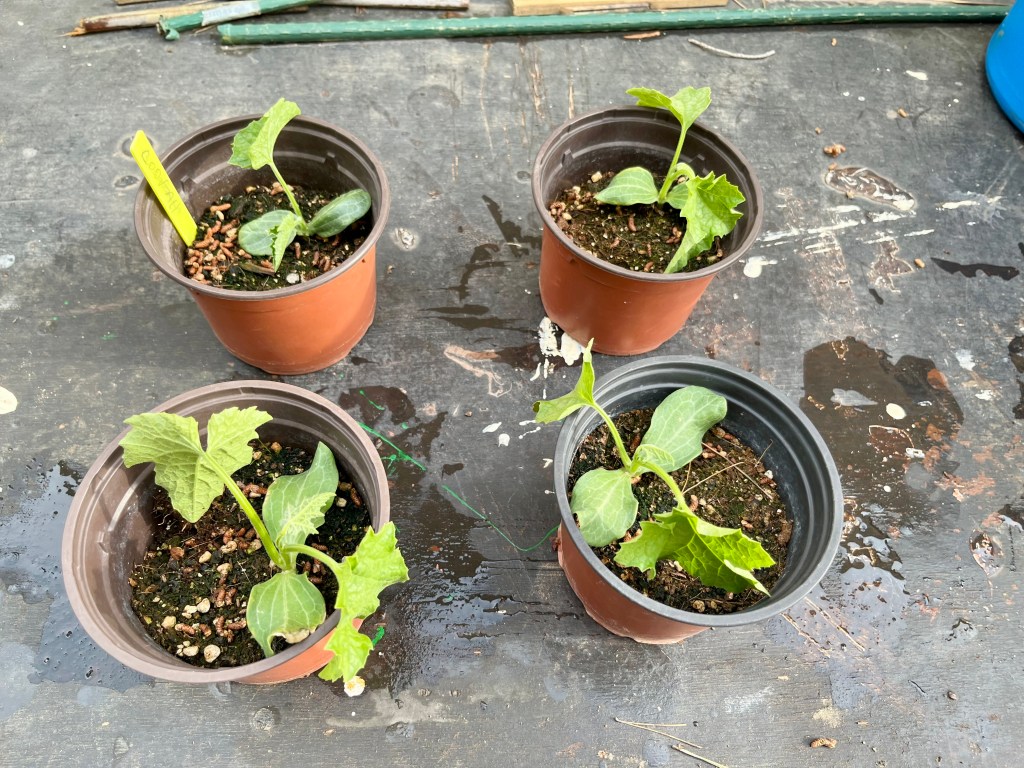
Potting up Loofahs. I enjoy growing Loofahs for two reasons: First they are unusual and provide flowering interest in the garden. Second, I sell the subsequent loofah plants to my wife (Cruella) and others from her Coven who use them to defoliate nose warts from the ends of their noses.

Plant loofahs seeds in four inch pots by pushing the seeds a finger nail deep into compost. They will grow quickly and you will need to pot them on when they are about two inches high. Loofahs do not like having their roots disturbed, so fill your new pots with compost around the existing 4 inch pots and then replant your loofahs into the subsequent pot shaped space. See photos below.

Dealing with Sawfly. If you have roses then you need to keep an eye out for Sawfly caterpillars or they could decimate your plants. Sawfly specialise in chomping through roses and they have a very simple but effective strategy.

Mummy Sawfly lands on your rose stem and saws a sliver from the stem and lays rows of eggs into the exposed stem. Once the eggs hatch as caterpillars, they have one mission to chomp through your rose leaves as they make their way to the ground. Once at ground level they burrow into the soil and the whole process starts again next summer. The first photo shows the caterpillars chomping on my roses, whilst the second shows the type of damage they can do, together with some of the culprits.

Most caterpillars you can just pick off your plants and throw them to the ground. But with Sawfly if you do this then you are fulfilling their life cycle. Instead you must break their life cycle by either spraying or plucking them off and drowning them in a pot.

Luckily I managed to arrange my own Sawfly massacre by eventually persuading Cruella’s chickens that they were tasty. I have to tell you this was no mean feat persuading chickens that are hand fed grapes and strawberries that the wriggly worm like things I presented to them were tasty. I even ended up shouting at them that there were chickens in Africa that would be overjoyed to have Sawfly caterpillars.

Eventually after covering a few of them in chocolate I persuaded Helga my favourite chicken to try a few. The photo below shows the start of the Sawfly massacre as Helga tentatively sniffs the caterpillars before being joined by the others in consuming every one.

The bee and chicken pamper day. Well, the bees are here, and I am now the proud owner of 2 hives, 20,000 bees and two queens. It has taken a year of planning and much learning but I made it. Cruella is beside herself since she found out that most of the bees are girls. I mentioned in my last post that she and her chickens were planning a massive welcome ceremony for the bees, and they out did themselves.

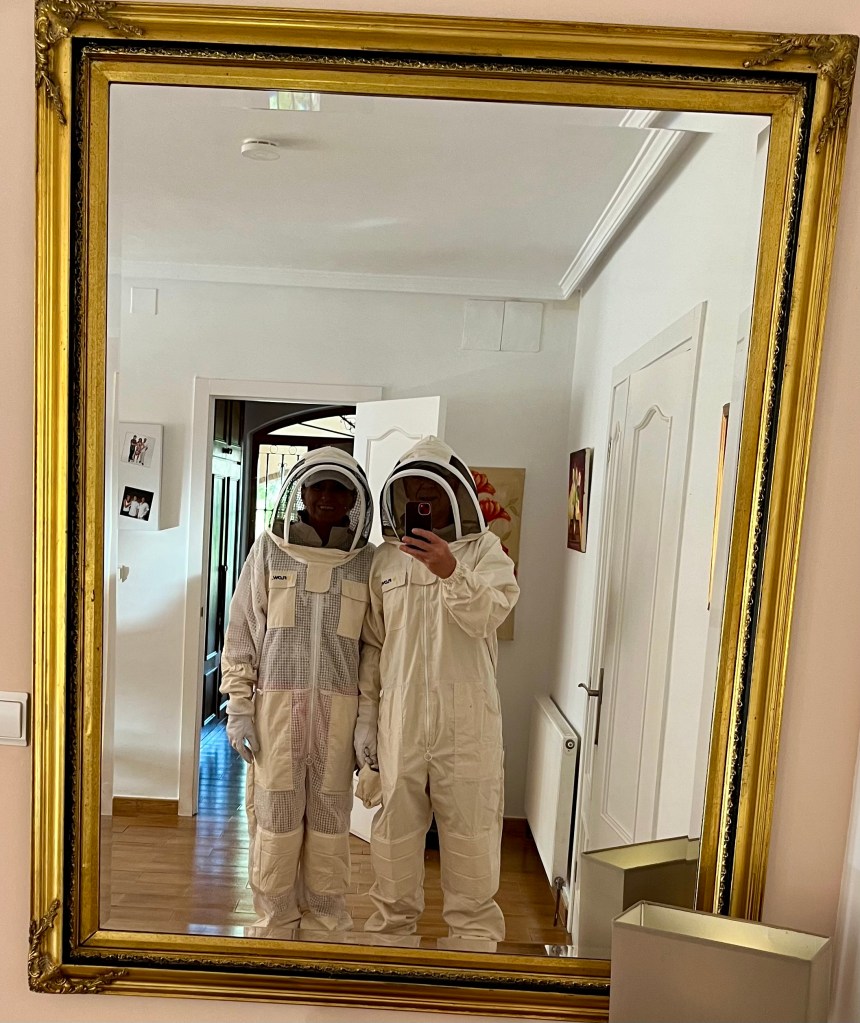
Apart from the banners and balloons, there was a special buffet, a fancy dress competition and bunting over each of the hives. By the time both Cruella and I had got all our bee keeping outfits on and placed the Bees in their new hives, Cruella decided that they would be too tired for the fireworks so we just let them settle in. In case you were wondering what we look like in our new outfits I took a photo for you.

I sent our idiot son this photo and he reckons we look like demented Teletubbies.

The next day Cruella rose early and by the time I got up she was already well into her girl pampering and wellness day. This started with the chickens getting a pedicure and then having nail polish applied to their toenails. At the end of it all Cruella asked me whether bees have toenails? I confessed that I didn’t know as I hadn’t got to that stage in my training course.

The early afternoon was spent in what Cruella termed a “Power Brunch”; she insists all her girls will eventually get professional jobs. As far as I could see this consisted of what Cruella calls a balanced diet for the chickens: strawberries, grapes, mulberries and infused juices. The bees got honey and I got some stale crisps.

After the brunch, the afternoon involved mainly chicken and bee therapy sessions, which included topics such as:

  • Bee assertive
  • Never Chicken out
  • Striving for Eggcelence
  • How to stand out in the hive

The day ended with Cruella excitedly announcing there would be a grand sleepover with her and her girls joining the bees down by the hives. I wasn’t invited as it was girls only; I was glad really as bees snore! The photo below shows Cruella and her girls heading off to the sleepover. I went to bed early but was kept awake all night by renditions of “I will survive” and “ girls just wanna have fun”.

Cruella is cuddling Helga as she has difficulty sleeping

Seeds, cuttings and chickens welcoming bees


I know the above title is a bit confusing, but all will become clear later. But in the meantime you need to be continuing to plant seeds and now you can also begin to take cuttings from your strongly growing perennials. Take action now, or you are doomed to continue buying expensive plants from Garden Centres which in many cases die within a few weeks. In the meantime I am getting ready to welcome my bees! and getting on with the gardening.

10th April 2025. Things I have been doing lately:

  • Treating for Palm Weevil
  • Finishing patching the lawn
  • Starting my plant feeding regime
  • Taking cuttings
  • Pricking out seedlings
  • Getting ready for my bees

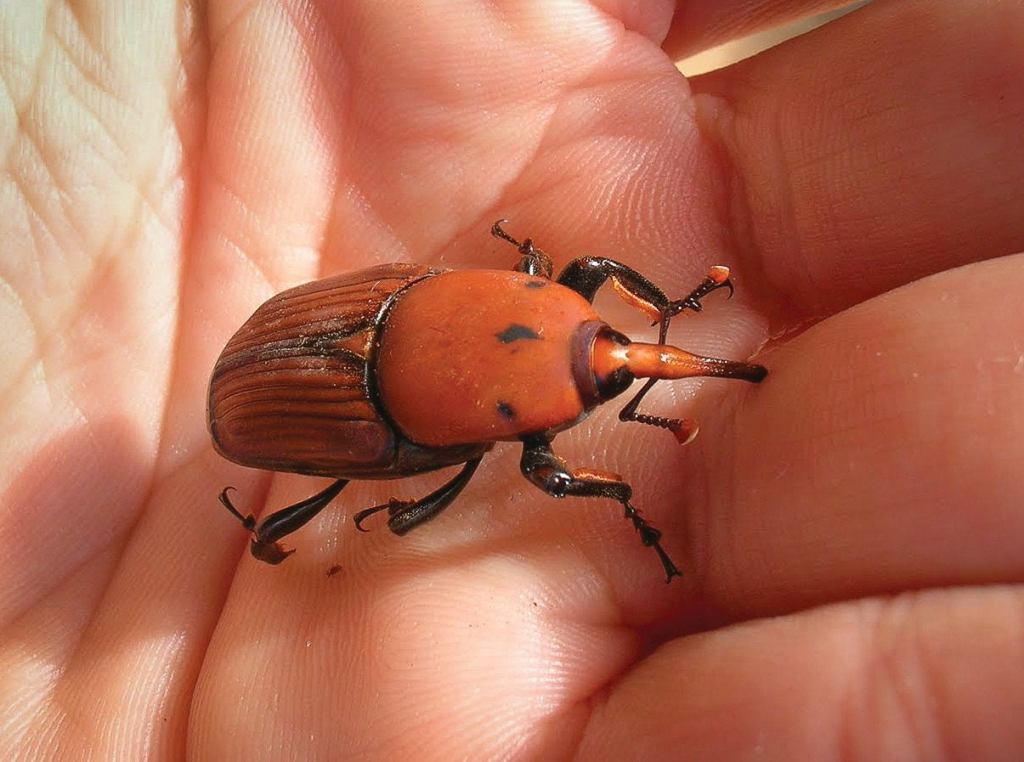
Treating for Palm Weevils. The dreaded Palm Weevil has started flying now that the weather has got better. This large beetle lays its eggs mainly in Phoenix Palms and the subsequent grubs munch the trees to death. You should not be cutting your palms at this time of year as the beetle can smell a cut palm from a long distance. The photo below shows some of my many palms cut by a professional Palmista before the beetles were flying.

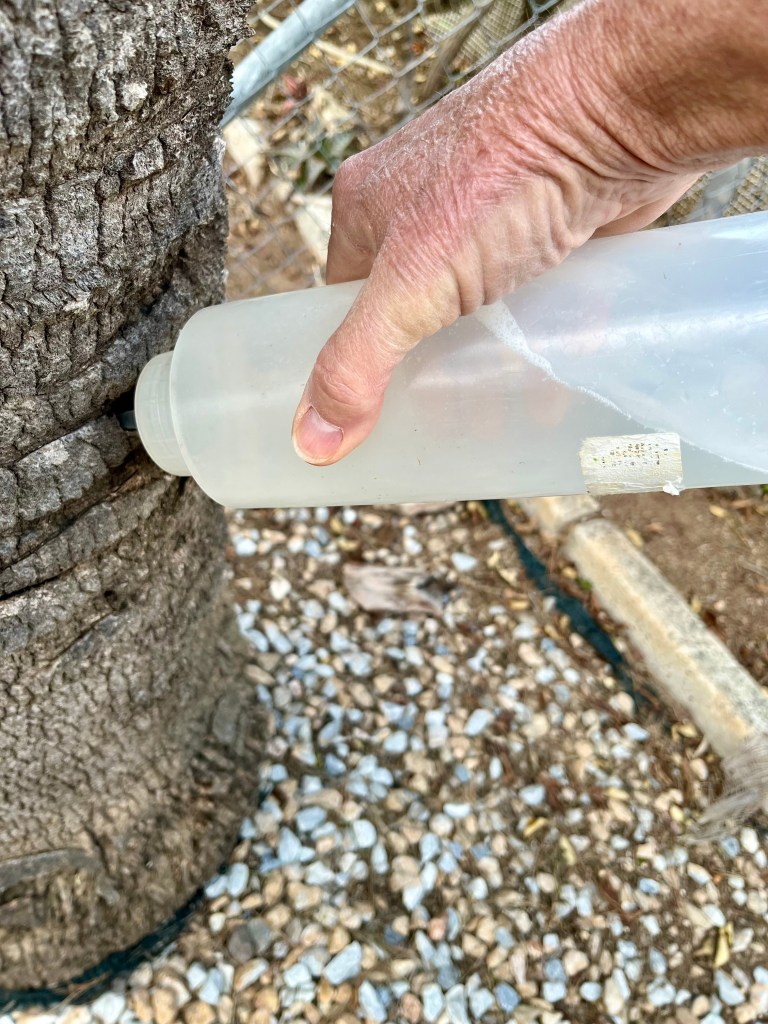
Because my palms are too large to treat at the crown I developed a different method of delivering chemicals to the crown. This involves drilling a hole diagonally half way into your palms trunk. Fill the resultant bore hole with proprietary weevil killing chemicals, and allow the sap to take the chemicals up into the crown and infuse all the fronds with killer chemicals. One nibble of your palm and the beetle is dead.

This is a simple method that once in place will ensure your palms are beetle free. All you need to do is keep topping up the chemicals every month or so, and once a year poke a steel rod in the hole to keep the scar open and stop the tree calcifying it over. The photos below show me in action.

Finish patching the lawn. If you have a lawn then now is the time to do any last minute reseeding on bald patches. I don’t know why I bother really, my lawn is now just a chicken playground. But anyway, if your lawn needs patching up just scratch and scarify the bald part. Add some top dressing. Then sprinkle some grass seed and cover with fleece. Keep the area moist and the warmth of the earth should do the rest. The photos below show my efforts.

Start your plant feeding regime. You should have already started your citrus feeding routine, and now is the time to start feeding other fruiting trees and shrubs. Don’t be tempted to think one size fits all, and that you only need a general purpose feed. Yes, a general purpose feed will do no harm, but it will not contain specific nutrients that are targeted at different plant types.

The photo below shows the variety of different types of feed that I use. In addition each watering can gets a “Glug” (old English term) of iron.

Taking cuttings. If you have a favourite plant, or just want to multiply your existing stock of plants for free, then now is the time to take cuttings. The cuttings you take now can be allowed to develop over summer on the potting bench, ready to be planted out in the autumn.

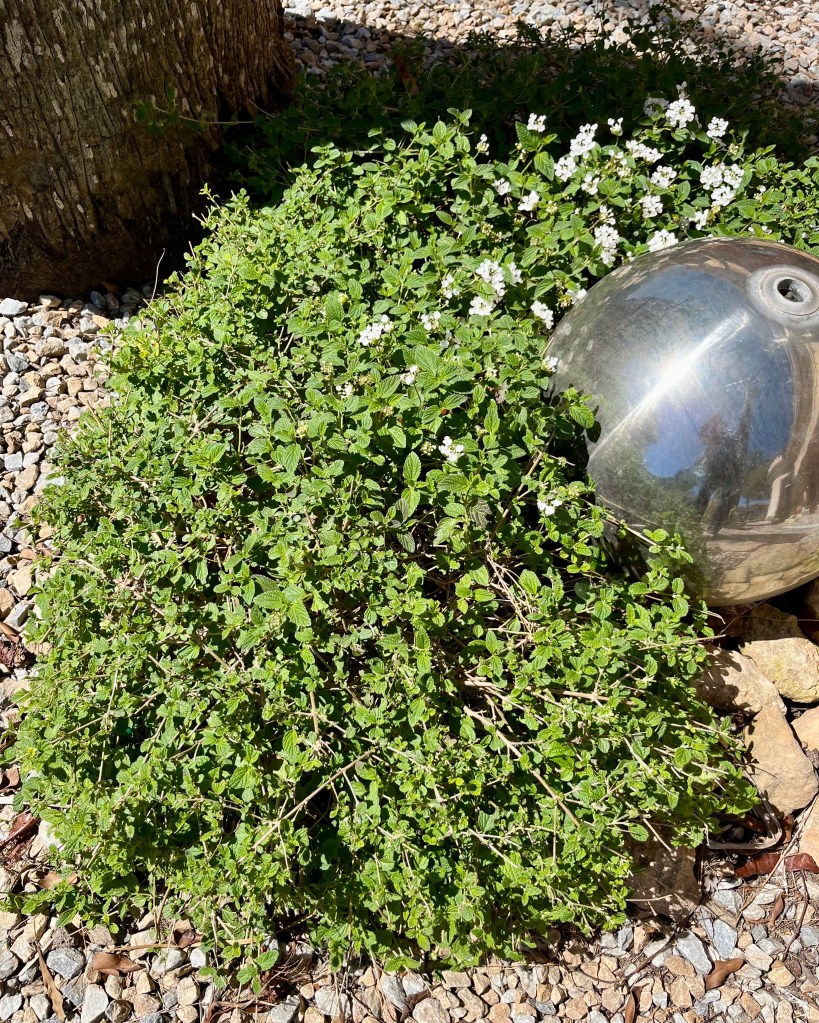
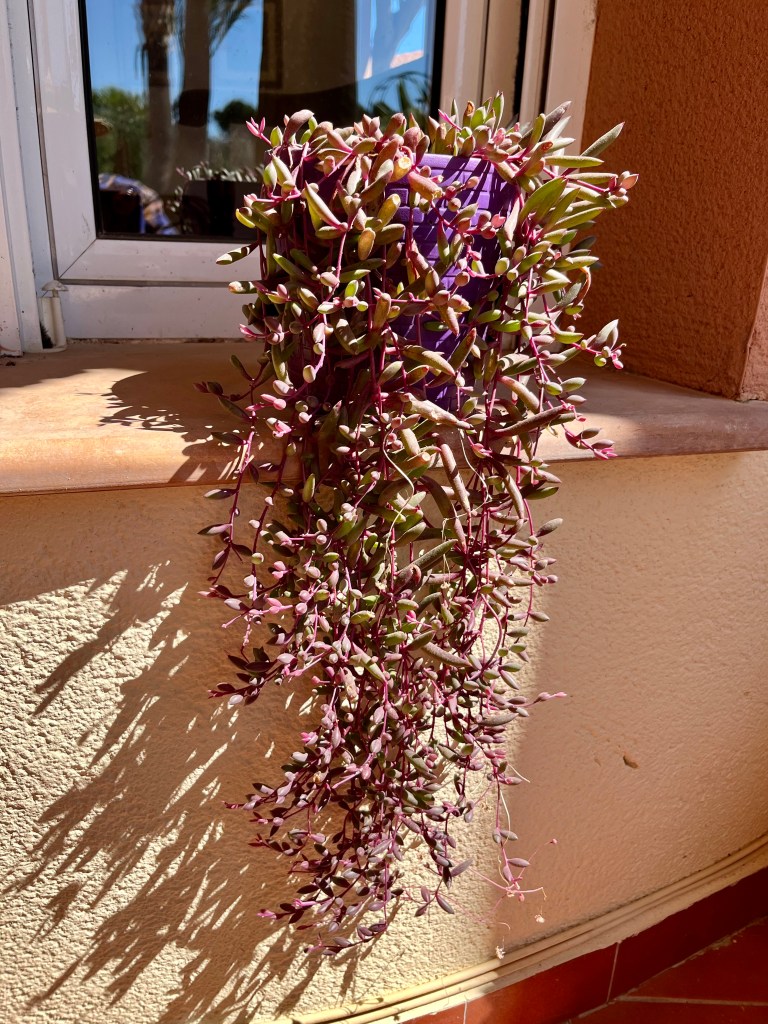
My first cuttings have been taken from Dianthus, Trailing Lantana and Little Pickles. See photos below.

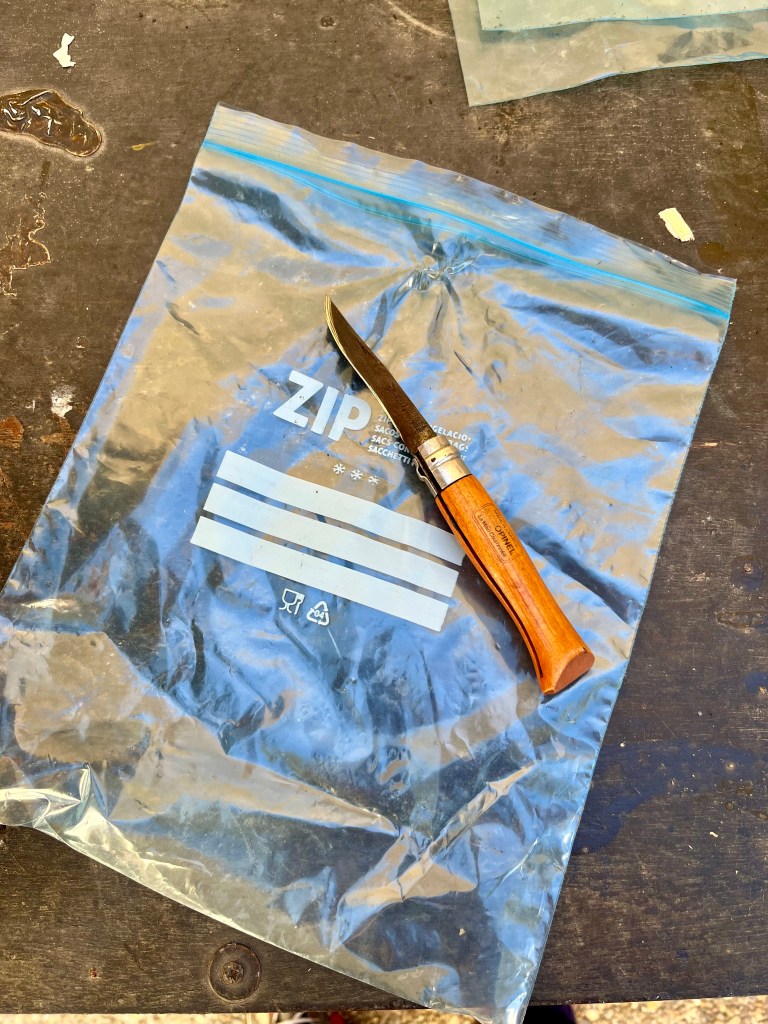
An easy way to take cuttings is to go around with a sealable plastic bag and your pruning knife (never secateurs as they crush stems) and select non flowering stems. Take at least three cuttings from each plant by cutting just below a leaf or growth node. Place your cuttings straight into your bag to stop them drying out as you wander round.

Once you are back at your potting bench, make sure you have the following to hand:

  • good free draining compost with added vermiculite
  • a selection of sealable ziploc plastic bags (available in every supermarket)
  • short pieces of can cut to about six inches
  • rooting hormone powder or liquid (not essential but helps)

Fill 4 inch pots with your good free draining compost, water them well, and tamp down the compost to remove air pockets. Take your cutting, remove all leaves up till about the top two, holding your cuttings by the leaf, dip them into your rooting compound and then place gently into pre prepared dibber holes around the side of your pot (3 or 4 to each pot).

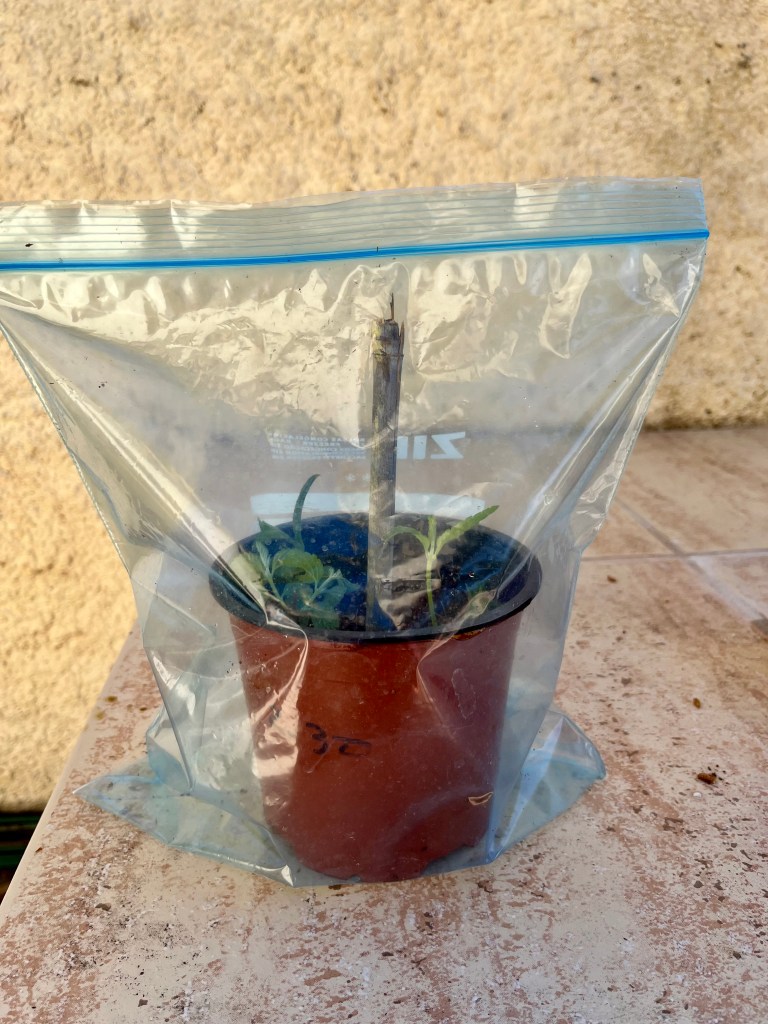
Push your little cane right into the centre of the pot and then seal the whole pot into your plastic ziploc bag. The cane will stop the plastic bag collapsing onto your cuttings and starting rot. Place your pots in the shade and leave them alone. They will have a mini micro climate so will not need watering till they get some roots and new growth. It is a good idea to open the bags every 3 days or so just to refresh the air, but only for a moment don’t leave them open. I like to breathe into them as I think a dose of Co2 might help! The photos below show the process.

Pricking out seedlings. You will remember in my last post that I have been sowing seeds. This should be a regular feature of every gardeners calendar whether you have a huge plot or a small terrace. The joy of growing seeds and seeing them developing is an essential part of being a gardener. Don’t be lured into huge garden centres to buy, at great expense, plants that you could easily grow yourself. Any way enough of. My ranting.

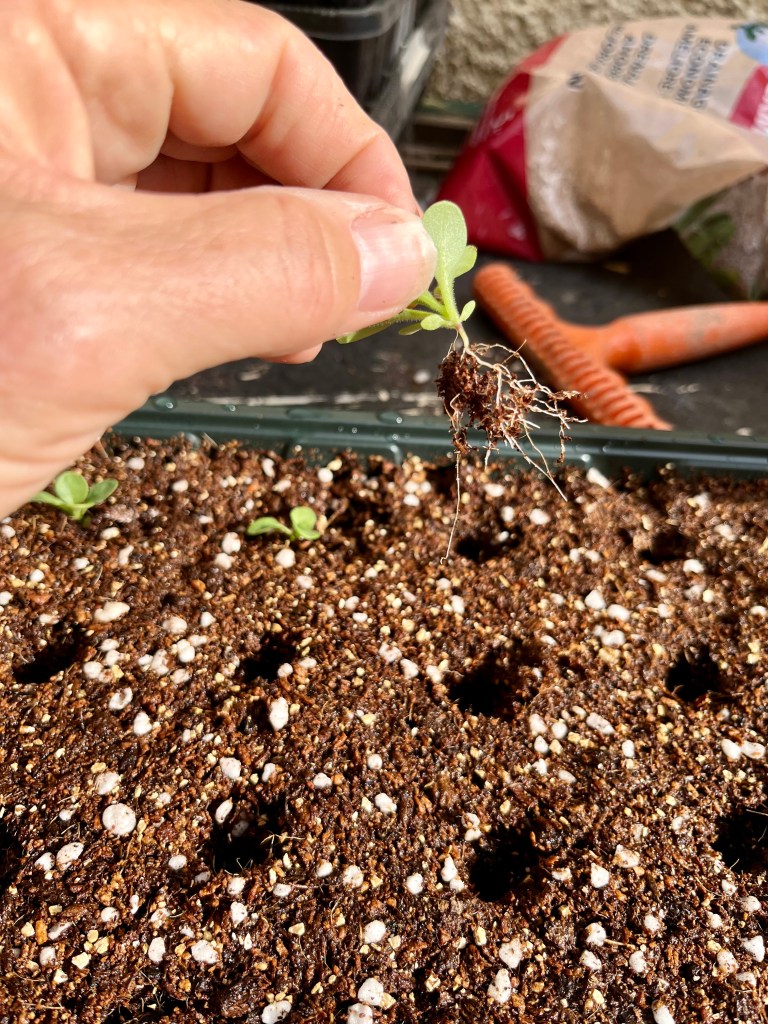
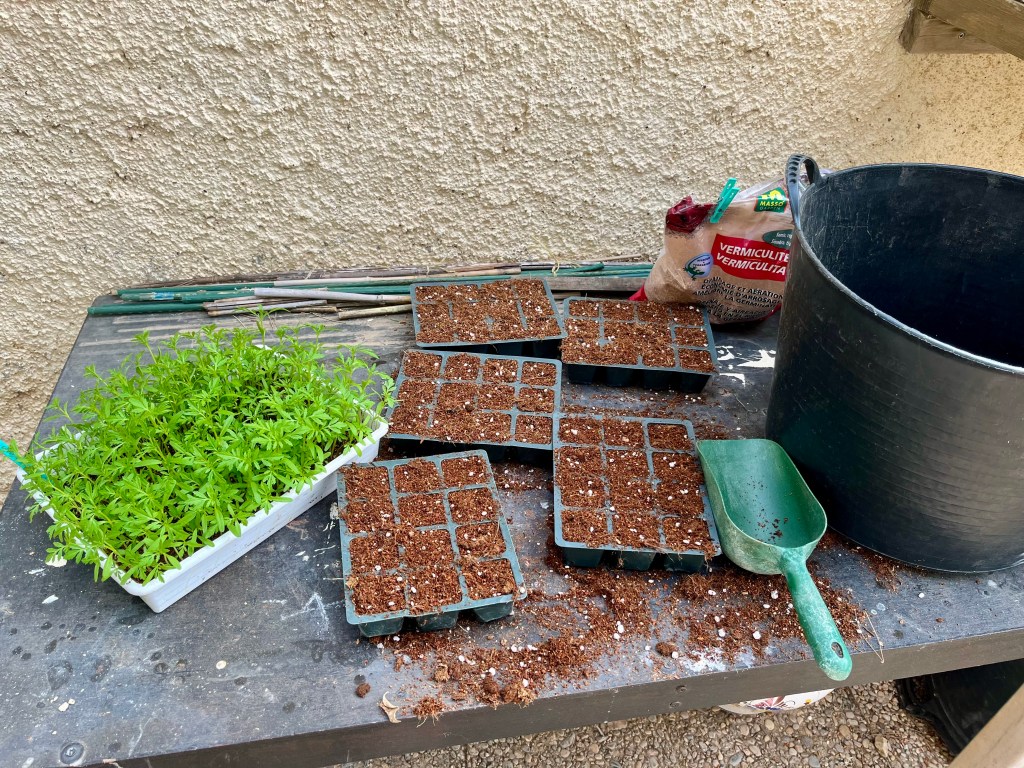
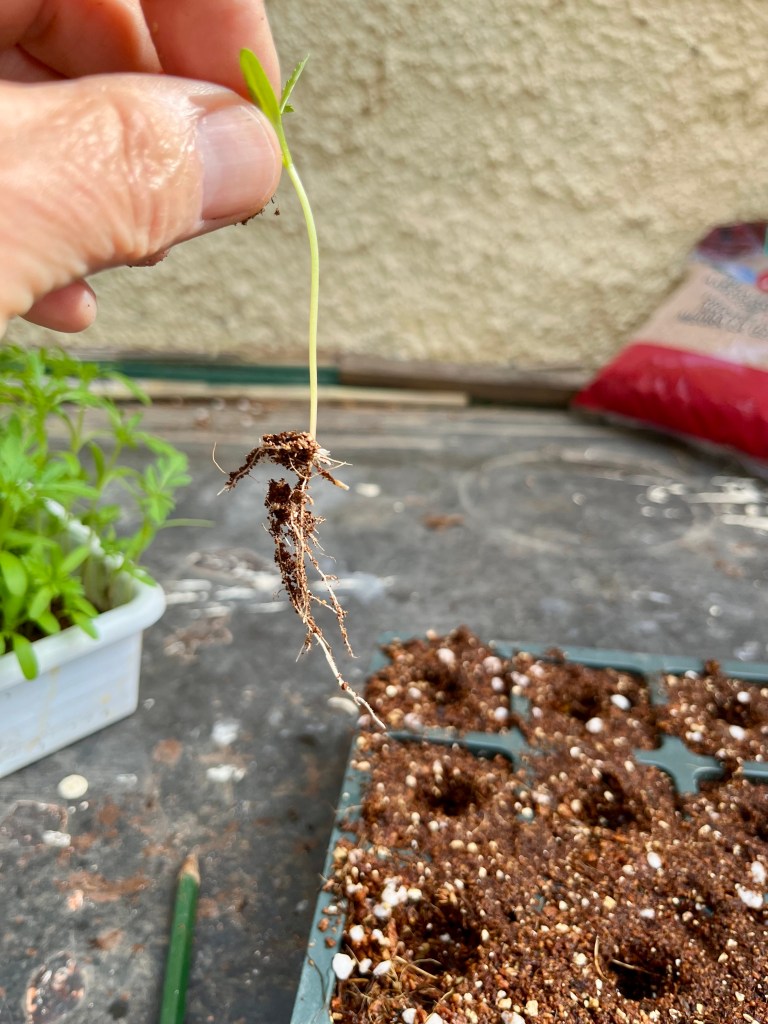
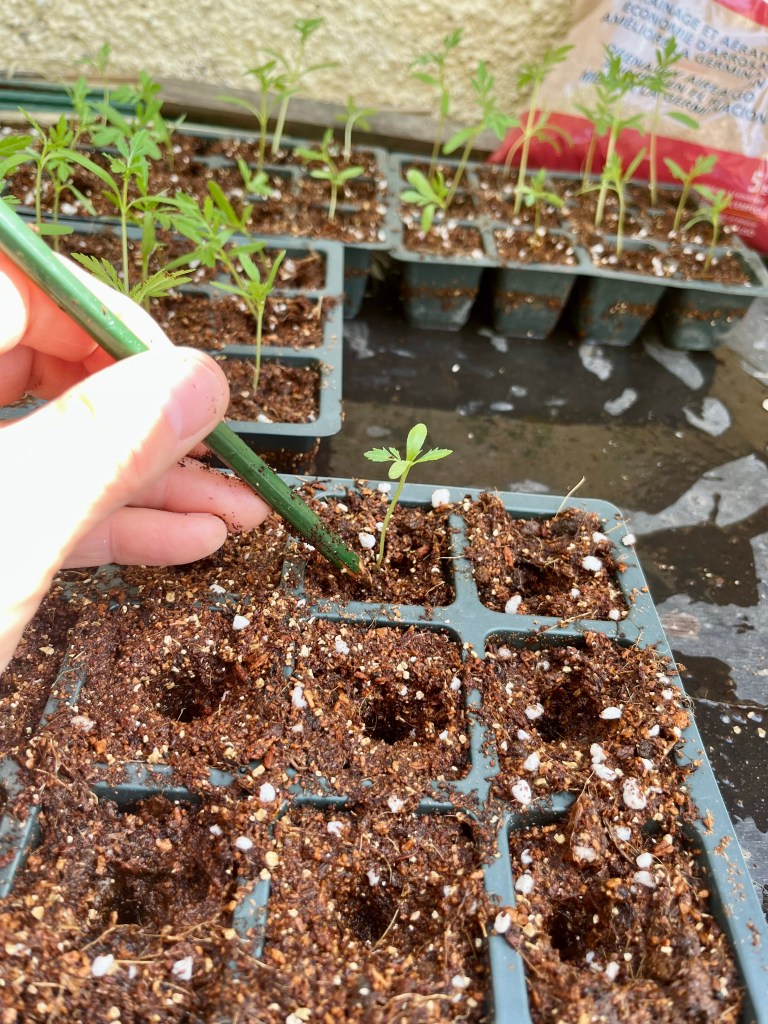
When seeds have sprouted and have at least two “true leaves”- discount the first two leaves and wait till there at least four or more. Then It is time to “prick out”, cue laughter, stop it. When you prick out seedlings you are basically easing them out of their seed tray and replanting them in individual modular plug trays to give them more growing room.

I use a pencil to gently ease out a group of seedlings, then separate them and holding them by a leaf ( if you hold them by the stem then you may damage the seedling), I carefully transplant them into watered and prepared plug trays. This can be quite an intense process so I tend to do it over a couple of days. Once the seedlings are rehomed, then keep them out of direct sun in a sheltered spot until they settle in and then gradually accustom them to direct sun. The photos below show the process.

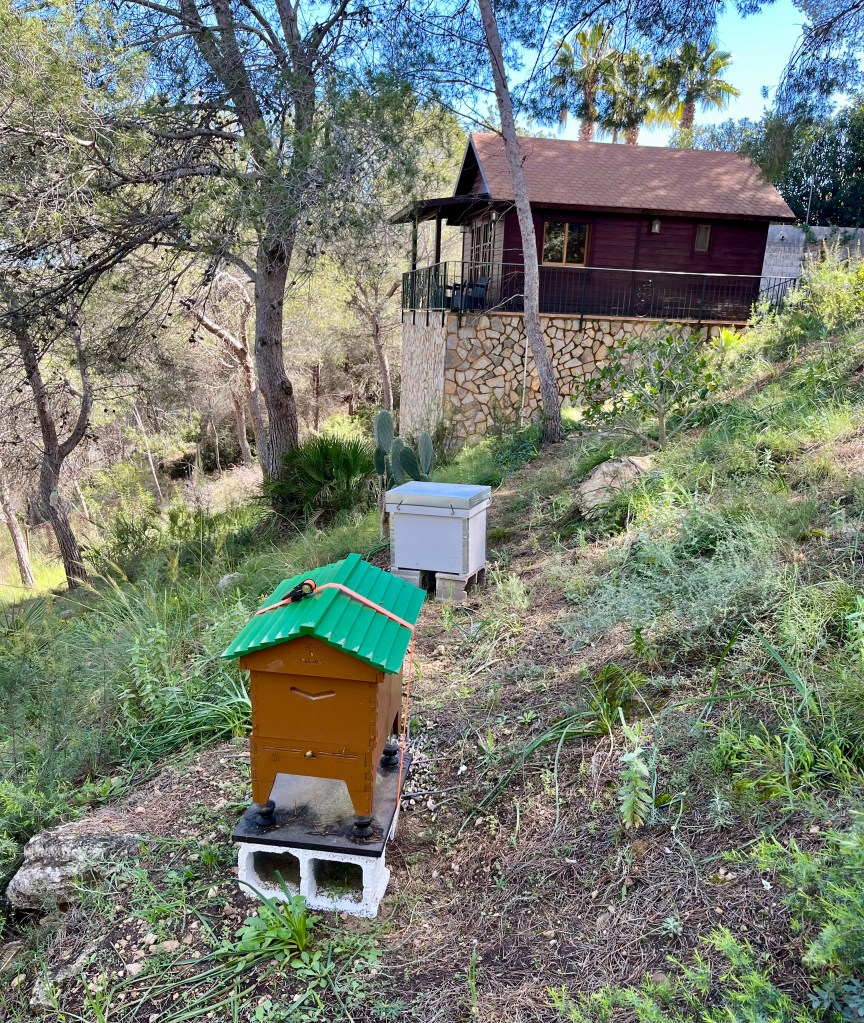
Getting ready for my bees. It has been a year in the planning but my bees arrive later this month. I will be setting up two hives which will be a wonderful addition to my garden. I have been taking an online bee course, I have watched numerous YouTube videos and I am as ready as can bee (sorry about the pun). The photo below shows my hives ready for occupation.

Cruella wants to turn our guest cabin (in the background) into a clubhouse for all her 20,oo4 girls

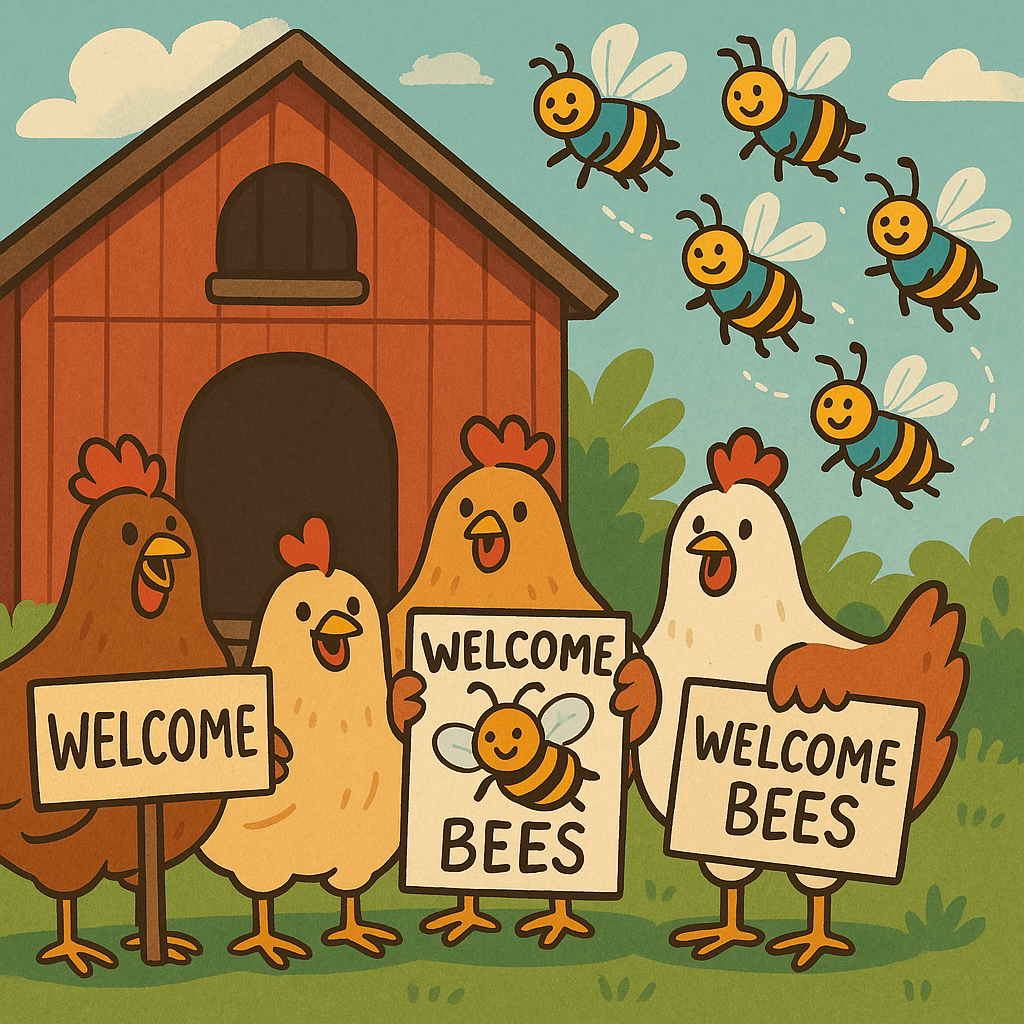
When I told Cruella (my wife) that bees are mainly female she became quite animated and said that her girls would prepare a welcome party to help the bees settle in. I explained that wouldn’t be necessary but she started rambling about girls leaving home and the need to feel welcomed she eventually ended up calling me an unfeeling chauvinist and shouting girl power slogans at me.

Anyway the outcome is that she and her chickens. have been preparing banners and posters to welcome the bees, they have even started knitting little sweaters as gift as for the bees for them all to wear for the welcome barbecue. I will keep you informed of how it goes when 20,000 bees meet 4 chickens and Cruella.

Spring has sprung and I have been dobbed in by a Dove

Cruella (my wife) is at our English house ruining the life of our idiot son. I am in charge of everything here: the house, the car, Tango the lonely blind Labrador and the bloody chickens. I just ignore everything and garden all day, the chickens don’t get fed unless they ask directly, and I don’t understand chickenese. It was all going so well until Cruella somehow found out. There were consequences, but more of that later.

Spring is such an exciting time for us gardeners and there is so many things that we need to be getting on with.

15th March 2025. Things I have been doing lately.

  • Deadheading Aeoniums
  • Refreshing plants in pots
  • Reviving your lawn
  • Planting seeds
  • Dealing with a traitor pigeon

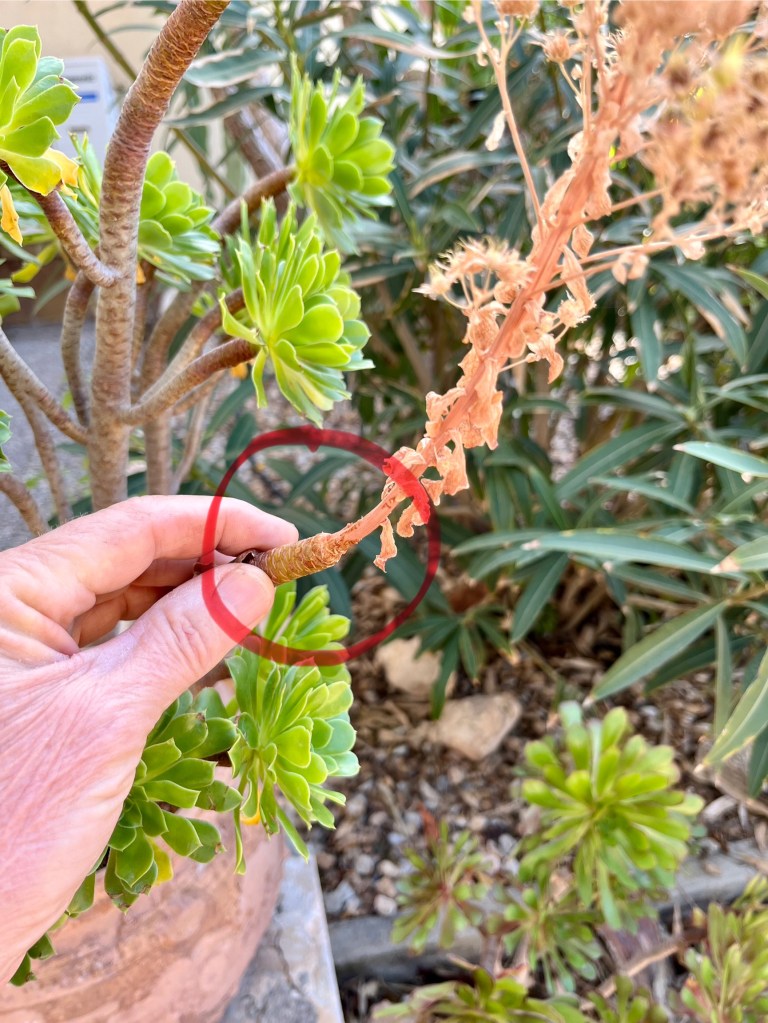
Deadheading Aeoniums. By now most of your Aeoniums should have finished flowering and it is time to tidy them up by a bit of judicious deadheading. The process is simple. Look just below the spent flower and you will see that the plant stem has started to thin and is noticeably thinner. The plant is naturally cutting off the flower as it no longer needs it. All you have to do is help it along, using your secateurs cut the stem at the thinnest point below the flower. The photos below show the process. Click on each photo for a larger view.

Refreshing plants in pots. If you have plants in pots then now is the time to refresh them. Over time plants can become untidy, pot bound and in need of fresh compost. Walk around and have a good look at all your plants in pots. The first thing to do is sit down and pull out all the debris, dead leaves and detritus that has built up.

Next, prune back any dead or dying stems and reshape the plant. Finally, most plants can only thrive for a couple of years in the same compost. Tease the plant out of its pot being careful of the roots then fill with fresh compost and gently ease the plant back into its pot. The photos below show a number of my potted plants all looking a bit bedraggled, overcrowded and in need of attention.

It is important to note that if you are tidying up Yucca and other spikey or spiny plants, then it is essential that you wear eye and hand protection. The photos below show what a difference a tidy up makes in restoring each plants self esteem!

Reviving your lawn. I know that not many of you have lawns in Spain, but those of you in the US and other parts of Europe are in love with your grass. But like love, if neglected it soon dies. And so it is with your lawn, Spring is the time to revive the love affair with your lawn. There are a number of things you should be doing:

  • rake out areas that are dead or dying
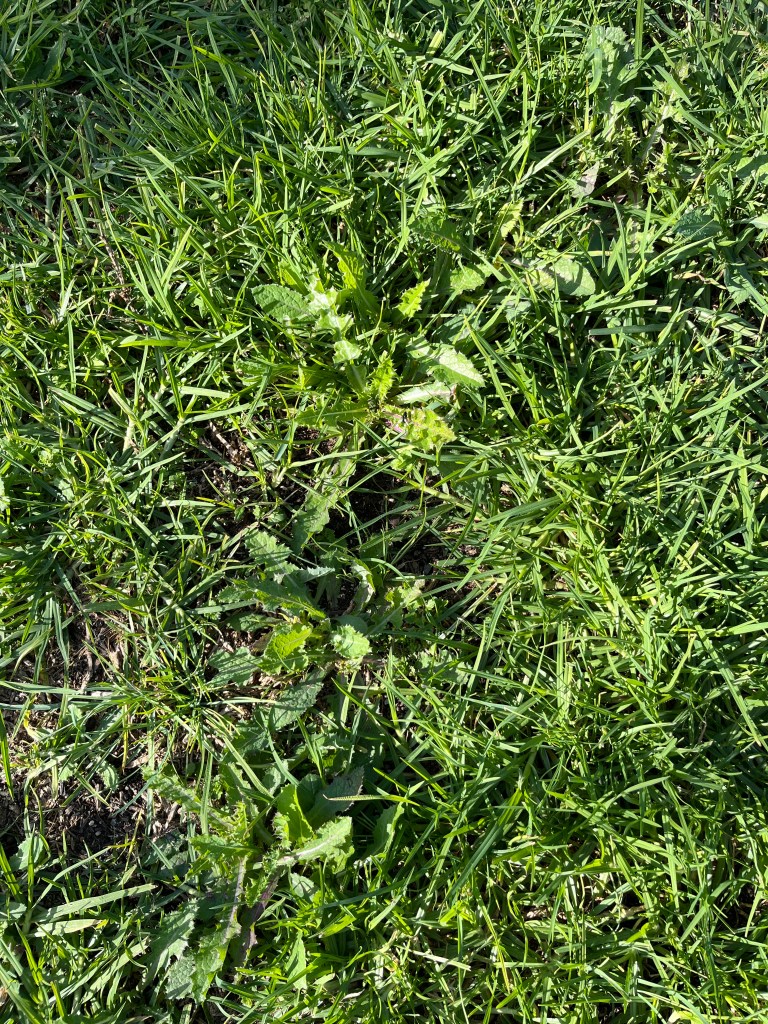
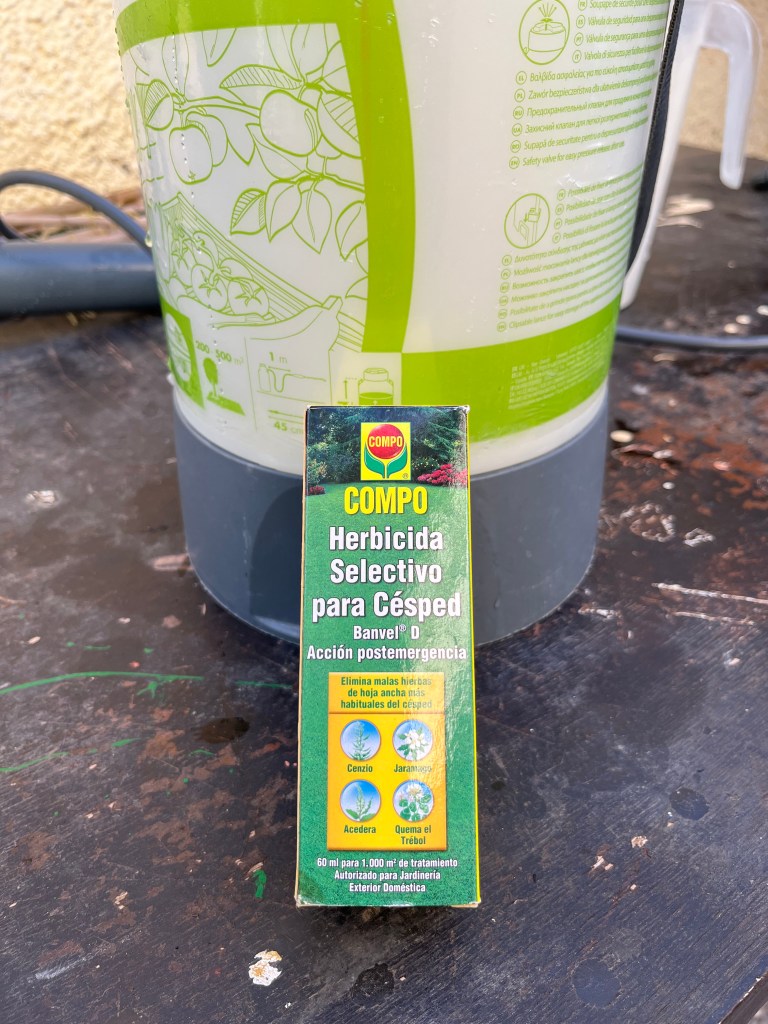
  • apply a selective weed killer
  • top dress with a specialist compost
  • feed with a specialist feed
  • reseed when the weather is warm enough in your area

The photos below show all of this activity going on in my lawn, with the final photo showing the lawn after its first cut of the season.

I have to admit photos from this angle do flatter the lawn, there are a few bareish patches

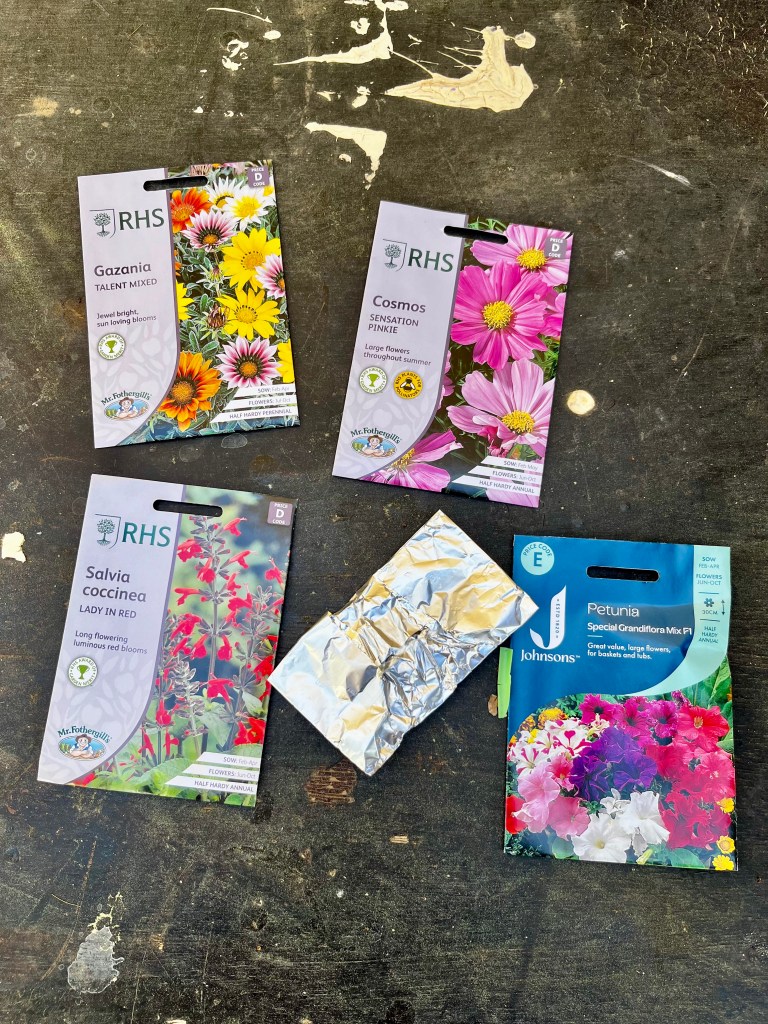
Planting seeds. Oh the joy and delight in planting seeds and creating your own plants. Not only is it cost effective; as you get hundreds of plants for a few Euros, but also you will really be gardening rather than just shopping for plants.

If you have never planted seeds before then don’t panic, it is so simple. Go out to the local Garden Centre or supermarket check out the packets of seeds and buy a few packets of the ones you like. Try and pick ones that are easy to grow and suitable for your local climate and garden. But better still, why not gather seeds from your garden this summer and start your own seed collection. The photo below shows some of my collection.

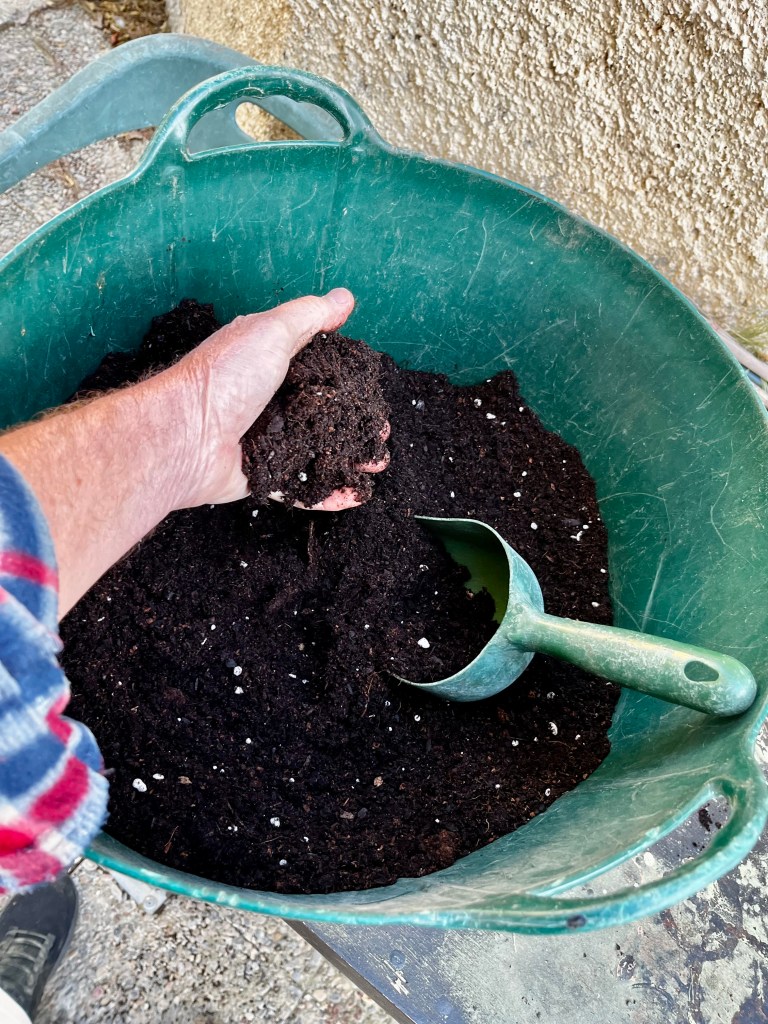
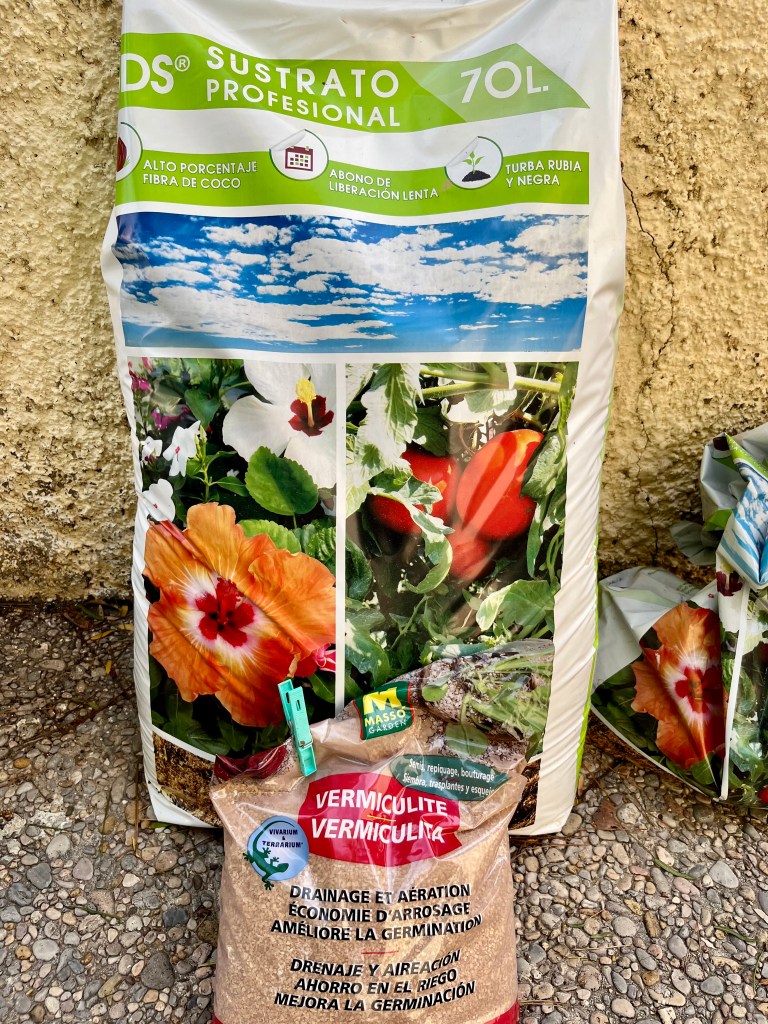
The key to success in seed growing is the growing medium you use. Pick the best compost you can afford, and make sure it is for seedlings. You can help your compost by making it as free draining as possible, so buy some vermiculite to mix in with your compost. The photo below shows the stuff I use.

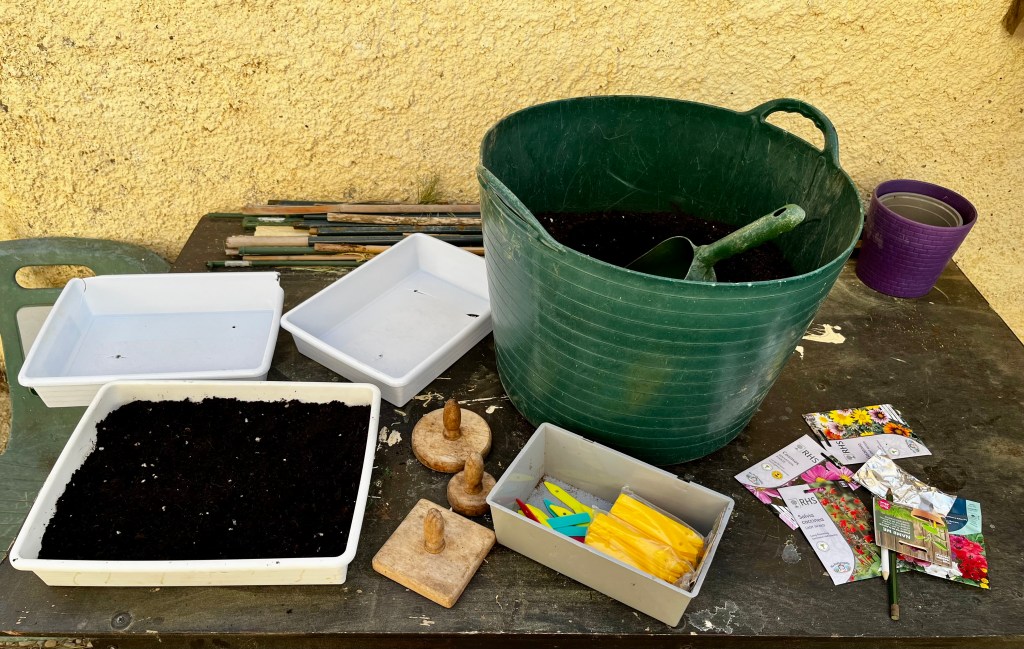
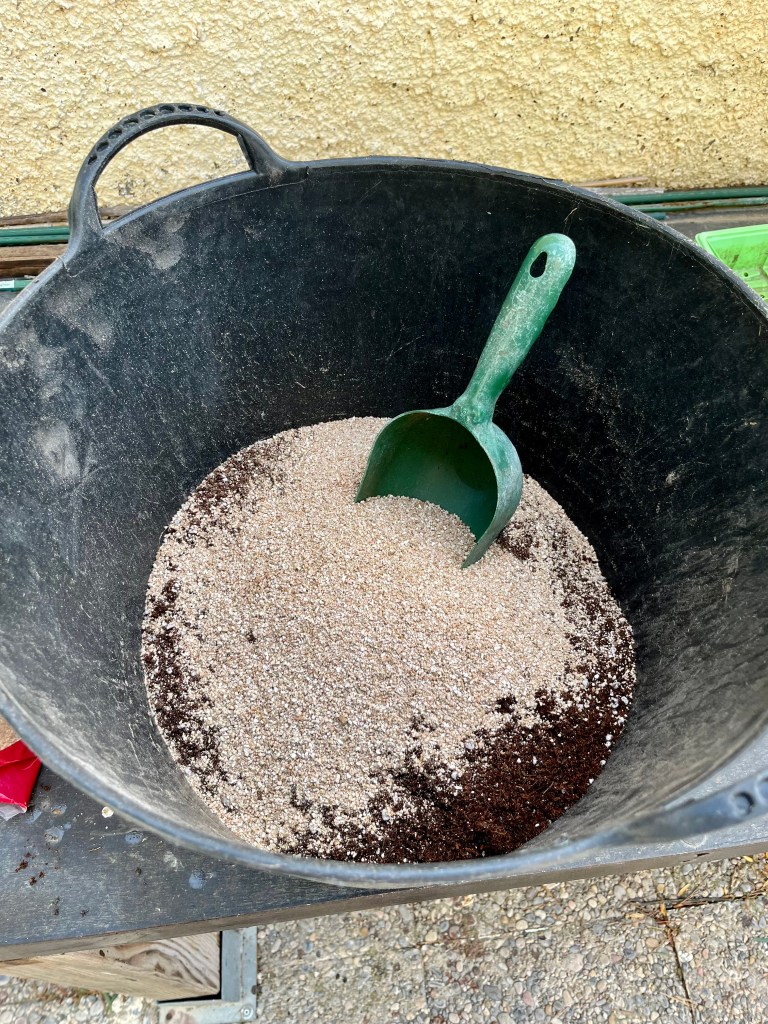
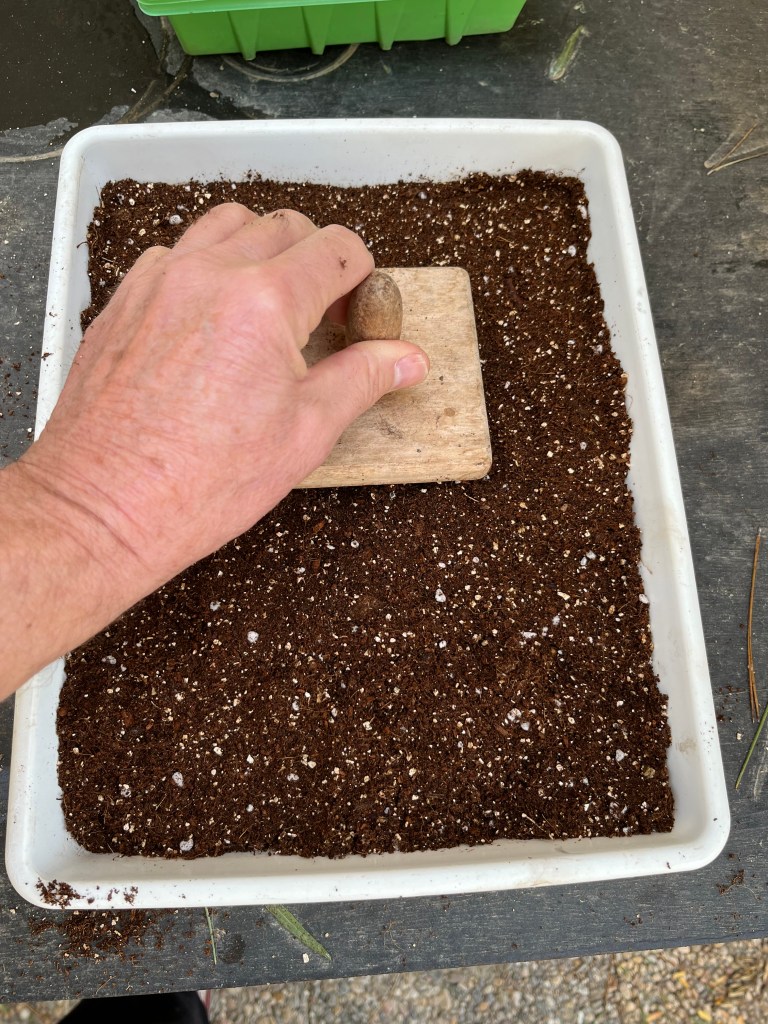
Mix your compost and couple of handfuls of Vermiculite in a trug. Make sure there are no lumps in your mixture then fill up some seed trays. Finish by tamping down the compost in the seed tray to get rid of any air pockets. The photos below show the process.

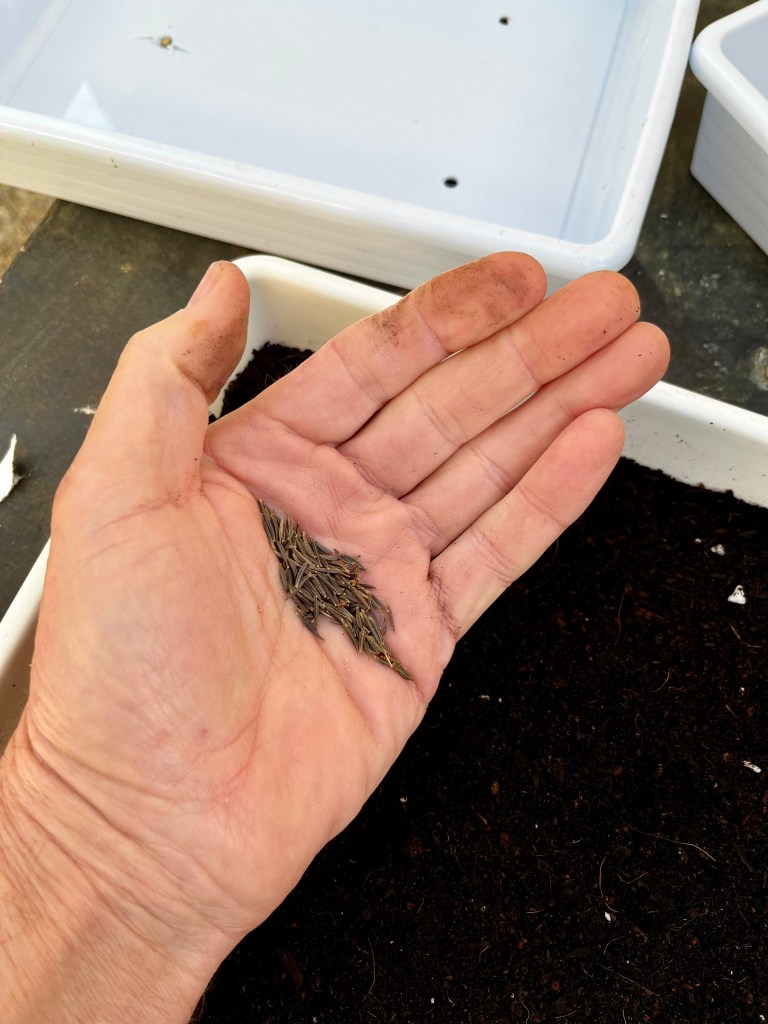
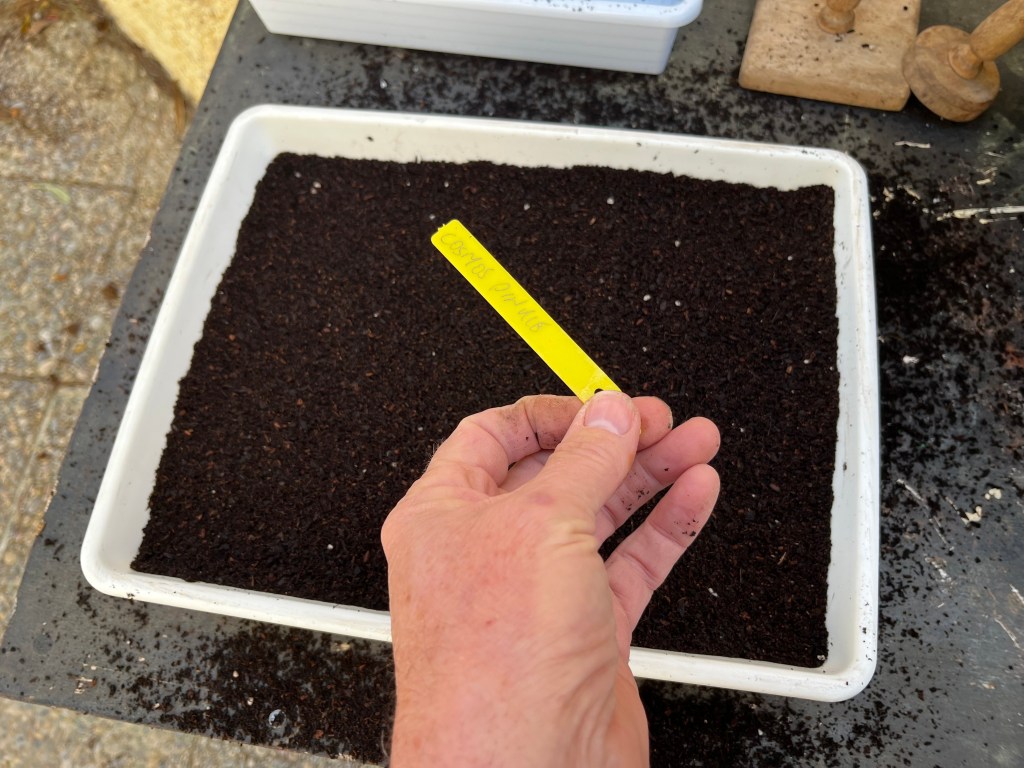
When you have your seeds trays ready, then just follow the instructions on the packet. Most seeds are sprinkled on the surface of the compost then lightly covered with compost. The photos below show this process.

With larger seeds the process is slightly different. Most larger seeds need to be sown individually in 4 inch pots or cellular seed trays. Just fill the pots or cells with compost, water lightly. Then using a pencil or dibber make a hole about half and inch deep pop your seed in and pinch the top of the hole closed. The photos below show this process.

The final,part of the whole process is to put your new seeds somewhere warm to allow them time to germinate. This need not be expensive you can use a window ledge indoors or just buy a real cheap mini greenhouse, you will only need it for a few weeks. The photos below shows my first seeds planted and in my mini greenhouse. The final photo is four days later and God has worked his magic and I have lovely new plants.

Dealing with a traitor pigeon. Whilst Cruella is away I take the opportunity to show the chickens whose boss. This means no special treats, early bed times, and restricted exercise periods. As you would expect this has engendered lots of discontent. In the past the chickens have somehow got a message to Cruella (my wife) and I have been made to reverse my restrictions including having to publicly apologise to the chickens whilst they smirk at me.

Anyway, this time I had taken the necessary precautions to stop them communicating. All chickens had been frisked for phones, I changed the Wi-Fi password and taped over the ChickenCam Cruella had insisted on; I told her there was an electrical problem.

I had to put up with all their squeaking and frantic gesticulations, but I just point to my ear and shout “me no speak chickenese” it drives them mad. They have held meetings, protest marches and even sent Elsa to plead their case. The photos below show their attempts to protest.

But I held out and was really pleased with myself until a furious phone call from Cruella. She was literally screaming at me “what have you done to my girls” I pleaded ignorance, but it was no good, she knew everything. I tried to blame Tango the lonely blind Labrador, but to no end. The end result was that she insisted that I make it up to the girls. I had to put Elsa on the phone, they chatted away in chickense, in what sounded a very animated call. The end result was that the chickens had demanded reparations and I have been forced to give them grapes every day. The photos below show the humiliation.

I couldn’t understand how Cruella had found out about my neglect of the chickens, especially after all my precautions. Then it came to me, I had covered everything apart from the bloody Dove that Cruella has adopted. It seems I thought it was an innocent Dove, when all along it was a stool pigeon! Photo of the traitor below – I didn’t give it any grapes!

The big Winter cutback stage 4. I Tackle the big tree and the chickens try to assassinate me

The last thing I tackle in my winter cutback is to prune back my big ficus tree. This sits majestically in a gravelled area on part of my front garden. The pruning is a mammoth task mainly because the ficus gets bigger year by year whilst I get smaller over the same time frame. Those of you who regularly follow this blog will remember that I pruned this tree back to a donut effect over 13 years ago by cutting out the central trunk to create a hole in the middle into which I inserted a statue of the Cheshire Cat from Alice’s Adventure in Wonderland.

The big ficus has always seen this reshaping as an affront to its dignity, and as such has sought to punish me over the years by various means including:

  • Becoming infested with wooly aphids and many other creatures
  • Deliberately dropping its leaves to make the gravel area untidy
  • Tripping me up in its roots
  • Throwing me off my ladder when I am entering the centre of the tree

Anyway let’s get on with the gardening:

24th February 2025. Things I have been doing lately:

  • Pruning the big Ficus
  • Surviving chicken assisination attempts

Pruning the big Ficus.  An important part of my pre-pruning ritual is to build up my courage by pre-prune psyching out. This is a bit like boxers at the weigh in. We stare at each other, I strike postures around the tree and issue a series of blood curdling threats. For its part the tree just waits silently knowing its time is coming. To be honest my pre-prune ritual was hindered by Cruella’s (my wife) chickens constantly mocking me and deliberately making “chicken” sounds. The first two photos below show the terror of the big Ficus, the final photo shows the centre of the tree overgrown and ready for reshaping.

The first stage in pruning is to begin to open up the centre of the tree to let light in. This involves using long reach electric trimmers. The photo below shows the first few trimmings. Note the two trugs at the base of the tree these are to protect existing plants from damage.

I then move on to trimming the sides of the tree.This takes place in two stages.The first stage involves me walking around the tree trimming up the bottom half and underneath before standing on my platform to trim the top half. The photos below show the action.

When the sides are finished the tree begins to take shape. The photos below show the sides trimmed and ready for the top and inside to be cut.

Getting up inside the tree is the bit that I dread most. I have to climb the ladder then stand at the centre of the tree precariously balancing on the main branches whilst reaching out with the long trimmers to get at the farthest branches. This year has been more precarious than most for chicken related reasons that I outline later. The photos below show me in action. Where you can’t see me, I’m in the middle of the tree.

The final act is the big clean up. I do this over a couple of days so that most of the moisture has gone out of the cut leaves making them easier to gather up. The photo below shows the official end of the big cut back and the declaration that Spring has come.

The chickens try to assassinate me. I didn’t like to mention this when I was telling you about the big tree, as I was a bit upset and emotional. It all started about two weeks ago when Cruella (my wife) casually mentioned the British government’s “Assisted Dying Bill”. She enquired. Whether I had given any thought to perhaps not being a burden to her and her girls.

Since then she has asked me to sign various documents, I don’t quite know what they are for, but she has assured me they are just admin and nothing to worry about. Evidently it turns out we might be going to Switzerland for a holiday. I only became suspicious when I found the tickets and I haven’t got a return.

Since signing those documents I have had a few near miss accidents, things have fallen on me, my food has tasted funny and my electric blanket appears to have been rewired. I have started taking precautions and the only place I felt safe was in the garden hiding by the compost bins.

That all changed when I was cutting back the big tree. When I was up the ladder I could see Cruella and her chickens close by in deep conspiratorial discussion. Suddenly without any warning the chickens all charged at the ladder. Screaming in Chickenese “banzai” (I know that’s Japanese, but that’s what it sounded like). I only survived by clinging to the tree as the ladder fell away.

Cruella apologised, and I accepted that accidents happen, and I wouldn’t have minded but it happened twice more. On the last occasions I was left up the tree for 6 hours. When eventually I got down I found Cruella and the chickens had remodelled my bedroom and thrown all my clothes out. I am consulting a solicitor.


The big winter cutback Part 3 and I am chicken free.

I am currently at our English house freezing despite the heating being on very, very high. The days are grey and misty, punctuated by heavy down pours, the only gardening I can do is to look out the window and plan. So when you have romantic longings for gardening in the UK, be careful what you wish for.

Despite the weather I am blessed to be free from Cruella (my wife) and her chickens; but I want to confess I am worried about the last part of my big winter cutback when I reshape the big Ficus tree. Anyway, on with the gardening.

6th February 2025. Things I have been doing lately:

  • Preparing your flower beds and planting seedlings
  • Pruning roses
  • Cutting back palms
  • Cutting back hedges

Preparing your flower beds and planting seedlings. Over the past few weeks I have been clearing out my flower beds, weeding them and then mulching with compost. Normally, I remove self seeded plants such as Osteospermum and put them into seed trays to grow on and then plant later. This year I am cutting out the seed tray part and re-siting and replanting the Osteospermum as I go along. The photos below show the flower beds in the process of being cleaned up followed by the seedlings being replanted.

The photos below show the strong seedlings ready for transplanting. You can only do this with strong over winterers like Osteospermum. Do not try and plant new plants now as they will just rot in the ground.

Finally, the beds all set out with their new seedlings. I will interplant these with Marigolds and other spring plants as I grow them from seed.


Pruning roses. Now if you are a rose lover you can fetishise rose pruning. Over the years I have lost gallons of blood as I carefully prune back my roses to exactly just the right bud. I have castigated others who have left their roses unpruned or worse still pruned them badly.

I now have lots of rose bushes and adopt a more cavalier approach. Instead of carefully pruning each stem I get out my hedge trimmers and take everything back to about six inches. If necessary I will go back in a few weeks and trim up any straggly stems with my secateurs. The photos below show below shows pruning in action.

Cutting back palms. Now is the time to cutback all types of palms. The sap has been drawn down into the roots, there is no growth, and most importantly the dreaded palm weevil is not flying. Do not be tempted to cut back in the warmer weather as the palm weevil will smell your cut and soon home in on your tree. For larger palm trees I always use a professional Palmista, do not try and cut back large trees yourself as it is extremely dangerous.

I have a lovely stand of European Fan Palms planted in a rotunda on my front path. These serve to block the view from the street towards the house and need cutting back yearly. To prune palms all you need to do is cutback the old drooping fronds, stopping when you have only fronds that are pointing upwards at about 45 degrees. The photos below show my palms ready for their annual trim.

And finally here they are looking all trim and ready for another years growth.

Bringing hedges back into shape. Hedges are an important part of my garden as they mark boundaries so much better than fences, and they flower, which fences never do. I have about 200 metres or more of hedges all tightly packed and encouraged to fight to earn the right to flower. These include:

  • Bignonia
  • Plumbago
  • Trumpet vine
  • Jasmine
  • Roses
  • Bower vine
  • Bougainvillea 
  • Hibiscus

In addition to all of the above I have two self seeded trees that have found their way in: a white maple and pomegranate both of which add a bit of contrast in height. The rule with hedges is very simple; everything is cut back drastically to the same height, with the edges taken back straight to encourage light into other areas. The photos below show my hedges before, during and after their prune. Click on each photo for a larger view.

The final act of hedge pruning is to shred the thicker stems from the maple and the pomegranate and use them as mulch under other trees. Click on each photo for a larger view.

The big winter cutback part 2. Cruella demands chicken workers rights

The big winter cutback continues, and this post covers the main jobs you should be doing in your garden right now. Remember, don’t delay as growth will start in late February and you will have missed the window to prepare your garden for summer.

All is going well with my cutback and I have managed to find a use for the chickens in the garden; Cruella (my wife) is not impressed. Anyway, this is what I have been up to:

19th January. Things I have been doing lately:

  • Pruning figs safely
  • Pruning grapevines
  • Cutting back ornamental grasses
  • Pruning figs safely
  • Mulching with chickens

A well maintained fig tree is a joy: it not only looks good, but it provides you with hundreds of juicy figs. Unfortunately the majority of figs trees in gardens in Spain are large bulky behemoths that are far too big with fruit that is impossible to reach. Maintaining your fig tree is simple. If you have a young fig tree (less than 7 years old), then just prune to keep the tree trim and with an open centre. If however you have a large tree, or one that you want to keep manageable then I would recommend pruning to a “pollard”. When pollarding you take the tree right back to a few key branches then let it grow annually from these knuckles. Unfortunately you may lose fruit for the first year, but thereafter it will be much better.

I have two fig trees one that is pollarded and one that is espalied. The photos below show both trees when they are in full leaf. Click on each photo for a larger view.

The important point to remember when you are pruning figs is that they will weep a very caustic sap from their pruning wounds so you must not attempt to prune until January or February when the sap will have returned to the roots. Even then it is best to wear a long sleeve shirt, gloves and eye protectors.

The photos below show both of my figs with their leaves off and safe to prune.

The large free standing tree was pollarded a few years ago so all that I need to do is to take back this year’s growth to the knuckles. Using lopers, and secateurs I cut everything right back to knuckle, but be careful not to take it right back or you will breech the “collar” of the branch where the next growth comes from. Leave a centimetre or two.

The first photo below shows the structure of the knuckle, the second shows a knuckle pruned, and finally the tree cutback for another year and ready to burst into leaf in about a month.

Pruning the espalier tree is different. I want this to grow along the wall on the wires that I have trained it. So the main stem I have stopped growing and want no more upward growth. Neither do I want growth at the back against the wall, or any growth that goes to the right, as I am espaling to the left. In this case I trim all the side shoots back to the lead branches. The end result is shown in the photo below.

Pruning grapevines. Pruning grapevines is very similar to pruning espalied figs. You need to take all the side shoots away and take everything back to the main vine. I have three grapevines. One grows along the front of the house and is mainly ornamental as it gets mildew each year because of its position against the wall. The others grow along wires attached to balustrades and therefore have lots of air flow and ventilation. See photos below. Click on each photo for a larger view.

In each case I just move along the main stem taking out any side shoots and taking everything back to the one strong vine. The photos below show the vines pruned. You may be interested to note that I am using the large Euphorbia at the end to grow the vine through, hopefully this will be a nice feature in a couple of years.

Cutting back ornamental grasses. You have to be determined when cutting back ornamental grasses. You might think “well they don’t look too bad let’s leave it this year”. But if you are lenient then this years growth will soon fallback into a matted mess, that will not only look untidy, but will hinder this years new growth.

Cutting back grasses is simple, just use your hedge trimmer or shears to cut right back to a small mound shape. The photos below show one of my my grasses before and after its trim. Click on each photo for a larger view.

Shearing Lantana. Lantana are a perennial favourite in Spanish gardens. It is a reliable and hardy shrub that produces a continuous flow of lovely little flowers all summer. I prefer trailing Lantana and these do not need much pruning, but to keep them in shape you should shear around the outside to keep them neat. The first photos below show my main Lantanas ready for a trim, whilst the second shows them brought back into shape. Click on each photo for a larger view.

Mulching with chickens. If you have a compost bin, (and if not, why not?), then now is the time to start mulching your flower borders and under trees with your compost. If you don’t have your own compost then buy some from a garden centre. The benefits of mulching is that you replenish the micro organisms in your soil and generally enrich and enhance your growing medium. The photo below shows my composting area with a full bin and one in the process of being emptied.

This is a gardening gold mine

Normally I spread mulch under all my fruit trees, only to see the bloody chickens kick it all over the place. This year I had a great idea, instead of spreading the mulch I left it piled around the tree trunks and just as I hoped the chickens then spread it for me. The photos below show the chickens in action. Click on each photo for a larger view.

When I rushed in to tell Cruella (my wife) about my great idea, she said “you are exploiting my girls” and demanded reparations for slavery. I explained that they were enjoying it. Despite my explanation she stormed off furiously and called all the chickens together. Since then she has given all the chickens what she calls “slave names” and keeps muttering about the underground railway and heading north. As if all this wasn’t bad enough they have started chanting in chickenese what sounds like work songs. So far I can make out “Go Down Moses” and “Nobody Knows the Troubles I’ve Seen”.

Anyway the upshot of all this is that she demands I pay them a living wage. I agreed that they should benefit from their labour and promptly produced a plate of maggots from the compost. Cruella ran away screaming, but the chickens seemed pleased, if a little perplexed.

They are not singing now

The big winter cutback Part 1. Cruella hails the idiot son as the Chicken Prince

Well it has finally arrived, it is time for the big winter cutback. Depending where you are in Spain you have a maximum of two months (January and February) to get you garden in shape and to guarantee a healthy floriferous garden this summer.

The basic idea of cutting back is that you take out all last summers old growth, you take the opportunity to reshape plants that have become ungainly and you allow light to get into plants that have become congested. If you don’t cutback then you will not get the best out of your plants and your garden can end up as a brown messy jungle with no definition and few flowers.

But don’t worry, even if you don’t quite know what you are doing, as most plants apart from spring bulbs are dormant and you can’t do too much damage. So get out there, take your time, do it in weeks rather than days your reward will come in Summer.

13th January 2025. Things I have been doing lately:

  • Reshaping Yucca
  • Bringing climbing plants back into shape
  • Cutting back Canna
  • Pruning Dame de Noche
  • Trimming grasses
  • Dealing with the Chicken Prince

Reshaping Yucca. You may remember in my last post I talked about the need to bring Yuccas under control and cut back to a size where you can appreciate the flower spikes. I have now taken a month or so to look at my yucca and decide where I want to cut. So aided by the idiot son I set out to resize all my yucca.

Yucca are a cane and not a tree as they are sometimes mistakenly called. In effect this means that you can cut the trunk back to almost any point, and the plant will regrow from there. You can use either a chainsaw, or more flexibly, a bow saw. Most plants will cut relatively easily, but you must wear eye protection and gloves or you will get a nasty spiking. In addition large yuccas will be very heavy, and just because they look light and spindly in the air, they are extremely heavy and will cause you serious damage if they fall on you. The photos below show my yuccas before their prune. Click on each photo for a larger view.

The photos below show the pruned yucca in the same order as above with the addition of the head gardener and idiot assistant.


Bringing climbing plants back into shape. Most climbing plants will climb for two basic reasons:

1. To escape competition at ground level from other plants.
2. To out compete other plants for sun by throwing out flowering side shoots.

Because of this growing habit most climbing plants will require pruning at the end of every summer. Failure to do this will result in the plant becoming congested and normally flopping over itself and thereby killing off the growth underneath. The simplest and easiest way to prune most climbers is just take a hedge trimmer or shears and skim up the face up the plant shearing off last summers extended side shoots. This will keep your plants tidy and ready for next summer. The photos below show examples of climbers I have started to cutback. Click on each photo for a larger view.

The photos below show an old palm tree trunk with various climbers growing up it. This includes: Trumpet Vine, Jasmine, Stephanotis and Bower Vine. I just run the hedge trimmers over it to tidy it up and it is ready for another year. The photos below show you before and after.

Cutting back Canna. Normally Canna are beautiful showy plants with exotic foliage and stunning flower spikes. However, this year has been a bit of a disaster. Because of a lack of early rain the rhizomes did not swell enough and most plants were half size.

I have left my plants to die right back before cutting them down to just about 3 or 4 inches from the ground. By cutting back to this level you are telling the plant that there is no point trying to regrow this year and it might as well wait till the spring. Also, by leaving a small stalk you will stop rain water seeping into the rhizome and rotting it. The photos below show some of my disappointing cannas, followed by the correct level of stalk to leave. Click on each photo for a larger view.

Pruning Dame de Noche. Now is the time to give your Dame de Noche their big winter cutback. If your plant is more than three years old then you can drastically cut back if you wish. Last year was not a great year for my plant so instead of taking it right back to 50cm or so, I am going to leave it a little bigger so that it gets a jump start in the Spring. The simplest way to prune Dame de Noche is by running hedge trimmers over them and shaping them into a mound. The photos below show my plant before and after its trim. Click on each photo for a larger view.

Dealing with the Chicken Prince. The idiot son duly arrived for Christmas and Cruella (my wife) immediately went into a frenzy of mothering. In many ways this suited me as I could start the big winter cutback without interruption. But it only lasted a day or two before she confronted me with a wide eyed manic look declaring “he is the one”, I knew the answer, but I had to ask who? “It’s him”she declared our son is the Chicken Prince.

Anyway it turned out that she had decided that the idiot was a natural with chickens and therefore was now her rightful heir to the chickens. She hoped I wouldn’t be too upset at being usurped, but to be honest I didn’t know what she was on about. She then proceeded to regale me with tales of his expert chicken handling; as seen in the photos below. Click on each photo for a larger view.

I explained if he fed me bloody grapes every day (see first photo) then I would sit on his knee. She ignored my protestations at the price of grapes and informed me he was now on an advanced course of Chickenese and grooming. As far as I know this involves lessons every day where they sit in a circle on the lawn and chat away in Chickenese. I think he is still at an early stage but it sounds a bit like this:

“Cluck!” “Cluck-cluck!” “Ba-kawk!” “Squawk!” “Brrr-cluck!”“Bawk-bawk!”

I insisted that if the chickens were to be groomed, then Tango the lonely blind Labrador should be involved. After much arguing she agreed. The photos below show them all lined up on the lawn for grooming. I insisted that Tango should be first.

They tried to rush Tango through but I insisted that as he was “special needs” they needed to spend extra time on him. The photos below show Tango being pampered. The sad thing was he gave little squeaks when they brushed him on his many bruises from bumping into things.

They spent twice as long on the chickens as they did on Tango, and to make matters worse they awarded a prize to Helga as the best groomed animal. The photos below show shows the awards ceremony.

Tango and I boycotted the ceremony and sat in the shed. I held a mirror up to him – even though he can’t see -and assured him how lovely he looked, but tears still fell from his little milky eyes. I didn’t tell him he came fifth!

Don’t cutback yet! Just tidy up and get ready. Cruella meanwhile has left me for the farmers

Now that we are into autumn and most flowering plants have died back and everything else is looking scraggly and scruffy, don’t be tempted to start cutting back. The recent much needed rain and the very warm autumn have meant that everything is having one last little burst of life.

If you cutback now you will stop all of God’s goodness being drawn back into the roots, bulbs, corms and rhizomes of your various plants. Your plants strength and growth next summer all depends on it drawing every last bit of goodness from its sap and leaves etc down into itself. Cut now and your plants will not fulfill their full, potential next year.

Instead of cutting back spend your time wandering round your garden tidying everything up and planning for next year. I have been happily pottering round the garden as Cruella (my wife) has flown off to support the British Farmers (Chicken Section) more of this later. But here is some of the stuff I have been doing.

25th November 2024. Things I have been doing lately:

  • Continue to clear up leaves
  • Remove suckers from your citrus trees
  • Trim standards
  • Tie back Canna and any other floppy plants
  • Get ready to cut yucca
  • Finish your lawn tasks
  • Cruella has left me for the farmers

Continue to clear up leaves. I know it sounds obvious and I keep telling you to do it, but it is important. If you leave leaves and let them settle in the gravelled areas of your garden, then they break down and present a perfect mulch for pernicious weeds. Don’t say I didn’t warn you! The photos below show my regular clean up efforts. Click on each photo for a larger view.

Remove suckers from your citrus trees. Nearly all of you have citrus trees, and people constantly ask me how to improve their crop. The best ways are correct pruning – but I will discuss that in the Spring, the next best way is to feed regularly during the blossom season, and last but not least remove all suckers on a regular basis. Suckers are those little bright green stems you find poking out of the trunk of your citrus trees, especially at this time of year. Suckers will divert your trees growth potential away from the main trunk and thereby weaken your tree.

You need to remove these by simply pulling straight down on the sucker stem as close to the trunk of your tree as possible. They will come away easily, but if you are not careful others will pop up, so you need to look at your trees weekly. The photos below show you examples of suckers on my trees and how to get rid of them. Click on each photo for a larger view.

Trim standards. If you have standards, then now is the time to give them the last trim of the year. The overall aim is to leave them in their basic shape so that they suddenly don’t get away from you next Spring. The photos below show my standards before and after their last trim. Click on each photo for a larger view.

Just a light trim nothing drastic.

Tie back Canna and any other floppy plants. It hasn’t been a good year for Cannas. The lack of early rain meant that their rhizomes (ugly bulbs) did not swell or develop new growth nodes. Most of my Cannas have been quite weedy and stunted. Just because your Cannas look all floppy and unsightly, don’t cut them back.

Instead you need to roughly tie them up and keep them in place until they have fully withered and gone completely brown. This will allow the last bits of goodness to be extracted down into the rhizomes ready for a better effort next year. The photos below show my Cannas tied up and ready for the chop, probably in January. Notice the lurking chickens, they have been tasked with spying on me. Click on each photo for a larger view.

They will get messy and embarrassing, but hang on in there no cutting till January.

Get ready to cut yucca. Everyone in Spain has Yucca, and sometimes they let them get so out of hand that they begin to resemble a large tree. Yucca are a good addition to any Spanish garden as they give shape, structure and sometimes drama. But if you want to get the best out of your yucca then you need to keep it appropriately proportioned to your garden, and a size where the flower spikes are not 20ft in the air where nobody can see them.

Don’t cut your Yucca yet, just think about it. What I mean by this is, it is a good idea to wander round envisioning what you want your yucca to look like. If you just cut before planning you will undoubtedly live to regret it. Yucca can sometimes be quite slow growing so you will have to live with your mistake for about a year.

I will be cutting my Yucca over the Christmas holiday when I can press gang my idiot son to help me. But as a preview the photos below show the yuccas I am currently thinking about. Click on each photo for a larger view.

These will be cut back at various levels to give added interest.

Finish your lawn tasks. I know not many of you have lawns. And yes, I know I am stupid having a lawn in Spain. But I can’t help it, it’s a man thing. My lawn suffered terrible depredations in our long summer drought and was reduced to desert. I even thought about abandoning a lawn all together and had begun designing other options.

However, the lawn has stayed, I top dressed the whole thing, fed it copiously and selectively weeded it. It is not perfect, I still have one largish bare patch, but I will do some more work in the spring, but at least I now don’t cry myself to sleep at night. The photos below show the current condition of the lawn. Click on each photo for a larger view.

Cruella has left me for the farmers. Last week Cruella (my wife) suprised me by suddenly announcing “the farmers need me, I have to go back”, normally I don’t really listen to what she says so at first I thought she said “Fur-murs”. I was wracking my brain for what a furry Mur would look like and why it would need Cruella, when she noticed my blank look of incomprehension.

Mistaking my look for concern – when really my heart was singing at my planned hours of undisturbed gardening – she said “farmers you idiot”, but don’t worry, I have asked the girls to keep an eye on you. Instantly my heart sank because I knew that what she really meant was “don’t try anything because the chickens will be watching you”. It is a little known fact that the East German Stasi used chickens to spy on their population.

Anyway, the upshot is that Cruella (my wife) flew off the other day dressed in a full chicken suit to take part in the national farmers demonstration in the UK. She assures me that she will be leading the Chicken Section on the protest march. She carried with her a load of placards that she and her girls had made with lots of protest slogans including:

  • “Our lives aren’t cheep
  • “Fowl play must end”
  • “We egg-spect better”

In the meantime I have been left with the chickens. They follow me everywhere, watch everything I do, and I think they have bugged the house. Even when I stop for a cup of tea, they silently sit and watch. To be honest I am finding it a bit unnerving. The photo below shows the problem.

I prepare the garden for the autumn and Cruella holds a Chickens for Trump rally

Well it’s that time of the year again when we begin the slow process of winding down the garden for the year. However, just because the flowers have stopped coming and most of the fruit is now in, don’t think you can let up, there is still so much to do.

I am still working on my lawn , but as yet, it is not fit to be seen in public, maybe in the Spring. In the meantime I still have major chicken problems mainly involving digging, scratching and intimidating me by staring. But things have taken a strange turn as Cruella (my wife) has started holding chickens for Trump rallies! Ah well, more later, let’s get on with the gardening.

18th October 2024. Things I have been doing lately:

  • Harvesting the last of the summer fruits.
  • Autumn planting
  • Don’t forget these autumn jobs
  • Cruella holds chickens for Trump rallies

Harvesting the last of the summer fruits. Most of the summer fruits have gone now and we await the citrus fruits from December. But here in the Costa Blanca there is still a few fruits we can harvest:

Loofahs. I only grow loofahs for their cosmetic purposes. Once harvested and prepared they can be used as a skin defoliant whilst showering. Normally I make a small fortune this time of year selling loofahs to Cruella’s coven. They highly prize them for their ability to remove warts from their noses. However, the crop of loofahs this year has been terrible. The photo below shows my paltry crop ready for harvesting. Click on each photo for a larger view.

Neverthless, don’t let this put you off, loofahs are a lovely crop with lots of little yellow flowers and usually a crop of up to 10 loofahs per plant. Loofahs are simple to process.

  • When the pods are completely brown, dry and wrinkled (Cruella just looked over my shoulder and asked if I was writing about her); shake each pod and you should hear the seeds rattling inside. If so they are ready to harvest.
  • Using your secateurs cut off each pod leaving about 1 inch of stem attached.
  • Holding the pod upright, use your thumb to press against the stem and the top will pop off Leaving a neat hole at the top of the pod.
  • Turn the pod over and pour the many seeds into the palm of your hand. This is next years crop.
  • Once the seeds have been successfully harvested take the pod in both hands and gently crush it. This will cause the skin to crack and break open. You then just need to peel the skin away to reveal your lovely loofah. Store this in a drawer and each one can be used for about three months in your bathroom as a skin defoliant.
  • Lastly store all your seeds in a paper envelope and keep ina dark place till next year.

The photos below show this process in action. Click on each photo for a larger view.

Persimmons. Persimmons are a lovely juicy sweet fruit about the size of an apple normally, but this year, the size of a tomato. The birds love this fruit so you have to net and pick the crop daily. Luckily persimmon is one of those fruits that happily continue ripening after picking.

All you need to do is beat the birds to them every day, then just wash them and place them in the fridge. Use them daily, either eat them on their own or add them to your breakfast cereal, either way they are lovely.

The photos below show my persimmons happily washed and then nestling in my fridge ready for use. Spookily if you look carefully at the fridge photo you can see the face of Donald Trump smiling up at you. This is because Cruella (my wife) has purchased lots of Donald Trump chocolate bars which she uses in her “chickens for Trump rallies”. Click on each photo for a larger view.

Pomegranate. Pomegranates are really the last of my summer crops and I don’t really get many of them. In Spain, pomegranates are the most valued summer cash crop. Over the years I have tried many a routine aimed at retrieving the seeds to eat, but by far the best way is as follows:

  • Cut the pomegranate in half.
  • Hold the cut side down in the palm of your hand over a bowl.
  • Bash the round half of the fruit with a heavy wooden spoon
  • Let the seeds fall between your fingers into the bowl. Keep bashing till you have them all.

The photos below show my paltry crop and the process for retrieving the seeds. Click on each photo for a larger view.

Autumn planting. If you have taken some cuttings and you have grown them on, or if you have been to the garden centre and bought lots of plants, then now is the time to plant them out. The extreme heat of the summer has gone, but there is still plenty of warmth both in the air and the soil.

In the Costa Blanca we have a growth window between now and December when you can put plants in the ground or repot and you will still get some growth before everything more or less stops for the Winter. If possible try and stand your new plants in the area where you intend to plant them for at least a couple of days to see how they acclimatise.

My usual planting regime includes:

  • Watering thoroughly the new plants or cuttings the night before.
  • Digging the planting hole at least twice the size of the new plants roots.
  • Filling the planting hole with water and letting it drain.
  • Using Mycorrhizal fungi sprinkled on the roots (not essential but helpful).
  • Firming the new plant in with fresh compost and watering thoroughly.

The photos below show the planting process for some Swedish Ivy cuttings that I have been growing on for a couple of months. Click on each photo for a larger view.

Don’t forget these autumn jobs. In the rush to close your garden up for winter, don’t forget these two important jobs:

Feed all your plants in pots and maybe include a few of your favourites that are in the ground. By feeding them now you will be ensuring that they will still have some oomph (an old English gardening term) as they slowly subside into their period of non growth. In addition to feeding them add a little bit of Iron to each watering can just to stop them taking Chlorosis into the winter.

Lastly, don’t forget to take any nets off of tree or bushes you may have placed them on to save your fruit. Nets left on will definitely snare a few little birds as they search around for winter food. Photo aide memoir below. Click on each photo for a larger view.

Cruella holds chickens for Trump rallies. Cruella (my wife) has always been interested in politics, but usually she has stuck to British politics. Lately however, things have taken a strange turn and she has started following USA politics in general, and Donald Trump and the Republicans in particular.

This mania all started when someone told her that Donald Trump likes chickens. This knowledge made her determined that her and her girls would do all in their power to secure Trumps election to the Presidency. No matter what I tell her, she is convinced that she will have a vote in the elections and that when elected Mr Trump will support chicken emancipation and universal chicken suffrage.

I am only telling you all this because it is radically affecting my gardening. Every morning she holds a chickens for Trump rally and they march up and down the garden singing “Born in the USA” and “Eye of the Tiger”. This is followed by Cruella insisting that all the chickens drink out of her Trump mug. I consistently refused and stuck with my tea till she sent Helga to stop me by sitting on my teapot. The photos below show the latest idiocy. Click on each photo for a larger view.

The ants have stolen my grass seed and I set up a chicken internment camp

Cruella (my wife) is away for almost three weeks. She is visiting our idiot son and subjecting him to what she calls “mother’s love” and what he calls harassment.

Anyway, the good news is that I am gardening on a 24 hour cycle. I divide each day into three 6 hour portions of gardening with two hours rest between each. I mainly sleep in the compost bin for the warmth and I wash in the water feature.

The bad news is that I have been tasked with taking care of Cruella’s chickens whilst she is gone. The last thing she said to me as she sat astride her broom – before taking off over the trees – was “look after my girls”. And I have, they have been locked up 24 hours a day with Tango the lonely blind Labrador acting as guard. All was going well till she found out. More later, on with the gardening.

22nd September 2024. Things I have been doing lately:

  • Continuing to deadhead and tie up.
  • Cleaning up leaves on gravel.
  • Revitalising my lawn
  • Setting up a chicken internment camp.

Continuing to deadhead and tie up. By now most of your flowering plants will be almost spent. But don’t give up on them yet, with careful care you can get another month of flowering.

Your starting point should be to assess which plants are worth bothering with, and which just need to come out and go to the compost heap. Any plant that is not producing new flower heads and where all you have is spent flowers, needs to come out. Alternatively, any plant that has at least 50% flowers and is still producing should be saved.

You will need to start by tying the plant to a cane to give it some support. Then deadhead on a daily basis. Given this encouragement there will be a lot more flowers.

The photos below show the various stages of saving your plants for some autumn colour. Click on each photo for a larger view.

Cleaning up leaves on gravel. This may seem like a mundane job and not really worth doing. But in my part of Spain (Costa Blanca) lots of people have enhanced their gardening by using gravel. Used properly with island planting gravel can really enhance a garden, and in our heat is a practical solution. My problem is when people completely gravel over their garden and turn them into what looks like a car park. Any way, my petty prejudices are for another day.

Whatever the reasons for gravel, if you have it, then you need to keep it clear of debris. Debris, such as leaves and pine needles will gradually mulch down into your gravel providing a lovely fine tilth ideal for weeds. So you need to keep your gravel clear or you will eventually lose it to weeds.

You can keep your gravel clear by raking on a regular basis, but a more practical approach – if you have a large garden – is to use a garden blower. The photos below show me in action with my regular clean up process.

Revitalising my lawn. Regular readers of this blog will know that I have neglected my lawn all Summer as I was contemplating giving up on grass. However, after a complete change of mind I have spent the past few weeks trying to revitalise my lawn and bring it back into some sort of shape.

Now I know that the vast majority of you do not have lawns, and think that I am mad, but I can’t help it, I just love to see the green in a Spanish garden. Anyway, there is no point in trying to talk me out of it, I have made up my mind.

If like me you a setting out to revitalise your lawn, then these are the various stages.

To start with you need to assemble the various things you will need. This will include a top dressing to provide a grow medium for your seeds. You will also need a good grass seed. This can be bewildering as there are so many different types. I chose one that was appropriate for renovation rather than a new lawn. Lastly, you will need a membrane to cover your new seeds and keep them from the birds (and chickens). The photos below show my assembled accoutrements. Click on each photo for a larger view.

To start your renovation process you will need to rake (with a garden tine) and remove the thatch. Before applying your top dressing. The photos below show my main problem areas and the start of my raking. Click on each photo for a larger view.

You need to rake in both directions firstly to remove the thatch then to provide a key for your new top dressing.

Once you have completed the above you then need to add your top dressing and brush this over the area you are about to seed. When you are ready, sow your seed by moving across the patch and then traversing from side to side to ensure an even spread. Finish off by sieving some top dressing to cover your seeds and then rolling the area to ensure good contact between the seed and the soil. The photos below show the various stages. Click on each photo for a larger view.

The final task is to completely cover the seeded area with a protective membrane to ensure that the birds can’t rob you of your precious seed. The photos below show some of my work, I did go on to do more.

As with all things gardening, nothing is simple. Resting safe in the knowledge that I had protected my precious seed from birds, I completely forgot the danger of ants.

Grass seed provides ants with an ideal take-away of ready made and packaged food. I had forgotten how they had robbed me a few years ago, when they happily trundled all my grass seed under ground.

Sure enough they came back. I was happily perusing my work a few days later when I noticed an earth disturbance under my membrane. When I pulled the membrane back to check, sure enough there was a volcanic entrance to Hades, into which all my grass seed had been taken. The photos below show the horror, together with my retribution. Click on each photo for a larger view.

Setting up a chicken internment camp. As soon as Cruella (my wife) had disappeared over the trees, I immediately locked all the chickens up in their coop. Ostensibly this was so they would not interfere with my gardening, but really it was for revenge for all the indignities both they and Cruella had inflicted on me.

You should have seen their faces. Every time I walked by they would all rush to the wire and jabber away in Chickenese indignantly. Although I don’t speak Chickenese I could tell from their faces what they were saying. Basically, “let us out…we are going to tell our Mum…you will be for it when she gets back”. But I just ignored them happily pointing at my ear in a pantomime fashion whilst shouting in a loud voice “sorry I don’t speak Chickenese”. The photos below show their imprisonment. Click on each photo for a larger view.

Everything was going well for a few days. I was getting on with the gardening and Tango the lonely blind Labrador was enjoying his role as a guard dog; he was very keen on the uniform. Yes, I know we are both perfectly cognisant with the flaws in his role, but he is old and it gives him purpose.

Anyway, it all fell apart after five days. Cruella rang up asking me how things were. I explained everything was fine and there were no problems. She asked to speak to her girls, but I said they were not here as they were running around the garden. I thought I had got away with it as there was no way the chickens could contact her as I had taken all their phones away and cut off their Wi-Fi.

The next day she phoned back incandescent with rage. “What have you done” she screamed. “Nothing” I replied, “don’t lie to me, let me speak to the girls”. I tried to stall, I said they were sleeping etc, but all to no avail. I asked her why she thought there was something wrong, and her only reply was “I can feel it there has been a disturbance in the Chicken Force”.

The upshot of all this was that I had to put Helga the Hen on the phone. As I said previously I don’t speak Chickenese, but I could pick up phrases like… “he has done what!…how long” I might have got away with it but Tango turned Kings Evidence. He had taken off his uniform and confessed everything to Cruella. When later I berated him as a traitor he said he had mental health issues.

Well they are out again, roaming the garden stealing what is left of my grass seed. I still don’t know how they got word to Cruella (my wife), but I have my suspicions. I have seen them talking to a white Dove that has been in their coop. But I don’t think it is a Dove, I think it is a stool pigeon. See the photo below.

If you look carefully the little brown one has just passed the pigeon a note